 English
  Español
  Français
  Deutsch
  Português
  Italiano
  Русский
  中文(简体)
  日本語
日本語  한국어
한국어  العربية
  हिन्दी
  Nederlands
  Türkçe
  Polski
The world is more connected than ever, and breaking down language barriers is no longer a luxury but a necessity for businesses, travelers, and individuals alike. When you need to communicate across cultures, you’re faced with a fundamental choice: AI translation or human translation? Both have their champions, their undeniable strengths, and their limitations. But the truth is, it’s rarely an either/or scenario. Understanding the nuances of each approach will help you leverage them effectively, and perhaps even discover how they can become powerful allies.
The Rise of AI Translation: Speed, Scale, and Accessibility
For years, machine translation (MT) was a clunky, often comical, affair. Remember those early days of awkward phrasing and nonsensical sentences? Those days are largely behind us, thanks to the incredible advancements in Artificial Intelligence, particularly in the realm of Natural Language Processing (NLP) and neural networks. Modern AI translation engines, like the one powering Linguin, are remarkably sophisticated.
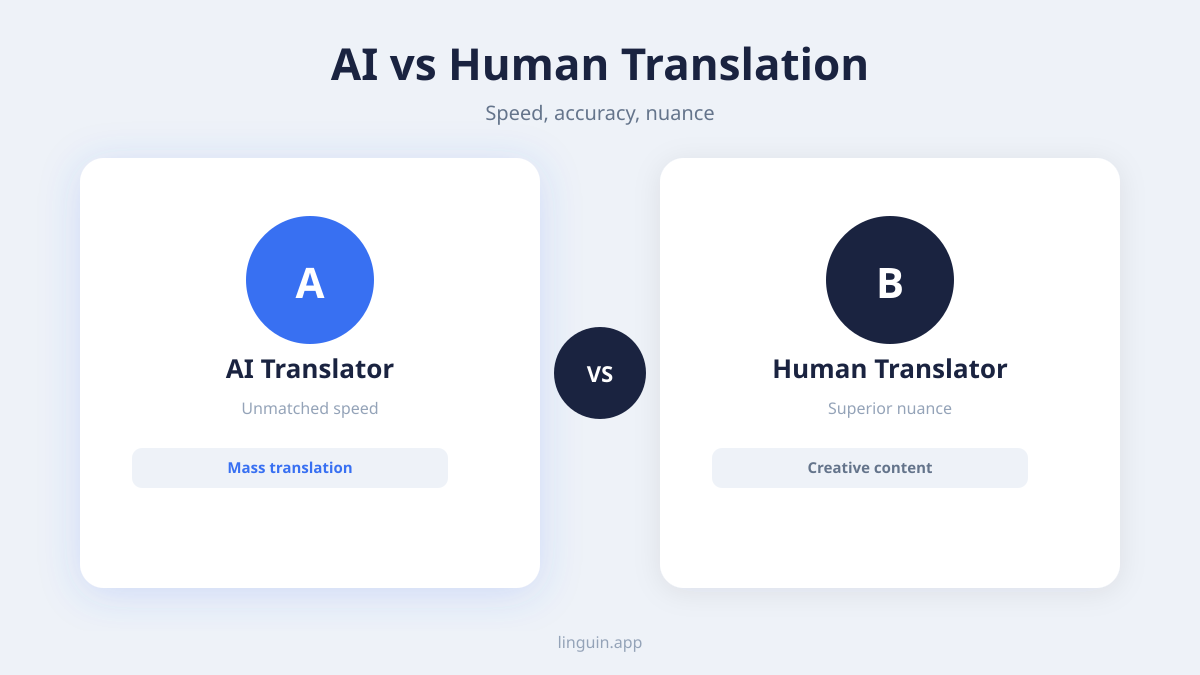
The most significant advantage of AI translation is its sheer speed and scalability. Need to translate a thousand-page document instantly? AI can do it. Want to understand a website in a foreign language as you browse? AI-powered tools, such as the Linguin Chrome and Safari extensions, make it seamless. This accessibility is revolutionary. It democratizes communication, allowing individuals and small businesses to engage with global content and markets without breaking the bank.
AI translation excels in handling large volumes of text quickly. It’s incredibly efficient for:
- Getting the gist: If you need to quickly understand the main points of an email, an article, or a social media post, AI is your go-to.
- Internal documentation: Translating internal memos, technical manuals, or knowledge bases where absolute perfection isn’t paramount.
- Website localization (initial pass): Providing a basic translated version of your website to reach a wider audience.
- Everyday communication: Quick chats, understanding product descriptions, or deciphering signs while traveling.
The cost-effectiveness of AI translation is another major draw. Compared to the hourly rates of human translators, AI services are often significantly cheaper, and many offer free tiers for basic usage. This makes it an indispensable tool for budget-conscious users. Moreover, AI is constantly learning. The more data it processes, the better it becomes, refining its understanding of context, idiom, and even subtle stylistic differences over time.
The Enduring Power of Human Translation: Nuance, Culture, and Context
While AI has made leaps and bounds, it still struggles with the intricate tapestry of human language. This is where human translators shine. They bring to the table not just linguistic knowledge, but cultural understanding, emotional intelligence, and the ability to grasp subtle nuances that AI might miss.
Human translators are trained professionals who understand the deep cultural context behind words and phrases. They can differentiate between sarcasm and sincerity, formal and informal registers, and the specific connotations of words within a particular cultural framework. This is crucial for:
- Marketing and advertising: Crafting compelling slogans, persuasive copy, and engaging content that resonates with a target audience requires an understanding of cultural sensitivities and persuasive language. A literal translation might fall flat or even offend.
- Legal and medical documents: Accuracy is paramount in these fields. A slight misinterpretation can have serious consequences. Human translators ensure that legal terminology is precise and medical information is conveyed without ambiguity.
- Literary works and creative content: Novels, poetry, and scripts are imbued with artistic intent, emotional depth, and stylistic flair. Capturing this requires a human’s creative and interpretive skills.
- High-stakes business communication: Important contracts, executive presentations, or sensitive negotiations demand the absolute highest level of accuracy and cultural appropriateness that only a human can provide.
Human translators can also handle ambiguity, complex sentence structures, and specialized jargon with a level of understanding that AI is still developing. They can ask clarifying questions, research terminology, and ensure that the final output not only conveys the meaning but also the intended tone and impact. For many, the peace of mind that comes with a professional human review is invaluable.
Where AI and Human Translation Intersect: The Hybrid Approach
The most powerful strategy for many situations isn’t choosing between AI and human translation, but rather embracing a hybrid approach. This is where the true magic happens, leveraging the strengths of both to achieve unparalleled results.
Think of AI as the initial engine and human translators as the skilled mechanics and quality control experts. Here’s how this synergy works:
- Post-Editing Machine Translation (PEMT): This is a widely adopted method. AI translates the text first, providing a rapid initial draft. Then, a human translator reviews, edits, and refines the AI-generated output. This significantly speeds up the process compared to purely human translation, while ensuring accuracy and natural flow. This is where tools like Linguin can be incredibly useful, providing a solid first draft that a human can then polish to perfection.
- Pre-translation Analysis: AI can be used to quickly identify terminology, segment the text, and provide basic translations of common phrases. This helps human translators work more efficiently by preparing the groundwork.
- Quality Assurance: Even after human translation, AI tools can be used for a final check, identifying potential inconsistencies or grammatical errors that might have slipped through.
This hybrid model offers a compelling balance:
- Speed and Cost-Efficiency: AI handles the bulk of the work quickly and affordably.
- Accuracy and Quality: Human expertise ensures that nuance, tone, and cultural appropriateness are preserved.
- Scalability: Large projects can be managed effectively by combining AI’s speed with human oversight.
Imagine you’re launching a new product in multiple international markets. You could use Linguin’s AI translation to get all your product descriptions and website content translated quickly. Then, you could engage human translators to review and localize the marketing copy for each specific region, ensuring it sounds natural and appealing to local consumers. This saves immense time and resources while guaranteeing a high-quality, culturally relevant result.
When to Choose Which: A Practical Guide
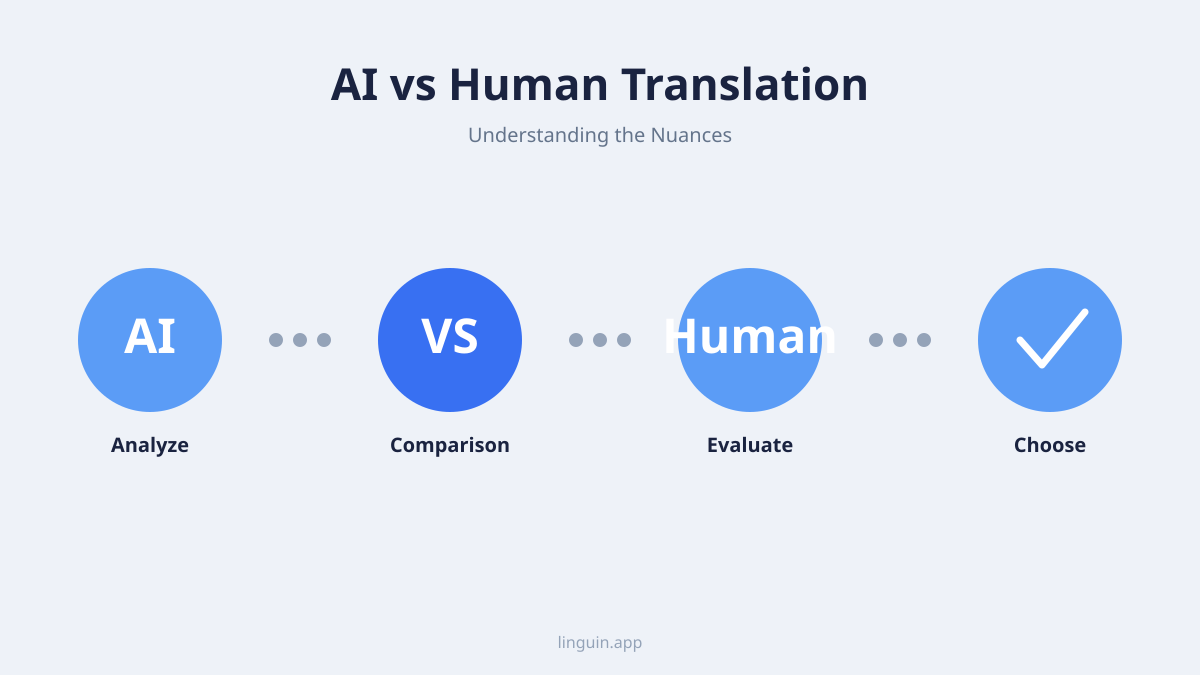
Deciding between AI and human translation (or a blend) depends on several factors:
Opt for AI Translation when:
- Speed is critical: You need an instant understanding of text.
- Volume is high, and budget is tight: Translating large amounts of content for internal use or initial analysis.
- Accuracy to the absolute nearest degree isn’t essential: Understanding the core message is sufficient.
- You need a quick translation for personal use: Understanding an email, a social media post, or a foreign menu.
- You’re using tools like Linguin for everyday tasks: Quickly translating a sentence or a paragraph on your Mac, iPhone, or iPad.
Opt for Human Translation when:
- Accuracy is paramount: Legal documents, medical records, financial reports.
- Nuance and cultural appropriateness are key: Marketing copy, advertising, creative content, literary works.
- The tone and style need to be precisely conveyed: Executive communications, brand messaging.
- The target audience is highly discerning: Ensuring your message is received exactly as intended.
- You’re dealing with highly idiomatic or ambiguous language.
Consider a Hybrid Approach when:
- You need a balance of speed, cost, and quality: Most business translation projects fall into this category.
- You have a large volume of content but require a high level of accuracy: Website localization, technical documentation, software interfaces.
- You want to optimize your translation workflow: Utilizing AI for initial drafts and human translators for refinement.
The Future of Translation: Collaboration, Not Competition
The conversation around AI vs. human translation is evolving. It’s less about a battle and more about intelligent collaboration. AI is a powerful tool that enhances human capabilities, making translation more accessible, faster, and more efficient than ever before. Linguin is built on this principle, offering seamless AI translation across your devices and browsers, empowering you to understand and be understood across languages.
As AI continues to advance, its ability to grasp context and nuance will undoubtedly improve. However, the uniquely human elements of creativity, cultural intuition, and critical thinking will likely remain the domain of human translators for the foreseeable future. By understanding the strengths of both AI and human translation, you can make informed decisions and build robust translation strategies that bridge divides and foster global understanding. The future of translation is collaborative, and with tools like Linguin, you can be at the forefront of this exciting evolution.