 English
  Español
  Français
  Deutsch
  Português
  Italiano
  Русский
  中文(简体)
  日本語
日本語  한국어
한국어  العربية
  हिन्दी
  Nederlands
  Türkçe
  Polski
The world is more connected than ever, and the ability to communicate across language barriers is no longer a luxury but a necessity. As AI continues to revolutionize how we interact with information, translation tools have become remarkably sophisticated. Two prominent players leading this charge are DeepL and ChatGPT, both offering impressive capabilities. But when it comes to translating text, which one reigns supreme? Let’s break down DeepL vs. ChatGPT translation and help you decide which AI is your ultimate champion.
Understanding the Contenders: DeepL and ChatGPT
Before we pit them against each other, it’s essential to understand what each tool brings to the table.
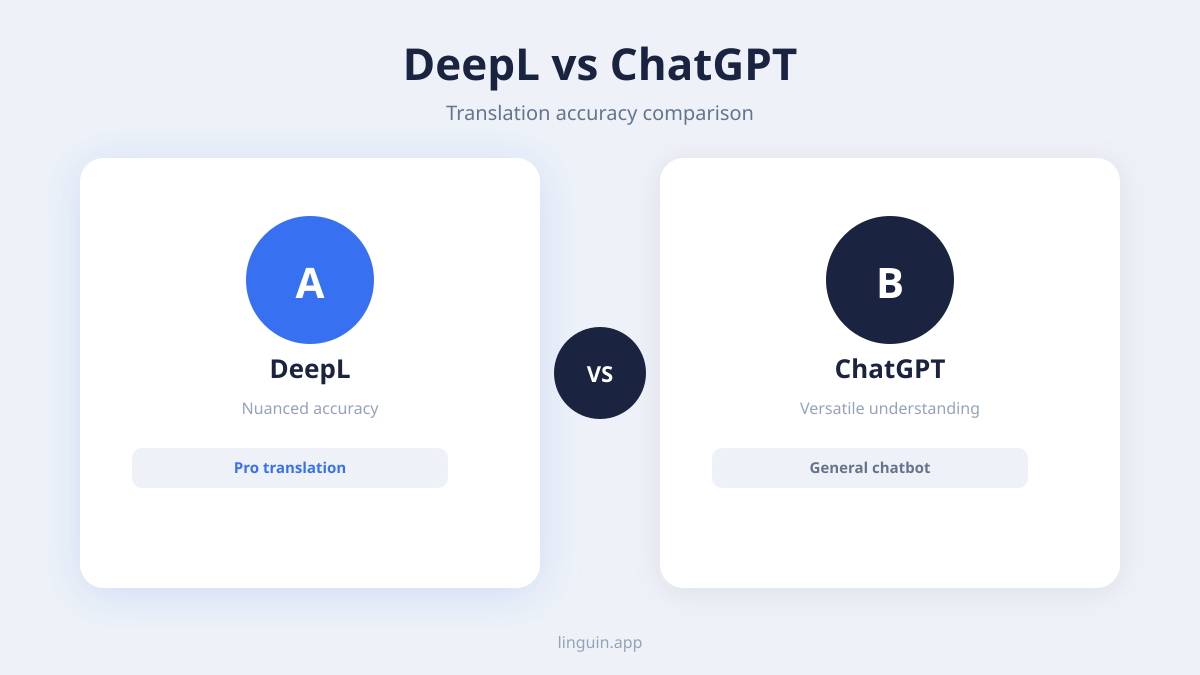
DeepL is a German company that has rapidly gained a reputation for delivering exceptionally accurate and nuanced translations. It leverages advanced neural network technology, focusing specifically on the intricacies of language. DeepL’s core strength lies in its dedication to translation quality, aiming to capture not just the literal meaning but also the tone, style, and context of the original text. It supports a growing list of languages, and for many language pairs, it’s considered the gold standard for professional-grade translation.
ChatGPT, developed by OpenAI, is a large language model (LLM) renowned for its versatility. While it excels at generating human-like text, answering questions, and engaging in conversations, translation is just one of its many capabilities. ChatGPT can translate text by understanding the prompt and generating the equivalent in another language. Its strength lies in its broad understanding of language and its ability to handle a wide array of tasks, making it a powerful all-in-one AI assistant.
Accuracy and Nuance: Where the Rubber Meets the Road
When we talk about translation, accuracy is paramount. This means not just conveying the correct words but also the intended meaning, including subtle nuances, idiomatic expressions, and cultural context.
DeepL has consistently been praised for its accuracy, often outperforming other translation services in blind tests. Its algorithms are trained on vast amounts of high-quality parallel corpora (texts that exist in multiple languages), allowing it to learn intricate linguistic patterns. This results in translations that often sound more natural and less “robotic” than those produced by less specialized tools. For instance, translating complex technical jargon or literary prose where every word choice matters, DeepL often demonstrates a superior grasp of context and idiom. It’s particularly adept at capturing the subtle emotional undertones in a sentence, which is crucial for marketing copy, literature, and sensitive communications.
ChatGPT, while capable of producing accurate translations, can sometimes be less consistent than DeepL, especially with highly technical or idiomatic content. Because translation is one of many functions, its neural networks are trained on a broader spectrum of text and tasks. This means it might occasionally miss the subtle idiomatic flavor or the precise technical term that DeepL, with its specialized focus, would capture effortlessly. However, ChatGPT’s ability to understand context and generate coherent text means it can often provide a “good enough” translation for many general purposes, and its conversational nature allows for iterative refinement if you feel a translation isn’t quite right. You can, for example, ask it to rephrase a translation with a different tone or for a specific audience, which is a powerful way to fine-tune the output.
Speed and Efficiency: Getting the Job Done Quickly
In today’s fast-paced world, efficiency is often as important as accuracy. How quickly can you get a usable translation?
DeepL is generally very fast. Its dedicated translation engine is optimized for speed, delivering results almost instantaneously. This makes it an excellent choice for quickly translating emails, web pages, or documents where immediate understanding is key. The sheer speed with which it can process large volumes of text is impressive.
ChatGPT, being a more general-purpose LLM, can also provide translations quickly, especially for shorter texts. However, when dealing with very long documents or complex queries that require more processing, there might be a slight delay compared to DeepL’s specialized system. The speed can also be influenced by server load and the complexity of the prompt itself. If you’re asking it to translate and then summarize, or perform another task concurrently, the speed might be slightly impacted.
Language Support and Features: Beyond the Basics
Both tools offer a good range of languages, but their feature sets differ.
DeepL supports a significant number of languages and continues to expand its offerings. Beyond simple text translation, it offers features like document translation (preserving formatting), a glossary for custom terminology, and API access for developers. Its commitment to linguistic accuracy means that for the languages it supports, the quality is consistently high.
ChatGPT’s language capabilities are vast, largely due to its extensive training data. It can often handle lower-resource languages or dialectal variations more readily than some specialized tools. The true power of ChatGPT lies in its conversational interface. You can ask it to translate, explain cultural nuances, suggest alternative phrasing, or even adapt the tone for a specific audience. This interactive approach makes it a fantastic tool for learning and refining your understanding of a language, not just for raw translation. For example, if you get a translation that feels a bit stiff, you can simply ask ChatGPT, “Can you make this sound more casual?” or “How would a native speaker say this in a business context?”
User Experience and Integration: Making Translation Seamless
How easy is it to use these tools, and how well do they integrate into your workflow?
DeepL offers a user-friendly web interface, desktop applications for macOS and Windows, and mobile apps. It also provides browser extensions for Chrome and Edge, allowing for quick translations directly on web pages. For those who need to integrate translation into their own applications, DeepL offers a robust API. The interface is clean, intuitive, and focused purely on delivering excellent translation.
ChatGPT is primarily accessed through its web interface and mobile app, with API access available for developers. Its conversational interface is a key part of its user experience. You interact with it by typing prompts, and it responds in a natural, conversational manner. This makes it incredibly accessible for users who might not be familiar with traditional translation interfaces. While it doesn’t have dedicated browser extensions in the same vein as DeepL, you can copy and paste text into the chat window, or use third-party integrations that leverage the ChatGPT API to bring its translation capabilities to your browser or other applications. Linguin, for instance, aims to provide seamless translation across your macOS, iOS, and browser environment, drawing on the best AI models available to offer you accurate and contextually relevant translations, whether you’re reading an article, composing an email, or working on a document.
When to Choose Which: Your Personal Translation Strategy
The choice between DeepL and ChatGPT often boils down to your specific needs and priorities.
Choose DeepL if:
- Absolute Accuracy is Your Top Priority: For critical documents, professional correspondence, legal texts, or anything where a mistranslation could have serious consequences, DeepL is often the safer bet due to its specialized focus and proven accuracy.
- You Need High-Quality Translations of Nuanced or Technical Content: DeepL excels at capturing the subtleties of language, making it ideal for literary works, marketing materials, or complex technical manuals.
- You Value a Dedicated, Streamlined Translation Experience: If you want a tool that does one thing exceptionally well and offers a clean, no-fuss interface for translation, DeepL is a strong contender.
- You Need to Translate Documents While Preserving Formatting: DeepL’s document translation feature is excellent for this.
Choose ChatGPT if:
- You Need Versatile AI Assistance Beyond Translation: If you want an AI that can translate, brainstorm, summarize, write code, and much more, ChatGPT is the all-in-one solution.
- You Prefer an Interactive and Conversational Approach: The ability to ask follow-up questions, request rephrasing, or explore cultural context makes ChatGPT a powerful learning tool.
- You Need to Translate Less Common Languages or Dialects: ChatGPT’s broad training data may give it an edge in handling a wider array of linguistic variations.
- You’re Looking for Quick, General-Purpose Translations: For everyday tasks like understanding an email or a social media post, ChatGPT provides fast and often perfectly adequate results.
- You Want to Experiment and Refine Translations Iteratively: The ability to chat with the AI and ask for modifications is invaluable for fine-tuning output.
The Future of AI Translation
The competition between DeepL and ChatGPT isn’t a zero-sum game. Both represent the cutting edge of AI-powered language technology, and their ongoing development promises even more impressive capabilities in the future. As AI models become more sophisticated, the lines between specialized translation tools and general-purpose LLMs may blur further.
At Linguin, we believe in harnessing the power of the best AI models to provide you with an unparalleled translation experience. Whether it’s the precision of a dedicated engine like DeepL or the versatile intelligence of models like ChatGPT, our goal is to integrate these advancements seamlessly into your daily workflow across all your devices. We’re constantly evaluating and integrating the latest AI innovations to ensure that when you need to break down language barriers, Linguin is your most reliable and efficient partner.
Ultimately, the “best” AI for translation depends on you and the task at hand. For rigorous, professional-grade translation, DeepL often shines. For a more interactive, versatile, and broadly capable AI assistant that includes translation, ChatGPT is a fantastic choice. By understanding their respective strengths, you can leverage these powerful tools to communicate more effectively in our increasingly globalized world.