 English
  Español
  Français
  Deutsch
  Português
  Italiano
  Русский
  中文(简体)
  日本語
日本語  한국어
한국어  العربية
  हिन्दी
  Nederlands
  Türkçe
  Polski
The Growing Need for Legal Document Translation
In today’s interconnected world, businesses, individuals, and governments increasingly engage in cross-border activities. This inevitably leads to a demand for accurate and reliable translation of legal documents. From international contracts and court filings to intellectual property registrations and immigration applications, the need to understand and be understood across different legal systems and languages is paramount. Misunderstandings or inaccuracies in legal translations can have severe consequences, leading to disputes, financial losses, and even legal repercussions. This is where the critical role of precise legal document translation comes into play, demanding not just linguistic fluency but also a deep understanding of legal terminology and context.
The complexity of legal language, known as “legalese,” is a significant hurdle. It is characterized by specialized vocabulary, intricate sentence structures, and a reliance on established precedents and legal frameworks that vary drastically from one jurisdiction to another. Translating these documents requires more than a word-for-word conversion; it necessitates a nuanced approach that preserves the original intent, legal effect, and cultural context. This is especially true when dealing with common law systems versus civil law systems, which have fundamentally different approaches to legal interpretation and document drafting. Furthermore, the sheer volume of legal documents requiring translation is constantly growing, driven by globalization, international trade, and evolving legal landscapes.
Understanding the Challenges of Legal Translation
Translating legal documents presents a unique set of challenges that go far beyond general translation tasks. The primary difficulty lies in the specialized terminology. Legal systems are built upon a rich lexicon of terms with precise meanings, often derived from Latin or ancient legal traditions. A single English legal term might have several equivalents in another language, each carrying a slightly different nuance or legal implication. For instance, terms like “estoppel,” “indemnify,” or “force majeure” do not have simple, direct translations and require careful consideration of the surrounding legal context to convey the correct meaning.
Another significant challenge is the structural and stylistic differences across legal systems. The way contracts are structured, the formality of court documents, and the expected arguments in legal briefs can vary widely. A direct translation might inadvertently alter the legal effect of a clause or misrepresent the intended legal argument. For example, concepts like “consideration” in common law contracts have no direct equivalent in many civil law systems, requiring a more conceptual translation to convey the underlying principle.
Moreover, cultural nuances play a crucial role. Legal systems are deeply embedded in the cultural fabric of their societies. What is considered standard practice or acceptable in one culture might be viewed differently in another. A translation that fails to account for these cultural differences can lead to misinterpretations and unintended consequences. The interpretation of a document often depends on the cultural understanding of legal principles and practices within a specific jurisdiction.
The Role of Technology in Legal Translation
Historically, legal translation was the exclusive domain of highly specialized human translators with extensive legal backgrounds. While the expertise of these professionals remains invaluable, technology has begun to play an increasingly significant role in streamlining and augmenting the translation process. Machine translation (MT) engines, once considered too rudimentary for legal texts, have made significant strides in accuracy and contextual understanding.
AI-powered translation tools, like Linguin, are at the forefront of this technological advancement. Linguin, available across macOS, iOS, and as browser extensions for Chrome and Safari, offers a powerful solution for individuals and businesses needing to translate various types of documents. For legal documents, the ability to quickly process large volumes of text and provide an initial draft translation is a game-changer. This allows human translators to focus their expertise on refining the nuanced terminology and ensuring legal accuracy, rather than spending countless hours on the initial conversion.
Linguin’s advanced algorithms are trained on vast datasets, including legal texts, enabling them to grasp the context and specific terminology common in legal documents. This can significantly speed up the translation workflow, making it more efficient and cost-effective. While AI translation should always be followed by human review for critical legal documents, it provides an indispensable foundation, dramatically reducing the time and effort required to get a comprehensible translation.
Best Practices for Translating Legal Documents
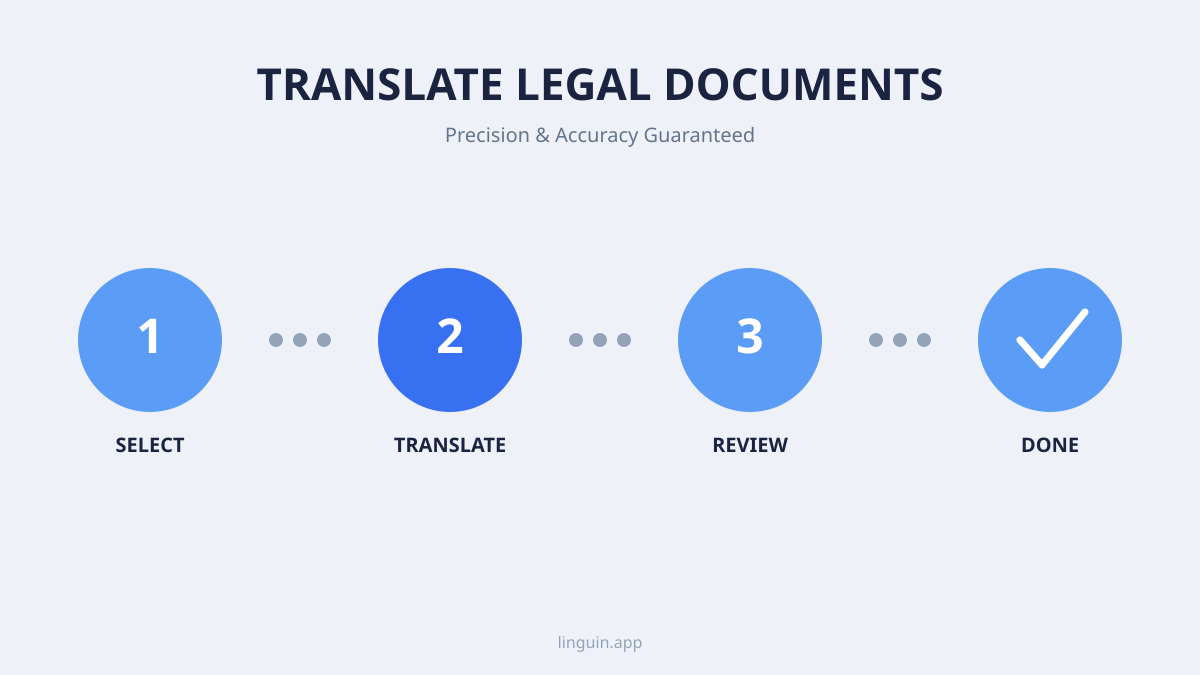
Given the high stakes involved, a meticulous approach is essential when translating legal documents. The process should involve several key steps to ensure accuracy and reliability.
Firstly, understanding the source document’s purpose and audience is paramount. Is it a contract intended for a specific jurisdiction? Is it a court pleading that needs to be understood by a foreign judge? Knowing the document’s intended use will inform the translation choices and the level of formality required. This initial understanding helps in selecting the appropriate terminology and style.
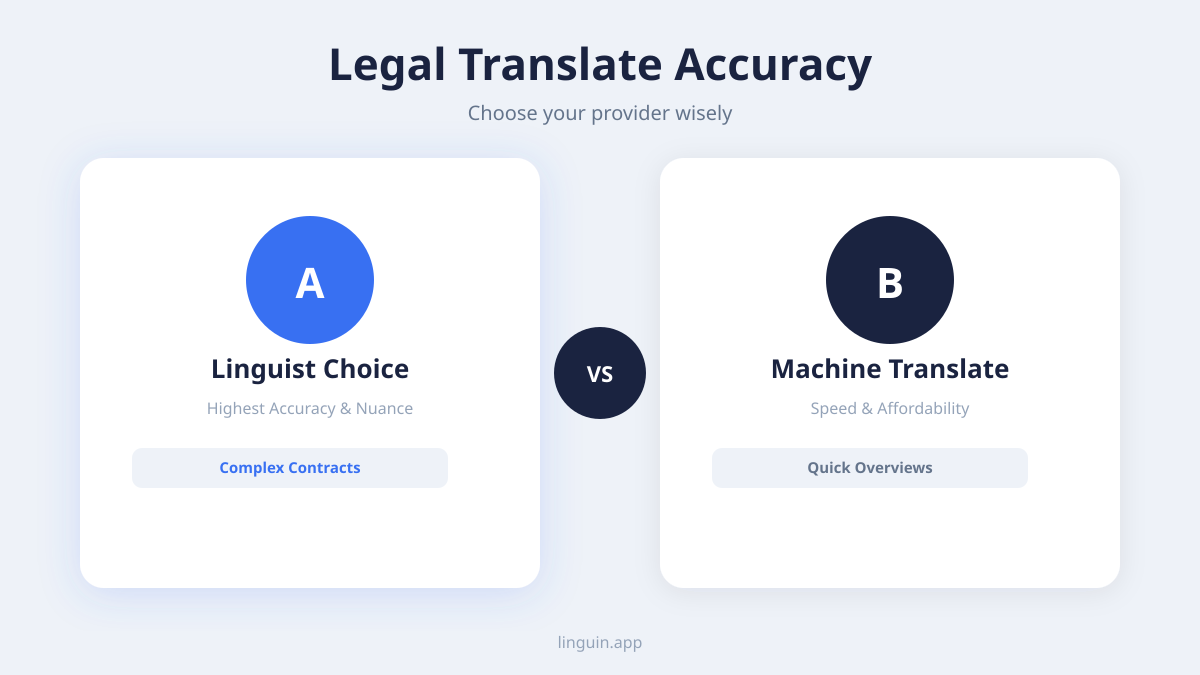
Secondly, choosing the right translation tool or service is critical. For non-critical internal documents or to get a quick gist, an AI-powered tool like Linguin can be highly beneficial. However, for documents that have legal standing or will be submitted to a court or official body, it is imperative to engage a professional legal translator. These individuals possess not only linguistic skills but also a deep understanding of the legal systems involved. Many professional translators also utilize AI tools like Linguin as part of their workflow to enhance efficiency.
Thirdly, maintaining consistency in terminology is crucial. Legal documents often repeat key terms, and ensuring that these terms are translated consistently throughout the document is vital to avoid ambiguity. Creating a glossary of key terms for the specific document or project can be very helpful. This is an area where AI can assist by identifying recurring terms and suggesting consistent translations, but human oversight is essential to verify the appropriateness of the chosen translations.
Fourthly, localization and legal adaptation are key. This goes beyond simple linguistic translation to adapting the document to the legal and cultural norms of the target jurisdiction. This might involve ensuring that the translated document complies with local regulations and customs, even if it means adapting certain phrasing or clauses. For instance, legal holidays, reference to specific laws, or even the structure of addresses can differ significantly and require adaptation.
Finally, rigorous proofreading and review by legal professionals or experienced legal translators are non-negotiable. This final check ensures that no errors have been introduced, that the legal intent has been preserved, and that the document is accurate and legally sound in the target language. This review process is where the human element shines, catching subtle errors that even the most advanced AI might miss.
Utilizing Linguin for Your Legal Translation Needs
Linguin offers a versatile and powerful platform that can significantly aid in the process of translating legal documents. Whether you are a legal professional dealing with international cases, a business owner drafting cross-border agreements, or an individual navigating immigration or international law, Linguin can provide swift and accurate translations.
For initial understanding or to quickly get the gist of a lengthy legal document, Linguin’s translation capabilities can be invaluable. You can easily paste text into the Linguin app on your macOS or iOS device, or use the Chrome and Safari extensions to translate text directly on web pages, for example, when researching international legal frameworks. This immediate access to translation can save considerable time and effort, especially when dealing with foreign-language legal resources.
When working with complex legal documents, Linguin can serve as an excellent first pass. Imagine receiving a contract in a language you are not fluent in. By running it through Linguin, you can quickly understand the main clauses, identify key terms, and get a foundational translation. This preliminary understanding allows you to then decide whether a more in-depth, human-led translation is necessary, and where to focus your attention during that process.
For legal professionals, integrating Linguin into their workflow can dramatically improve efficiency. Instead of manually translating every paragraph, they can use Linguin for the initial translation and then leverage their expertise to refine specific legal terms, ensure proper legal phrasing, and verify the overall accuracy within the context of the target jurisdiction’s laws. This hybrid approach, combining AI speed with human legal acumen, is proving to be the most effective strategy for many.
Furthermore, Linguin’s commitment to user privacy and data security is crucial when dealing with sensitive legal documents. Protecting client confidentiality and the integrity of legal information is paramount, and knowing that your translations are handled with care provides peace of mind.
The Future of Legal Translation
The field of legal translation is on a dynamic trajectory, with AI and advanced technologies playing an increasingly central role. While human expertise will always be essential for the ultimate validation of legal documents, AI tools are rapidly evolving to handle more complex linguistic challenges. We can expect to see further improvements in AI’s ability to understand legal nuances, recognize context-specific terminology, and even identify potential ambiguities within source documents.
The development of specialized legal AI models, trained on vast corpora of legal texts from diverse jurisdictions, will continue to enhance accuracy. These models will become even better at recognizing the subtle differences between legal systems and adapting translations accordingly. This will lead to more sophisticated machine translation engines that can provide highly accurate initial drafts, significantly reducing the time and cost of legal translation.
Moreover, the integration of AI into legal workflows will become more seamless. Tools like Linguin are just the beginning. We can anticipate more comprehensive platforms that combine translation, terminology management, and even legal document analysis. These integrated solutions will empower legal professionals to manage international cases and transactions with greater ease and confidence.
The future of legal translation is one of collaboration – a powerful synergy between cutting-edge AI and the indispensable expertise of human legal translators. This partnership will ensure that legal documents can be translated with unprecedented speed, accuracy, and reliability, fostering clearer communication and stronger international legal frameworks in an increasingly globalized world. Whether you are a solo practitioner or part of a large law firm, embracing these technological advancements will be key to navigating the complexities of international law and expanding your reach. Linguin is proud to be part of this exciting evolution, empowering users to break down language barriers with confidence.