 English
  Español
  Français
  Deutsch
  Português
  Italiano
  Русский
  中文(简体)
  日本語
日本語  한국어
한국어  العربية
  हिन्दी
  Nederlands
  Türkçe
  Polski
The Rise of AI Translation: Bridging Language Gaps with Intelligent Machines
In today’s hyper-connected world, the ability to communicate seamlessly across languages is no longer a luxury – it’s a necessity. From international business deals to personal connections with friends and family abroad, language barriers can be significant obstacles. Fortunately, the rapid advancements in Artificial Intelligence (AI) have ushered in an era where sophisticated translation tools are becoming increasingly accessible and, crucially, accurate. At Linguin, we’re at the forefront of this revolution, dedicated to empowering users with reliable and intelligent translation solutions across their favorite platforms.
The journey of machine translation has been a long and winding one, evolving from rudimentary rule-based systems to the powerful neural networks that underpin today’s AI translators. Early systems relied on dictionaries and grammatical rules, often resulting in translations that were literal, awkward, and sometimes nonsensical. These systems struggled with nuances, context, and the sheer complexity of human language. The breakthrough came with the advent of neural machine translation (NMT), a paradigm shift that treats translation as a single, end-to-end learning problem. NMT models, particularly those based on transformer architectures, can process entire sentences and even paragraphs, learning complex relationships between words and phrases in different languages. This allows them to generate more fluid, natural-sounding, and contextually appropriate translations.
This progress has been fueled by massive datasets of parallel text – the same content translated into multiple languages. By training on these vast corpuses, AI models learn patterns, idiomatic expressions, and cultural references that are vital for accurate translation. The result is a dramatic improvement in translation quality, making AI translation an indispensable tool for individuals and businesses alike. Whether you’re a student researching a foreign-language academic paper, a traveler navigating a new city, or a professional communicating with international clients, AI-powered translation is transforming how we interact with the world.
How AI Achieves Translation Accuracy: A Glimpse Under the Hood
Understanding how AI achieves such remarkable accuracy is key to appreciating its capabilities and limitations. At its core, modern AI translation relies on complex algorithms and vast amounts of data. The dominant approach is Neural Machine Translation (NMT), which, as mentioned, uses deep learning models, often inspired by the human brain’s structure.
One of the most significant architectures in NMT is the Transformer. Unlike older recurrent neural networks (RNNs) that process text sequentially, Transformers use a mechanism called “attention.” Attention allows the model to weigh the importance of different words in the source sentence when generating each word in the target sentence. This is crucial because the meaning of a word can depend heavily on its surrounding words, even if they are far apart. For example, in the sentence “The bank of the river,” the word “bank” refers to the edge of the river. However, in “He went to the bank to deposit money,” “bank” refers to a financial institution. The attention mechanism helps the NMT model understand these contextual differences.
The process typically involves an “encoder” and a “decoder.” The encoder reads the source sentence and converts it into a numerical representation (a vector) that captures its meaning. The decoder then takes this representation and generates the translated sentence word by word, paying attention to the context learned by the encoder.
The accuracy of these models is directly correlated with the quality and quantity of the training data. Companies and researchers invest heavily in curating massive datasets of high-quality translations. This data is then used to “train” the NMT models. During training, the model makes predictions, and if they are incorrect, it adjusts its internal parameters to get closer to the correct translation. This iterative process, repeated millions of times, allows the model to learn the intricate patterns of language.
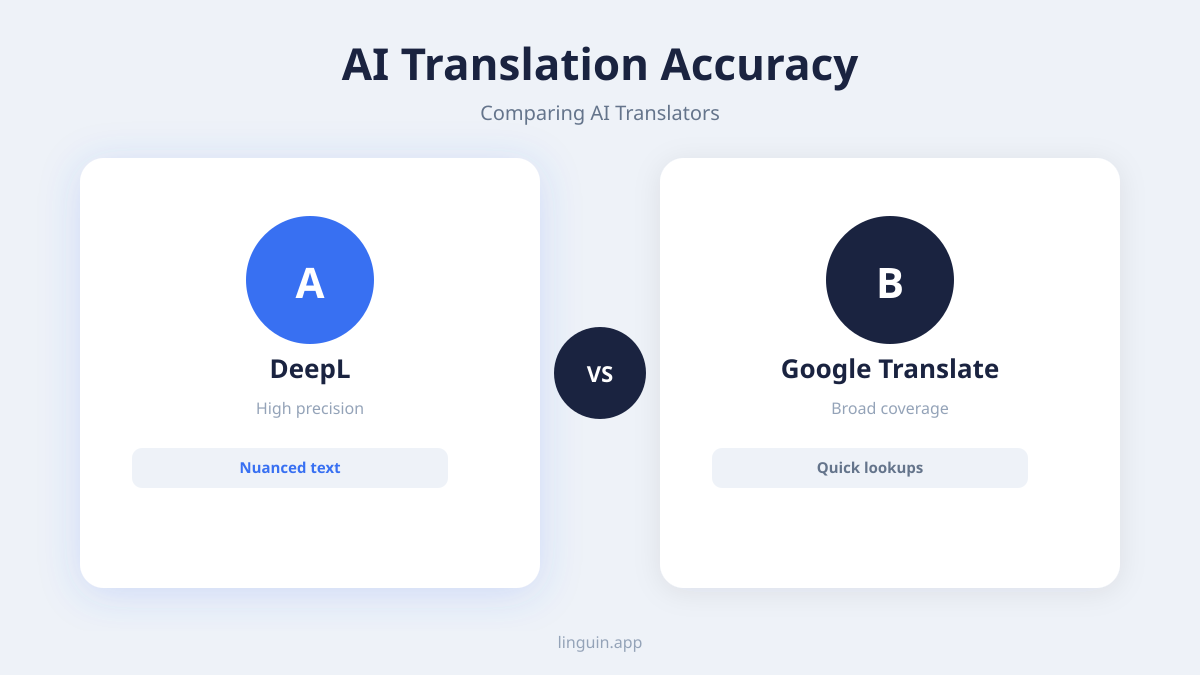
Furthermore, specialized models are often trained for specific language pairs or domains. For instance, a model trained on legal documents will likely perform better at translating legal jargon than a general-purpose translation model. This is one reason the translation style you pick matters: Linguin’s free Standard style runs on Google Translate, while the four paid styles (Casual, Formal, Technical, Creative) route through a separately hosted AI model built to sound more natural and context-appropriate. Choosing Technical for a spec sheet or Formal for a business email gets you closer to the right register than a single one-size-fits-all engine would.
The Nuances of Language: Where AI Still Faces Challenges
While AI translation has made astounding progress, it’s essential to acknowledge that human language is incredibly complex and multifaceted. There are still areas where AI can falter, leading to translations that, while often understandable, may lack the perfect polish or profound understanding of a human translator.
One of the primary challenges is idiomatic expressions and cultural context. Phrases like “kick the bucket” or “spill the beans” have meanings that cannot be deduced from the literal interpretation of the words. AI models are getting better at recognizing and translating common idioms, but less common or culturally specific ones can still prove tricky. The same applies to humor, sarcasm, and subtle shades of meaning. An AI might translate a sarcastic comment literally, completely missing the intended irony.
Ambiguity is another hurdle. Many words have multiple meanings, and their correct interpretation often relies on broad contextual understanding that AI might not fully grasp. For example, the word “fine” can mean “good,” “acceptable,” or “a penalty.” Without sufficient context, an AI might choose the wrong translation.
Tone and style can also be difficult to replicate. The emotional weight, formality, or informality of a text is crucial for effective communication. While AI can often capture the basic meaning, conveying the precise tone and stylistic nuances requires a deeper human understanding. A highly technical document requires a different tone than a casual email, and an AI might struggle to adjust appropriately without explicit guidance.
Furthermore, creative language, such as poetry, song lyrics, or highly stylized marketing copy, presents a significant challenge. These forms of expression often rely on wordplay, double meanings, and cultural allusions that are deeply embedded in human experience and are not easily quantifiable or learnable by algorithms.
Finally, emerging language and slang are constantly evolving. AI models are trained on existing data, so they can lag behind the latest linguistic trends. New slang terms or evolving meanings of existing words might not be recognized or translated accurately until the training data is updated.
These limitations don’t diminish the power of AI translation but rather highlight the ongoing need for human oversight in critical situations. Tools like Linguin aim to bridge this gap by offering highly accurate translations while also providing features that allow users to refine and improve upon the AI’s output.
Measuring AI Translation Accuracy: Metrics and Real-World Performance
How do we quantify AI translation accuracy? It’s not as simple as a single percentage. Various metrics and evaluation methods are used to assess the quality of machine translations, each with its strengths and weaknesses.
One of the most widely used automatic evaluation metrics is BLEU (Bilingual Evaluation Understudy). BLEU compares the machine-generated translation against one or more human-generated reference translations. It calculates a score based on the overlap of n-grams (sequences of words) between the machine translation and the references. A higher BLEU score generally indicates a better translation. However, BLEU has its limitations; it doesn’t always correlate perfectly with human judgment of quality and can penalize valid translations that differ in wording from the reference.
Other metrics include METEOR (Metric for Evaluation of Translation with Explicit Ordering), which also considers synonyms and word stems, and TER (Translation Edit Rate), which measures the number of edits required to transform the machine translation into a reference translation.
Beyond these automated metrics, human evaluation remains the gold standard. Linguists and subject matter experts assess translations based on several criteria:
- Fluency: How natural and grammatically correct does the translation sound in the target language?
- Adequacy: Does the translation accurately convey the meaning of the source text?
- Readability: Is the translation easy to understand?
- Style and Tone: Does the translation match the original’s style and tone?
While human evaluation is the most accurate, it is also time-consuming and expensive, which is why automated metrics are crucial for rapid development and testing.
In practice, the “accuracy” of an AI translation tool like Linguin depends on several factors:
- The Language Pair: Some language pairs are easier to translate than others. Languages with similar grammatical structures and vocabulary (e.g., Spanish and Portuguese) tend to have higher accuracy than those that are vastly different (e.g., English and Japanese).
- The Domain of Text: As discussed, specialized domains often yield more accurate translations due to domain-specific training data.
- The Complexity of the Source Text: Simple, straightforward sentences are more likely to be translated accurately than complex, nuanced, or idiomatic expressions.
- The Model’s Architecture and Training Data: The underlying AI model and the data it was trained on play a significant role. Continual updates and improvements to these underlying models are vital, and Linguin doesn’t train its own from scratch: the free Standard style runs on Google Translate, while the four paid styles route through a hosted AI model maintained by its provider.
Ultimately, for everyday use cases, AI translation tools are remarkably accurate and provide immense value. For instance, when you use the Linguin Chrome extension to understand a foreign webpage or the iOS app to translate a message before you send it, the AI is working diligently to provide you with a clear and understandable translation. The goal isn’t always perfect, human-level fluency but rather effective communication that bridges understanding.
The Future of AI Translation: Towards Perfect Polyglots
The trajectory of AI translation accuracy is undeniably upward. Researchers and developers are constantly pushing the boundaries, driven by the vision of truly seamless, universal communication. Several key areas are likely to see significant advancements:
One of the most exciting frontiers is context-aware translation. Future AI models will likely be able to understand and utilize broader context, perhaps even remembering previous conversations or documents to ensure consistency and deeper comprehension. This could lead to translations that are not just accurate sentence-by-sentence but maintain a cohesive understanding across entire exchanges.
Personalization and adaptation will also play a larger role. AI could learn your specific vocabulary, preferred phrasing, or even your industry jargon to tailor translations to your individual needs. Imagine an AI translator that understands your unique writing style and applies it to its translations.
The integration of multimodal AI will be transformative. Imagine translating not just text but also spoken language in real-time, including not just the words but also the tone and emotion behind them. Picture an AI that can analyze an image and translate any text within it, or even describe the scene in another language.
Furthermore, advancements in low-resource language translation will be crucial. While AI translation is excellent for widely spoken languages, many of the world’s thousands of languages have limited digital text available for training. New techniques are being developed to enable AI to learn from smaller datasets, opening up translation capabilities for a much wider range of communities.
We are also likely to see improved handling of creativity and style. While perfect replication of human artistry might remain elusive, AI will likely become much better at adapting tone, capturing subtle humor, and even assisting in creative writing across languages.
Some of the accuracy gains in this space come from open engines rather than proprietary ones, and our guide to open source translation models looks at what that means for everyday users.
That same accuracy question gets trickier with spoken language, and our guide on how to translate English audio to Spanish covers keeping tone and meaning intact when there’s no text to double-check against.
At Linguin, we are committed to being at the vanguard of these developments. Our translation app for macOS and iOS, along with the Chrome extension and Safari extension for Mac, is built around Google Translate for quick, free lookups and a hosted AI model for the four paid styles when you need more natural, context-aware wording. Our goal is to make global communication as effortless as possible, dissolving language barriers one translation at a time. As the underlying models this industry relies on keep evolving, so too will the quality of everyday translation. The future of translation is intelligent, and it’s happening now.