 English
  Español
  Français
  Deutsch
  Português
  Italiano
  Русский
  中文(简体)
  日本語
日本語  한국어
한국어  العربية
  हिन्दी
  Nederlands
  Türkçe
  Polski
The Democratization of Language: What are Open Source Translation Models?
In an increasingly interconnected world, the ability to communicate across language barriers is no longer a luxury; it’s a necessity. From global business to personal connections, understanding and being understood is paramount. At the heart of every translation service, whether it’s a sophisticated app like Linguin or a basic online tool, lies a translation model. Traditionally, these powerful engines were proprietary, developed and guarded by large tech corporations. However, a significant shift is underway, driven by the philosophy of open source.
Open source translation models are, in essence, AI algorithms and their associated data that are made publicly available. This means that the code, the architecture, and often the training data used to build these models are accessible to anyone. Developers, researchers, and even enthusiastic hobbyists can inspect, modify, and build upon these models. This transparency and collaborative spirit are the hallmarks of the open-source movement, and when applied to the complex field of machine translation, it unlocks a wealth of potential.
Think of it like this: instead of a chef guarding their secret recipe, an open-source model shares the recipe, the ingredients, and the cooking techniques. This allows anyone to learn, experiment, and even create their own unique dishes. For translation, this translates to faster innovation, greater accessibility, and a more diverse range of language solutions.
Why Open Source Matters for Translation
The advantages of embracing open-source translation models are multifaceted and profoundly impact how we approach language technology. Firstly, accessibility and affordability are major drivers. Developing sophisticated translation models requires immense computational resources and specialized expertise, making them prohibitively expensive for many individuals and smaller organizations. Open-source models significantly lower this barrier to entry. Developers can leverage existing, high-quality models without incurring exorbitant licensing fees or starting from scratch. This democratizes access to cutting-edge translation technology, allowing more people and businesses to benefit.
Secondly, transparency and trust are inherent to open-source development. With proprietary models, users have to trust that the algorithms are unbiased and that their data is handled responsibly. Open-source models, however, can be scrutinized by the community. Researchers can examine them for potential biases, security vulnerabilities, or ethical concerns. This collective oversight fosters greater trust and accountability in the technology. At Linguin, while we continuously innovate with our own proprietary models for optimal performance, we recognize the immense value and ethical considerations that open-source transparency brings to the broader translation landscape.
Thirdly, rapid innovation and customization are accelerated. The collaborative nature of open source means that a global community of developers can contribute to improving models. Bugs are identified and fixed faster, new features are proposed and implemented, and models can be fine-tuned for specific domains or language pairs. This agility allows for a much quicker pace of development than what is typically possible within a single organization. For instance, a model trained on general news articles might be fine-tuned by a linguist to excel at translating legal documents or medical texts, a process that is often more accessible with open-source frameworks.
Furthermore, educational and research benefits are immense. Students and researchers can learn from real-world, high-performing translation models, dissecting their architecture and understanding the underlying mechanisms. This hands-on experience is invaluable for nurturing the next generation of AI and linguistics experts.
The Building Blocks: Common Open Source Translation Architectures
The field of natural language processing (NLP) and, by extension, machine translation, has been revolutionized by deep learning. Many open-source translation models are built upon powerful neural network architectures. Understanding these core components provides insight into how these models achieve their impressive translation capabilities.
One of the most significant breakthroughs was the Transformer architecture. Introduced in the seminal paper “Attention Is All You Need,” the Transformer eschewed traditional recurrent neural networks (RNNs) and convolutional neural networks (CNNs) in favor of a mechanism called “self-attention.” This allows the model to weigh the importance of different words in the input sentence when translating each word in the output sentence, regardless of their distance. This parallel processing capability makes Transformers incredibly efficient and effective for capturing long-range dependencies in language, which are crucial for accurate translation. Numerous popular open-source models are direct descendants or adaptations of this architecture.
Projects like Fairseq (developed by Meta AI) and Hugging Face Transformers have become central hubs for open-source NLP research, providing implementations of Transformer-based models and tools for training and deploying them. These libraries offer pre-trained models for various language tasks, including translation, that developers can readily use or adapt.
Another important concept is pre-training. Large models are often pre-trained on massive, diverse datasets of text and code. This pre-training allows the model to learn general language understanding, grammar, and world knowledge. Subsequently, these pre-trained models can be “fine-tuned” on smaller, task-specific datasets, such as parallel corpora of source and target language sentences, to become effective translation models. Examples of such pre-trained models that can be adapted for translation include BERT (Bidirectional Encoder Representations from Transformers) and its successors, though these are often more general-purpose language understanding models that require specific adaptation for translation tasks.
For translation specifically, models like MarianMT (part of the Hugging Face ecosystem) are highly efficient and designed for various language pairs. These models are often optimized for performance and can be deployed even on devices with limited resources, making them valuable for applications where speed and offline capabilities are important. Linguin leverages cutting-edge research, including advancements inspired by these open-source architectures, to ensure our users receive fast and accurate translations across all our platforms.
Navigating the Challenges of Open Source Translation
While the benefits of open-source translation models are compelling, it’s important to acknowledge the challenges that come with them. One of the most significant hurdles is quality and performance variation. Not all open-source models are created equal. The quality of a model is heavily dependent on the data it was trained on, the architecture used, and the expertise of the developers who created it. A model that performs exceptionally well for English-to-French might be mediocre for Japanese-to-Swahili. Users need to carefully evaluate the performance of a model for their specific language pair and use case.
Technical expertise and infrastructure are also crucial. While open-source models lower the barrier to entry, implementing and deploying them effectively still requires a certain level of technical proficiency. Understanding machine learning concepts, Python programming, and potentially cloud infrastructure is often necessary. Fine-tuning a model for a specific domain also requires specialized knowledge and significant computational resources, which might be a bottleneck for individuals or small teams.
Maintenance and support can also be a concern. Unlike proprietary solutions with dedicated support teams, open-source projects rely on community contributions for bug fixes and updates. While vibrant communities can offer excellent support, response times can vary, and there might not be guaranteed service-level agreements (SLAs) for critical applications. This means that users might need to be more self-sufficient in troubleshooting and problem-solving.
Furthermore, data privacy and security require careful consideration. While the models themselves are open, the data used to train and run them might not always be. If an organization is using an open-source model and feeding it sensitive data for translation, they need to ensure that the deployment environment and any associated services are secure and compliant with relevant data protection regulations. This is a critical aspect that Linguin prioritizes, ensuring your data is handled with the utmost care and security.
Finally, ethical considerations and bias remain an ongoing challenge. Open-source models, like all AI systems, can inherit biases present in their training data. This can lead to unfair or discriminatory translations. While the transparency of open source allows for the identification of these biases, mitigating them requires ongoing research and development, often driven by community efforts and ethical guidelines.
The Future is Collaborative: Open Source and Commercial Solutions
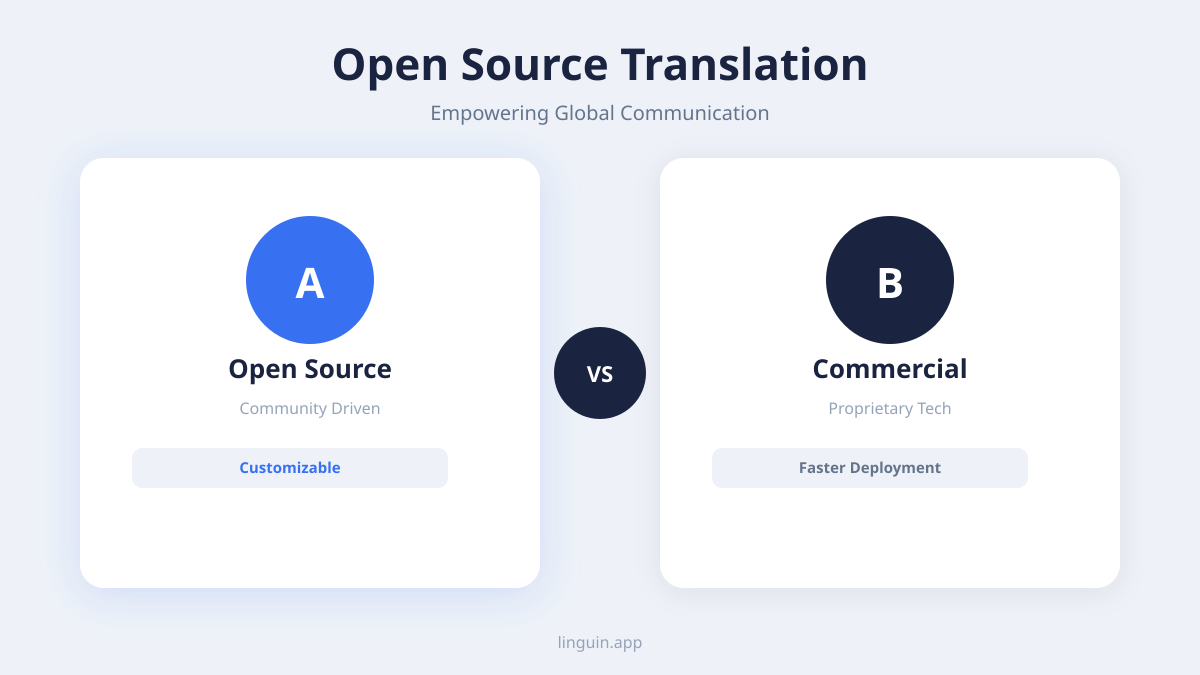
The relationship between open-source translation models and commercial translation services is not one of pure competition but rather one of synergy and evolution. Open-source initiatives often serve as incubators for innovation, pushing the boundaries of what’s possible. Commercial entities, in turn, can leverage these advancements to build polished, user-friendly products and offer robust support and specialized services.
Companies like Linguin can benefit immensely from the open-source ecosystem. We can integrate proven open-source components, research innovative architectures developed within the community, and even contribute back our own findings to accelerate progress. This allows us to focus our internal resources on areas where we can provide unique value, such as optimizing performance for specific devices, enhancing user experience, developing specialized translation capabilities, and ensuring the highest standards of data privacy and security for our users.
For example, an open-source model might provide the core translation engine. Linguin then builds upon this by developing:
- User-friendly interfaces for macOS, iOS, Chrome, and Safari, making powerful translation accessible to everyone.
- Advanced features like document translation, real-time voice translation, and context-aware suggestions.
- Dedicated infrastructure for reliable and scalable translation services.
- Rigorous testing and quality assurance to ensure accuracy and consistency across numerous language pairs.
- Robust security protocols to protect user data, a commitment that is paramount to our service.
The future of translation technology will likely involve a dynamic interplay between open-source innovation and commercial development. Open-source projects will continue to democratize access and drive foundational research, while commercial applications will build upon these foundations to deliver polished, secure, and feature-rich solutions to a global audience. This collaborative approach ensures that language barriers continue to fall, fostering greater understanding and connection worldwide. As Linguin continues to evolve, our commitment to harnessing the best of both worlds – open innovation and our own dedicated expertise – will remain at the forefront, empowering you to communicate with confidence, no matter the language.