 English
  Español
  Français
  Deutsch
  Português
  Italiano
  Русский
  中文(简体)
  日本語
日本語  한국어
한국어  العربية
  हिन्दी
  Nederlands
  Türkçe
  Polski
The Dawn of Smarter Translation
For centuries, the dream of effortless communication across language barriers has captivated humanity. From ancient translators meticulously rendering sacred texts to the clunky, often comically inaccurate, phrasebooks of the past, the journey towards seamless global understanding has been long and arduous. For a significant period, machine translation (MT) offered a glimpse of this future, but it was often a flawed one. Rule-based systems relied on intricate linguistic dictionaries and grammatical rules, while statistical machine translation (SMT) analyzed vast amounts of parallel text to predict the most probable translations. While SMT represented a leap forward, it still struggled with context, fluency, and the nuanced intricacies of human language. Then came a revolution, powered by artificial intelligence: Neural Machine Translation (NMT).
NMT isn’t just an upgrade; it’s a paradigm shift. It leverages the power of deep learning, specifically artificial neural networks, to process and translate entire sentences or even larger chunks of text at once, rather than word-by-word or phrase-by-phrase. This fundamental difference allows NMT to grasp the context and meaning of sentences much more effectively, leading to translations that are not only more accurate but also remarkably more natural and human-sounding. Think of it as moving from a mechanical assembly line that bolts together words to a skilled artisan who crafts a coherent and meaningful message.
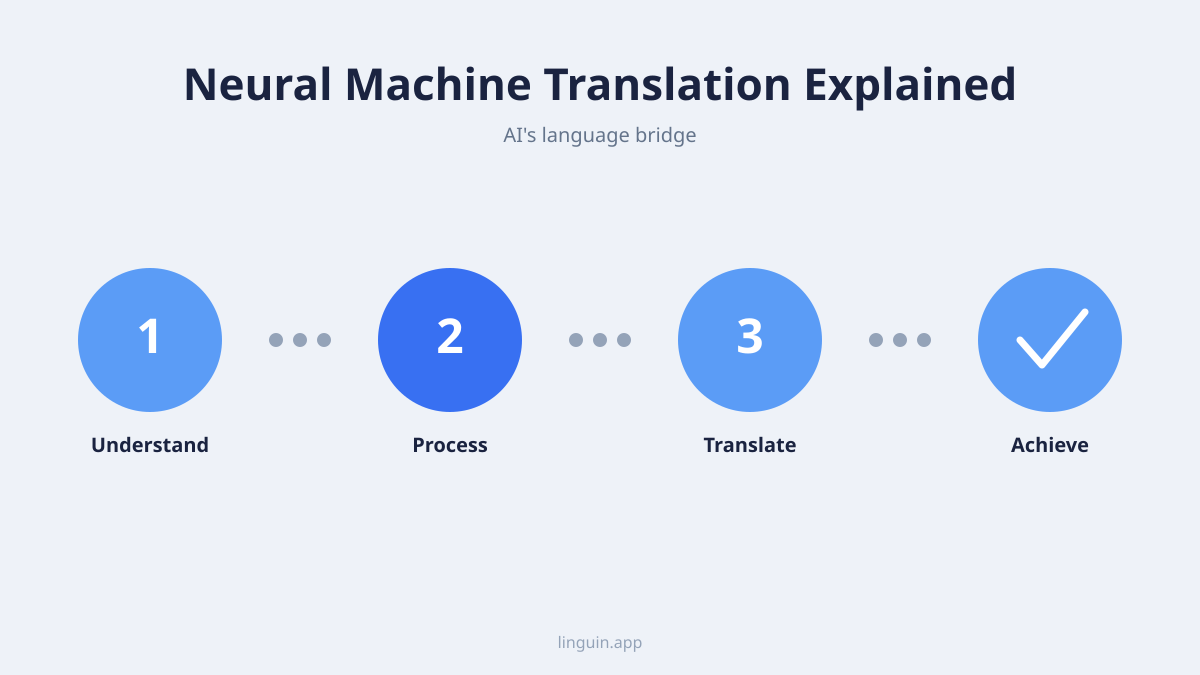
How Does Neural Machine Translation Actually Work?
At its core, NMT models are inspired by the structure and function of the human brain. They are composed of layers of interconnected “neurons” that process information. For translation, these models typically employ an “encoder-decoder” architecture.
The encoder takes the source sentence (the text you want to translate) and processes it, converting it into a dense, numerical representation. This representation isn’t a direct word-for-word mapping but rather a “contextual embedding” that captures the semantic meaning and grammatical structure of the entire input. Imagine it as distilling the essence of the sentence into a rich, multi-dimensional vector. This process involves sophisticated algorithms like Recurrent Neural Networks (RNNs), Long Short-Term Memory (LSTM) networks, or more recently, the highly effective Transformer architecture. These architectures are designed to handle sequential data like language, remembering information from earlier parts of the sentence to inform the understanding of later parts.
The decoder then takes this encoded representation and generates the translated sentence in the target language. It works step-by-step, predicting the most likely next word based on the encoded meaning and the words it has already generated. This sequential generation allows for a fluid and contextually appropriate output. The attention mechanism, a key innovation within NMT, is particularly crucial here. It allows the decoder to focus on different parts of the encoded source sentence at each step of the translation process, effectively assigning “attention” to the most relevant words for generating the current output word. This is what enables NMT to handle long sentences and complex dependencies much better than previous methods.
For instance, when translating “The cat sat on the mat” from English to French, the encoder would process “The cat sat on the mat” and create a numerical representation of its meaning. The decoder would then start generating “Le chat s’est assis sur le tapis”. At each step, the attention mechanism might focus on “cat” when generating “chat”, then on “sat” when generating “s’est assis”, and so on, ensuring that the grammatical agreement and word order are correctly handled in French.
The training of these NMT models involves feeding them massive datasets of parallel text – millions of sentences and their accurate human translations. Through a process of iterative learning and error correction, the model adjusts its internal parameters to minimize the difference between its generated translations and the actual human translations. This is where the “neural” aspect truly shines, as the network learns complex patterns and relationships within language that would be incredibly difficult to explicitly program.
The Advantages of Neural Machine Translation
The superiority of NMT over older MT technologies is evident in several key areas, directly impacting the quality of translation tools like Linguin.
Improved Fluency and Naturalness: This is perhaps the most noticeable advantage. NMT-generated translations sound less like a machine struggling to string words together and more like a human speaking. They flow better, use more appropriate idioms, and capture the nuances of tone and style. This is because NMT models learn the underlying patterns of language, not just isolated word correspondences.
Better Contextual Understanding: Traditional MT often failed to grasp the broader meaning of a sentence or paragraph. NMT’s encoder-decoder architecture, especially with attention mechanisms, allows it to consider the entire sentence’s context, leading to more accurate translations of ambiguous words or phrases. For example, the word “bank” can refer to a financial institution or the side of a river. NMT is far more likely to correctly identify the intended meaning based on the surrounding words.
Handling of Idioms and Figurative Language: Idioms are notoriously difficult for machines to translate literally. NMT, by learning from vast amounts of natural language data, can often recognize and correctly translate idiomatic expressions, maintaining the intended meaning rather than producing a nonsensical literal translation.
Reduced Errors and Increased Accuracy: While no translation system is perfect, NMT has significantly reduced common errors found in older MT systems, such as grammatical mistakes, incorrect word order, and mistranslations of polysemous words.
Adaptability and Continuous Improvement: NMT models can be fine-tuned on specific domains or language pairs to achieve even higher accuracy. As more data becomes available and research progresses, these models can be continuously improved, making them more powerful and versatile over time. This is a core principle behind the ongoing development of Linguin’s translation engine.
NMT in Action: The Linguin Experience
For users of Linguin, the power of Neural Machine Translation translates directly into a superior translation experience. Whether you’re using our macOS app to understand an important email, the iOS app to navigate a foreign city, or our Chrome and Safari extensions to comprehend web pages in real-time, you’re benefiting from the cutting-edge capabilities of NMT.
When you input text into Linguin, our NMT engine works diligently in the background. It analyzes your source text, understands its meaning and context, and then reconstructs it in your chosen target language with remarkable fidelity. This means that when you use Linguin to translate a complex technical document, a casual chat message, or even a creative piece of writing, you can expect a translation that is not only accurate but also reads naturally and preserves the original intent.
Our commitment at Linguin is to make global communication as seamless and effortless as possible. By harnessing the power of NMT, we are able to provide translations that empower you to connect with people, information, and ideas from around the world, breaking down language barriers with confidence and ease. The technology behind Linguin is constantly evolving, with our team dedicated to refining our NMT models to ensure you always have access to the most advanced and reliable translation capabilities.
The Future of Neural Machine Translation
The field of NMT is far from static. Researchers and engineers are continuously pushing the boundaries, exploring new architectures, and developing innovative techniques to further enhance translation quality and efficiency.
One exciting area of development is multilingual NMT, where a single model can translate between multiple languages. This is more efficient than training separate models for every language pair and can even allow for zero-shot translation (translating between language pairs the model has never explicitly seen during training).
Another frontier is low-resource language translation, where NMT models are trained for languages with limited available data. Techniques like transfer learning and unsupervised NMT are showing promise in bringing high-quality translation to languages that were previously underserved by machine translation.
Furthermore, research into explainable AI is aiming to make NMT models more transparent, allowing us to understand why a particular translation was generated. This can help identify and rectify biases or errors more effectively.
The integration of NMT with other AI technologies, such as natural language understanding (NLU) and natural language generation (NLG), is also paving the way for more sophisticated language applications. Imagine tools that can not only translate but also summarize, rephrase, and even generate entirely new content based on a given prompt, all while maintaining perfect linguistic accuracy.
Neural Machine Translation has fundamentally reshaped our ability to communicate across linguistic divides. It has moved us from a world of awkward, literal translations to one where technology can facilitate genuine understanding and connection. At Linguin, we are proud to be at the forefront of this revolution, bringing the power of NMT to your fingertips on macOS, iOS, and your web browser, making the world a smaller, more connected place, one translation at a time.