 English
  Español
  Français
  Deutsch
  Português
  Italiano
  Русский
  中文(简体)
  日本語
日本語  한국어
한국어  العربية
  हिन्दी
  Nederlands
  Türkçe
  Polski
The Global Landscape of Academic Research
In today’s interconnected world, research is no longer confined by geographical borders. Scientific breakthroughs, innovative theories, and profound insights are being generated by scholars across the globe. For academics, staying at the forefront of their field necessitates engaging with this vast international body of knowledge. However, a significant hurdle often stands in the way: language. Whether you’re a student seeking to cite international studies, a researcher aiming to collaborate with foreign peers, or an educator building a comprehensive curriculum, the ability to understand and utilize research published in languages other than your own is paramount.
This is where the crucial practice of academic paper translation comes into play. It’s the bridge that connects diverse scholarly communities, democratizes access to information, and fosters a truly global academic dialogue. Imagine a medical researcher in Japan making a groundbreaking discovery, or a sociologist in Brazil uncovering a novel social trend. Without effective translation, these vital contributions might remain inaccessible to a significant portion of the academic world, potentially slowing down progress and hindering collaborative efforts. The sheer volume and pace of academic output further amplify this need. New research is published daily, and trying to keep up with just the English-language literature can be a challenge; doing so across multiple languages exponentially increases the difficulty.
The Challenges of Translating Academic Papers
Translating academic papers is a far more intricate task than simply converting words from one language to another. Academic discourse is characterized by its own unique set of linguistic and stylistic conventions, which can present significant challenges for even the most skilled human translators, let alone automated tools.
One of the primary hurdles is specialized terminology. Every academic discipline, from quantum physics to medieval literature, boasts its own lexicon of technical terms, jargon, and idiomatic expressions. A direct, literal translation of these terms can often be nonsensical or, worse, convey an entirely incorrect meaning. For example, a term in chemistry might have a completely different meaning in economics, and understanding the precise context is vital.
Beyond terminology, complex sentence structures and nuanced argumentation are hallmarks of academic writing. Papers often feature long, multi-clause sentences, sophisticated grammatical constructions, and subtle rhetorical devices designed to convey precise meanings and build logical arguments. Capturing these nuances in translation requires not only linguistic accuracy but also a deep understanding of the underlying concepts and the author’s intended message. A poorly translated sentence can obscure a crucial point, misrepresent an argument, or even lead to misinterpretations that have serious consequences in fields like medicine or law.
Furthermore, cultural context and disciplinary conventions play a significant role. What might be considered standard phrasing or an accepted way of presenting data in one academic culture could be unusual or even misleading in another. A translator needs to be sensitive to these differences to ensure the translated paper is not only linguistically accurate but also culturally appropriate and adheres to the expected standards of the target academic community. For instance, the way research findings are presented, the level of formality, and the use of passive versus active voice can vary significantly between academic traditions.
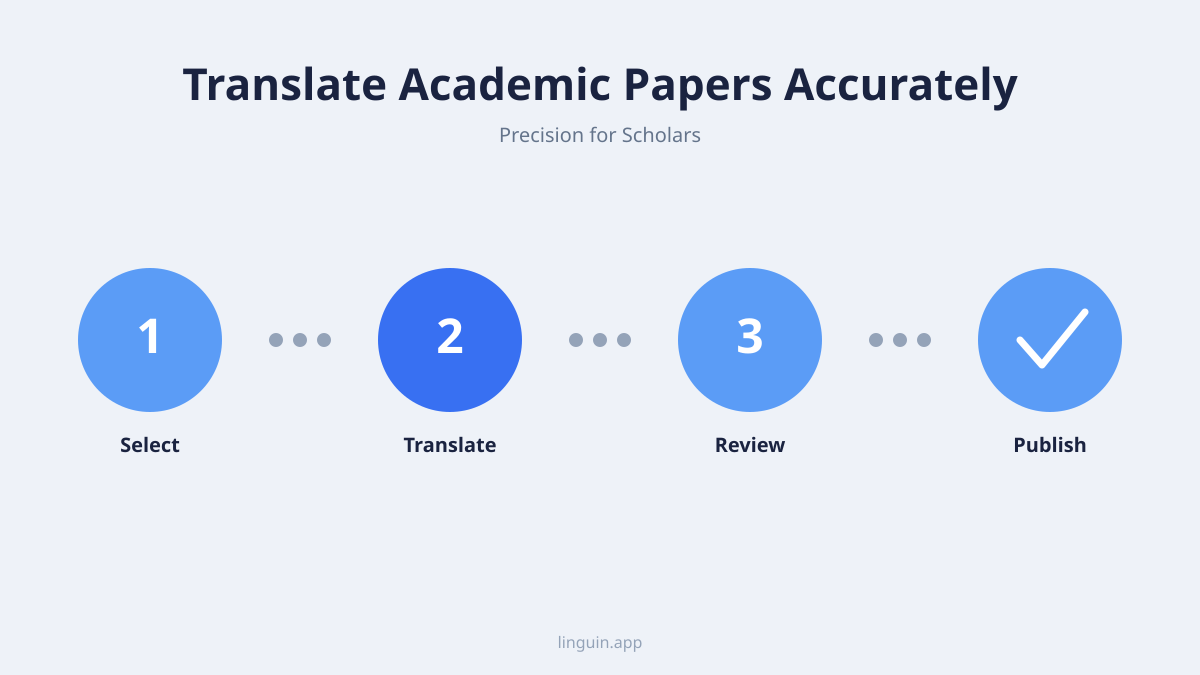
Finally, the sheer volume and urgency associated with academic paper translation can be overwhelming. Students often need to review numerous papers for literature reviews, while researchers might need to quickly grasp the findings of a recently published study from an international competitor. The time and cost associated with engaging professional human translators for every research requirement can be prohibitive, making efficient and accessible translation solutions indispensable.
The Role of AI in Academic Translation
Recognizing these challenges, artificial intelligence has emerged as a powerful ally in the quest to overcome language barriers in academia. AI-powered translation tools, like Linguin, leverage sophisticated machine learning algorithms and vast datasets of parallel texts to offer increasingly accurate and nuanced translations.
The evolution of Natural Language Processing (NLP) has been a game-changer. Modern AI translation models are no longer simply performing word-for-word substitutions. Instead, they analyze the context of entire sentences and even paragraphs to understand the relationships between words and the overall meaning. This allows them to handle idiomatic expressions, understand grammatical structures, and even adapt to different writing styles with a growing degree of proficiency.
For academic papers, this means AI can now do a much better job of identifying and translating specialized terminology. By being trained on vast corpora of academic texts from various disciplines, these models can recognize discipline-specific terms and their correct equivalents in other languages. While human review may still be necessary for the most critical or highly specialized documents, AI can provide a remarkably strong first draft, saving significant time and effort.
Moreover, AI’s ability to process large volumes of text rapidly makes it ideal for handling the demands of academic research. Instead of waiting days or weeks for human translators, researchers can get instant translations, allowing them to quickly assess the relevance and potential impact of a paper. This speed is invaluable in fast-paced research environments where staying ahead of the curve is essential.
Linguin embodies this advancement in AI translation. Designed with the modern academic in mind, it offers a seamless translation experience across multiple platforms. Whether you’re using a macOS desktop, an iOS device on the go, or browsing research articles through its Chrome or Safari extensions, Linguin ensures that language is never a barrier to your academic pursuits. Its intelligent algorithms are continually learning and improving, making it an ever-more reliable tool for navigating the global academic landscape.
Leveraging Linguin for Your Academic Needs
Linguin is engineered to simplify and accelerate your academic paper translation process, offering a robust and intuitive solution across all your Apple devices and web browsers. Our goal is to empower you to access and understand research, no matter where it originates.
One of the key advantages of Linguin is its cross-platform availability. Imagine you discover a crucial research paper while browsing on your Mac at the university library. With Linguin for macOS, you can instantly translate the entire document or selected passages. Later, while commuting, you might receive an email with an abstract from an international conference. Linguin for iOS allows you to translate it on your iPhone or iPad, ensuring you never miss an important update. Furthermore, the Linguin Chrome extension and Safari extension enable direct translation of web pages, meaning you can translate academic journals, research portals, and online articles without ever leaving your browser. This integrated experience ensures that your workflow remains uninterrupted, and vital information is always at your fingertips.
Linguin’s intelligent translation engine is specifically optimized for academic content. While general translation tools might struggle with the intricacies of scholarly language, Linguin’s AI has been trained on an extensive library of academic texts, allowing it to better understand and translate complex sentence structures, specialized terminology, and nuanced arguments. This means you can rely on Linguin for more accurate and contextually relevant translations of your academic papers, saving you the time and effort of extensive post-editing. Whether it’s a dense scientific article, a theoretical economics paper, or a historical analysis, Linguin strives to preserve the integrity and precision of the original text.
Beyond simple text translation, Linguin offers features that cater specifically to academic workflows. For instance, you can translate entire documents, preserving formatting where possible, which is a significant time-saver when dealing with lengthy research papers. Our app also allows for instantaneous translation of selected text, enabling you to quickly clarify specific terms or sentences without translating the entire document. This is particularly useful for literature reviews where you might need to cross-reference information from multiple sources.
Furthermore, Linguin is committed to continuous improvement. Our AI models are constantly being updated with new data and learning from user interactions to enhance translation quality. This means that as you use Linguin, you are not only benefiting from its current capabilities but also contributing to its ongoing development, making it an increasingly valuable tool for your academic journey.
Best Practices for Using AI to Translate Academic Papers
While AI translation tools like Linguin are incredibly powerful, they are most effective when used strategically. Employing best practices ensures you maximize accuracy, efficiency, and the overall value of your translated academic content.
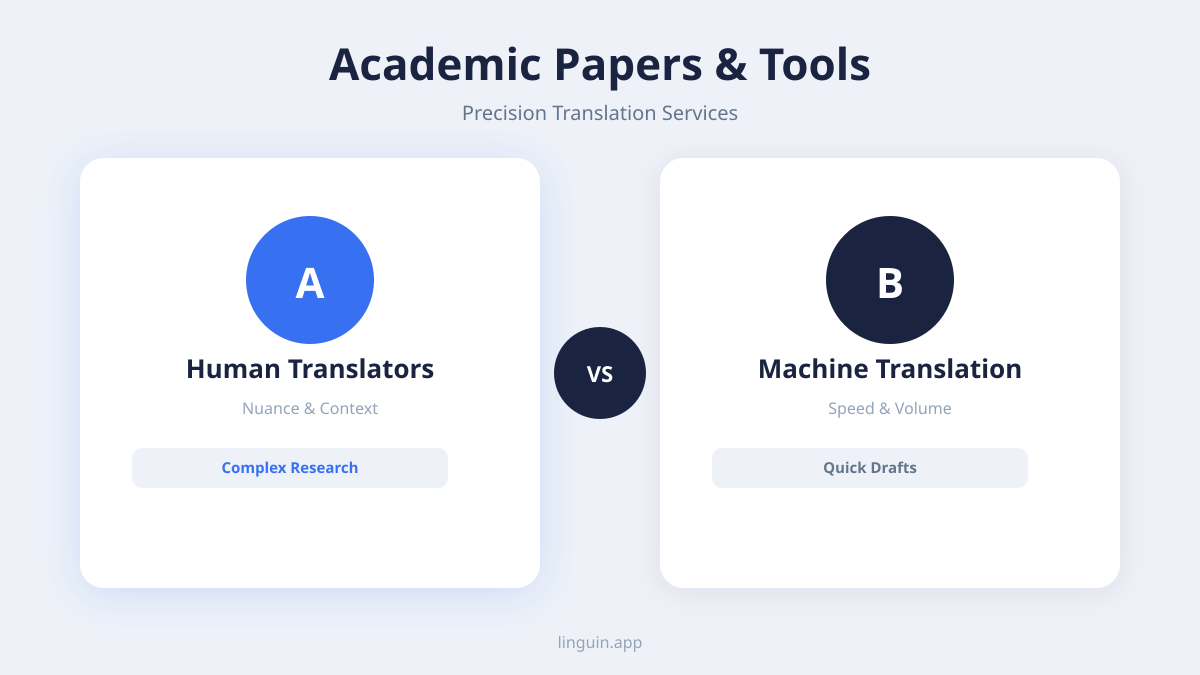
Firstly, understand the capabilities and limitations of AI translation. Linguin provides highly accurate translations, especially for well-represented languages and common academic disciplines. However, for extremely niche subjects, highly experimental research, or languages with limited digital training data, a human expert’s review might still be beneficial. Think of AI as a powerful first responder or a highly competent assistant, not necessarily the final arbiter of truth for every single word.
Secondly, provide context whenever possible. While Linguin is adept at understanding context, if you are translating a snippet of text and want to ensure maximum accuracy, consider pasting a slightly larger portion of the surrounding text. This helps the AI better grasp the intended meaning and avoid potential ambiguities. For document translations, Linguin handles this automatically, but for smaller text segments, this is a good practice.
Thirdly, always proofread and verify critical information. After obtaining an AI translation, especially for crucial findings, methodologies, or conclusions, take the time to review it. Cross-reference key terms with their original language equivalents if you have some familiarity, or consult a dictionary or glossary for specialized vocabulary. If the paper is central to your research or publication, consider having a subject-matter expert or a professional translator review the translated sections that are most critical. Linguin helps you get to the core of the paper much faster, allowing you to focus your verification efforts where they are most needed.
Fourthly, be mindful of disciplinary nuances. As discussed earlier, academic fields have their own conventions. While Linguin is trained on academic corpora, it might not always perfectly capture the most subtle stylistic preferences of a particular journal or discipline. For instance, the preferred phrasing for statistical reporting might differ slightly between, say, a biology paper and a psychology paper. Awareness of these potential variations will help you make informed edits.
Finally, utilize Linguin’s multi-platform approach to your advantage. Don’t hesitate to use the right tool for the right situation. Translate a full paper on your desktop using the macOS app for a comprehensive overview. Quickly check an abstract on your phone with the iOS app while on the go. Use the browser extensions to translate articles as you discover them online. This flexibility ensures you’re always equipped to handle translation needs efficiently, no matter where your research takes you. By combining the power of Linguin with a thoughtful approach, you can unlock a world of academic knowledge and significantly enhance your research capabilities.
The Future of Global Academic Collaboration
The increasing sophistication of AI translation tools like Linguin is fundamentally reshaping the landscape of academic research and collaboration. As these technologies continue to evolve, the barriers posed by language are becoming increasingly surmountable, paving the way for a more inclusive, efficient, and interconnected global academic community.
Imagine a future where a researcher in Argentina can collaborate seamlessly with a team in South Korea, where groundbreaking research published in any corner of the world is instantly accessible to anyone with an internet connection, and where the next generation of scholars can draw inspiration from the full spectrum of human knowledge, regardless of its original language. This is the future that AI-powered translation is helping to build.
Linguin is proud to be a part of this exciting evolution. By providing intuitive, powerful, and accessible translation solutions across macOS, iOS, Chrome, and Safari, we are dedicated to empowering academics, students, and researchers worldwide. Our commitment to continuous innovation means that Linguin will continue to adapt and improve, staying at the forefront of AI translation technology. We believe that by breaking down language barriers, we can foster a more vibrant, collaborative, and progressive global academic ecosystem. The pursuit of knowledge knows no borders, and with tools like Linguin, neither should access to it.