 English
  Español
  Français
  Deutsch
  Português
  Italiano
  Русский
  中文(简体)
  日本語
日本語  한국어
한국어  العربية
  हिन्दी
  Nederlands
  Türkçe
  Polski
Why Translating Your Website is Crucial for SEO
In today’s interconnected digital landscape, the internet has transcended geographical boundaries. Your target audience is no longer confined to your immediate locality. If your website is only available in one language, you’re missing out on a significant portion of potential customers and readers worldwide. This is where website translation comes into play, not just for user experience, but as a powerful, often overlooked, SEO strategy.
Search engines like Google aim to provide users with the most relevant results. When a user searches in a specific language, search engines prioritize websites that are also in that language. By offering your content in multiple languages, you instantly expand your potential search engine visibility. This means more eyes on your content, more traffic to your site, and ultimately, more opportunities for conversions, whether that’s a sale, a signup, or a read.
Beyond direct search engine benefits, a translated website demonstrates a commitment to understanding and serving a global audience. This inclusivity fosters trust and can lead to higher engagement rates and lower bounce rates, both of which are positive signals for SEO. Users are more likely to stay on a site that speaks their language and understand their needs.
Understanding the Nuances of Multilingual SEO
Translating your website isn’t just about a word-for-word conversion. Effective multilingual SEO requires a strategic approach that considers the linguistic and cultural nuances of each target market.
First and foremost is keyword research. Keywords that perform well in one language may not translate directly or have the same search volume in another. You need to conduct dedicated keyword research for each target language. Tools can help, but understanding cultural context is paramount. For instance, a colloquial phrase or an idiom might be highly searched in one region but completely nonsensical in another.
Next, consider language targeting. Search engines use various signals to determine the language of a page and its intended audience. The most effective method is to use hreflang tags. These HTML attributes tell search engines which language and regional variations of a page exist. This prevents duplicate content issues and ensures that users are directed to the most relevant version of your site. For example, if you have an English version and a Spanish version for Spain, hreflang tags will correctly direct users searching in Spanish to the Spanish page and users searching in English to the English page.
Another critical aspect is site structure. You have several options for structuring your multilingual website:
- Subdirectories:
yourwebsite.com/es/for Spanish,yourwebsite.com/fr/for French. This is often the most SEO-friendly approach as it consolidates authority to the main domain. - Subdomains:
es.yourwebsite.com,fr.yourwebsite.com. This can be good for distinct regional markets but might dilute domain authority. - Separate Domains:
yourwebsite.es,yourwebsite.fr. This offers the most distinct branding but can be the most complex and expensive to manage.
Regardless of your chosen structure, consistency in URLs, meta descriptions, and title tags across all language versions is key for maintaining a clean and understandable site for both users and search engines.
How Linguin Enhances Your Multilingual SEO Efforts
This is where a powerful translation tool like Linguin can be an invaluable asset. Linguin, available as a macOS app, iOS app, and browser extensions for Chrome and Safari, simplifies the process of translating your website content, ensuring accuracy and efficiency, which are vital for SEO success.
Streamlined Content Translation
Manually translating an entire website can be a monumental task, prone to errors and time-consuming. Linguin’s AI-powered translation engine provides high-quality translations across numerous languages. Whether you’re translating blog posts, product descriptions, landing pages, or even entire sections of your website, Linguin can handle it with speed and precision. For macOS and iOS users, the integrated apps mean you can translate text directly within other applications, making it easy to translate content before publishing it on your site.
For those who prefer to work directly in their browser, Linguin’s Chrome and Safari extensions are game-changers. You can select text on any webpage and instantly get a translation, or even translate an entire webpage with a single click. This allows for quick research into foreign markets, understanding competitor websites, and most importantly, ensuring your own website’s content is accurately translated before you push it live. This is particularly useful for testing and refining translations to ensure they resonate culturally and linguistically.
Maintaining Consistency and Accuracy
SEO relies heavily on consistent and accurate information. Inaccurate translations can lead to user confusion, high bounce rates, and negative SEO signals. Linguin’s advanced AI is designed to understand context, idioms, and nuances, producing translations that are not only grammatically correct but also culturally appropriate. This is crucial for building trust with your international audience.
When you use Linguin to translate your website content, you can be confident that the core message remains intact. This consistency is recognized by search engines and contributes to a positive user experience, which in turn, benefits your SEO rankings. Imagine translating product descriptions for an e-commerce site; accuracy here is paramount for customer understanding and preventing returns. Linguin helps ensure that this level of detail and clarity is maintained across all languages.
Expanding Your Reach with Ease
The primary goal of website translation for SEO is to expand your reach. Linguin empowers you to do this without the prohibitive costs and complexities often associated with professional translation services for every single piece of content. You can strategically translate your most important pages first, targeting specific regions and languages based on your business goals and market research.
By leveraging Linguin’s extensions, you can quickly translate meta titles and descriptions – critical elements for SEO. These short snippets are what users see in search results, and they need to be compelling and accurate in the user’s native language to encourage clicks. Linguin makes it easy to review and refine these before they go live, ensuring they are optimized for both search engines and potential visitors.
Practical Steps to Implement Multilingual SEO with Website Translation
Now that you understand the benefits and the role Linguin can play, let’s outline some practical steps to implement a successful multilingual SEO strategy.
1. Identify Target Languages and Regions
Don’t try to translate your website into every language at once. Start by researching which languages and regions have the highest potential for your business. Look at your current website analytics: where is your traffic coming from? Are there specific countries showing interest? Also, consider markets where your competitors are strong. Tools like Google Analytics and Google Trends can provide valuable insights.
2. Conduct Keyword Research for Each Language
As mentioned earlier, this is non-negotiable. Use SEO tools to find relevant keywords in your target languages that match user search intent. Consider the cultural context of search terms. A direct translation might not capture the same search behavior.
3. Choose Your Website Structure
Decide on subdirectories, subdomains, or separate domains based on your technical capabilities, budget, and long-term strategy. For most businesses, subdirectories are the most recommended for SEO consolidation.
4. Implement hreflang Tags Correctly
This is vital for informing search engines about your multilingual content. Ensure that each language version of a page links to all other language versions of the same page. You can implement hreflang tags in your HTML, via your sitemap, or through HTTP headers.
5. Translate Your Content (and Optimize It!)
This is where Linguin shines. Use the macOS app, iOS app, or browser extensions to translate your website’s core content:
- Homepage: Your first impression needs to be clear and welcoming in every language.
- Product/Service Pages: Detailed descriptions must be accurate and persuasive.
- About Us Page: Share your brand story and values effectively.
- Blog Content: Regularly updated content in multiple languages attracts a broader audience and signals to search engines that your site is active and relevant.
- Meta Titles and Descriptions: These are your billboards in search results. Ensure they are translated and localized for maximum impact.
When using Linguin, don’t just accept the initial translation. Review it for cultural appropriateness and SEO optimization. Ensure that your target keywords are naturally integrated into the translated text.
6. Localize Images and Multimedia
Beyond text, consider if your images and videos are culturally relevant. A product image that resonates in one culture might not in another. Localizing these elements can significantly improve user engagement.
7. Promote Your Multilingual Content
Once your translated pages are live, actively promote them to your target audiences. Share links on social media in the relevant languages, and consider running targeted ad campaigns in those regions.
8. Monitor and Analyze Performance
Use analytics tools to track the performance of your translated pages. Monitor traffic, engagement metrics, and conversion rates for each language. This data will inform your future translation efforts and SEO strategy. Are certain languages performing better than others? Why? This feedback loop is crucial for continuous improvement.
Common Pitfalls to Avoid
While translating your website for SEO offers immense benefits, there are common mistakes that can hinder your progress.
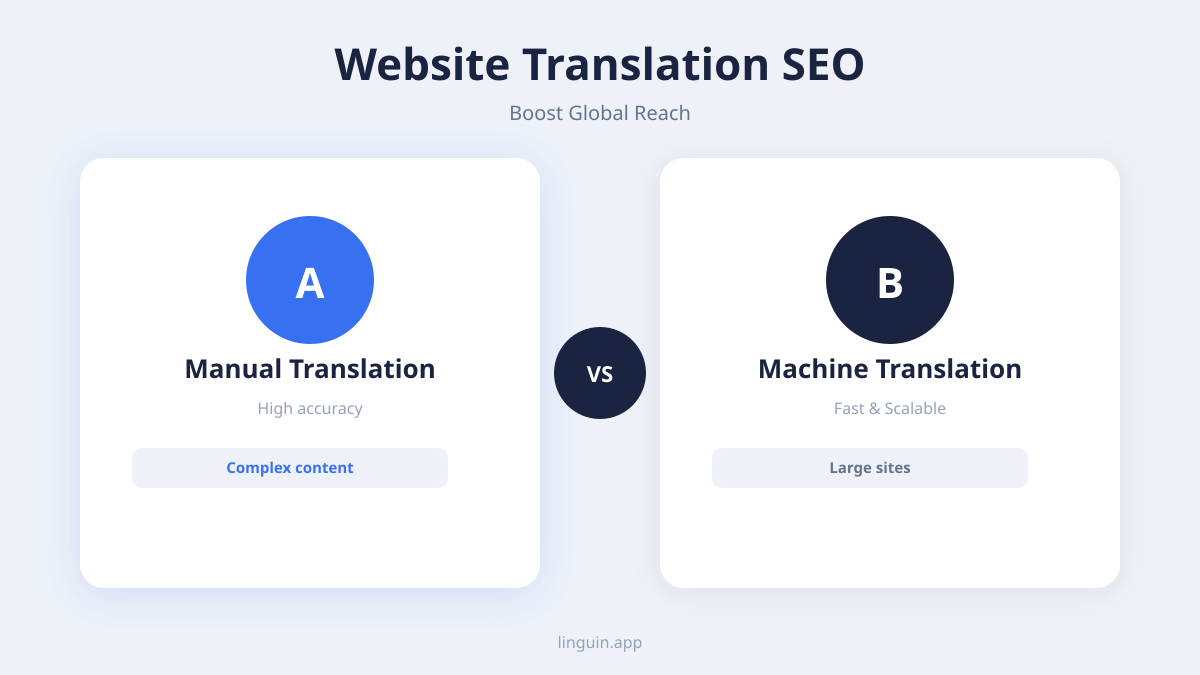
- Machine Translation Without Review: Relying solely on raw machine translation without human review for accuracy and cultural context is a recipe for disaster. While tools like Linguin are advanced, a final human check, especially for critical content, is always recommended.
- Ignoring
hreflang: Failing to implementhreflangtags correctly can lead to duplicate content penalties and your pages not being served to the right audiences. - Not Localizing Keywords: Using the same keywords across languages without research will result in poor search performance.
- Poor Site Structure: A disorganized multilingual site can confuse both users and search engines.
- Inconsistent User Experience: Ensure that the overall user experience, including navigation, design, and loading speeds, is consistent across all language versions.
- Neglecting Mobile Experience: With the majority of internet traffic coming from mobile devices, ensure your translated website is fully responsive and optimized for mobile users in all languages. Linguin’s mobile app for iOS ensures you can manage and translate content even on the go.
The Future of Global Reach: AI-Powered Translation
The integration of AI into translation services has revolutionized how businesses approach international markets. Linguin represents the cutting edge of this technology, offering a powerful yet accessible solution for macOS, iOS, Chrome, and Safari users. By embracing website translation powered by advanced AI, you’re not just adapting to a globalized world; you’re proactively positioning your business for success on the international stage.
With Linguin, the barrier of language is significantly lowered. This allows you to focus on what you do best – creating valuable content and services – while Linguin handles the complexities of linguistic adaptation. Investing in multilingual SEO by translating your website is no longer an option for ambitious businesses; it’s a necessity. And with tools like Linguin at your disposal, achieving global SEO dominance has never been more attainable. Start translating today and unlock your website’s true global potential.