 English
  Español
  Français
  Deutsch
  Português
  Italiano
  Русский
  中文(简体)
  日本語
日本語  한국어
한국어  العربية
  हिन्दी
  Nederlands
  Türkçe
  Polski
What is a Translation API?
In today’s interconnected world, breaking down language barriers is no longer a luxury but a necessity for businesses, developers, and even individual users. Whether you’re building a global e-commerce platform, creating multilingual content, or simply want to offer your users seamless communication, the ability to translate text accurately and efficiently is paramount. This is where Translation APIs come into play.
At its core, a Translation API (Application Programming Interface) is a set of protocols and tools that allows different software applications to communicate with each other. In the context of translation, a Translation API acts as a bridge, enabling your application to send text to a sophisticated language processing service and receive the translated version back. Think of it as a direct line to a vast network of linguistic expertise, accessible programmatically. Instead of manually copying and pasting text into a translation tool, your application can directly request translations, opening up a world of automated possibilities.
These APIs leverage powerful machine learning models, often trained on massive datasets of text and human translations, to understand the nuances of language and provide translations that are increasingly accurate and contextually relevant. The complexity of natural language processing means that building such a robust translation engine from scratch is an undertaking of immense scale and cost. This is precisely why readily available Translation APIs have become an indispensable tool for developers seeking to integrate multilingual capabilities into their products and services without reinventing the wheel.
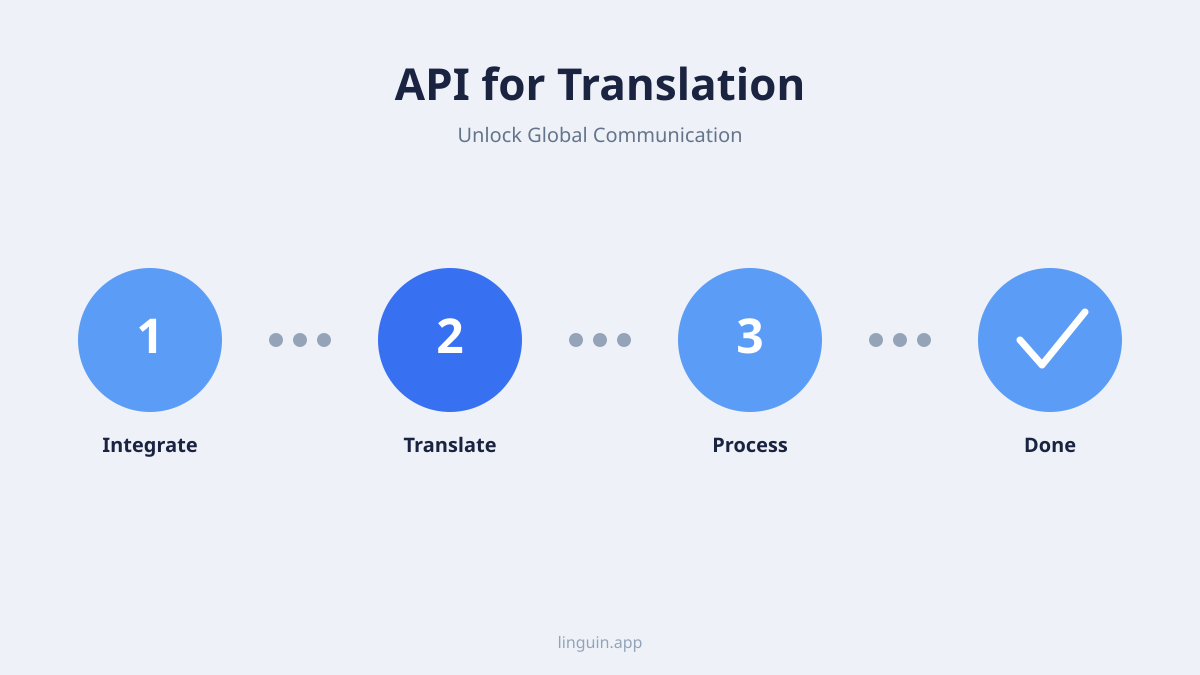
The magic happens through requests and responses. Your application sends a request, specifying the source language, the target language, and the text to be translated. The Translation API then processes this request, utilizes its advanced algorithms and linguistic models, and returns a response containing the translated text. This might seem simple, but behind those elegant requests and responses lies a world of cutting-edge artificial intelligence and natural language processing.
The Mechanics of Machine Translation APIs
The power behind modern Translation APIs lies in advanced machine learning techniques, primarily Neural Machine Translation (NMT). Unlike older methods like Statistical Machine Translation (SMT) which relied on statistical models derived from parallel corpora (large collections of texts and their translations), NMT utilizes deep neural networks to model the translation process.
Here’s a simplified breakdown of how NMT works:
-
Encoding: The input sentence in the source language is fed into an “encoder” neural network. This network processes the sentence word by word (or sub-word units), creating a rich, contextualized numerical representation of its meaning and structure. This representation is often called a “context vector” or “thought vector.”
-
Decoding: A “decoder” neural network then takes this context vector and generates the translated sentence in the target language, word by word. It considers the context vector and the words it has already generated to predict the most probable next word.
-
Attention Mechanisms: A key innovation in NMT is the “attention mechanism.” This allows the decoder to dynamically focus on different parts of the source sentence as it generates each word in the target sentence. This is crucial for handling long sentences and ensuring that the translation accurately reflects the relationships between words. For example, when translating a complex sentence, the decoder might pay more attention to the subject when translating the verb, and to the adjective when translating the noun it modifies.
The training process for these NMT models is computationally intensive and requires vast amounts of parallel text data. The more data and the more sophisticated the neural network architecture, the better the translation quality tends to be. This is why established providers of Translation APIs invest heavily in data collection, model training, and continuous improvement.
For developers, interacting with these APIs typically involves sending HTTP requests to a specific endpoint provided by the API provider. These requests often include an API key for authentication and authorization, ensuring that only legitimate users can access the service. The request payload will contain the text to be translated, the source language code (e.g., “en” for English), and the target language code (e.g., “es” for Spanish). The API then returns a response, usually in JSON format, containing the translated text, sometimes with additional metadata like confidence scores or detected language.
Linguin, for instance, leverages these sophisticated NMT models to provide accurate and contextually aware translations across multiple platforms. Our commitment is to make powerful translation technology accessible and user-friendly, whether you’re using our macOS app, iOS app, or browser extensions.
Key Benefits of Integrating Translation APIs
Integrating a Translation API into your application or workflow unlocks a multitude of benefits, fundamentally enhancing user experience, expanding market reach, and streamlining operations.
Expanding Global Reach and Market Access
Perhaps the most significant advantage is the ability to transcend linguistic boundaries. For businesses, this means opening up new markets by making products, services, and content accessible to a global audience. A website that automatically translates into multiple languages can attract and retain customers from all over the world, leading to increased sales and brand loyalty. Similarly, software applications can cater to a diverse user base, fostering a more inclusive and accessible digital experience.
Enhancing User Experience
Imagine a user from France interacting with an English-language application. Without translation, their experience would be frustrating and limited. By integrating a Translation API, you can provide real-time translations for user interfaces, help documentation, customer support messages, and even user-generated content. This dramatically improves usability and satisfaction, making your application a pleasure to use regardless of a user’s native tongue. Linguin’s extensions for Safari and Chrome, for example, offer on-the-fly translation of web pages, making global information readily available to everyone.
Automating Workflows and Saving Time
Manual translation is a time-consuming and expensive process. By automating translations through an API, you can significantly reduce the time and resources spent on localization. This is particularly beneficial for:
- Customer Support: Automatically translating incoming support tickets and outgoing responses allows support teams to handle queries from customers speaking different languages more efficiently.
- Content Management: Translating blog posts, articles, product descriptions, and marketing materials can be automated, allowing for faster content deployment across different regions.
- Communication: Internal or external communication can be instantly translated, facilitating seamless collaboration among international teams.
Cost-Effectiveness
While there are costs associated with using Translation APIs (typically based on usage), they are generally far more cost-effective than hiring human translators for every single piece of text, especially for high-volume or dynamic content. Many API providers offer tiered pricing models, allowing you to scale your usage and costs as your needs grow.
Scalability and Flexibility
Translation APIs are designed to handle varying volumes of translation requests. Whether you need to translate a few sentences or millions of words, the API can scale to meet your demand. This flexibility is invaluable for businesses experiencing growth or seasonal fluctuations in their translation needs.
Data Analysis and Insights
Some advanced Translation APIs can provide additional data points, such as detected source languages or confidence scores for translations. This information can be valuable for data analysis, helping you understand the linguistic diversity of your user base or identify areas where translation quality might need further human review.
Types of Translation APIs and Providers
The landscape of Translation APIs is diverse, with numerous providers offering varying levels of features, quality, and pricing. Choosing the right one depends heavily on your specific needs and technical requirements.
Here are some of the most prominent types and providers:
General-Purpose Cloud Translation Services
These are the giants of the industry, offering comprehensive translation capabilities across a vast number of languages. They are built on sophisticated NMT models and are ideal for a wide range of applications.
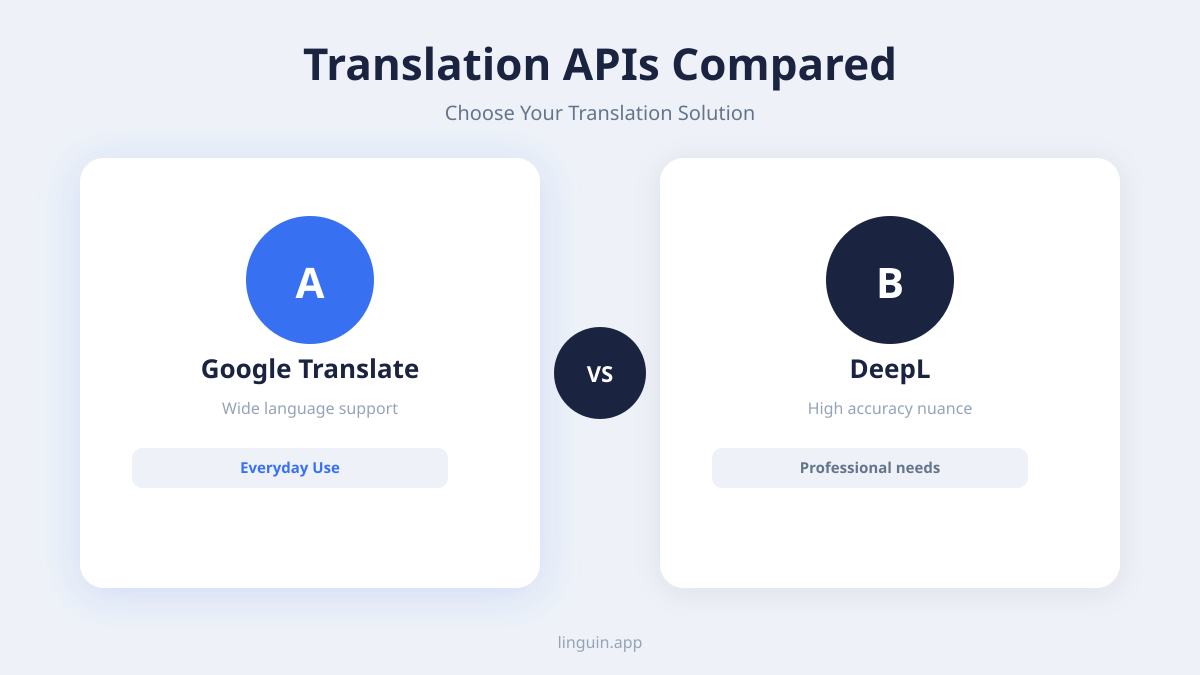
- Google Cloud Translation API: A highly robust and widely adopted service known for its extensive language support and competitive pricing. It offers features like batch translation, glossary support, and AutoML Translation for custom models.
- Microsoft Azure Translator Text API: Another powerful contender, offering similar capabilities to Google Cloud Translation. It integrates well with other Azure services and provides features like speech translation and language detection.
- Amazon Translate: Part of Amazon Web Services (AWS), this service provides high-quality, neural machine translation and integrates seamlessly with other AWS products. It’s known for its ease of use and competitive pricing.
Specialized Translation APIs
Some providers focus on specific niches or offer unique functionalities.
- DeepL API: Renowned for its exceptionally high-quality translations, particularly for European languages. DeepL often produces more natural-sounding and nuanced translations compared to its competitors, making it a favorite for many users. Linguin often recommends DeepL for its superior accuracy in many common language pairs.
- IBM Watson Language Translator: Offers advanced language translation capabilities as part of its broader AI suite, including customization options for specific domains.
Open-Source Libraries and Frameworks
For developers who prefer more control or wish to build their own translation solutions, open-source options exist. However, these often require significant technical expertise to set up, train, and maintain.
- OpenNMT: A popular open-source toolkit for NMT, providing researchers and developers with the tools to build and experiment with NMT models.
- Marian NMT: Another powerful open-source NMT framework, known for its efficiency and flexibility.
When selecting an API, consider the following factors:
- Language Support: Does it support the languages you need?
- Translation Quality: How accurate and natural are the translations for your specific use case? (Testing is crucial here!)
- Pricing: What is the cost structure, and does it fit your budget?
- API Features: Does it offer features like batch translation, glossary support, or custom model training?
- Documentation and Support: Is the documentation clear, and is reliable support available?
- Integration Ease: How straightforward is it to integrate the API into your existing tech stack?
Linguin integrates with various leading translation engines to provide you with the best possible translation experience, offering flexibility and quality across our suite of applications.
Implementing a Translation API in Your Project
Integrating a Translation API into your project can be a game-changer, but it requires careful planning and execution. While the specifics will vary depending on the API provider and your chosen programming language, the general process involves a few key steps.
Getting Started: API Keys and Setup
The first step is to sign up with your chosen Translation API provider and obtain an API key. This key is essential for authenticating your requests and is usually associated with your account and billing information. Most providers offer a free tier or trial period, allowing you to test their services before committing.
Once you have your API key, you’ll need to familiarize yourself with the API’s documentation. This document will detail:
- Endpoint URLs: The specific web addresses your application will send requests to.
- Request Methods: Typically HTTP
POSTorGETrequests. - Request Parameters: Information such as the text to translate, source language, target language, and your API key.
- Response Format: How the translated text and any accompanying data will be returned, often in JSON.
Making Translation Requests
In most programming languages, you’ll use an HTTP client library to send requests to the API. For example, in Python, you might use the requests library; in JavaScript, fetch or axios.
A typical request might look something like this (conceptual, using Python with requests):
import requests
import json

API_KEY = "YOUR_API_KEY"
ENDPOINT_URL = "https://api.translationprovider.com/v2/translate" # Example URL

def translate_text(text, target_language, source_language=None):
    headers = {
        "Authorization": f"Bearer {API_KEY}", # Or other auth methods
        "Content-Type": "application/json"
    }
    data = {
        "text": text,
        "target_lang": target_language,
    }
    if source_language:
        data["source_lang"] = source_language

    try:
        response = requests.post(ENDPOINT_URL, headers=headers, json=data)
        response.raise_for_status() # Raise an exception for bad status codes (4xx or 5xx)
        result = response.json()
        # The exact structure of 'result' will depend on the API provider
        # For example, it might be: {'translations': [{'text': '...'}]}
        return result['translations'][0]['text']
    except requests.exceptions.RequestException as e:
        print(f"Error during translation: {e}")
        return None

# Example usage:
translated = translate_text("Hello, how are you?", "es") # Translate to Spanish
if translated:
    print(f"Translated text: {translated}")
Important Considerations During Implementation:
- Error Handling: Network issues, invalid API keys, or rate limits can cause requests to fail. Implement robust error handling to gracefully manage these situations and provide feedback to the user.
- Rate Limiting: Most API providers impose rate limits to prevent abuse. Your application should respect these limits, perhaps by implementing a queuing system or back-off strategy if you encounter them.
- Asynchronous Operations: For web applications or mobile apps where responsiveness is key, consider making API calls asynchronously to avoid blocking the main thread.
- Language Detection: If the source language isn’t always known, many APIs offer a language detection feature. You can call this first to automatically identify the source language before initiating the translation.
- Caching: For frequently translated content, consider caching the results to reduce API calls and improve performance.
Integrating with Linguin
For users who don’t want to dive into coding, Linguin offers a seamless way to experience the power of translation APIs. Our macOS and iOS applications, along with our Chrome and Safari extensions, integrate with leading translation engines. This means you can enjoy high-quality translations directly within your existing workflows without needing to write a single line of code. Whether you’re browsing the web, writing an email, or working on a document, Linguin makes translation accessible and effortless. Our goal is to democratize advanced translation technology, making it available to everyone.
Best Practices for Using Translation APIs Effectively
To truly harness the power of Translation APIs and ensure the best possible outcome, adhering to a few best practices is essential. These guidelines will help you maximize accuracy, efficiency, and user satisfaction.
Understand Your Audience and Content
Not all translations are created equal. The “best” translation engine can vary depending on the language pair and the type of content. A highly technical document might require a different approach than a casual marketing slogan.
- Context is King: Provide as much context as possible. If your API supports it, use glossaries to ensure consistent translation of key terms, brand names, or technical jargon.
- Know Your Limits: Machine translation is incredibly powerful, but it’s not perfect. Complex idioms, cultural references, highly creative text, or deeply nuanced poetry can still pose challenges. Be aware of these limitations.
Post-Editing and Human Review
For critical content or situations where absolute accuracy is paramount, Post-Editing Machine Translation (PEMT) is highly recommended. This involves having a human linguist review and edit the machine-translated output. This is often far more efficient than translating from scratch and results in a high-quality, polished translation.
- Identify High-Impact Content: Determine which content absolutely needs human review. This might include legal documents, marketing campaigns, or crucial user interface elements.
- Develop a Workflow: Establish a clear process for sending machine-translated content for human review and for integrating the revised translations back into your system.
Manage Costs and Monitor Usage
Translation APIs are typically priced based on usage (e.g., per character or per request). It’s crucial to monitor your API consumption to avoid unexpected bills.
- Set Budgets and Alerts: Many cloud providers offer tools to set spending budgets and receive alerts when you’re approaching them.
- Optimize Your Usage: Implement caching for frequently translated content and only translate what is necessary. Avoid redundant translations.
Choose the Right API for the Job
As discussed earlier, different providers excel in different areas.
- Experiment and Test: Don’t be afraid to test multiple APIs with samples of your own content to see which one performs best for your specific needs. Linguin’s ability to integrate with various engines allows you to experience these differences firsthand.
- Consider Specialized APIs: If you’re dealing with very specific domains (e.g., legal, medical), look for APIs that might offer specialized models or customization options.
Maintain API Keys Securely
Your API key is a credential that grants access to your account and incurs charges. Treat it like a password.
- Never Embed Keys Directly in Client-Side Code: For web applications, always handle API keys on the server-side or use environment variables.
- Use Access Controls: If possible, restrict API key access to specific IP addresses or applications.
Stay Updated
The field of AI and machine translation is constantly evolving. New models, improved algorithms, and expanded language support are released regularly.
- Follow Provider Updates: Keep an eye on announcements from your chosen API providers.
- Re-evaluate Periodically: Periodically re-evaluate your chosen API to ensure it still meets your needs as your project grows and technology advances.
By following these best practices, you can effectively leverage Translation APIs to break down language barriers, connect with a global audience, and enhance your applications and workflows. Linguin is dedicated to making these powerful tools accessible and user-friendly, empowering you to communicate globally with confidence.
The Future of Translation APIs
The evolution of Translation APIs is a testament to the rapid advancements in artificial intelligence and natural language processing. We are on the cusp of even more groundbreaking developments that promise to make cross-lingual communication more seamless, nuanced, and ubiquitous than ever before.
One of the most exciting areas of development is the continued improvement in contextual understanding and nuance. Current NMT models are already impressive, but future iterations will likely excel at capturing subtle meanings, humor, sarcasm, and cultural references that can sometimes elude even advanced systems. This will lead to translations that feel less like direct conversions and more like genuine human communication.
Real-time, multi-modal translation is another frontier. Imagine having a conversation with someone speaking a different language, and your device translates their speech and your responses instantaneously, allowing for natural, flowing dialogue. This could extend to translating visual information, such as signs or menus, in real-time through your camera. Applications like Linguin are already pushing the boundaries of convenience with their multi-platform approach, and future iterations will likely incorporate even more sophisticated real-time features.
The ability to personalize and customize translations will also become more sophisticated. Beyond simple glossaries, AI will likely learn individual user preferences and communication styles, adapting translations to match. Businesses will be able to train models on their specific brand voice and terminology with greater ease, ensuring brand consistency across all languages.
Furthermore, we can expect increased accessibility and affordability. As the technology matures and competition intensifies, Translation API services will likely become even more accessible to individuals and smaller businesses, democratizing global communication on an unprecedented scale.
The integration of translation capabilities will become even more invisible and embedded within our digital lives. Instead of consciously using a translation tool, we will simply experience communication in our preferred language, with the underlying AI working silently in the background. This vision of effortless global connection is what drives innovation at Linguin, and we are thrilled to be part of this dynamic and transformative journey. The future of translation is bright, interconnected, and speaking every language.