 English
  Español
  Français
  Deutsch
  Português
  Italiano
  Русский
  中文(简体)
  日本語
日本語  한국어
한국어  العربية
  हिन्दी
  Nederlands
  Türkçe
  Polski
The Global Imperative: Why Your App Needs Localization
In today’s interconnected world, the digital landscape is anything but local. If your app is only available in one language, you’re likely missing out on a massive chunk of potential users. Language barriers are no longer just inconveniences; they are significant obstacles to user acquisition, engagement, and ultimately, revenue. This is where app localization comes in.
Localization is far more than just simple translation. It’s the process of adapting your app’s content, features, and even design to suit the linguistic, cultural, and technical requirements of a specific target market. Think of it as making your app feel like it was built specifically for that user, in their native tongue and cultural context. When done right, it fosters a deeper connection with your users, builds trust, and significantly boosts your app’s appeal and usability.
The statistics speak for themselves. Studies consistently show that users are far more likely to download and engage with an app that is available in their native language. A localized app demonstrates respect for your users’ preferences and makes their experience seamless. For instance, a user in Japan will feel more comfortable and inclined to use an app that is fully localized into Japanese, rather than struggling with an English interface. This isn’t just about understanding the words; it’s about understanding the nuances, idioms, and cultural sensitivities that make an app truly resonate.
The Tangible Benefits of App Localization
Investing in app localization isn’t just about expanding your reach; it’s about strategic growth. The benefits are multifaceted and can directly impact your app’s success metrics:
- Expanded User Base: This is the most obvious benefit. By offering your app in multiple languages, you unlock access to billions of potential users who might otherwise never discover or use your product. Imagine tapping into the vast markets of China, Brazil, or Germany – your user base could skyrocket.
- Increased User Engagement and Retention: Users are more likely to stick around and actively use an app that they can understand and relate to. A localized experience reduces friction, improves usability, and makes the app feel more personal, leading to higher engagement rates and a more loyal user base.
- Enhanced Brand Perception and Trust: A localized app signals professionalism and a commitment to serving a global audience. It shows that you’ve taken the time and effort to understand their needs, fostering trust and building a positive brand image. This can differentiate you from competitors who haven’t yet made the leap.
- Improved App Store Optimization (ASO): Localizing your app’s metadata (title, description, keywords) in relevant languages can significantly improve its visibility in app store searches worldwide. Users are more likely to find your app when they are searching in their native language.
- Higher Revenue and Conversion Rates: Ultimately, all these benefits translate into tangible financial gains. A larger, more engaged user base that trusts your brand is more likely to make in-app purchases, subscribe to premium features, or engage with ads, leading to increased revenue and higher conversion rates.
Beyond Translation: What App Localization Entails
As mentioned, app localization is a holistic process. It goes far beyond simply swapping words. Here are the key components to consider:
1. Internationalization (i18n)
Before you can localize, you need to prepare your app’s codebase for it. This is called internationalization. It’s the process of designing and developing your app in a way that makes it easily adaptable to various languages and regions without requiring significant engineering changes.
Key aspects of internationalization include:
- Text Handling: Storing all user-facing text in external resource files (like
.stringsfiles for iOS/macOS or resource bundles for Android) instead of hardcoding it directly into the code. This allows translators to work with these files without touching the core application logic. - Layout Flexibility: Designing your UI to accommodate varying text lengths. Some languages, like German, can have much longer words than English. Your layouts need to be flexible enough to stretch or reflow without breaking the design or user experience. This also applies to text direction (left-to-right vs. right-to-left languages like Arabic or Hebrew).
- Date, Time, and Number Formatting: Different regions use different conventions for displaying dates, times, and numbers. For example, the US uses MM/DD/YYYY for dates, while most of Europe uses DD/MM/YYYY. Similarly, decimal separators and currency formats vary widely. Internationalization ensures your app uses the correct locale-specific formatting.
- Image and Icon Considerations: Images, icons, and even colors can have different meanings or connotations in different cultures. You may need to provide culturally appropriate alternatives or avoid imagery that could be offensive.
2. Translation
This is the core linguistic aspect of localization. It involves translating all the user-facing text within your app. This includes:
- UI Elements: Button labels, menu items, error messages, tooltips, and all other interface text.
- Content: Articles, descriptions, tutorials, marketing copy, and any other textual information.
- Legal Text: Terms of Service, Privacy Policies, and other legal disclaimers need accurate and legally sound translations.
Leveraging Linguin for Seamless Translation:
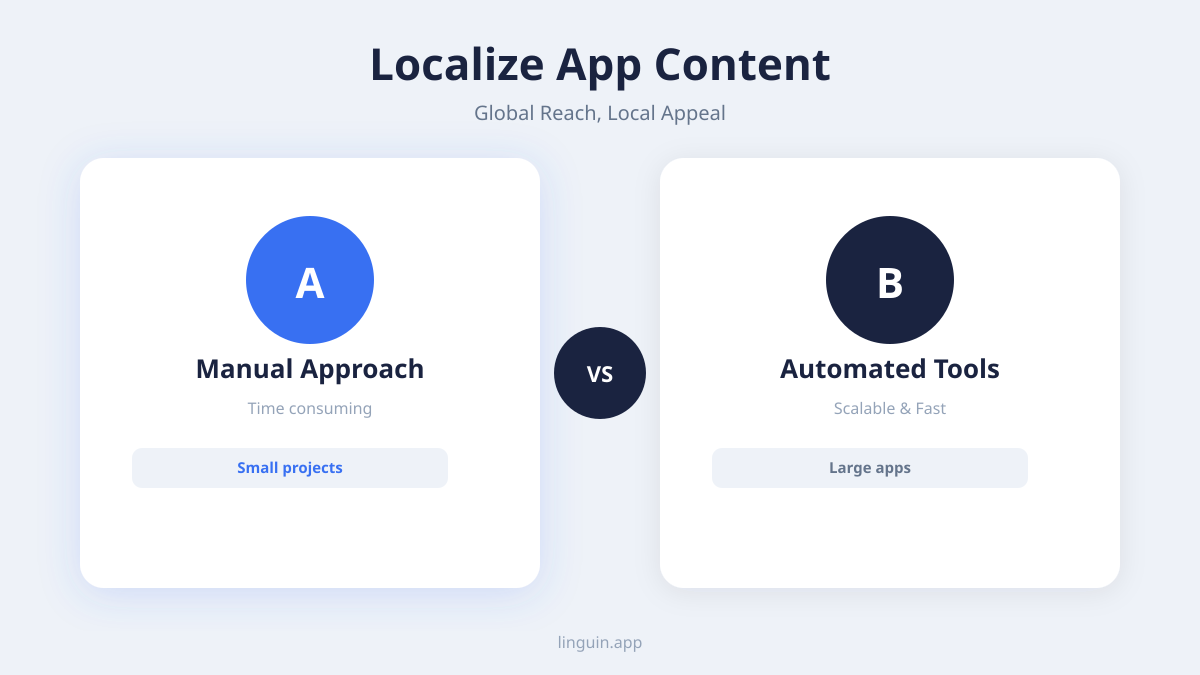
This is where tools like Linguin can be incredibly valuable. Manually translating an entire app can be a daunting and time-consuming task. Linguin’s AI-powered translation engine can rapidly translate your app’s text content, providing a strong foundation for your localization efforts. Whether you’re using Linguin directly on your macOS device, through its iOS app, or via its Chrome and Safari extensions to translate web content that might inform your app’s copy, the goal is to streamline the process. You can then use these translations as a starting point, refining them with human review for the highest quality and cultural accuracy. This hybrid approach often offers the best balance of speed, cost-effectiveness, and precision.
3. Cultural Adaptation (Linguistic and Non-Linguistic)
This is where localization truly shines and differentiates itself from mere translation. It involves adapting your app to fit the cultural norms and expectations of the target audience.
- Linguistic Nuances: This goes beyond word-for-word translation. It involves adapting idioms, slang, humor, and tone to sound natural in the target language. A direct translation might be grammatically correct but sound awkward or even nonsensical to a native speaker.
- Units of Measurement: Ensure your app uses the appropriate units of measurement for the target region (e.g., metric vs. imperial systems).
- Currency: Display prices in the local currency and adhere to local currency formatting conventions.
- Imagery and Graphics: As mentioned earlier, ensure images, icons, and color schemes are culturally appropriate. What might be a positive symbol in one culture could be negative in another.
- Legal and Regulatory Compliance: Different countries have different laws regarding data privacy, content, and user agreements. Your app must comply with these local regulations.
- User Interface (UI) and User Experience (UX): Beyond just text, consider how users in different cultures interact with technology. Navigation patterns, button placement, and overall UX might need subtle adjustments to align with local expectations.
4. Technical Considerations
Localization also involves technical adaptations:
- Character Encoding: Ensure your app supports the character sets used by the target languages (e.g., UTF-8 is a good standard).
- File Size and Performance: Translated text can sometimes be longer, potentially increasing file sizes. Monitor this and optimize where necessary.
- App Store Metadata: Localize your app’s name, descriptions, keywords, and promotional text for each target app store.
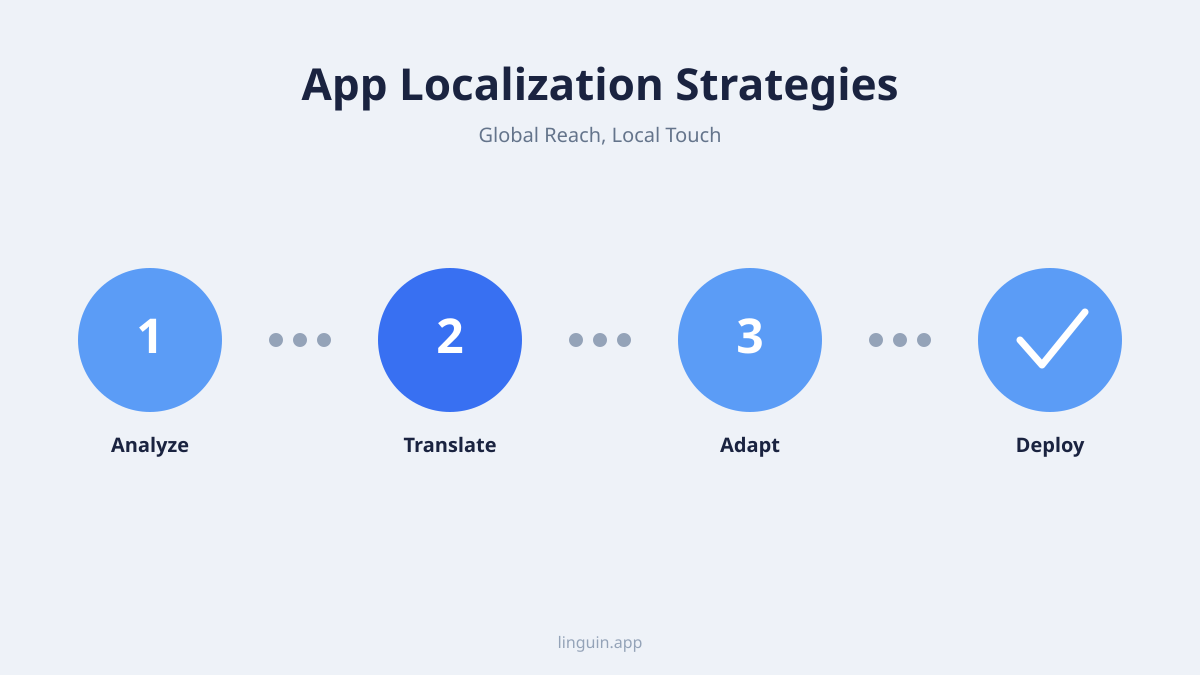
The Localization Workflow: A Step-by-Step Approach
Implementing a successful localization strategy requires a structured approach. Here’s a breakdown of a typical workflow:
Step 1: Define Your Localization Strategy
Before diving into translations, lay the groundwork:
- Identify Target Markets: Which regions offer the greatest potential for your app? Consider market size, competition, and your business goals. Start with a few key markets rather than trying to localize for everyone at once.
- Conduct Market Research: Understand the cultural nuances, language preferences, and competitive landscape of your target markets.
- Prioritize Languages: Based on your research, rank your target languages. This will help you allocate resources effectively.
- Set Goals and KPIs: What do you aim to achieve with localization? Increased downloads, higher user retention, improved revenue? Define measurable goals.
Step 2: Internationalize Your App
As discussed earlier, this is a crucial prerequisite. Ensure your app’s architecture is flexible enough to handle multiple languages and regional variations. This involves working with your development team to implement best practices in code.
Step 3: Prepare Your Content for Translation
Once your app is internationalized, extract all the strings and content that need to be translated. Organize these into a clear, structured format, often using resource files or a dedicated translation management system (TMS).
Step 4: Translation and Linguistic Review
This is the core linguistic work.
- Initial Translation: Utilize AI-powered tools like Linguin to get a rapid, cost-effective initial translation. This can quickly provide a usable draft for many parts of your app.
- Human Translation and Editing: For critical content, or to ensure the highest quality, engage professional human translators or a translation agency. They can refine the AI-generated translations, ensuring accuracy, cultural appropriateness, and natural flow.
- Proofreading: A final check by a native speaker is essential to catch any errors in grammar, spelling, or punctuation.
Step 5: Cultural Adaptation and Review
Beyond linguistic accuracy, ensure the app’s overall experience is culturally relevant. This might involve:
- Image Review: Confirm that all imagery is appropriate for the target culture.
- Design and UX Check: Assess if any UI/UX elements need adjustment.
- Legal and Compliance Check: Verify that all legal and regulatory requirements are met.
Step 6: Implementation and Testing
Integrate the localized content back into your app. Rigorous testing is paramount:
- Linguistic Testing: Have native speakers test the app to ensure all text displays correctly, is grammatically sound, and flows naturally.
- Functional Testing: Ensure that all features work as expected in the localized version. Check for any bugs introduced during the integration process.
- Usability Testing: Observe how users from the target culture interact with the localized app. This can reveal unexpected usability issues.
Step 7: Deployment and Ongoing Maintenance
Once testing is complete, deploy your localized app. Localization isn’t a one-time task. New features, updates, and content will require ongoing localization efforts. Establish a process for managing these updates efficiently.
Tools and Technologies to Aid Your Localization Journey
The landscape of localization tools is vast and evolving. Here are some categories and examples:
- Translation Management Systems (TMS): These platforms centralize the localization process, managing content, workflows, translators, and terminology. Examples include Phrase, Lokalise, and Smartling.
- AI-Powered Translation Tools: As we’ve highlighted, tools like Linguin offer fast, scalable translation capabilities. These are excellent for initial drafts and for translating large volumes of text quickly.
- Computer-Assisted Translation (CAT) Tools: These tools assist human translators by providing translation memory, terminology management, and quality assurance features. Examples include Trados Studio and memoQ.
- Localization Platforms: Some platforms combine TMS functionalities with translation services and AI capabilities.
- Crowdsourcing Platforms: For some types of content, you might consider crowdsourcing translations, though this requires careful management and quality control.
Remember, the best approach often involves a combination of these tools, leveraging the strengths of AI for speed and efficiency, and human expertise for nuance, accuracy, and cultural understanding.
The Future of App Localization
The future of app localization is deeply intertwined with the advancements in AI and machine learning. We can expect:
- Even More Sophisticated AI Translation: AI models will become even better at understanding context, nuance, and cultural idioms, leading to more accurate and natural-sounding translations with less human intervention required.
- Real-time Localization: Imagine apps that can adapt their language and content in real-time based on user location or preferences, offering a truly dynamic and personalized experience.
- Hyper-Personalization: Localization will extend beyond language to encompass personalized content, imagery, and even feature sets tailored to individual user profiles and cultural backgrounds.
- Seamless Integration: Localization tools will become even more deeply integrated into development workflows, making the process less of a separate step and more of an intrinsic part of app creation.
By embracing localization today, you’re not just preparing your app for a global market; you’re investing in its future success and ensuring it can connect with users on a deeper, more meaningful level, no matter where they are in the world. Make Linguin your partner in this exciting journey, and unlock the true potential of your app.