 English
  Español
  Français
  Deutsch
  Português
  Italiano
  Русский
  中文(简体)
  日本語
日本語  한국어
한국어  العربية
  हिन्दी
  Nederlands
  Türkçe
  Polski
Understanding machine translation quality metrics is essential for anyone relying on AI to bridge language barriers. These metrics are the tools researchers and developers use to measure, compare, and improve the output of translation systems. Whether you are a developer choosing an API, a business professional vetting translation services, or a curious user wanting to know how good your translations really are, this knowledge helps you make informed decisions. This guide will break down the key automated and human evaluation methods, explaining what they measure, their limitations, and how you can apply this understanding to get the best possible translations in your daily work.
Key takeaways
- Automated metrics like BLEU and METEOR compare AI output to human reference translations, providing a fast, consistent score for development and comparison.
- Human evaluation remains the gold standard for assessing fluency, adequacy, and real-world usability, capturing nuances automated scores can miss.
- No single metric is perfect; the best approach combines multiple automated scores with targeted human checks for the specific use case, from casual chats to legal documents.
Why measuring translation quality matters
In our interconnected world, machine translation is a utility millions use daily. We trust it for quick website glimpses, deciphering foreign messages, or getting the gist of a document. But when stakes are higher, such as for business communications, app localization, or understanding sensitive material, blind trust is not enough. You need a way to gauge reliability. This is where translation quality metrics come in. They provide a systematic, though not infallible, way to answer the question: “How good is this translation?”
For developers building or integrating translation services, these metrics are indispensable. They allow for objective comparison between different AI models or between successive versions of the same model. A team can run thousands of translations through an automated metric to see if a new training technique yields a higher average score, indicating improvement. For end-users and businesses, understanding these metrics demystifies the claims made by translation providers. Knowing that a service is evaluated with rigorous methods adds a layer of confidence. It shifts translation from a black box to a tool with known performance characteristics.
Say you’re a project manager localizing a software application. You receive translated interface strings from an AI service. Using the concept of adequacy (whether the meaning is correct) and fluency (whether the text reads naturally), you can set up a human review process specifically targeting these aspects. This structured evaluation is more effective than a vague instruction to “check the translations.” Ultimately, measuring quality is about risk management and efficiency. It helps you identify where machine translation can be used autonomously, where it needs human post-editing, and where human translation is necessary from the start.
Automated metrics: the quantitative backbone
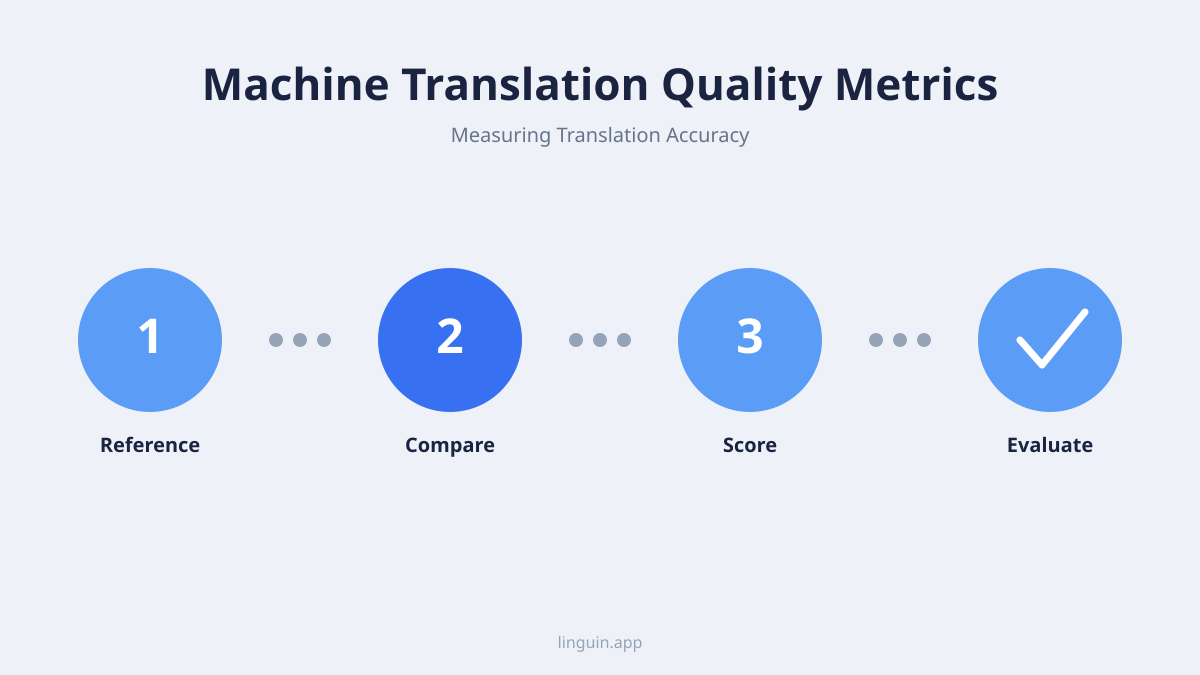
Automated metrics are algorithms that produce a numerical score by comparing a machine’s translation output against one or more high-quality human reference translations. They are fast, repeatable, and cost-effective, making them the workhorse for ongoing development and large-scale testing.
BLEU: the industry standard
The BLEU (Bilingual Evaluation Understudy) score is perhaps the most widely known automated metric. It works by measuring n-gram overlap. An n-gram is a sequence of ‘n’ words. BLEU checks for matches of single words (1-grams), pairs of words (2-grams), triplets (3-grams), and quadruplets (4-grams) between the machine output and the reference translation. A perfect match would score 1.0, though this is rare in practice. BLEU’s strength is its correlation with human judgment at the corpus level; when evaluating hundreds of sentences, a system with a higher BLEU score is generally better than one with a lower score. However, it has limitations. It can be insensitive to grammatical correctness if the word overlap is high, and it struggles with valid translations that use completely different wording than the provided reference. For creative or highly variable text, BLEU can be misleading.
METEOR and TER: addressing BLEU’s weaknesses
Other metrics were developed to address BLEU’s shortcomings. METEOR (Metric for Evaluation of Translation with Explicit Ordering) incorporates synonyms and stemming (reducing words to their root form, like “running” to “run”). This allows it to give credit for meaning matches even if the exact word differs, making it more aligned with human judgment on a sentence-by-sentence basis. TER (Translation Edit Rate) takes a different approach. It measures the minimum number of edits (insertions, deletions, substitutions, and shifts of word order) required to change the machine output to match the reference. A lower TER score is better, indicating fewer edits were needed. TER is useful for estimating post-editing effort; a translation with a TER of 0.25 means, roughly, that 25% of the words needed to be changed.
These metrics are tools, not arbiters of absolute truth. They require high-quality reference translations to be meaningful. They also primarily measure fidelity to a reference, not necessarily the translation’s inherent quality if the reference itself is subpar or if multiple correct translations exist. For everyday use, think of them as the engine diagnostics a developer uses to tune the AI model that powers tools like Linguin’s AI translation app. The end result is a more reliable and accurate translation experience for you.
Human evaluation: the qualitative gold standard
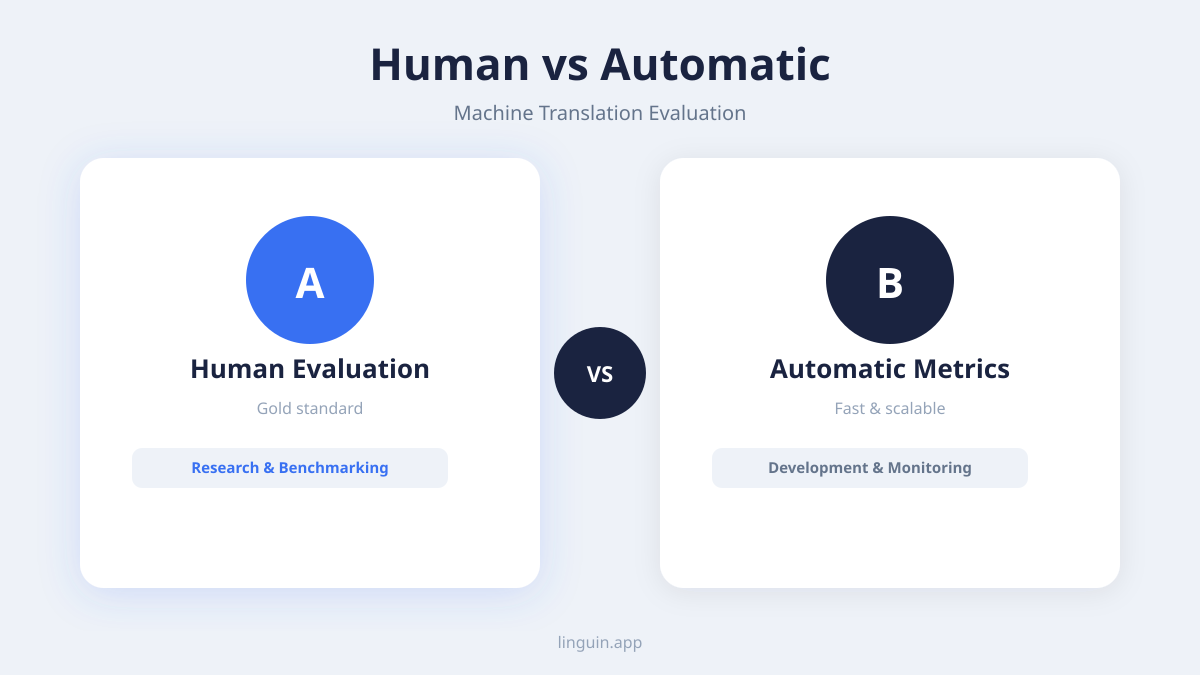
While automated metrics provide essential data, human evaluation is the ultimate benchmark for translation quality. Humans assess aspects of language that algorithms still struggle to quantify fully: natural flow, cultural appropriateness, stylistic tone, and the precise conveyance of intent and nuance.
The two core dimensions of human evaluation are adequacy and fluency. Adequacy asks: “Does the translation convey the same meaning as the original source text?” A reviewer rates whether all, most, some, or none of the meaning is preserved. Fluency asks: “Is the translation a well-formed, natural sentence in the target language, independent of the source?” This judges grammar, word choice, and idiomatic expression. A translation can be adequate but not fluent (it gets the meaning across with clunky grammar), or fluent but not adequate (it reads beautifully but misses or distorts key points). The ideal is high marks in both.
Human assessment often uses ranking or error analysis. In ranking, a reviewer is given several translations of the same source (e.g., from different AI systems or a human translator) and must order them from best to worst. This is a powerful comparative method. Error analysis is more diagnostic. Reviewers categorize mistakes: is it a mistranslation of a term, a grammatical error, an omission, an unnatural word order, or a register issue (using slang in a formal context)? This detailed feedback is invaluable for improving AI models. For instance, if an error analysis consistently shows a model fails on idiomatic expressions, developers can focus training data on that area. This cycle of human feedback is central to advancing the AI translation accuracy users experience today.
Choosing the right metric for your needs
With various metrics available, selecting the right one depends on your goal. Are you developing a system, comparing services, or checking a specific batch of translations? Your approach will differ.
For system development and benchmarking: Use a suite of automated metrics. Relying on BLEU alone is risky. A better practice is to track BLEU, METEOR, and TER together. If a new model shows improvement across all three, it’s a stronger signal of genuine progress than an improvement in just one. This multi-metric view helps avoid over-optimizing for a single score’s quirks. These automated scores are the pulse checks during training.
For product selection or vendor comparison: Look for providers that transparently discuss their evaluation methodology. A vendor that mentions both automated scores and human evaluation processes is likely more rigorous. You can also conduct your own small-scale human evaluation. Take a sample of texts critical to your business (e.g., product descriptions, support emails) and run them through different services like Google Translate, DeepL, and AI-powered tools. Have a bilingual colleague rate the outputs for adequacy and fluency on a simple scale. This hands-on test is often more revealing than any published benchmark score.
For quality control in production: If you use machine translation for business documents or app localization, establish a human-in-the-loop process. Use automated metrics as a first filter. For instance, you could flag all translations with a very low confidence score (if the API provides one) or sentences where the output is unusually short or long compared to the input. Then, apply human review to the flagged items and a random sample of the rest. This balances efficiency with reliability, ensuring critical errors are caught without manually reviewing every single sentence.
The limitations and future of evaluation
It is crucial to recognize the inherent limitations of current quality metrics. Both automated and human methods have blind spots. Automated metrics depend on reference translations, which may not be unique or perfect. They fail to capture pragmatics, the context-dependent meaning. For example, the phrase “You’re on fire!” could be a compliment (in a game) or a literal warning. A metric would not catch if the translation picked the wrong interpretation, even if the words matched a reference.
Human evaluation, while superior, is expensive, slow, and subjective. Ratings can vary between reviewers. It also scales poorly for the constant, massive evaluation needed to train modern AI. The future lies in hybrid approaches and more sophisticated automated metrics. Research is moving towards metrics that assess meaning directly using neural networks, potentially evaluating semantic similarity without relying on rigid references. Another direction is task-based evaluation: does the translation allow the user to successfully complete a task? For example, if a user follows translated instructions to assemble furniture, does it work? This measures real-world utility, not just textual similarity.
For the user, this evolution means translation tools will become more context-aware and reliable. As evaluation methods improve, so will the underlying models. The gap between human and machine translation will continue to narrow in many domains, though complex, creative, or high-stakes translation will likely require a human touch for the foreseeable future. Understanding these dynamics helps you set realistic expectations and leverage the technology effectively, such as knowing when to use an AI translator for Mac for a quick email and when to hire a professional for a contract.
Applying metrics to real-world translation scenarios
Let’s examine how quality metrics translate into practical advice for different use cases. This framework helps you decide on the appropriate level of scrutiny.
Scenario 1: Casual conversation and travel. You’re messaging a colleague in Japan or reading a menu in Paris. Here, the primary need is basic adequacy. You need to grasp the core intent. Fluency is secondary. In this scenario, you can trust modern AI translation with little verification. The risk of a minor error is low, and the speed benefit is high. Tools like translation Chrome extensions are perfect for this, providing good enough quality instantly. Automated metrics used to train these models ensure they perform well on common, everyday language.
Scenario417 2: Business communication and document gisting. You receive a report in Spanish and need to understand its conclusions. Or you are drafting an email to an international partner. Here, both adequacy and fluency become important. A mistranslated data point or a rude-sounding phrase due to incorrect register can have consequences. The best practice is to use machine translation for a first draft or comprehension, but then apply a human review. You could use the machine output and have a bilingual team member check it, or you could post-edit it yourself if you know the target language well. This process mirrors a human evaluation cycle, focusing on error spotting in key areas.
Scenario 3: Publishing and localization. Translating a website, marketing materials, or a software application for public release. This is a high-stakes scenario where quality is paramount. Machine translation can be used as a productivity aid for translators (a technique called machine translation post-editing, or MTPE), but the output must undergo full human review. Here, error analysis is key. Reviewers check for consistency of terminology, cultural adaptation, brand voice, and legal compliance. Automated metrics are used early in the vendor selection process to choose a capable engine, but the final quality assurance is entirely human-driven. For such needs, dedicated document translation services with human expertise are often the recommended path.
Frequently asked questions
What is a good BLEU score?
There is no universal “good” BLEU score, as it depends heavily on the language pair, text domain, and the quality of the reference translations. For common language pairs like English-French on news text, scores above 0.35 (or 35) are often considered strong for machine translation. However, comparing scores only makes sense within the same test set. A more practical approach is to look for relative improvement: if a new version of a translation app raises its BLEU score by several points on a standard benchmark, it indicates a meaningful upgrade in performance.
Can I trust a translation with a high automated score?
Not blindly. A high automated score means the output closely matches the human reference translations used in the test. It is a strong indicator of general capability. However, it does not guarantee a specific translation you receive is perfect. The model could still make an error on a complex sentence or an ambiguous phrase. For critical tasks, a high score should give you confidence to use the tool, but it does not eliminate the need for due diligence on important outputs.
How do translation apps like Linguin use these metrics?
Translation apps and the AI models that power them use these metrics during development and training. Engineers use automated metrics like BLEU and METEOR to evaluate different model architectures and training data, selecting the best-performing one. Human evaluators also provide feedback on fluency and adequacy to guide refinements. This ongoing evaluation cycle is what drives improvements in AI translation accuracy year over year. The end user benefits from these rigorous internal evaluations without needing to understand the metrics themselves.
What is more important, adequacy or fluency?
The importance depends on the use case. For informational purposes where you just need to understand content, adequacy is paramount. For text that will be published or read by others, such as a website or a formal email, fluency becomes equally important because it affects credibility and perception. The best translations achieve both, accurately conveying the source’s meaning in natural, idiomatic target language.
How can I check translation quality without being bilingual?
There are a few indirect methods. For adequacy, you can use back-translation: translate the text into the target language, then immediately translate that result back into the source language. Compare the back-translation to the original. Major discrepancies often indicate a problem. For fluency, you can use text-to-speech to listen to the translation; unnatural phrasing often sounds jarring. However, these methods are not foolproof. For important texts, the only reliable method is review by a proficient human.
Leveraging quality knowledge for better translations
Understanding machine translation quality metrics empowers you to be a smarter user of this transformative technology. You now know that automated scores are useful for development and comparison but are not a guarantee for every sentence. You recognize that human evaluation of adequacy and fluency is the true benchmark for high-quality output. Most importantly, you can match the evaluation rigor to your specific need, from casual use to professional publication.
The next step is to apply this framework. When you next choose a translation tool, look beyond marketing claims. Consider if the provider discusses their approach to quality evaluation. When you have an important text to translate, establish a simple process: use AI for the first pass, then, based on the text’s importance, decide if it needs a bilingual check, a light review, or professional human translation. This balanced approach maximizes efficiency while minimizing risk.
Tools like Linguin are built with these principles of continuous evaluation and improvement at their core, striving to provide the most natural and context-aware translations across over 100 languages. By being an informed user, you can leverage these advancements to communicate more effectively and confidently in our global digital world.