 English
  Español
  Français
  Deutsch
  Português
  Italiano
  Русский
  中文(简体)
  日本語
日本語  한국어
한국어  العربية
  हिन्दी
  Nederlands
  Türkçe
  Polski
Context-aware translation is the technology that allows AI to understand the full meaning behind your words before translating them. It moves beyond simple word-for-word substitution to interpret the surrounding text, the speaker’s intent, and cultural nuances. For anyone communicating across languages, whether for business, travel, or personal connections, this shift is critical. It’s the difference between a confusing, literal translation and a clear, natural one that conveys your actual message. This article will explain how context-aware translation works, its tangible benefits, and how you can leverage it to communicate more effectively.
Key takeaways
- Context-aware translation analyzes surrounding sentences, tone, and subject matter to determine the most accurate meaning.
- It solves common translation pitfalls like ambiguous words, idioms, and grammatical structures that vary between languages.
- This technology is essential for professional documents, real-time conversations, and any scenario where nuance matters.
What is context-aware translation?
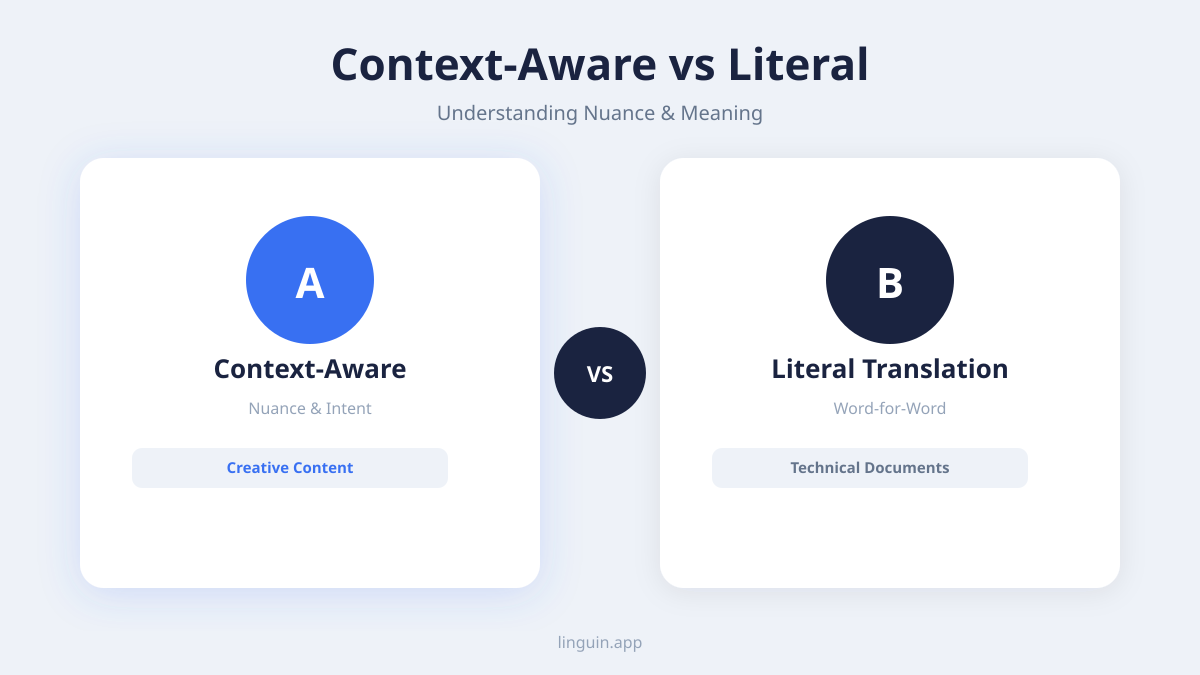
At its core, context-aware translation is a method where artificial intelligence models consider the broader context of a piece of text to produce a more accurate and natural translation. Traditional machine translation often operates on a sentence-by-sentence or even phrase-by-phrase basis, treating each segment in isolation. This approach frequently fails because language is inherently interconnected. The meaning of a word in one sentence can be clarified by a previous sentence, and the tone of a paragraph informs how individual statements should be interpreted.
Context-aware AI models are trained on massive datasets of parallel texts and real-world conversations. They learn patterns, not just vocabulary pairs. For instance, the AI learns that the word “bank” is likely related to finance when surrounded by words like “account,” “loan,” and “money,” but refers to a riverside when the text discusses “water,” “fishing,” or “mud.” This disambiguation is a fundamental task of context-aware systems. By evaluating the entire input-the preceding and following sentences, the document type, and even the conversational domain-the AI selects the most probable meaning.
The technology relies on advanced architectures like transformers, which use a mechanism called “attention” to weigh the importance of different words in the input sequence when generating each word in the output. This allows the model to effectively “look back” at relevant parts of the text, even if they are several sentences away. The result is output that reads as if it were originally written in the target language, preserving the author’s intent and the flow of ideas. For a deeper look at the AI models powering this, explore our guide on AI translation accuracy.
Why context matters in translation
Language is not a simple code where one word equals another. It is a fluid system of meaning shaped by situation, culture, and implied knowledge. Ignoring context leads to translations that are, at best, awkward and, at worst, completely wrong or offensive. The need for context becomes glaringly obvious in several common linguistic scenarios where literal translation fails.
First, consider homonyms and polysemous words-words that are spelled the same but have multiple meanings. As mentioned, “bank” is a classic example. “Crane” could be a bird or a piece of construction equipment. “Date” could be a fruit, a calendar day, or a social meeting. Without context, a translator has to guess, and the guess is often wrong. Context-aware translation analyzes the topic and related terms to make the correct choice consistently.
Second, idioms and colloquial expressions are landmines for literal translation. Telling an English speaker to “break a leg” would be horrifying if translated word-for-word. A context-aware system recognizes this as a fixed expression related to performance and would translate it to the target language’s equivalent well-wishing phrase, such as “merde” in French or “toi toi toi” in German. Similarly, translating “it’s raining cats and dogs” word-for-word would confuse any non-English speaker. The context-aware approach finds the natural expression for heavy rain in the target language.
Finally, pronouns and grammatical gender present major challenges. Many languages have grammatical gender for objects, and pronouns must agree. For example, the English sentence “I finished the book and put it on the shelf” is simple. In German, however, “book” (Buch) is neuter, so the pronoun is “es.” If the previous context was about a feminine “novel” (Roman) or a masculine “tome” (Foliant), the pronoun would change accordingly. A context-aware translator tracks these references throughout a document to maintain grammatical coherence and clarity.
How context-aware translation works in practice
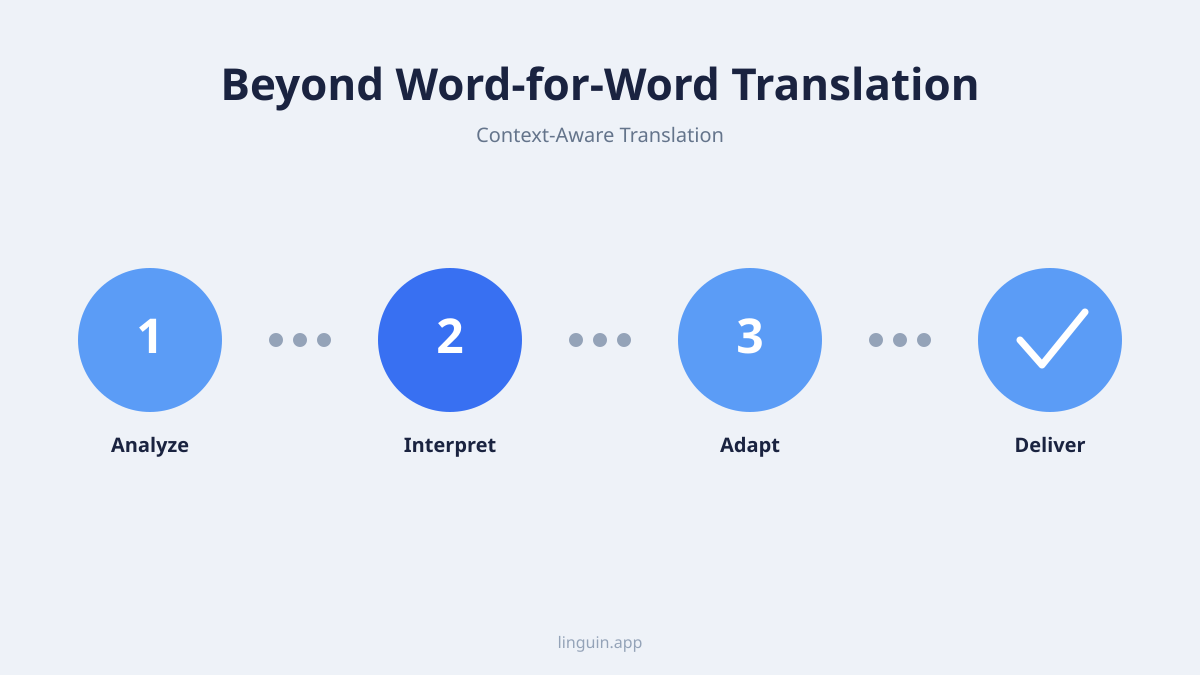
Understanding the theory is one thing, but seeing context-aware translation in action clarifies its transformative impact. It functions across different scales of context, from the immediate sentence to the entire document or conversation. This practical application is what makes modern translation tools like Linguin effective for real-world tasks.
At the sentence level, the model looks at the entire sentence structure to resolve ambiguities. Take the English sentence “The fisherman saw the seal on the rock with his binoculars.” Who has the binoculars? A primitive translator might ambiguously attach it to the seal. A context-aware model uses syntactic and semantic analysis to determine the most logical agent (the fisherman) based on typical human behavior, producing a clearer translation. It also handles verb tenses and aspects by understanding the timeline described in the sentence.
At the paragraph or conversational level, the power of context truly shines. The AI maintains a running understanding of the subject. Say you’re messaging a colleague in Japan about a project deadline. You write, “The deliverable is due Friday. It’s tight, but we’ll make it.” A context-aware translator understands that “it” refers to the timeline or situation, not the deliverable itself. It will ensure the Japanese translation uses the appropriate pronoun or omits it as per Japanese stylistic norms, while conveying the sense of a challenging but achievable deadline. This level of coherence is vital for business communication and document translation.
For domain-specific content, advanced systems can recognize the field of discussion-legal, medical, technical, casual-and adjust terminology and formality. Translating a medical prescription requires precise, formal terminology, while translating a recipe can be more colloquial and imperative. By analyzing the vocabulary and sentence patterns, the AI selects from its trained knowledge on that domain, significantly boosting accuracy. This is especially important for specialized fields where a mistranslation can have serious consequences.
Key benefits of using context-aware translation
Adopting translation tools that prioritize context delivers immediate and significant advantages for users. These benefits translate into saved time, reduced risk, and more successful cross-cultural interactions. The primary benefits extend across accuracy, efficiency, and natural communication.
Dramatically improved accuracy and reduced errors. This is the most direct benefit. By correctly interpreting ambiguous words, idioms, and complex sentences, context-aware translation minimizes embarrassing or costly mistakes. It ensures that technical terms are used correctly in manuals, legal clauses retain their precise meaning in contracts, and medical instructions are unambiguous. This reliability builds trust, whether you’re localizing an app for a global market or communicating with an international client. You can read more about the evolution of this accuracy in our analysis of AI translation in 2026.
More natural and fluent output. Translations no longer sound like they were made by a machine. The output flows naturally, using the appropriate register, connectors, and sentence structures for the target language. This naturalness is crucial for content meant to engage readers, such as marketing copy, website content, or literary excerpts. It helps preserve the author’s voice and intent, making the translated text feel original and authentic.
Increased efficiency for translators and professionals. For human translators, a context-aware AI tool serves as a powerful assistant, providing a strong first draft that requires less post-editing. For professionals who are not translators, it enables confident self-service for emails, reports, and communications. You spend less time deciphering awkward translations or rewriting confusing passages, and more time on your core work. This efficiency gain is a key reason why AI translator apps for Mac and other platforms have become essential productivity tools.
Better handling of real-time conversation. In live chat or speech translation, context is fleeting but critical. Context-aware models can retain the topic of discussion over several turns, ensuring that pronouns and implied subjects are translated correctly. This makes conversations smoother and more understandable, reducing the back-and-forth clarifications that can plague simpler translation tools.
Limitations and challenges of the technology
While context-aware translation represents a massive leap forward, it is not a perfect solution for every scenario. Understanding its current limitations helps set realistic expectations and informs users when extra caution or human review is necessary. The challenges primarily stem from the complexity of language and the nature of AI training data.
Requirement for sufficient context. The technology’s greatest strength is also a potential weakness: it needs context to work well. If you provide a single, isolated word or a very short phrase with multiple meanings, the AI has little to no information for disambiguation. For instance, translating the standalone word “spring” is a guess between a season, a coil, or a water source. Effective use means providing complete sentences or, better yet, paragraphs whenever possible.
Cultural nuance beyond text. Language is deeply intertwined with culture. Some concepts, jokes, historical references, or social norms may not have direct equivalents. While a context-aware AI might translate the words correctly, the deeper cultural resonance or humor might be lost. It may not catch subtle sarcasm or irony that relies on cultural knowledge. For high-stakes creative or marketing work, a human with cultural expertise is still indispensable, a point we explore in AI vs human translation.
Bias in training data. AI models learn from existing human-created text, which can contain societal, gender, or cultural biases. The model might inadvertently perpetuate these biases in its translations. For example, it might default to male pronouns for certain professions if its training data shows that pattern. Developers continuously work to mitigate this, but users should be aware of the possibility.
Computational cost and speed. Processing large chunks of text to understand context requires more computing power than translating sentence by sentence. For most cloud-based applications, this is seamless. However, for offline translator apps, there may be trade-offs between model complexity, speed, and device storage. Advances in efficient AI are steadily reducing this gap.
Implementing context-aware translation in your workflow
To truly benefit from context-aware translation, it’s important to integrate it thoughtfully into your daily tasks. How you use the tool directly impacts the quality of the results. By following a few best practices, you can ensure you’re getting the most accurate and useful translations possible, whether for work, study, or personal use.
Provide as much context as you can. When translating a document, upload or paste the entire section or the whole document if the tool supports it. Don’t just copy-paste confusing sentences in isolation. For translating a website, use a Chrome translator extension that translates the full page, as it allows the AI to see the consistent theme and terminology across the entire site. When using real-time conversation features, allow the tool to process full sentences or complete thoughts before speaking.
Choose the right domain or tone setting if available. Many advanced translation tools offer settings for formal, informal, business, or technical translation. Selecting the appropriate option gives the AI a crucial hint about the expected style and vocabulary, further refining the context it uses. For example, translating a legal clause with the “business” or “legal” setting activated will yield more precise terminology than the general default.
Use it for iterative clarification. Context-aware translation is excellent for dialogue. Say you’re negotiating a contract with a partner in Spain and a clause seems unclear. You can translate your question about the clause, then translate their response. Because the AI is considering the ongoing conversation, the translations of terms like “liability,” “deliverable,” or “termination” will remain consistent throughout the exchange, preventing confusion from shifting terminology.
Review for sense, not just words. Even the best AI output should be reviewed. Instead of checking for word-for-word correctness, read the translation for overall sense and fluency. Does it convey the original idea naturally? Are any technical terms consistently used? This high-level review is faster and more effective than line-editing and catches any remaining issues where context may have been insufficient.
Frequently asked questions
What is the difference between context-aware translation and traditional machine translation?
Traditional machine translation, like early rule-based or statistical systems, often translates phrases or sentences in isolation. Context-aware translation uses AI to analyze the entire provided text, including surrounding sentences and the overall topic, to understand meaning, resolve ambiguities, and produce a translation that is coherent and natural from start to finish.
Can context-aware translation handle slang and idioms?
Yes, this is one of its significant strengths. By recognizing patterns and fixed expressions within a given context, it can identify common idioms, slang, and colloquial phrases. Instead of translating them literally, which would cause confusion, it finds the equivalent expression or suitable paraphrase in the target language that conveys the same intended meaning.
Is my data safe when using context-aware AI translation?
This depends entirely on the provider and their privacy policy. Reputable services prioritize data security. For instance, Linguin processes translations with a focus on user privacy. It is crucial to review a service’s data handling practices, especially if you are translating sensitive business or personal documents. Look for providers that offer encryption and clear data retention policies.
How does context-aware translation work for languages with very different structures, like English and Japanese?
The AI models are trained on vast amounts of parallel text in these language pairs. They learn how concepts expressed in one language’s structure (e.g., English subject-verb-object) map to another’s (e.g., Japanese subject-object-verb with topic markers). Context helps the model make the correct structural transformations, like properly placing particles in Japanese or handling the topic-comment structure, ensuring the translation is grammatically sound in the target language.
Unlock clearer communication with context
Context-aware translation has moved from a theoretical advantage to a practical necessity for reliable cross-language communication. By understanding the full picture, AI can now deliver translations that are not only accurate in vocabulary but also coherent in meaning and natural in flow. The key is to remember that providing clear, complete input and choosing the right tool for your task will yield the best results.
For professionals, it eliminates a major source of error in international correspondence. For travelers and language learners, it bridges the gap between textbook phrases and real-world conversation. The next step is to experience the difference firsthand. Try translating a complex paragraph with a context-aware tool like Linguin, then compare it to a basic, word-for-word translation. You will see how context transforms garbled text into clear communication. Explore how Linguin’s AI-powered approach integrates this technology across devices to help you translate text and conversations accurately, right where you work and browse.