
 English
  Español
  Français
  Deutsch
  Português
  Italiano
  Русский
  中文(简体)
  日本語
日本語  한국어
한국어  العربية
  हिन्दी
  Nederlands
  Türkçe
  Polski
The world is more connected than ever, and the need for seamless communication across language barriers is paramount. Whether you’re a traveler navigating a foreign city, a student researching international topics, or a business professional collaborating with global partners, effective translation tools are indispensable. For years, Google Translate has been the ubiquitous go-to for many, offering quick and accessible translations for a vast array of languages. However, the landscape of translation technology has evolved dramatically, with the rise of advanced AI translators. This raises a crucial question: how does the familiar Google Translate stack up against these newer, AI-powered solutions? And more importantly, which one is the right fit for your needs?
Understanding the Evolution of Machine Translation
To truly appreciate the differences, it’s essential to understand the journey of machine translation. Early translation systems, often referred to as rule-based machine translation (RBMT), relied on extensive dictionaries and grammatical rules crafted by linguists. While they could handle some basic translations, they often produced stilted, literal, and grammatically incorrect output. Think of it like a very precise but uninspired dictionary.
Then came statistical machine translation (SMT). This approach analyzed vast amounts of parallel text (the same text in two different languages) to identify statistical patterns and probabilities of word and phrase translations. SMT was a significant leap forward, producing more fluid translations than RBMT. Google Translate, for a long time, heavily relied on SMT. This method was effective for many common phrases and sentence structures, making it incredibly useful for getting the gist of a text.
The real game-changer, however, has been the advent of neural machine translation (NMT). This is where modern AI translators truly shine. NMT models, inspired by the human brain’s neural networks, process entire sentences and even paragraphs at once, considering context and meaning rather than just isolated words or phrases. This allows for a much deeper understanding of nuance, idiom, and sentence structure, leading to translations that are not only grammatically correct but also more natural and human-sounding.
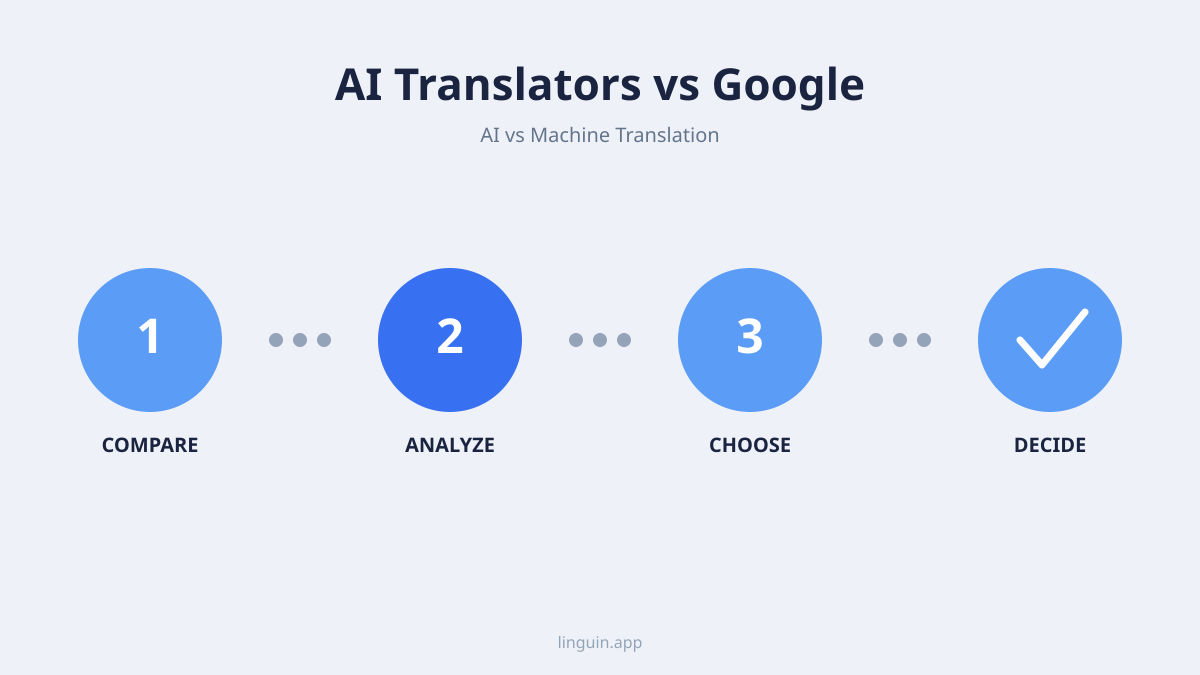
Google Translate has also embraced NMT, significantly improving its output over the years. However, the term “AI translator” is now often used to describe newer tools built from the ground up with sophisticated NMT architectures, advanced deep learning techniques, and often fine-tuned on massive, specialized datasets. These dedicated AI translators are frequently engineered to excel in specific areas, offering a level of precision and contextual awareness that goes beyond what even a general-purpose NMT system can achieve.
Google Translate: The Accessible Giant
Google Translate’s strength lies in its accessibility and breadth. Available on virtually every platform imaginable – web, mobile apps, and browser extensions – it’s incredibly easy to use. For quick translations of single words, short phrases, or understanding the general meaning of a foreign website, Google Translate is often sufficient. Its ability to support over 100 languages means that even obscure language pairs are usually covered, a feat that smaller, specialized translators might not match.
The user interface is straightforward: you paste text, select languages, and get a translation. It also offers features like voice translation, image translation (using OCR), and offline translation for downloaded language packs. For travelers needing to quickly decipher a menu or ask for directions, Google Translate remains a reliable companion. Its sheer scale of data and continuous development by Google means it’s constantly being refined and improved.
However, relying solely on Google Translate for critical or nuanced communication can be problematic. While NMT has improved its output, it can still falter with:
- Idiomatic expressions and slang: These rely heavily on cultural context and are difficult for algorithms to grasp without extensive, specific training.
- Technical jargon and specialized terminology: Unless a term is extremely common, Google Translate might produce a literal translation that misses the precise meaning in a specific industry.
- Subtlety and tone: Capturing sarcasm, humor, or subtle emotional undertones is a significant challenge for any machine translation, and Google Translate, being a general-purpose tool, can sometimes miss these.
- Complex sentence structures: While NMT is better, very intricate or ambiguous sentences can still lead to awkward or incorrect translations.
- Consistency: For lengthy documents or ongoing projects, maintaining consistent terminology and style can be a challenge with general-purpose translators.
Google Translate’s aim is to provide a good-enough translation for the widest possible audience. This “good enough” can be excellent for casual use, but it might fall short when accuracy and a natural flow are paramount.
AI Translators: Precision and Nuance
Modern AI translators, like Linguin, route requests through leading AI models built on cutting-edge neural networks and optimized for high-quality translation, rather than relying on a single general-purpose engine for everything. The focus is on capturing the essence of language, not just its literal components.
Here’s where dedicated AI translators often pull ahead:
- Contextual Understanding: AI translators excel at understanding the broader context of a sentence or even an entire document. They can differentiate between words with multiple meanings based on their surroundings, leading to more accurate choices. For example, the English word “bank” can refer to a financial institution or the side of a river. An advanced AI translator will correctly interpret which “bank” is intended based on the surrounding text.
- Idiomatic Proficiency: Many AI translators are trained on vast corpora that include a significant amount of idiomatic language and colloquialisms. This allows them to translate phrases like “kick the bucket” or “break a leg” into their natural equivalents in the target language, rather than a nonsensical literal translation.
- Specialized Domain Adaptation: Some AI translators, or features within them, are trained on specific domains like legal, medical, or technical fields. This means they have a deeper understanding of industry-specific terminology and can provide more accurate and appropriate translations for specialized content.
- Natural Language Flow: The output from advanced AI translators tends to sound more natural and human-like. They pay close attention to sentence structure, word choice, and grammatical agreement in the target language, resulting in text that reads smoothly and is easier to comprehend.
- Nuance and Tone Preservation: While still a frontier for all machine translation, dedicated AI translators are making significant strides in preserving the subtle nuances and intended tone of the original text. This is crucial for marketing copy, literary works, or any communication where emotional impact is important.
- User Experience and Integration: Tools like Linguin are designed to integrate seamlessly into your workflow. Whether it’s through a desktop app for macOS, extensions for Chrome and Safari, or a mobile app for iOS, they aim to make translation effortless and readily available within the applications you already use, offering a more streamlined experience than constantly switching to a separate translation website.
For example, when translating a complex business proposal or a piece of creative writing, the subtle differences in word choice and sentence construction provided by an AI translator can mean the difference between a clear, persuasive message and a translation that feels slightly off or even misleading.
Linguin: Bridging the Gap with AI Excellence
At Linguin, we believe that true communication transcends literal word-for-word translation. That’s why the four paid translation styles (formal, casual, creative, technical) route through a hosted AI model rather than a flat, general-purpose engine, aiming for output that captures tone and context, not just a literal conversion. The free Standard style uses Google Translate for a quick, reliable baseline.
Our focus on user experience means that reaching Linguin is fast: dedicated apps for macOS and iOS, a web app, and browser extensions for Chrome and, on Mac, Safari, put translation a shortcut or a right-click away. On Mac and iOS, that means pasting text into the app rather than translating it in place inside other apps, while the browser extensions can translate a whole page or a selection right where it is. Whether you’re reading an article online, drafting an email, or working through a passage of a longer document, Linguin is there to help, even if it’s copy-paste rather than fully invisible integration everywhere.
We understand that different translation needs require different solutions. While Google Translate is a fantastic general-purpose tool for quick checks, for situations demanding precision, nuance, and a natural flow, an advanced AI translator like Linguin offers a distinct advantage.
When to Choose Which Tool
The choice between Google Translate and a dedicated AI translator isn’t always about one being universally “better” than the other. It’s about selecting the right tool for the specific task at hand:
Choose Google Translate when:
- You need to get the gist of a website, email, or document quickly.
- You’re translating short, simple phrases or single words.
- You need to translate between less common language pairs where dedicated AI options might be limited.
- Speed and accessibility are your absolute top priorities, and perfect accuracy is not critical.
- You are a traveler needing quick translations for basic communication like ordering food or asking for directions.
Choose a Dedicated AI Translator (like Linguin) when:
- Accuracy and nuance are critical for your communication.
- You are translating complex sentences, technical jargon, or specialized terminology.
- You need to convey tone, style, and cultural context effectively.
- You are working on professional documents, marketing materials, creative writing, or academic research.
- You require consistent terminology across longer texts or projects.
- You value a seamless integration into your workflow and a user-friendly experience across your devices and browsers.
- You want translations that sound natural and human-like.
For instance, if you’re browsing a foreign news site and just want to understand the main points, Google Translate will likely suffice. However, if you’re drafting a business email to an international client, negotiating a contract, or translating a personal letter where emotional sincerity matters, investing in a more sophisticated AI translator like Linguin will yield far superior results and foster better understanding.
The Future of Translation is AI-Powered
The continuous advancements in artificial intelligence are revolutionizing every field, and machine translation is no exception. While Google Translate remains a powerful and accessible tool, the future of high-quality, nuanced, and contextually aware translation lies with dedicated AI translators. These tools are not just about translating words; they are about fostering genuine understanding and connection across linguistic divides.
If you want to see how one specific AI app stacks up rather than the category as a whole, our direct comparison of Linguin and Google Translate breaks down the differences point by point.
For a practical example of using an AI translator on an official document, you might find our article on translating a marriage certificate useful.
If you’re curious about the distinct roles of language professionals, you might also be interested in our post on the difference between an interpreter and a translator.
By understanding the strengths and limitations of both Google Translate and modern AI translators, you can make informed decisions about which tool best serves your communication needs. For those who require more than just a rough translation – for those who demand accuracy, fluency, and the preservation of meaning – exploring the capabilities of AI-powered solutions like Linguin is the next logical step in breaking down language barriers effectively and confidently.
-vs-translator.png)