 English
  Español
  Français
  Deutsch
  Português
  Italiano
  Русский
  中文(简体)
  日本語
日本語  한국어
한국어  العربية
  हिन्दी
  Nederlands
  Türkçe
  Polski
The Evolving Landscape of Machine Translation: Enter LLMs
For years, machine translation (MT) has been a powerful tool, bridging language barriers with increasing speed and accessibility. We’ve all used it – perhaps to decipher an email from an international colleague, understand a foreign website, or even navigate a new city with a translated menu. While early MT systems were often characterized by literal translations and awkward phrasing, the field has undergone a dramatic transformation, largely driven by the advent of Large Language Models (LLMs).
These sophisticated AI models, trained on vast datasets of text and code, possess an unprecedented ability to understand context, nuance, and even subtle idiomatic expressions. This leap in capability has significantly elevated the quality of machine translation, moving it from a useful utility to a near-indispensable tool for global communication. But what exactly does “LLM translation quality” entail? And how does it benefit users like you? Let’s dive in.
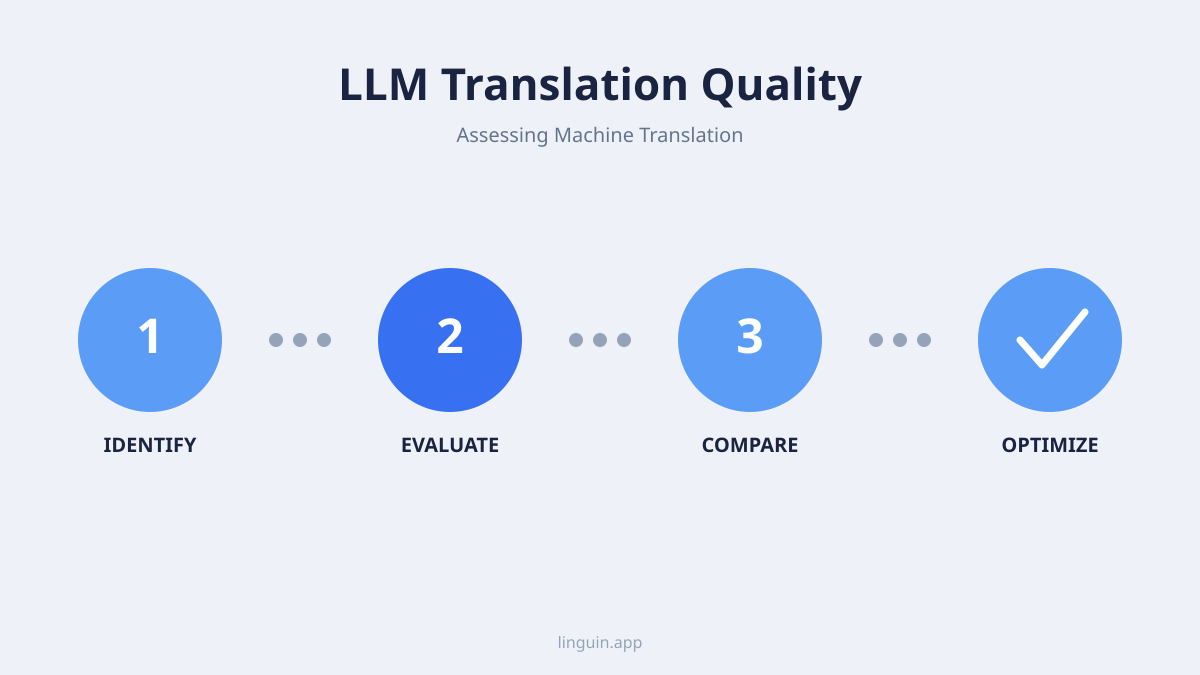
Understanding LLM Translation Quality: Beyond Word-for-Word
Traditional machine translation often relied on statistical methods or rule-based approaches. Statistical MT, for instance, would analyze vast bilingual corpora to find the most probable translations for word sequences. Rule-based MT, on the other hand, attempted to codify grammatical rules and dictionaries. While effective to a degree, these methods struggled with the inherent ambiguity and flexibility of human language. They could be rigid, missing the intended meaning, or producing output that sounded unnatural.
LLMs, however, operate on a fundamentally different principle. They are neural networks with billions of parameters, allowing them to learn complex patterns and relationships within language. When applied to translation, this means LLMs don’t just match words; they understand the source text’s meaning, intent, and cultural context, and then generate a translation that aims to be equally natural and accurate in the target language.
Several key aspects contribute to what we consider high LLM translation quality:
- Contextual Understanding: LLMs excel at grasping the surrounding words and sentences to infer the correct meaning of ambiguous terms. For example, the English word “bank” can refer to a financial institution or the side of a river. An LLM can accurately distinguish between these meanings based on the sentence’s context.
- Fluency and Naturalness: Unlike older MT systems that often produced stilted or robotic translations, LLMs generate text that flows smoothly and sounds like it was written by a native speaker. This is due to their ability to learn grammatical structures, idiomatic expressions, and common phrasing.
- Nuance and Tone: LLMs can often capture subtle nuances, such as the level of formality, the emotional tone, or the implied meaning, leading to translations that are more faithful to the original author’s intent. This is a significant improvement over systems that might simply translate words at face value.
- Handling Idioms and Cultural References: Idiomatic expressions (like “it’s raining cats and dogs”) and cultural references can be particularly challenging for MT. LLMs, having been trained on diverse datasets, are increasingly adept at recognizing and translating these effectively, often finding equivalent expressions in the target language rather than direct, literal translations that would be nonsensical.
- Consistency: In longer texts, LLMs can maintain consistency in terminology and style, which is crucial for professional documents, technical manuals, or creative writing.
The Strengths of LLM-Powered Translation
The advancements brought by LLMs have unlocked a new era of translation capabilities, offering significant benefits across various applications. Linguin, as an AI-powered translation app, is built to harness these strengths to provide you with an exceptional user experience.
Unparalleled Accuracy for a Wider Range of Content
LLMs have dramatically improved accuracy, especially for nuanced or complex texts. This means you can rely on LLM-powered translations for:
- Everyday Communication: Emails, social media posts, casual conversations – LLMs make cross-lingual communication more effortless and natural than ever before.
- Professional Documents: Reports, contracts, presentations, marketing materials – the improved fluency and accuracy mean you can share documents with international partners or clients with greater confidence.
- Technical and Specialized Content: While still an area of ongoing development, LLMs are showing remarkable progress in understanding and translating technical jargon and domain-specific language, especially when fine-tuned.
- Creative and Literary Works: While capturing the full artistic merit of literature is a profound challenge, LLMs can now provide translations that are far more engaging and evocative than previous MT generations, preserving more of the original’s style and spirit.
Speed and Efficiency Amplified
While LLMs require significant computational resources to train, their inference (the process of generating a translation) is remarkably fast. This means you get high-quality translations almost instantaneously, which is invaluable in fast-paced environments. Whether you’re a student needing to quickly understand a research paper, a traveler needing to decipher a sign, or a business professional responding to an urgent email, the speed of LLM translation is a game-changer.
Democratizing Access to Information and Communication
Perhaps one of the most profound impacts of LLM translation quality is its role in democratizing access to information and facilitating global communication. More people can now engage with content and communicate with others across language barriers, fostering understanding, collaboration, and cultural exchange. This is a core principle behind Linguin – making seamless multilingual interaction accessible to everyone, on any device.
Limitations and the Human Element
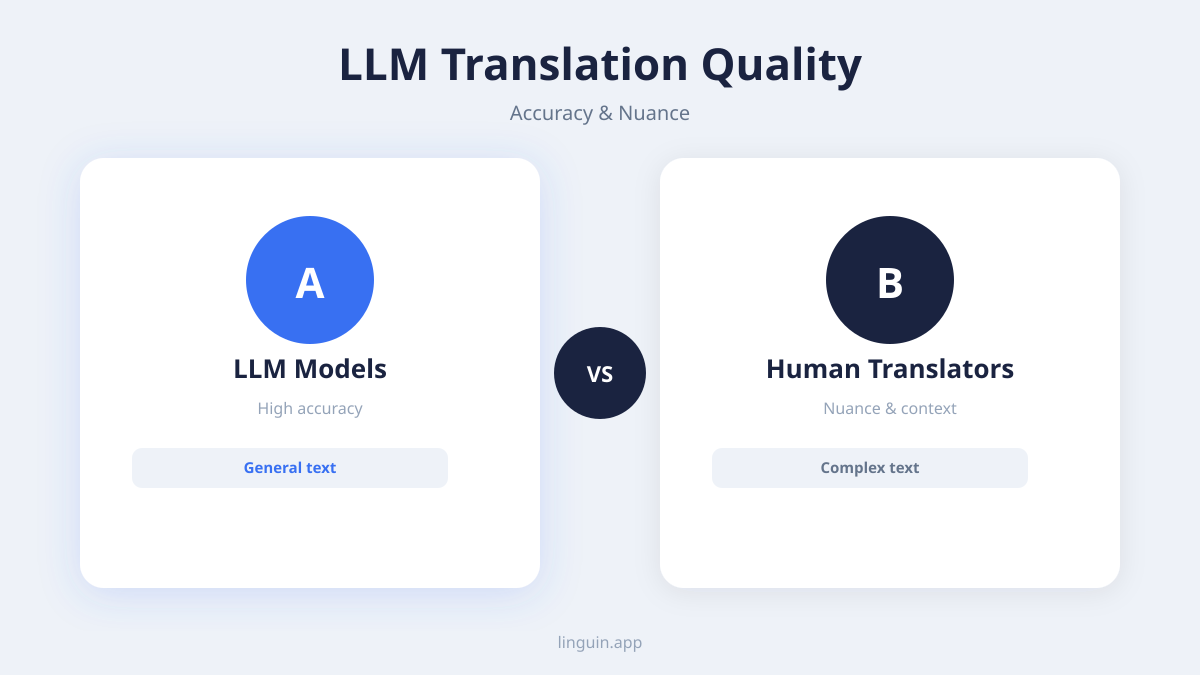
Despite their impressive capabilities, it’s crucial to acknowledge that LLMs, while powerful, are not perfect translators. There are still scenarios where their limitations become apparent, and the human touch remains invaluable.
- Deep Cultural Nuances and Humor: While LLMs can handle many idioms, deeply embedded cultural references, complex humor, or very specific cultural contexts can still be challenging. A subtle pun or a highly localized joke might not always translate perfectly.
- Subjectivity and Interpretation: Certain texts, especially highly subjective ones like poetry or deeply personal narratives, rely heavily on individual interpretation. LLMs can provide a faithful translation of the words, but the subjective emotional resonance might be harder to replicate precisely.
- Ambiguity Resolution: While LLMs are far better at context than ever before, in truly ambiguous sentences with multiple equally plausible interpretations, the model might favor one over another without explicit guidance.
- Emerging Terminology and Slang: Language is constantly evolving. LLMs are trained on data up to a certain point, and might lag behind the very latest slang or newly coined technical terms.
- High-Stakes Translations: For legal documents, critical medical information, or highly sensitive diplomatic communications, even a minor mistranslation can have serious consequences. In such cases, human review by professional translators remains essential.
This is where the power of AI-powered tools like Linguin shines. We leverage LLMs for their incredible speed and accuracy, but we also understand their limitations. For instance, Linguin’s design focuses on providing the best possible machine translation for everyday use and professional tasks, making it significantly more reliable and natural-sounding than previous generations of MT. For critical applications, our goal is to provide a strong foundation that a human expert can build upon, rather than replacing the expert entirely.
How Linguin Leverages LLM Translation Quality
At Linguin, we are committed to providing you with the most accurate, natural, and efficient translation experience possible. Our development is deeply rooted in the advancements of Large Language Models, and we continuously work to integrate the latest breakthroughs to enhance our app and extensions.
Here’s how Linguin benefits from and implements LLM translation quality:
- Core Translation Engine: Our translation engine is powered by state-of-the-art LLMs. This allows us to deliver translations that are not just word-for-word replacements but nuanced, contextually aware renditions of your original text. Whether you’re using Linguin on your Mac, iPhone, iPad, or directly within your Chrome or Safari browser, you’re benefiting from this advanced technology.
- Focus on User Experience: We understand that translation is not just about accuracy but also about ease of use. Linguin is designed to be intuitive, allowing you to translate text with minimal effort. Our LLM integration means fewer awkward phrases to edit and a more seamless experience, whether you’re translating a single word or an entire document.
- Continuous Improvement: The field of LLMs is evolving at an astonishing pace. The Linguin team is dedicated to staying at the forefront of these developments. We regularly update our models and algorithms to incorporate the latest research and improvements in LLM translation quality, ensuring that Linguin remains a top-tier translation solution.
- Broad Language Support: By leveraging LLMs, Linguin can support a growing number of languages with high-quality translations. This expansive reach allows you to connect with more people and access more information than ever before.
- Integration Across Platforms: Linguin’s availability as a macOS app, iOS app, and Chrome and Safari extensions means that wherever you are and whatever you’re doing online, you have powerful LLM-powered translation at your fingertips. Translate a webpage in Safari, an email in your inbox, or a document on your desktop with the same high level of quality.
The Future of Translation is Here
The era of LLM-powered translation has arrived, and it’s transforming how we communicate and interact with the world. The enhanced contextual understanding, fluency, and nuance offered by these advanced AI models mean that machine translation is no longer a last resort but a powerful and reliable tool for a vast array of needs.
While human translators will always play a critical role, especially in highly specialized or sensitive contexts, LLMs have dramatically bridged the gap, making cross-lingual communication more accessible, efficient, and natural for everyone. Linguin is proud to be at the forefront of this revolution, bringing the power of LLM translation quality directly to your devices.
We encourage you to experience the difference yourself. Download Linguin today and see how effortless and accurate global communication can be. The future of translation is not just about understanding words; it’s about understanding people, and LLMs are helping us get there, one accurate translation at a time.