
 English
  Español
  Français
  Deutsch
  Português
  Italiano
  Русский
  中文(简体)
  日本語
日本語  한국어
한국어  العربية
  हिन्दी
  Nederlands
  Türkçe
  Polski
The Universal Language of Health: Why Medical Document Translation Matters
In an increasingly interconnected world, health is a concern that transcends borders. Whether you’re a patient seeking specialized treatment abroad, a medical professional collaborating with international colleagues, or a researcher accessing global studies, the ability to understand and convey medical information accurately is paramount. Medical documents – from prescriptions and patient histories to research papers and diagnostic reports – are dense with specialized terminology and carry significant weight. A mistranslation, even a seemingly minor one, can have serious consequences, leading to misdiagnosis, incorrect treatment, or delayed care. This is where the crucial field of medical document translation comes into play.
Understanding the Nuances of Medical Translation
Medical translation is not simply a matter of swapping words from one language to another. It’s a complex discipline that requires a deep understanding of both the source and target languages, as well as a profound grasp of medical terminology, anatomy, physiology, pharmacology, and even cultural nuances in healthcare practices. Unlike general translation, medical translation demands absolute precision. There’s no room for ambiguity when discussing dosages, surgical procedures, or potential side effects.
The stakes are incredibly high. Imagine a patient allergic to a specific medication. If their medical history is translated incorrectly, and this critical allergy is missed, the consequences could be life-threatening. Similarly, a research paper detailing a breakthrough treatment needs to be translated with impeccable accuracy to ensure other scientists can replicate and build upon the findings without misinterpretation.
Common Medical Documents Requiring Translation
The scope of medical documents that frequently require translation is vast. Here are some of the most common:
- Patient Records: This includes medical histories, admission forms, discharge summaries, and physician’s notes. These documents provide a comprehensive overview of a patient’s health status and are vital for continuity of care.
- Prescriptions and Medication Information: Accurate translation of prescription labels, drug inserts, and patient leaflets is essential to ensure patients take their medication correctly and are aware of potential side effects.
- Diagnostic Reports: X-rays, MRI scans, lab results, and pathology reports contain critical information for diagnosis and treatment planning. Their accurate translation allows medical professionals to make informed decisions.
- Informed Consent Forms: When patients undergo procedures or participate in clinical trials, they must fully understand the risks and benefits. Translated consent forms ensure this understanding is clear.
- Clinical Trial Documentation: Protocols, case report forms, and investigator brochures are essential for the ethical and scientific conduct of international clinical trials.
- Medical Device Manuals and Instructions: For healthcare professionals and patients using medical equipment, accurate translation of user manuals and safety instructions is vital for proper operation and avoiding harm.
- Research Papers and Publications: The dissemination of medical knowledge relies heavily on the accurate translation of research findings, allowing for global collaboration and advancement.
- Insurance and Billing Documents: For international patients or those seeking treatment abroad, translated insurance claims and billing statements are necessary for financial clarity.
The Challenges of Translating Medical Documents
The inherent complexity of medical language presents several significant challenges:
- Specialized Terminology: Medical fields are rich with jargon, acronyms, and technical terms that may not have direct equivalents in other languages. A translator must be adept at finding the most accurate and contextually appropriate terms.
- Ambiguity and Context: Medical texts can sometimes be brief or rely on implicit understanding within a medical context. Translators need to decipher the intended meaning accurately.
- Cultural Differences in Healthcare: Even when medical terms are understood, the way healthcare is approached, patient-doctor communication styles, and common medical practices can vary significantly between cultures. This can impact how information is best conveyed.
- Regulatory Compliance: Medical documents often need to adhere to strict regulatory standards in both the source and target countries. This adds another layer of complexity to the translation process.
- Accuracy and Liability: As mentioned, even a small error can have severe repercussions. Translators bear a significant responsibility for the accuracy of their work, as it directly impacts patient safety and well-being.
Leveraging Technology for Medical Translation: The Role of Linguin
While human expertise remains indispensable in medical translation, technology offers powerful tools to streamline the process and enhance efficiency. AI-powered translation apps, like Linguin, are becoming increasingly valuable assets for individuals and organizations working with medical documents.
Linguin, available on macOS, iOS, the web, Chrome, and, on Mac, Safari, provides a fast way to translate text you type or paste in. It doesn’t read files, scans, or images, so for a printed prescription or a scanned lab report, you’d need to get the text out first (macOS’s Live Text can select text directly from an image) before pasting it in. Keep in mind translation requires an internet connection, there’s no offline or on-device mode, and any text you paste is sent to a translation provider to be processed, so avoid pasting information you wouldn’t want to send over the network, like full patient identifiers alongside diagnoses. For medical documents, its capabilities can aid in:
- Quick Initial Translations: For understanding the gist of a document or for non-critical internal review, Linguin can offer rapid translations. This is particularly useful for preliminary assessments or when time is of the essence.
- Bridging Language Gaps in Personal Health: If you’re a patient traveling abroad and need to understand a prescription label or a doctor’s note, copy the text and paste it into Linguin for a quick translation. This empowers you to take control of your health journey, no matter the language.
- Assisting Medical Professionals: Doctors and nurses interacting with patients who speak a different language can use Linguin for basic communication or to get a quick understanding of a foreign-language medical record before engaging a professional translator.
- Supporting Researchers: Academics and researchers can leverage Linguin to quickly get acquainted with studies published in other languages, identifying relevant findings for their own work.
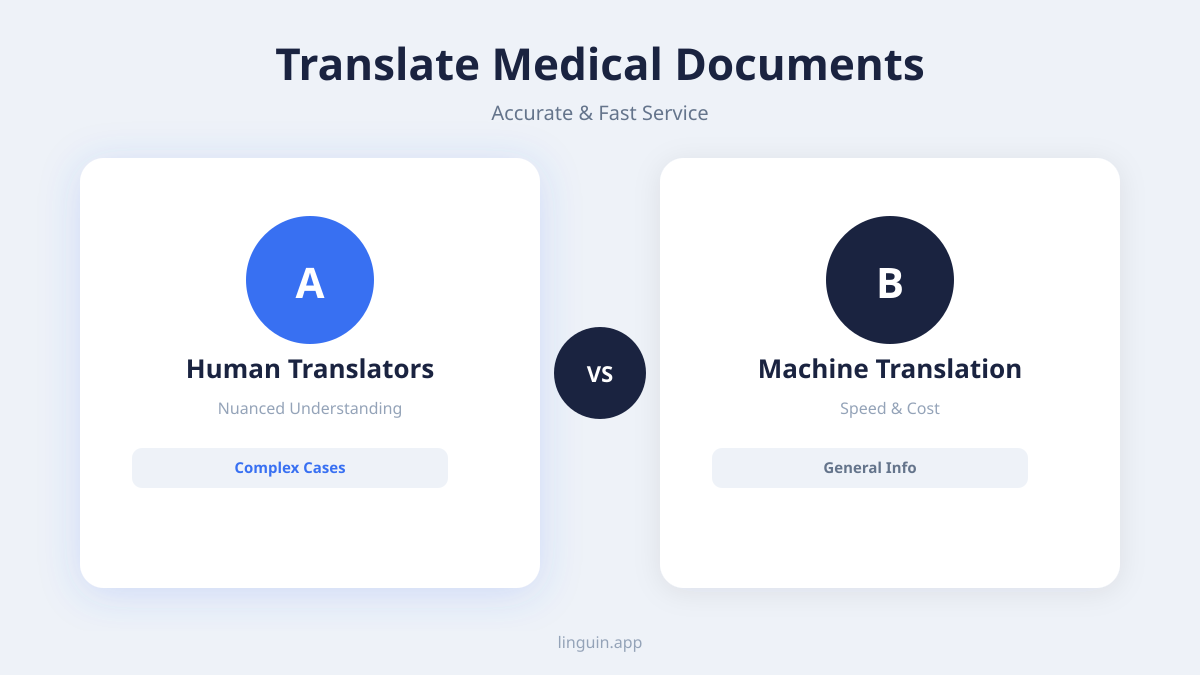
It’s important to emphasize that while AI translation tools are powerful, they should be used judiciously in the medical field. For critical documents where absolute accuracy is non-negotiable, such as official patient records, surgical reports, or clinical trial protocols, always consult with a certified human medical translator. AI tools are excellent for initial understanding, drafting, and less critical communications, but the final review and certification by a human expert are crucial for patient safety and legal compliance.
Best Practices for Translating Medical Documents
To ensure the highest level of accuracy and effectiveness when translating medical documents, consider these best practices:
- Identify the Purpose and Audience: Is the translation for a patient’s personal understanding, a doctor’s reference, a research publication, or a regulatory submission? The intended use will dictate the required level of formality and precision.
- Choose the Right Translator: For critical documents, opt for certified medical translators with expertise in the relevant specialization (e.g., cardiology, oncology, pediatrics). They understand the terminology, cultural contexts, and regulatory requirements.
- Provide Context: The more information you can provide to the translator about the document’s origin, intended audience, and purpose, the better they can ensure accuracy and appropriate tone.
- Consistent Terminology: If you’re translating the same handful of medical terms or drug names repeatedly, a personal glossary helps keep them consistent. In Linguin, you can add your own term replacements so specific words are translated the same way every time, useful for a recurring diagnosis or medication name, though for large-scale organizational glossaries you’ll still want a dedicated translation management tool.
- Review and Proofread: Even with the best translators, a thorough review and proofreading process by a second qualified individual is essential to catch any errors.
- Utilize Technology Wisely: As discussed, tools like Linguin can be invaluable for initial understanding, quick translations, and supporting the workflow. However, always use them as a supplement to, not a replacement for, professional human translation when accuracy is paramount.
Linguin: Your Everyday Translation Companion
Linguin is designed to be your go-to solution for a variety of translation needs, making language barriers less daunting. Whether you’re a student needing to understand an academic paper, a traveler navigating a foreign city, or someone who requires immediate translation of everyday text, Linguin offers:
- Cross-Platform Availability: Access Linguin across your Apple devices (macOS and iOS), on the web, and directly within your browser using our Chrome extension or, on Mac, our Safari extension. Your translations are always close at hand.
- User-Friendly Interface: We’ve prioritized an intuitive design so you can translate quickly and efficiently without a steep learning curve.
- Diverse Language Support: Linguin supports a wide array of languages, ensuring you can communicate and understand across a global spectrum.
While Linguin excels at providing rapid and accessible translations for general purposes, its utility extends to the medical domain by offering an immediate way to grasp the essence of medical texts. For instance, if you receive an email from an international clinic with a brief update, Linguin can provide a quick translation so you can understand the core message. If you’re researching a health condition and come across an article in another language, Linguin can help you get a preliminary understanding before deciding if a professional translation is warranted.
The Future of Medical Translation
The landscape of medical translation is continually evolving. Advancements in AI are leading to increasingly sophisticated translation engines that can better handle complex terminology and context. However, the human element – the cultural understanding, the critical thinking, and the ultimate responsibility for patient safety – will always remain central. The future likely involves a synergistic approach, where AI tools like Linguin empower human translators, making the process more efficient and accessible, while ensuring that the highest standards of accuracy and ethical practice are maintained for critical medical communications.
Navigating the complexities of global healthcare requires clear and accurate communication. By understanding the importance of medical document translation, being aware of the challenges, and leveraging the right tools, you can ensure that language never becomes a barrier to health and well-being. Linguin is here to support your journey, providing accessible translation capabilities that can empower you in various aspects of your life, including staying informed about your health and the world of medical advancements.
-vs-translator.png)