 English
  Español
  Français
  Deutsch
  Português
  Italiano
  Русский
  中文(简体)
  日本語
日本語  한국어
한국어  العربية
  हिन्दी
  Nederlands
  Türkçe
  Polski
The most effective way to use AI translation for academic research papers is to treat it as a powerful collaborative tool, not a one-click replacement for human expertise. For researchers navigating the global academic landscape, ensuring their findings are accessible and understood across language barriers is a significant challenge. This article provides a comprehensive guide on optimizing AI translation workflows to maintain the precision, tone, and integrity of scholarly work, ensuring your research makes an impact worldwide.
Key takeaways
- AI translation excels at providing fast, initial drafts and handling large volumes of text, but requires human oversight for domain-specific terminology and nuanced argumentation.
- A pre-translation preparation phase, including glossary creation and text simplification, drastically improves the quality of the AI’s output.
- The most effective workflow is iterative, combining AI translation with post-editing by a researcher or a professional familiar with the subject matter.
- Choosing an AI tool with context-aware models and the ability to handle formal tone is critical for academic texts.
Understanding the role of AI in academic translation
AI translation has moved beyond simple word substitution. Modern neural machine translation models, especially large language models, understand context and can produce remarkably fluent text. In academia, this capability is a double-edged sword. The fluency can mask subtle inaccuracies, making careful evaluation essential.
The primary value of AI for translating research papers lies in efficiency and scalability. It can process a complete draft manuscript in minutes, providing a foundational text that a human expert can refine. This is particularly useful for early-stage dissemination, such as sharing preliminary findings with international collaborators or preparing a paper for initial review by a multilingual committee. The key is to frame AI as a collaborative partner in the process.
For the researcher, this means a shift in focus from manual translation to translation management. Your role becomes one of preparation, guidance, and quality control. You provide the AI with the best possible input and context, and you critically assess its output. This approach leverages the speed of AI while safeguarding the academic rigor that your work demands. It is a pragmatic solution to the time and resource constraints faced by many scholars.
Preparing your manuscript for AI translation
The quality of any AI translation is directly tied to the quality of the source text. A clean, well-structured manuscript yields a far better translation draft. This preparation phase is often overlooked but is perhaps the most impactful step in the optimization process.
Begin by ensuring your original paper is as clear and unambiguous as possible. While your writing should already be precise, consider simplifying extremely complex sentence structures. Long, nested sentences with multiple clauses can confuse translation models, leading to fragmented or inaccurate output. Break them into shorter, more direct statements where possible without sacrificing scientific meaning.
Next, create a translation glossary. This is a list of key terms, phrases, acronyms, and proper nouns (like names of models, datasets, or specific methodologies) used in your paper. For each entry, provide the preferred translation in the target language. If a term is new or lacks a direct equivalent, you can note that it should remain untranslated or provide a brief explanatory note. Feeding this glossary to your AI tool, if it supports custom terminology, guides it to use consistent and correct terms throughout the document.
Finally, format your document cleanly. Remove any track changes, comments, or formatting artifacts. Use consistent headings and clearly distinguish elements like block quotes, code snippets, and equations. This helps the AI parse the document structure correctly, which is vital for maintaining the logical flow of your argument in the translated version.
Choosing the right AI translation tool and settings
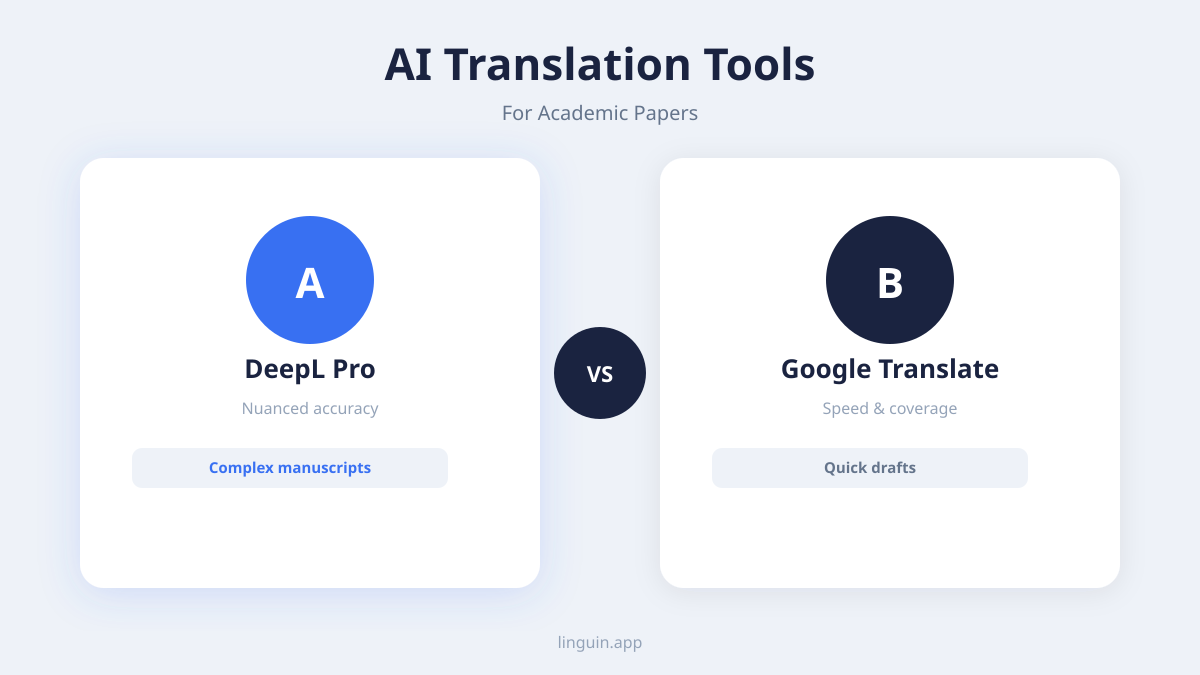
Not all AI translation tools are equally suited for academic text. The choice of platform and its configuration will significantly affect your results. Look for tools that offer control over formality and domain specificity.
A tool like Linguin, which leverages multiple advanced AI models, allows you to select for formal tone and context-aware translation. This setting instructs the model to avoid colloquialisms and maintain the professional register expected in research papers. Some tools also offer domain presets for fields like science, medicine, or law, which can slightly bias the model toward relevant terminology.
The ability to provide context is paramount. The best practice is to translate entire sections or chapters at once, rather than sentence by sentence. This gives the AI model the surrounding text to understand how a term is being used. For instance, the word “cell” has different translations in biology versus battery technology. Translating a full paragraph provides the necessary context for the AI to make the correct choice.
Consider the output format. Does the tool preserve your original formatting? Can it handle complex documents with tables, figures, and citations? For academic work, losing this formatting creates significant extra work. You may need to experiment with different tools or approaches, such as copying text segment by segment into a tool that offers high-quality, context-rich translation while being mindful of structure. For more on evaluating different tools, see our analysis of the best AI translator for 2025.
The iterative translation and post-editing workflow
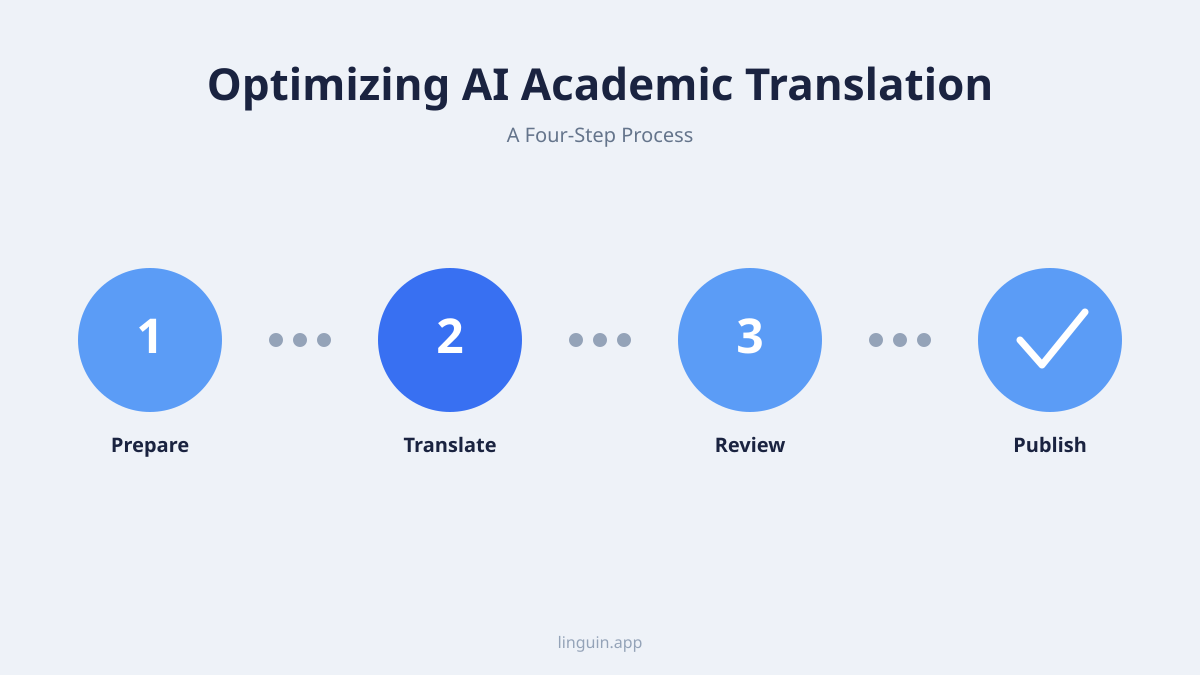
The optimal process for translating a research paper is iterative. The first AI output should never be considered final. Instead, it serves as a high-quality draft for post-editing. This structured approach maximizes efficiency while ensuring accuracy.
Step 1: Initial AI Translation. Run your prepared manuscript through your chosen AI tool, using the glossary and formal tone settings. Export this as a separate document.
Step 2: Bilingual Review. Open the original and the AI-translated draft side-by-side. Do a rapid read-through of the translation to check for obvious gross errors, nonsense sentences, or major omissions. This first review focuses on overall coherence.
Step 3: In-Depth Post-Editing. Now, edit the translated text with a focus on:
- Terminology: Verify every key term from your glossary. Does the translation use them correctly?
- Nuance and Precision: Academic writing often relies on precise modifiers (e.g., “significant,” “potential,” “suggests”). Ensure the translated words carry the exact same weight and caution.
- Logical Connectors: Words like “however,” “therefore,” and “consequently” are the glue of an argument. Check that their translations correctly convey the logical relationship.
- Cultural and Idiomatic Issues: Ensure that any metaphors or analogies are appropriately adapted or explained for the target audience.
Step 4: Back-Translation Check. For critical sections like the abstract, methodology, and conclusion, consider using a different AI model to translate the edited text back into the original language. This “back-translation” can reveal hidden ambiguities or errors you might have missed. The goal is not a perfect match, but to see if the core meaning remains intact.
Step 5: Native Speaker or Subject Expert Review. If possible, have a colleague who is a native speaker of the target language and familiar with your field review the post-edited translation. They can catch subtleties of language use and discipline-specific phrasing that you may not.
Handling discipline-specific terminology and jargon
Every academic field has its own lexicon, and sub-fields often develop highly specialized jargon. AI models trained on general web text may struggle with these terms. Proactive management of this terminology is the solution.
Start by identifying the tier of terminology in your paper:
- Standard Field Terms: Widely accepted terms in your discipline (e.g., “randomized controlled trial,” “quantitative analysis”). A good domain-specific AI model or a well-built glossary should handle these.
- Emerging or Niche Jargon: Newly coined terms, acronyms from your specific lab or project, or highly theoretical concepts. These are high-risk for mistranslation. Your glossary should mandate that some remain in the original language, followed by an explanation in parentheses upon first use in the translation.
- Cross-Disciplinary Homographs: Words that mean different things in different fields (e.g., “concentration” in chemistry vs. psychology, “model” in statistics vs. fashion). Providing context to the AI, as discussed earlier, is vital here.
For fields with highly structured language, like law or certain branches of engineering, you might find that AI tools designed for technical jargon and industry terminology yield better results. These models are often fine-tuned on corpora of technical documents.
When an AI tool consistently fails with a particular set of terms, note them. This feedback is valuable. In tools like Linguin, you can sometimes contribute to improving custom terminology databases, which benefits your future work and that of other researchers in your domain.
Ensuring stylistic and tonal integrity
Academic writing has a distinct style: formal, objective, precise, and often passive. An AI translation that inadvertently shifts to an informal, subjective, or overly active voice can undermine the perceived credibility of the work.
Instruct your AI tool explicitly to maintain a formal and academic tone. Beyond that, pay close attention during post-editing to:
- Voice: Is the passive voice preserved where it is used for objectivity? Has the AI incorrectly changed passive constructions to active ones?
- Hedging Language: Academic writing uses careful hedges like “it may be that,” “the data suggest,” or “one possible interpretation.” Ensure these nuanced expressions are translated with equivalent caution, not turned into definitive statements.
- Citation Format: Citation styles (APA, MLA, Chicago) have language-specific conventions. The AI might translate author names or journal titles within citations, which is usually incorrect. Verify that all in-text citations and reference list entries remain formatted correctly for the target language’s academic standards.
The goal is for the translated paper to “sound” like an academic paper written originally in that language. A useful tactic is to keep a few exemplary papers, originally written in your target language, on hand for reference. Compare the style and tone of their introductions and discussions to your AI-translated draft. For more on managing tone, our guide on formal vs. informal tone in emails offers foundational principles that apply to academic writing as well.
Collaborating across languages with AI support
Modern research is collaborative and often multilingual. AI translation can facilitate these collaborations in dynamic, real-time ways beyond just translating a final manuscript.
Scenario 1: Draft Exchange. You are co-authoring a paper with a team in Germany. You write a draft section in English and use an AI tool to quickly generate a German version for your collaborators to review and edit. They, in turn, can add comments in German, which you can instantly translate back to English to understand their feedback. This dramatically speeds up the iterative writing process.
Scenario 2: Literature Review. You encounter a highly relevant paper published in Japanese. Using an AI translation tool, you can get a working understanding of its methodology and findings to assess its relevance for your own work. While not suitable for direct citation without verifying the translation with an expert, it allows you to efficiently scan a broader body of international literature.
Scenario 3: Conference and Networking. Preparing for an international conference? You can use AI to translate your presentation slides and even practice questions and answers. While you would not rely on it for live, on-stage translation without a professional, it helps you prepare and engage with colleagues more confidently. These use cases highlight how AI acts as a bridge, reducing friction in multilingual research collaboration.
The key in all collaborative scenarios is transparency. Always inform your collaborators that AI translation was used as a drafting aid and that the text has undergone specific levels of post-editing. This maintains trust and scholarly integrity.
Frequently asked questions
Can I trust AI to translate my entire research paper for publication?
No, you should not trust AI to translate your paper for publication without human oversight. While AI provides an excellent first draft, the final responsibility for accuracy, nuance, and disciplinary conventions lies with the author. A workflow involving AI translation followed by rigorous post-editing by the researcher or a professional translator is the recommended standard for publication-ready work.
How do I handle mathematical formulas and equations in translation?
Mathematical formulas, chemical equations, and standard scientific notation should almost never be translated. They are universal languages. The AI tool should be instructed to leave them untouched. Your preparation should involve clearly marking these elements (e.g., by placing them on separate lines or using specific formatting) so the AI model recognizes them as non-translatable content. The surrounding explanatory text is what gets translated.
What is the biggest risk when using AI for academic translation?
The biggest risk is the “fluency trap,” where a perfectly grammatical and fluent translation contains subtle errors in terminology or logical nuance that can alter the scientific meaning. These errors can be difficult for a non-expert to spot and can mislead readers. This is why subject-matter expertise is irreplaceable in the post-editing phase.
Is it ethical to use AI-translated text in a research paper?
Yes, it is ethical if properly disclosed and managed. The ethics concern transparency and accuracy. Similar to using a statistical software package, the AI is a tool. The author is responsible for the final output. If the translation process is part of your methodology (e.g., for analyzing foreign-language texts), you should describe and justify the tools and validation steps used in your paper.
How does AI translation compare to human translation for academic work?
AI translation is faster and more cost-effective for producing initial drafts and facilitating communication. Professional human translation is superior for final, publication-ready quality, deep cultural nuance, and complex creative or highly persuasive texts. The most effective and economical approach is often a hybrid model: AI for the bulk draft translation and a human expert for post-editing and final polishing. For a deeper comparison, read our article on AI vs. human translation.
Integrating AI translation into your research workflow
Optimizing AI translation for academic papers is fundamentally about process. By preparing your text with glossaries and clear writing, choosing a tool capable of formal and context-aware translation, and adopting a rigorous post-editing workflow, you can harness AI’s speed without compromising your work’s integrity. The core takeaway is that AI serves best as a powerful first-draft engine and a collaboration bridge, freeing you to focus on the expert-level tasks of verification, nuance, and stylistic refinement.
The logical next step is to experiment. Take an existing paper abstract or a literature review section and run it through a capable AI translation tool like Linguin. Observe the output, note its strengths and weaknesses, and begin the post-editing process. This hands-on experience will quickly show you where the tool excels and where your expertise is essential, allowing you to build a personalized, efficient workflow for all your future multilingual research endeavors.