 English
  Español
  Français
  Deutsch
  Português
  Italiano
  Русский
  中文(简体)
  日本語
日本語  한국어
한국어  العربية
  हिन्दी
  Nederlands
  Türkçe
  Polski
Managing a global brand’s social media presence requires communicating in the language of your audience, but scaling this effort across multiple platforms and languages is a monumental task. Multilingual social media translation is no longer a luxury for elite brands; it is a core requirement for any business seeking meaningful engagement in today’s interconnected world. This article is for social media managers, community builders, and marketers who need to publish content that resonates locally without losing the brand’s global voice. You will learn how modern AI translation tools provide the speed, consistency, and cultural awareness necessary to manage a vibrant, multilingual social media ecosystem.
Key takeaways
- AI translation enables real-time publishing across multiple languages, turning days of manual work into minutes.
- Modern AI models understand cultural context and platform-specific slang, avoiding literal and awkward translations.
- Consistent use of AI tools helps maintain a unified brand voice across all languages and regions.
The challenge of scaling social media globally
Expanding a social media strategy beyond a single language presents a cascade of logistical and creative hurdles. The sheer volume of content required multiplies with each new language market. A single campaign post needs to be adapted, not just translated, for each audience, considering local holidays, trends, and conversational styles. Manual translation processes are slow, often involving multiple freelancers or agencies, which creates bottlenecks that prevent timely engagement. This delay is critical on platforms where trends can surge and fade within hours.
Beyond speed, maintaining brand voice consistency is a significant challenge. Different translators might interpret tone differently, leading to a fragmented brand personality. One region might receive formal, corporate-sounding posts while another gets a casual, playful version. This inconsistency can confuse global followers and dilute brand equity. Furthermore, social media language is inherently dynamic, filled with idioms, memes, and platform-specific jargon like “TL;DR” or “FOMO.” A traditional translation service might translate these phrases literally, resulting in confusing or meaningless content for the target audience.
Finally, the cost and complexity of managing multiple human translators for dozens of languages can be prohibitive for all but the largest organizations. This often forces brands to prioritize only a few key markets, leaving engagement opportunities untapped in others. The need for a solution that offers scalability, speed, and nuanced adaptation is clear.
How AI translation transforms social media workflows
AI translation directly addresses the core pain points of speed, scale, and cost in multilingual social media management. Instead of sending drafts to a translator and waiting for a return, social media managers can get a high-quality draft translation in seconds. This enables real-time engagement, allowing teams to react to comments, participate in trending conversations, and publish timely announcements across all language channels simultaneously. For example, if a product issue arises, a carefully crafted apology and solution can be published in all supported languages within minutes, not days.
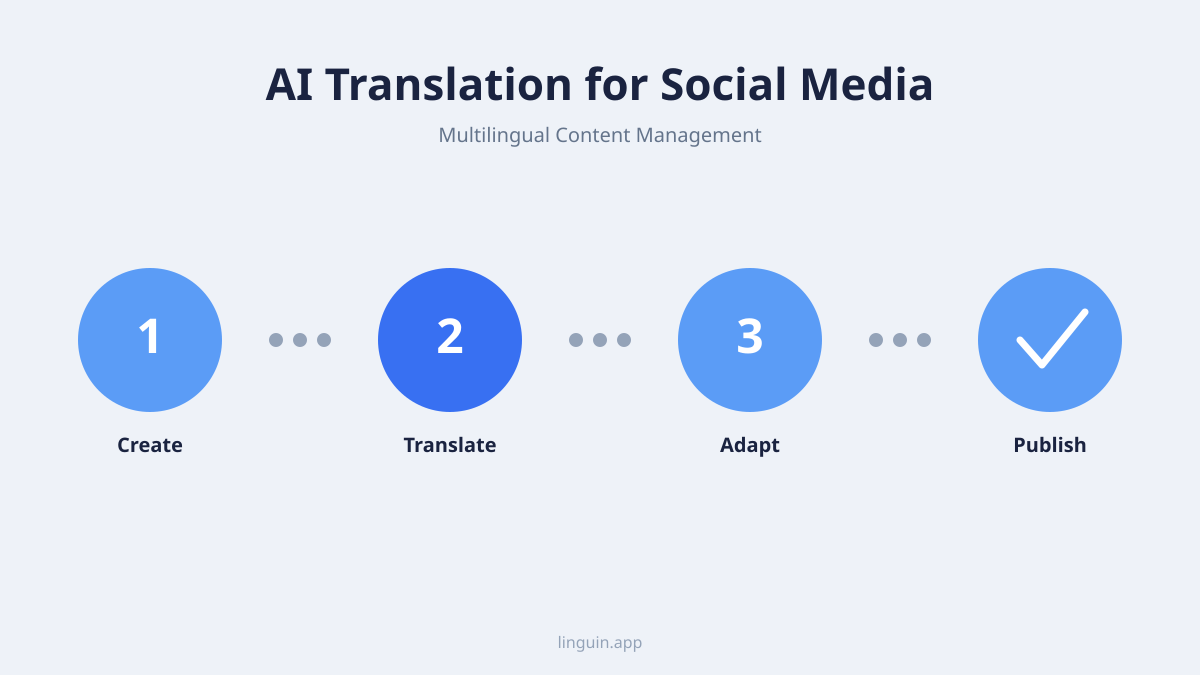
The workflow integration is transformative. Imagine drafting a campaign announcement in English. With an AI translation tool like Linguin, you can instantly generate versions in Spanish, Japanese, and Arabic. You then review these drafts-focusing less on grammatical correction and more on cultural nuance and brand fit-before scheduling them. This process turns a task that once took a week into one that takes an afternoon. It also empowers smaller teams to manage a global presence that was previously out of reach.
This technology also enables A/B testing at a global scale. You can quickly translate variations of a call-to-action or headline into multiple languages to see which performs best in each market. The agility afforded by AI translation means social media strategies can become more data-driven and responsive. It shifts the manager’s role from a project coordinator waiting on translations to a strategic editor refining and localizing content at the pace of the internet.
Beyond words: capturing tone, meme culture, and platform slang
Accurate social media translation is about far more than converting words from one language to another. It is about transcreating the feeling and function of the content. Modern AI translation models are trained on vast datasets that include social media posts, comments, and news, giving them a strong grasp of cultural context and platform-specific language. This allows them to handle the informal tone of a TikTok caption differently from the more structured announcement on LinkedIn.
Consider the translation of humor or sarcasm. A literal translation of a pun will likely fall flat. Advanced AI can recognize the intent behind the text and attempt to find a culturally equivalent joke or playful phrase in the target language. Similarly, when dealing with memes or viral trends, the AI’s understanding of context helps it decide whether to translate the text within the meme, describe the meme’s concept, or suggest a locally relevant alternative. This level of adaptation is crucial for content to feel native and shareable.
For instance, say you’re managing an account for a gaming brand and want to post: “GGs everyone! That update was a total game-changer. No cap.” A basic translator might struggle with “GGs” (good games) and “no cap” (no lie). A sophisticated AI model, familiar with gaming and internet slang, could produce a culturally resonant Japanese version that uses equivalent community slang, perhaps incorporating terms like “マジで” (maji de, meaning “seriously”) to convey the same excited, authentic tone. This ability to navigate platform slang and informal registers is what separates a usable translation from one that truly engages. For deeper insights into this challenge, explore our article on AI translation for humor, sarcasm, and tone.
Ensuring brand consistency across all languages
A unified brand voice is a key asset, and it must survive translation. AI translation aids this by offering translation memory and custom glossary features. Once you approve a translation for key brand terms, slogans, or product names, the AI will consistently use that approved translation in all future content. This ensures that your brand’s core messaging remains intact, whether a follower reads it in French, Portuguese, or Korean. Without this consistency, you risk presenting a fractured identity to the world.
Establishing these guidelines upfront is essential. Before launching in a new market, define a glossary of must-use terms, prohibited translations, and the desired tone (e.g., “helpful and expert, not salesy”). Feed this into your AI translation tool. Then, as you generate translations for social posts, the AI adheres to these rules. For example, if your brand always uses “team member” instead of “employee,” the AI will learn to translate the concept accordingly in every language, avoiding terms that imply a more hierarchical or impersonal relationship.
This consistency extends to visual and campaign elements. When you translate the text for an Instagram carousel or a video subtitle file, the AI’s consistent output means the visual narrative is supported by text that feels like it’s from the same source. It allows a single social media manager to oversee the global output with confidence, knowing the foundational voice is secure. This approach to multilingual project management is key for cohesive global campaigns.
Practical applications: from community management to crisis comms
The use cases for AI in multilingual social media are vast and go beyond scheduled posts. Real-time community management is a prime example. A brand with a global following will receive comments and questions in dozens of languages. AI-powered translation, especially via browser extensions, allows a community manager to read and understand these comments instantly. They can then craft a reply in their native language, translate it accurately and contextually, and post it-all within the same interface. This fosters a sense of direct connection and care, building stronger customer relationships.
Another critical application is in crisis communication. When a sensitive situation emerges, speed and clarity across all languages are paramount. AI translation enables the rapid creation of holding statements, updates, and resolutions. For instance, if a service outage affects users worldwide, the communications team can draft a clear explanation, translate it into all relevant languages while preserving the apologetic and reassuring tone, and push it out via social channels and help desks simultaneously. This prevents information vacuums where miscommunication can flourish.
For content creation, AI translation aids in multilingual content repurposing. A successful Twitter thread in English can be quickly adapted into a series of Instagram Stories in Spanish or a LinkedIn article in German. This maximizes the ROI on high-performing content and ensures valuable insights reach every segment of your audience. It also supports user-generated content campaigns, allowing you to quickly translate and share positive customer testimonials from different regions, making your community feel seen and celebrated on a global stage.
Choosing and implementing the right AI translation tool
Selecting an AI translation tool for social media requires evaluating specific features beyond raw translation accuracy. Look for tools that offer platform-native workflows. For example, a macOS or iOS app allows for quick translations while drafting posts in scheduling tools like Buffer or Hootsuite. A Chrome extension is indispensable for translating comments, competitor pages, or trending topics directly within the browser, enabling real-time social listening and engagement.
Key features to prioritize include:
- Context window handling: The ability to translate long-form text, like a carousel caption or a blog post shared on social media, without losing coherence.
- Tone adjustment: Controls to specify whether the output should be formal, informal, enthusiastic, or empathetic.
- Glossary and memory: Essential for enforcing brand terminology.
- Speed and offline capability: For working on-the-go or in situations with unreliable internet.
- Support for 100+ languages: To cover both major markets and niche audiences.
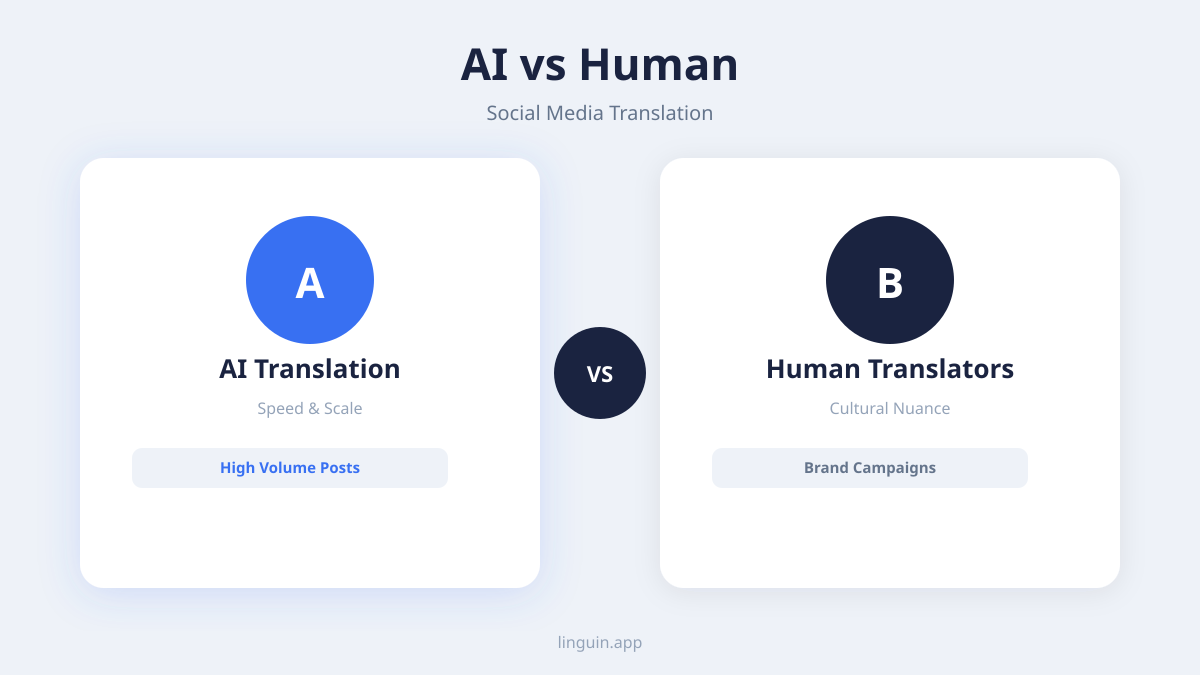
Implementation starts with integration into your existing content calendar. Designate a step for “AI translation draft” followed by “human cultural review.” The human reviewer’s role evolves from doing the translation to quality-controlling it, focusing on nuance, cultural fit, and platform optimization. This hybrid model leverages the speed of AI with the nuanced understanding of a human, creating an efficient and effective pipeline. For a look at tools designed for seamless integration into your workflow, consider our guide to the best AI translator for Mac.
Frequently asked questions
Can AI translation handle social media slang and emojis accurately?
Yes, modern AI translation models are trained on vast corpora of internet and social media text, giving them a strong understanding of contemporary slang, abbreviations, and the contextual use of emojis. They can differentiate between a sarcastic and a genuine use of language and can often suggest culturally appropriate equivalents. However, a human review is still recommended for high-stakes or nuanced posts to ensure the tone lands perfectly.
How do I maintain my brand’s unique voice when using AI translation?
You maintain your brand voice by using the glossary and customization features offered by advanced AI translation tools. By inputting your brand’s key terminology, preferred tone (e.g., “friendly but professional”), and examples of past translated content, you can train the AI to produce outputs that align with your established voice. Consistent use of the same tool also helps build a translation memory that reinforces this voice over time.
Is it safe to use AI translation for sensitive or crisis communications?
AI translation can be used safely and effectively for crisis communications due to its speed, which is of the essence. The critical step is to have a fluent speaker review the translated statement before publishing. The AI provides a rapid, high-quality draft that ensures the core factual message is consistent across languages, while the human reviewer ensures the emotional tone-such as empathy, regret, or reassurance-is appropriately conveyed in the cultural context.
Getting started with Linguin for your social media
Managing a multilingual social media presence hinges on two factors: the speed to engage in real-time and the cultural intelligence to resonate locally. AI translation bridges this gap, transforming a complex, costly operation into a streamlined, scalable process. By handling the heavy lifting of initial translation, it frees you to focus on strategy, creativity, and community connection.
For a practical walkthrough of the actual steps, our guide to translating social media posts covers browser extensions for the web and the copy-paste workflow for mobile apps.
The most effective next step is to integrate an AI translation tool directly into your daily workflow. Try translating a few of your recent social media posts with a tool like Linguin. Experiment with different tones and languages, and pay attention to how it handles your brand’s specific jargon. This hands-on test will show you the immediate gains in efficiency and provide a clear picture of how your process can evolve. Start by exploring how AI can handle the translation of cultural context in marketing to see the depth of adaptation possible.