 English
  Español
  Français
  Deutsch
  Português
  Italiano
  Русский
  中文(简体)
  日本語
日本語  한국어
한국어  العربية
  हिन्दी
  Nederlands
  Türkçe
  Polski
AI translation for legal documents is transforming how legal professionals manage multilingual case files, contracts, and correspondence. For lawyers, paralegals, and corporate counsel dealing with international matters, language barriers can create significant delays and risks. This article is for anyone navigating cross-border litigation, mergers, compliance, or client communications who needs to understand content in foreign languages quickly. You will learn how modern AI translation tools integrate into legal workflows, the critical balance between speed and precision, and best practices for using this technology effectively and ethically.
Key takeaways
- AI translation provides immediate, context-aware drafts of legal texts, accelerating initial reviews and triage in multilingual cases.
- Success hinges on a hybrid approach where AI handles bulk translation and preliminary analysis, followed by human expert verification for final accuracy.
- Specialized tools can preserve complex formatting, manage terminology consistency, and integrate with document management systems used in legal practice.
The evolving landscape of legal document review
The legal industry is inherently global. A single case can involve evidence in dozens of languages, from witness statements and emails to technical patents and financial records. Traditional review methods, relying solely on human legal translators, are thorough but can be prohibitively slow and expensive for large volumes of text. This creates a bottleneck, especially in time-sensitive situations like due diligence for an international acquisition or responding to discovery requests.
AI translation enters this space not as a replacement for human expertise, but as a powerful augmentation tool. Modern neural machine translation models, particularly those designed for context, can process vast amounts of text almost instantaneously. This allows legal teams to gain a functional understanding of a document’s content, identify relevant sections, and assess its potential importance to a matter before committing resources to a full, certified human translation. The core value is in prioritization and efficiency.
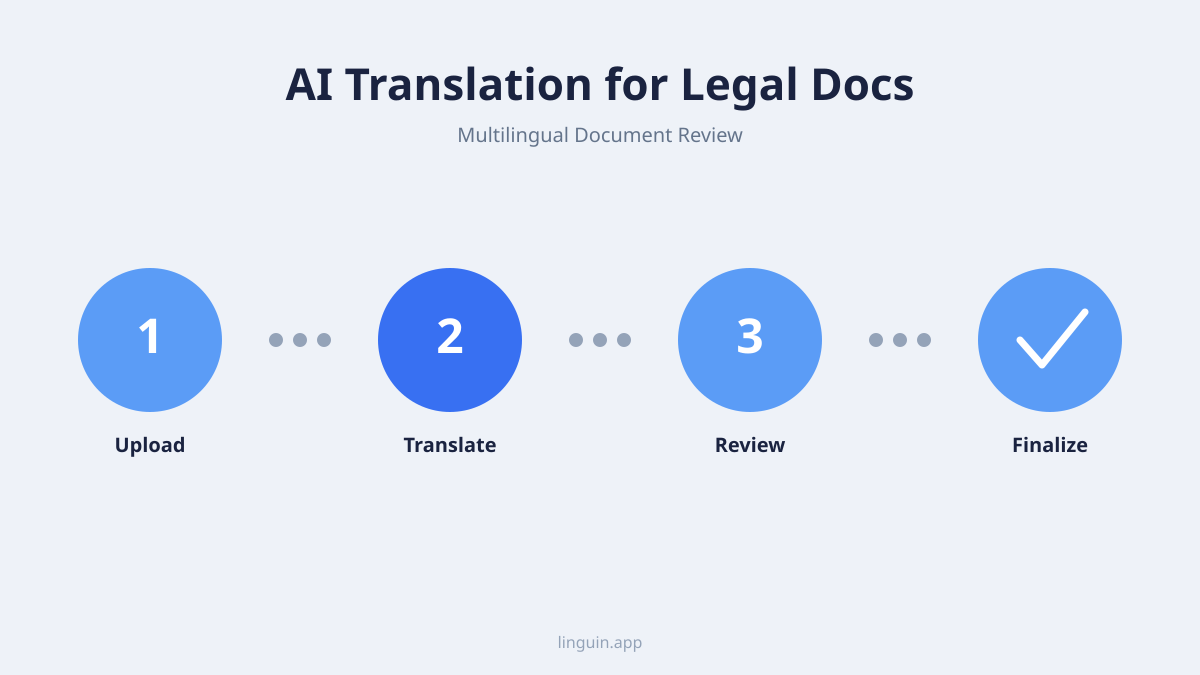
For example, a law firm receives a hard drive as part of discovery containing thousands of documents in Korean. Using an AI translation tool, the team can quickly run the files through a batch process. Within hours, they have readable English drafts. Paralegals can then review these drafts to flag documents pertaining to specific dates, individuals, or contract clauses, isolating the critical subset that requires a professional legal translator’s attention. This targeted approach saves considerable time and cost.
Core capabilities of AI for legal text translation
Not all translation tools are suited for legal work. The technology used must address the unique demands of legal language. Effective AI translation for legal documents relies on several key capabilities that go beyond general text conversion.
First is the handling of legal terminology. Contracts, statutes, and court opinions use precise, often archaic language that differs from everyday speech. A robust AI system is trained on legal corpora, allowing it to correctly translate terms like “force majeure,” “indemnification,” or “tort” with appropriate equivalents, rather than providing literal but incorrect interpretations. Consistency is also paramount; the same term must be translated identically throughout a lengthy document to avoid confusion.
Second is context preservation. Legal meaning often depends on the surrounding clauses and the document’s overall purpose. Advanced AI models analyze entire sentences and paragraphs to determine the correct meaning of ambiguous words. For instance, the word “execution” could refer to signing a document or carrying out a sentence. A context-aware AI translator will choose the correct meaning based on whether the text is from a contract or a court transcript.
Third is formatting and structure integrity. Legal documents have defined structures, numbered clauses, headers, and footnotes. A useful tool must preserve this layout in its output, ensuring the translated document mirrors the original’s organization. This allows reviewers to easily cross-reference between the source and translation. Some platforms, including Linguin, offer features that maintain this formatting during translation, which is crucial for practical review.
Finally, there is the ability to handle mixed content. Legal documents often contain boilerplate text, personal names, addresses, numerical data, and citations. A capable AI translator should recognize and appropriately treat these different elements, leaving names and numbers intact while translating the prose around them.
Understanding the limitations and risks
While powerful, AI translation is not a panacea for legal language barriers. Acknowledging its limitations is essential for responsible use. The primary risk is over-reliance. AI-generated translations, no matter how advanced, are probabilistic interpretations. They can lack the deep doctrinal understanding and cultural-legal nuance that a qualified human legal translator possesses.
One significant area of risk is the translation of untranslatable concepts. Every legal system has foundational concepts without direct equivalents. Think of the French “droit moral” (moral rights in copyright) or the German “Treuhand” (a specific type of fiduciary relationship). An AI might provide a close approximation, but it could miss subtle jurisdictional differences that have major legal consequences. The model may also struggle with highly idiomatic language or archaic phrasing found in older statutes.
Another limitation is the lack of legal accountability. A human translator can be engaged under a confidentiality agreement, can provide a certification of accuracy, and can be subject to professional malpractice standards. An AI tool operates as a service. Its output is a draft for informational use. It should not be submitted to a court as evidence or be the sole basis for drafting a responsive legal pleading without human verification.
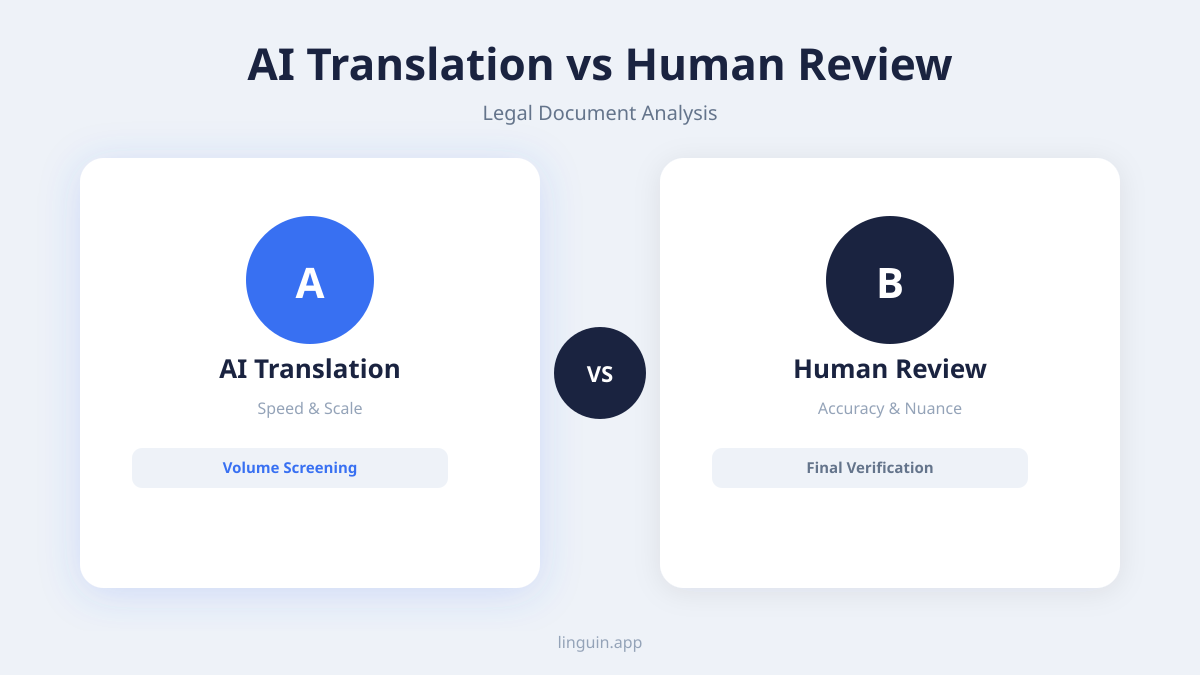
Consider a scenario where an in-house counsel needs to review a potential liability waiver from a Brazilian partner. The AI provides a clear, coherent English draft that suggests the waiver is standard. However, a human lawyer familiar with Brazilian civil law might spot that a particular clause, based on a specific article of the Brazilian Civil Code, has been translated in a way that subtly expands its scope. Only expert human judgment can catch this nuance. Therefore, the best practice is to use AI translation for comprehension, triage, and drafting, but to reserve human translation for finalizing any document that will be acted upon legally.
Implementing a hybrid human-AI workflow
The most effective approach to multilingual legal review is a structured hybrid workflow that leverages the strengths of both AI and human professionals. This creates a seamless, efficient, and accurate process. The workflow typically follows three distinct stages.
The first stage is AI-powered triage and initial analysis. Here, all incoming multilingual documents are processed through a secure AI translation tool. The goal is not perfection, but to generate a “working translation” that enables the legal team to understand the gist of the content. This allows for quick categorization, relevance scoring, and identification of key issues. It answers the initial question: “What is this document about, and is it important to our case?”
The second stage is targeted human expert review. Based on the AI triage, the team identifies the subset of documents that are legally material, complex, or ambiguous. These are then sent to a professional legal translator or a lawyer-linguist for full, certified translation. Crucially, the AI draft can be provided to the human translator as a reference, potentially reducing their time and cost, as they are editing and refining rather than starting from scratch.
The third stage is integration and validation. The finalized human translations are integrated back into the document management system. For documents where only AI translation was used (e.g., for internal comprehension of low-risk items), they should be clearly watermarked or labeled as “AI-assisted draft for informational purposes only.” This maintains a clear audit trail and manages risk. Tools that offer collaboration features, like comment threads on specific translations, can facilitate communication between the legal team and translators in this hybrid model.
Best practices for security and confidentiality
Legal work demands the highest standards of data security and client confidentiality. Using any external tool, including an AI translator, requires careful vetting. When selecting and using an AI translation service for legal documents, several non-negotiable practices must be followed.
First, scrutinize the provider’s data policy. For sensitive legal work, you must use a tool that offers local processing or explicit, contractual guarantees that data is not stored or used for training after the translation is complete. Transmitting client documents to a server that retains data poses an unacceptable breach risk. Look for providers who clearly state their data handling protocols for sensitive information.
Second, implement access controls. Even within a firm, not everyone may need access to raw multilingual documents or translation tools. Use enterprise features that allow administrators to control which team members can upload documents and access translation outputs. This aligns with the principle of least privilege common in legal data management.
Third, maintain a clear chain of custody. Your workflow should document when a document was translated, by which method (AI draft or human final), and by whom. This is part of good project management and is essential if the translation’s accuracy is ever questioned. For more on managing multilingual projects, see our guide on AI translation for multilingual project management.
Finally, educate your team. Everyone involved must understand the appropriate use cases for AI-translated drafts versus final human translations. They should know not to copy-paste AI output directly into a court filing or a final contract sent for signature without the proper verification steps. Establishing and following these protocols turns a powerful tool into a responsible asset.
Practical applications and use cases
To understand the concrete value, it helps to explore specific scenarios where AI translation for legal documents provides a tangible advantage. These applications span various practice areas and firm sizes.
International e-Discovery and Litigation Support: In cross-border disputes, the volume of potentially relevant electronic data can be overwhelming. AI translation can be applied to email threads, chat logs, and internal memos in multiple languages during the early case assessment phase. This allows legal teams to quickly identify patterns, key players, and smoking guns without waiting for weeks of human translation. It makes the discovery process more manageable and strategic.
Due Diligence for Mergers and Acquisitions: When a company considers acquiring a foreign entity, it must review thousands of documents, including employment contracts, lease agreements, litigation history, and regulatory filings. AI can provide rapid translations of these documents, enabling the diligence team to flag potential liabilities, intellectual property issues, or non-standard clauses that require deeper, expert analysis. This accelerates the entire M&A timeline.
Multilingual Client Communication and Intake: Law firms serving immigrant communities or global businesses often receive initial inquiries and evidence in various languages. An AI translation tool can help staff understand the basic nature of a potential case, assess urgency, and prepare for the first client meeting. For example, a personal injury firm might receive a medical report in Polish; a quick AI translation helps a paralegal understand the injuries described before the client consultation.
Compliance Monitoring: Global corporations must monitor internal communications and policies across regions for compliance with regulations like GDPR, anti-bribery laws, or trade sanctions. AI translation can scan internal reports or employee communications in different languages for keywords or phrases indicating potential compliance issues, allowing the legal or compliance department to investigate further. For handling specialized language, learn more about AI translation for technical jargon and industry terminology.
Choosing the right AI translation tool
With many options available, selecting the right tool for legal work requires evaluating specific criteria beyond general translation quality. Your choice should align with the security, functionality, and integration needs of a legal practice.
Prioritize tools that emphasize accuracy and context. Look for information on the AI models used and whether they are optimized for formal or legal language. The ability to handle long-form documents while maintaining context across pages is more important than translating single sentences perfectly. You can read our analysis of factors affecting AI translation accuracy for a deeper dive.
Evaluate the feature set for document handling. Can the tool translate entire PDFs, Word documents, and PowerPoint files while preserving formatting, tables, and footnotes? Does it offer batch processing for multiple files at once? These features are critical for practical legal workflow integration. A tool like Linguin, available as a desktop app for Mac and browser extensions, allows legal professionals to translate text directly within their existing document viewers and web browsers.
Consider integration capabilities. The ideal tool should fit into your existing tech stack. Does it offer API access for law firms with custom document management systems? Can it connect with cloud storage platforms like SharePoint or NetDocuments? Seamless integration reduces friction and encourages adoption by legal teams who are often resistant to new, disruptive software.
Finally, assess the provider’s transparency and support. A provider that understands the legal industry’s needs will have clear documentation on data security, offer enterprise-grade support, and may even provide templates for acceptable use policies within law firms. They should be a partner in enabling responsible use, not just a software vendor.
Frequently asked questions
Is AI translation accurate enough for legal contracts?
AI translation can provide a highly accurate draft for understanding the content and structure of a legal contract. However, for final execution or reliance in legal proceedings, a human legal translator should always review and certify the translation. The AI output serves as an excellent starting point that can reduce the human translator’s workload and cost, but it should not be the final product for binding documents due to risks with nuanced terminology and jurisdictional concepts.
How do you ensure the confidentiality of sensitive legal documents when using AI translation?
Choose an AI translation provider that explicitly states it does not store or use your data for model training after processing. Look for features like local processing on your device or enterprise plans with strong data privacy agreements. Always avoid free, general-purpose translation tools for sensitive legal work, as their data retention policies are often unclear. Implement internal protocols that define which types of documents can be processed with AI tools.
Can AI translation handle complex legal terminology from different countries?
Modern AI models trained on diverse legal and formal texts perform well with standard international legal terminology. However, they may struggle with unique concepts specific to a single jurisdiction’s legal system or with archaic language. For best results, use tools that allow you to create and manage custom terminology glossaries, ensuring consistent translation of key terms specific to your case or practice area across all documents.
What is the difference between AI translation and certified human translation?
Certified human translation is performed by a qualified professional who takes full responsibility for the accuracy and completeness of the translation, often providing a signed certificate to that effect. It is the standard for court submissions and official documents. AI translation is an automated process that generates a draft without legal certification or accountability. It is a tool for speed and comprehension, while human translation is a professional service for accuracy and legal validity.
How can AI translation help with large-scale document review projects?
AI translation excels at scale. It can process thousands of pages in the time it takes a human to do a few. In large-scale reviews like international e-discovery or due diligence, AI can quickly provide a “rough cut” of all foreign-language material. This allows legal teams to intelligently sample, prioritize, and select only the most relevant documents for expensive, time-consuming human translation, creating a more efficient and cost-effective review process.
Integrating AI translation into your legal practice
The journey toward more efficient multilingual legal work begins with a clear strategy. The core takeaway is that AI translation is a powerful assistant for initial review and comprehension, not a substitute for expert human judgment in final, binding matters. By adopting a hybrid workflow, you leverage AI’s speed for triage and drafting while reserving human expertise for verification and finalization. This balance manages risk while unlocking significant gains in productivity.
The next step is to experiment in a low-risk context. Start by using a secure, professional AI translation tool on non-critical internal documents or publicly available foreign-language legal texts to gauge its output quality and ease of use. Evaluate how it handles formatting and terminology relevant to your practice area. This hands-on experience will help you design internal guidelines for its appropriate use.
The same caution applies to numbers as it does to contracts, and our guide to translating financial reports walks through keeping tables and figures intact while a human verifies the final data.
Tools like Linguin are designed to integrate smoothly into professional workflows on macOS, iOS, and within your browser, providing that immediate, context-aware translation when you encounter text in a foreign language. By understanding both the capabilities and the boundaries of AI translation for legal documents, you can build a more responsive, informed, and effective practice in our interconnected world. For a broader look at how AI is applied across different professional fields, explore our article on AI translation for multilingual research collaboration.