 English
  Español
  Français
  Deutsch
  Português
  Italiano
  Русский
  中文(简体)
  日本語
日本語  한국어
한국어  العربية
  हिन्दी
  Nederlands
  Türkçe
  Polski
AI-powered translation is fundamentally reshaping how games and interactive media become accessible to global audiences. For players and developers alike, the language barrier has long been a significant obstacle to enjoyment, community building, and market expansion. This article is for developers, community managers, and gamers who want to understand how modern translation technology works and its practical impact. You will learn how AI-driven tools address the unique linguistic challenges of interactive content, from dynamic dialogue to real-time player communication.
Key takeaways
- AI translation enables real-time, in-game chat translation, fostering inclusive multilingual communities.
- Context-aware AI models accurately handle gaming-specific jargon, cultural references, and dynamic narratives.
- For developers, AI-powered workflows streamline the localization of in-game text, UI, and documentation, reducing costs and time-to-market.
- These tools empower players with disabilities by providing accessible translations of audio and text elements in their native language.
The unique language challenges of interactive media
Games and interactive media present a set of translation hurdles distinct from traditional documents or websites. The content is not static, it is dynamic and often reactive to player choices. A single narrative branch in a role-playing game can contain thousands of lines of dialogue that must maintain character voice and plot consistency across languages. Furthermore, the text is deeply integrated with the user interface. Menus, tooltips, skill descriptions, and error messages must be concise yet perfectly clear, as ambiguity can directly hinder gameplay.
Beyond the core narrative, there is the layer of player-generated content. Guild chat, strategy guides on forums, live-stream commentary, and patch notes all require understanding to fully participate in a game’s ecosystem. This content is informal, filled with community-specific slang, and evolves rapidly. A traditional translation process, which is slow and costly, cannot keep pace with this constant flow of informal, urgent communication. The result is siloed language communities, where players are isolated based on the language they speak, missing out on a huge part of the social and collaborative experience that defines modern gaming.
Consider a player in Brazil trying to follow a complex raid guide written by a top guild in South Korea. The guide is filled with abbreviated skill names, slang for boss mechanics, and cultural references. Without translation that grasps this specific context, the information is useless. Similarly, a developer releasing a small update needs to communicate balance changes to a global player base instantly. Waiting weeks for human translation of patch notes creates frustration and information gaps. AI translation addresses this need for speed and contextual understanding, operating at the pace the interactive medium demands.
How AI translation enhances player experience and accessibility
For the player, AI translation directly removes barriers to entry and deepens engagement. The most immediate application is in real-time communication. Imagine being in a cooperative multiplayer game where your team consists of speakers of English, Japanese, and Spanish. With AI-powered translation running in the background, chat messages and even voice comms can be translated on the fly, allowing for coordinated strategy and social bonding that would otherwise be impossible. This transforms a potentially frustrating experience into an inclusive, global collaboration.
Accessibility in gaming often focuses on visual, auditory, or motor needs, but language is a core accessibility issue. A player is effectively disabled from experiencing a game’s story, mechanics, and community if it is not in a language they understand. AI translation tools can provide real-time subtitles for in-game dialogue and cutscenes, or translate quest text and inventory items through screen capture tools. This empowers players to enjoy titles that were never officially localized in their language, preserving the artistic intent and narrative flow far better than crude, word-for-word machine translations of the past.
- Scenario 1: Exploring an unlocalized indie gem. A French-speaking player discovers a critically acclaimed indie narrative game only available in English and Japanese. Using an AI translation app that captures on-screen text, they can play the game with natural, context-aware translations of dialogue and descriptions, experiencing the story as the developers intended without waiting for a costly official localization that may never come.
- Scenario 2: Joining a global community event. An English-speaking player wants to participate in a special in-game festival hosted primarily by a Chinese-speaking player community. AI translation allows them to understand the event announcements on community Discord servers, follow the live-streamed instructions, and chat with participants, fully immersing themselves in the cross-cultural celebration.
This technology also aids in content consumption outside the game itself. Players can watch tutorial videos, read fan wikis, or browse subreddits in foreign languages, with AI tools providing seamless translations that preserve the nuance of community slang and guides. This breaks down the walls between regional servers and forums, creating a truly unified global player base. For more on how AI handles informal and evolving language, see our article on AI translation for internet slang and neologisms.
Streamlining developer workflows and localization
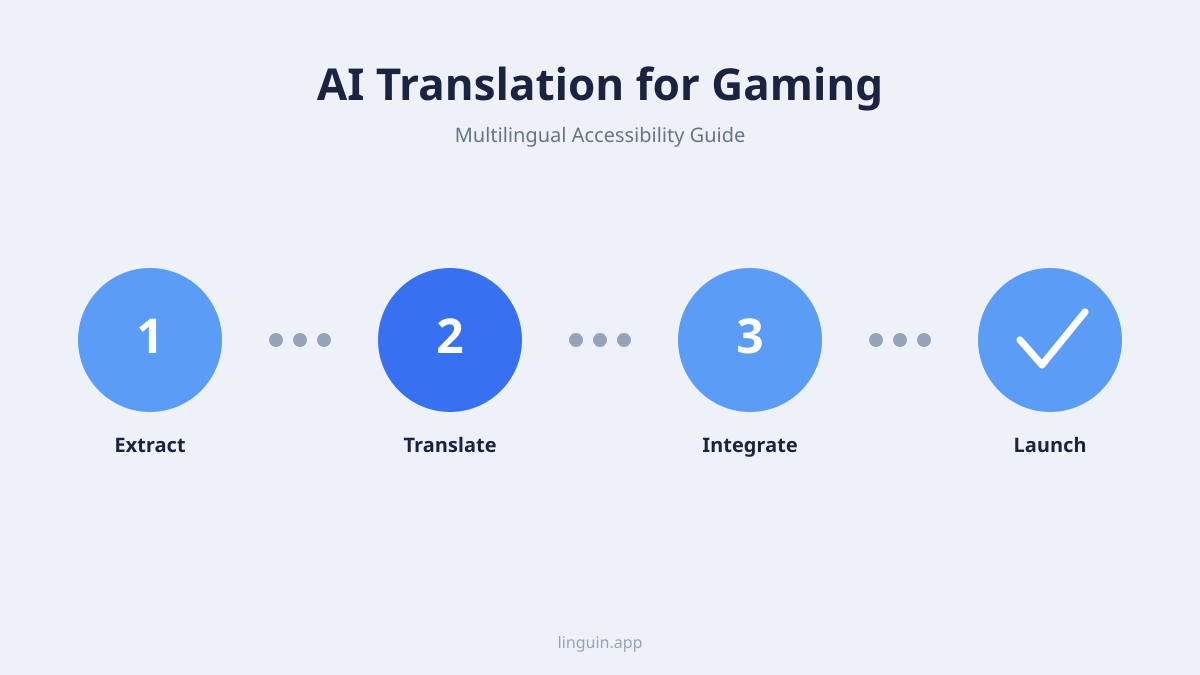
For development studios, especially indie teams and live-service operators, localization is a major bottleneck. Traditional processes involve lengthy strings of spreadsheets, multiple rounds of vendor management, and high costs that can make localizing for smaller markets financially unviable. AI translation integrates directly into developer workflows to alleviate this pressure. It can handle the initial bulk translation of in-game text, including UI strings, item databases, and dialogue trees, providing a high-quality first draft for human linguists to review and polish.
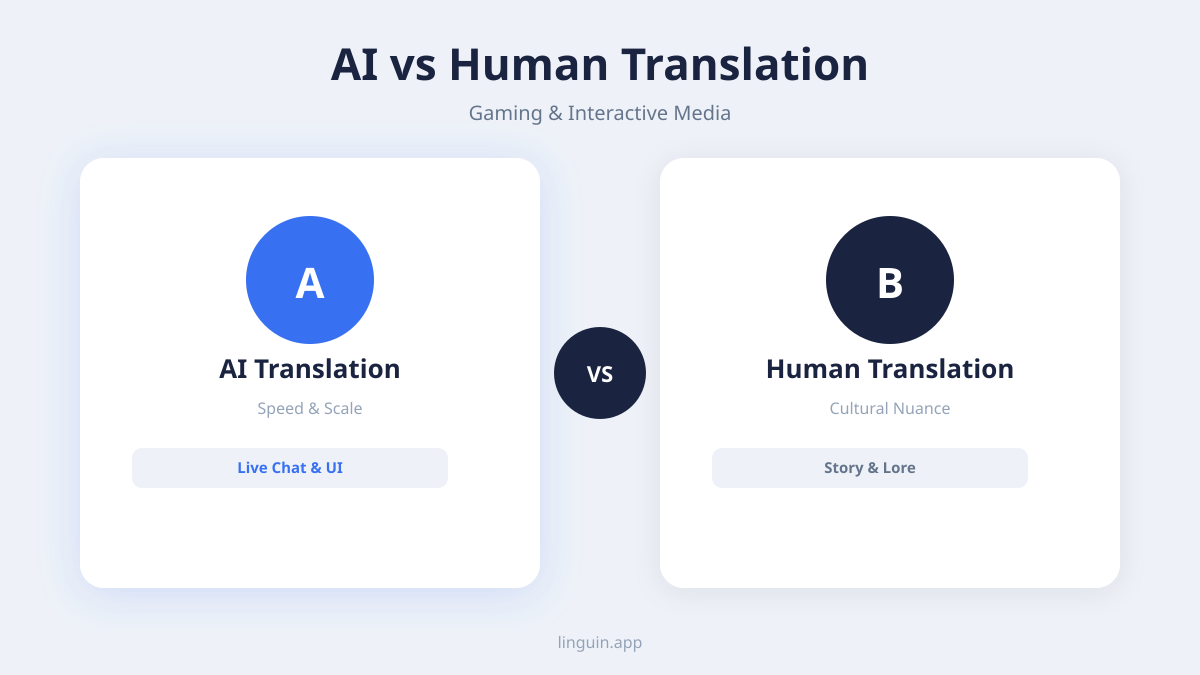
This human-in-the-loop model is crucial. The AI accelerates the tedious, high-volume work, allowing human localizers to focus their expertise on what matters most: refining character voice, ensuring cultural appropriateness, and adapting humor or wordplay. This drastically reduces time-to-market and lowers costs, enabling studios to launch with more language options simultaneously or to consider localizing for niche languages that were previously off the table. It also makes ongoing updates sustainable. Adding new dialogue for a seasonal event or translating a new batch of player-reported bugs becomes a task measured in hours, not weeks.
The consistency of terminology is another major benefit. AI models can be trained or fine-tuned on a project’s specific glossary. Once “Mana” is defined as the magical resource, the AI will consistently translate it correctly across all languages and contexts, avoiding the confusion that arises when different human translators use different terms for the same game mechanic. This ensures a professional, cohesive experience for players in every region. For a deeper look at how AI manages specialized vocabulary, explore our piece on AI translation for technical jargon and industry terminology.
Furthermore, AI aids in translating supporting materials that are essential for player success but often deprioritized: official documentation, knowledge base articles, store page descriptions, and community manager communications. Keeping all these elements synchronized in multiple languages is a monumental task that AI can help manage efficiently, ensuring all players have access to the same clear information.
The technical backbone: context and cultural nuance
The effectiveness of AI translation in gaming hinges on its ability to understand context and cultural nuance. Older rule-based or statistical translation systems would fail miserably with gaming content. They would translate “I need a tank” in a military game correctly, but in an MMO chat, they might bizarrely suggest the player needs an armored vehicle instead of a damage-absorbing character class. Modern neural AI models, trained on vast and diverse datasets, are much better at disambiguating meaning based on the surrounding text and the inferred domain.
This contextual awareness extends to narrative. AI can identify when a line of dialogue is spoken by a gruff dwarf warrior versus a sly elf rogue and adjust the formality and cadence of the translation to match that character’s voice. It can recognize common fantasy or sci-fi tropes and translate them in a way that resonates with the target culture, rather than producing a literal, awkward phrase. Handling cultural references, idioms, and humor is one of the toughest challenges, and while not perfect, advanced AI models make intelligent adaptations, sometimes suggesting culturally equivalent jokes rather than direct translations that fall flat.
The challenge of untranslatable concepts or code-switching (where characters mix languages) is also mitigated. A sophisticated AI system can identify when a word is left intentionally untranslated (like a specific martial arts term in a fighting game) and preserve it, adding a subtle gloss for clarity if needed. It can also detect when a character switches from Common to Elvish in a fantasy setting and handle that shift appropriately in the translation, perhaps by changing font or style to signal the language change to the player. Learn more about these advanced capabilities in our articles on AI translation for untranslatable words and concepts and AI translation for code-switching and mixed languages.
This technical backbone is what separates useful translation from confusing noise. It allows the AI to function not as a simple dictionary, but as a tool that understands the purpose of the text within the interactive experience, whether that purpose is to instruct, to entertain, to characterize, or to facilitate social connection.
Building inclusive global communities
The ultimate goal of multilingual accessibility is to build stronger, more inclusive global communities. When players can communicate freely, share strategies, and create content together regardless of their native language, the game’s ecosystem becomes richer and more resilient. AI translation acts as the infrastructure for this community building. It can be implemented in official community platforms like forums and Discord servers, providing automatic translation of posts and messages. This encourages cross-pollination of ideas and fosters a sense of belonging to a single, worldwide community, rather than fragmented regional groups.
Community managers and moderators benefit immensely. They can monitor conversations across different language channels for sentiment, identify emerging issues or feedback, and respond appropriately, all without needing to be fluent in a dozen languages. This allows for more proactive and equitable community support, ensuring no group of players feels neglected due to language. Translating community guidelines and rules clearly for all members also helps maintain a positive and respectful environment for everyone.
For content creators and esports, the impact is equally transformative. Streamers can interact with a global audience via real-time translated chat. Tournament organizers can provide live, multilingual commentary and analysis, broadening their viewership. Fan-made mods, guides, and wikis become accessible to a much larger audience, encouraging more user-generated content and deepening the game’s meta. This virtuous cycle of shared knowledge and social interaction is what sustains games for years, and AI translation is the key to unlocking it on a global scale. The principles of managing such multilingual interactions extend beyond gaming, as seen in our article on AI translation for multilingual customer support.
Frequently asked questions
Can AI translation handle gaming slang and jargon accurately?
Yes, modern AI translation models are particularly adept at this. They are trained on vast datasets that include informal online communication, forums, and gaming content. This allows them to understand context-specific meanings. For example, they can correctly translate “gg” (good game), “nerf” (weaken), or “adds” (additional enemies) based on the surrounding conversation, preserving the intended meaning rather than giving a literal, nonsensical translation.
Is AI translation fast enough for real-time voice chat in games?
The technology for real-time voice translation exists and is improving rapidly. It involves automatic speech recognition (transcribing speech to text), AI translation of that text, and then text-to-speech synthesis in the target language. While there is a slight latency, it is often minimal enough for cooperative gameplay and social chat. For competitive, split-second communication, text-based chat translation remains the most reliable and instantaneous method.
How does AI translation for games differ from standard website translation?
Game translation requires deep contextual understanding of narrative, character, and interactive mechanics. A website translation deals with static, declarative text. A game translation must handle dynamic dialogue trees, preserve character voice across thousands of lines, and correctly interpret UI text that is often isolated from full sentences. AI models for this purpose are often optimized or fine-tuned to recognize these specific patterns and challenges.
Will AI translation replace human game localizers?
No, it will augment and empower them. AI excels at handling high-volume, repetitive text quickly and consistently. Human localizers are essential for creative tasks like adapting humor, ensuring cultural sensitivity, refining artistic tone, and making final quality judgments. The future workflow uses AI for the initial heavy lifting, freeing human experts to focus on high-value creative and cultural adaptation, making the entire localization process more efficient and scalable.
Can I use tools like Linguin to translate games I’m playing?
Yes. Translation apps and browser extensions are designed for this very purpose. They can capture text displayed on your screen-whether in a game client, a forum, a video overlay, or a messaging app-and provide a natural, context-aware translation in real-time. This allows you to understand unlocalized game text, communicate with international teammates, and access community resources in any language.
Getting started with Linguin
The journey toward multilingual accessibility in gaming begins with integrating smart translation into your daily interactions, whether you’re a player or a developer. For players, using an AI-powered tool like Linguin can instantly unlock games and communities by translating in-game chat, guide websites, and live streams directly in your browser or on your device. This practical step removes the first and most frustrating barrier to global participation.
For developers and community managers, the key takeaway is that AI translation is no longer a futuristic concept but a practical workflow enhancer. It reduces the cost and time of localization, allowing you to reach wider audiences from day one. It also provides the infrastructure to support and grow a truly global, inclusive player community by ensuring clear communication across all languages.
Exploring how these tools handle the specific nuances of interactive content is the best next step. You can experience the difference context-aware AI makes in translating dynamic, informal, and jargon-heavy text. By bridging the language gap, we move closer to a gaming world where geography and native language no longer define your experience, but where shared passion and collaboration do.