 English
  Español
  Français
  Deutsch
  Português
  Italiano
  Русский
  中文(简体)
  日本語
日本語  한국어
한국어  العربية
  हिन्दी
  Nederlands
  Türkçe
  Polski
AI translation for literary works and poetry is moving beyond basic text conversion to interpret nuance, rhythm, and cultural context. This evolution opens literature to a global audience while presenting unique challenges for machine intelligence. For authors, translators, publishers, and avid readers, understanding this shift is key to appreciating the future of cross-cultural storytelling. This article explains how modern AI translation approaches creative text, the specific hurdles it faces, and the new opportunities it creates for accessing world literature.
Key takeaways
- AI translation can now analyze and attempt to preserve poetic devices like meter, rhyme, and metaphor, not just words.
- Context-aware models are better at interpreting cultural references and untranslatable concepts within narratives.
- These tools empower creators and readers by providing instant, draft-level access to foreign literary works for analysis or inspiration.
- The role of the human translator is evolving towards curation and refinement of AI-generated literary translations.
The unique challenge of literary translation
Translating literature and poetry is fundamentally different from translating a manual or an email. The goal is not merely to convey information, but to recreate an experience. A successful literary translation must carry over the author’s voice, the emotional weight of scenes, the pacing of a narrative, and the aesthetic beauty of the language. When poetry is involved, the task becomes even more complex, requiring attention to meter, rhyme, sound, and the precise arrangement of words where form is part of the content.
Literary translation has always been an act of interpretation and recreation. A translator makes countless conscious choices to bridge the gap between two linguistic and cultural systems. They decide whether to prioritize literal meaning or emotional impact, whether to adapt a cultural reference or explain it, and how to handle wordplay that may not exist in the target language. This process requires deep bilingual literacy and creative writing skill. AI translation enters this domain not to replace that human skill, but to augment it, offering new ways to approach these age-old problems.
The core challenges for any system, human or AI, include metaphor, idiom, and cultural context. A metaphor like “a heart of stone” might be translated directly, but its impact depends on whether that phrase carries the same connotations in the target culture. Idioms are often untranslatable and require finding a parallel expression. Furthermore, literature is filled with cultural touchstones, historical allusions, and social nuances that a reader from that culture understands implicitly. An AI must be trained on vast amounts of culturally annotated text to begin recognizing and handling these elements appropriately, a topic we explore in our article on AI translation for idioms and cultural nuances.
How AI models approach creative language
Modern AI translation systems, particularly large language models, approach creative text differently than earlier rule-based or statistical models. They do not translate word by word or phrase by phrase in isolation. Instead, they process the entire input, whether a sentence, stanza, or paragraph, to build a contextual understanding before generating an output in the target language. This allows them to maintain consistency in tone and character voice across longer passages.
For poetry, some advanced systems are trained to recognize structural elements. They can identify rhyme schemes (like AABB or ABAB) and metrical patterns (like iambic pentameter). While they may not perfectly replicate these in another language, they can attempt to produce output with a similar rhythmic quality or employ alternate poetic devices native to the target language. The AI’s task is to balance meaning with aesthetic form, often opting for a semantically faithful translation that evokes a poetic feel, rather than a rigid, awkward adherence to form that distorts meaning.
A key strength is handling ambiguity and polysemy, which are common in literature. A word like “light” could refer to illumination, weight, or a metaphor for understanding. The model uses the surrounding context to disambiguate. For instance, in the phrase “a light in the darkness,” it correctly interprets the metaphorical meaning. This contextual analysis extends to style and tone. AI can be prompted or fine-tuned to distinguish between the formal, archaic language of an epic poem and the casual, fragmented voice of a modern novel. This capability is crucial for projects like translating social media or informal narratives, as discussed in our guide to AI translation for informal grammar and slang.
From first draft to refined piece: The AI-human workflow
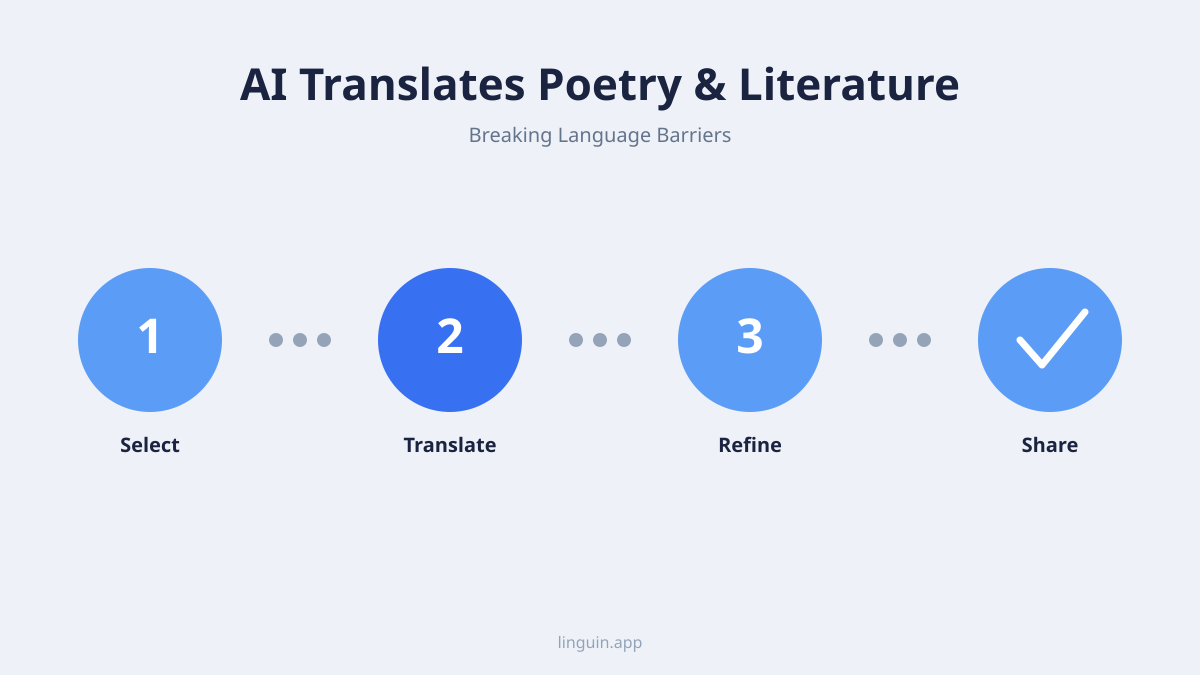
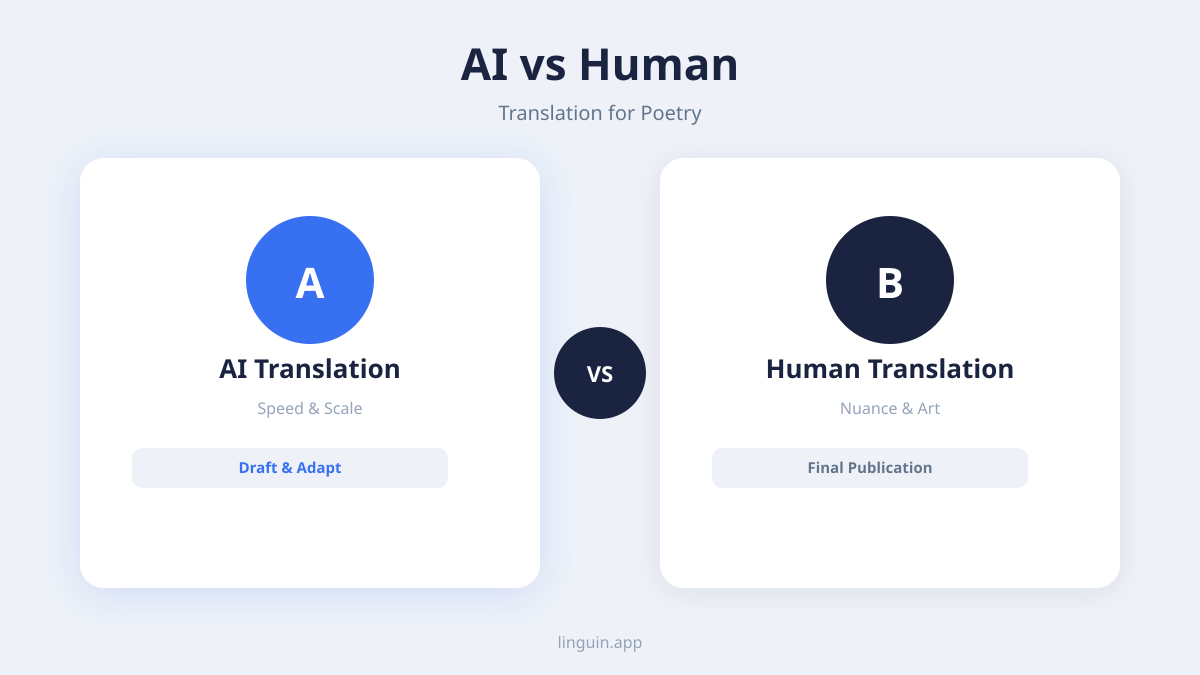
The most practical application of AI translation for literary works is not as a final product, but as a sophisticated first draft or collaborative tool. Imagine a literary scholar who wants to quickly analyze a Portuguese poem. They can use an AI tool to get a context-aware translation that preserves the metaphor and sentence flow, giving them immediate access to the content for study. This draft provides a foundation far superior to a word-for-word gloss.
For professional literary translators, AI can serve as a powerful assistant. The translator can input a challenging passage and generate multiple AI translation variants. Each variant might prioritize a different aspect: one stays close to the literal meaning, another captures the rhythm, a third finds a creative cultural equivalent. The human translator can then evaluate these options, combining their strengths or using them as inspiration for their own, superior synthesis. This hybrid process can increase productivity and spark creative solutions to difficult translation problems.
Consider a novelist collaborating with an international co-writer. They are drafting a scene together in a shared document. The AI translation operates in real-time, allowing each writer to see the other’s contributions in their native language with preserved narrative tone. This facilitates a truly multilingual creative collaboration, breaking down language barriers during the brainstorming and drafting phases. You can learn more about this collaborative potential in our article on real-time multilingual creative collaboration.
Specific applications in poetry and prose
The applications of this technology are broad and growing. For poetry enthusiasts and students, AI tools can provide parallel text analysis. A user can view the original poem alongside an AI translation, with interactive notes explaining key cultural or linguistic choices. This makes dense poetic works more accessible for initial engagement and study, though it cannot replace deep scholarly analysis.
Publishers and literary agents can use AI to evaluate international submissions. A manuscript in Korean can be translated to produce a readable synopsis and sample chapters, helping editors identify promising works for full professional translation. This democratizes access to the global literary market for authors writing in less commonly translated languages.
For prose, consistency is a major benefit. In a long novel with recurring themes, specific terminology, and distinct character voices, an AI model can help ensure these elements are translated consistently throughout the text. If a character always uses a particular regional dialect or slang term, the AI can be instructed to find and use a consistent equivalent. This is similar to the challenges and solutions found in managing regional dialects for business, but applied to narrative fiction.
Writers themselves can use translation as a creative tool. An author might write a passage, translate it into another language using AI, and then translate it back to see how the meaning and style have shifted. This “translation round-trip” can reveal unintended ambiguities or inspire new phrasings, acting as a form of AI-assisted editing.
Limitations and the irreducible human element
Despite advances, significant limitations remain. AI lacks true consciousness and lived experience. It cannot fully comprehend the profound human emotions, historical trauma, or cultural memory that often underpin great literature. Its translation of these elements is based on pattern recognition from its training data, not genuine empathy or understanding.
The subtlest aspects of literary style often elude AI. The faint irony in a narrator’s voice, the deliberate ambiguity of a symbolic ending, or the intertextual reference to another work might be missed. While AI is excellent at recognizing common patterns, truly unique, groundbreaking literary styles present a challenge because they, by definition, deviate from established patterns.
Furthermore, AI operates without intentionality. A human translator makes deliberate choices to align with a specific translation theory or artistic goal. They might choose to foreignize a text (keeping it strange and unfamiliar) or domesticate it (making it feel native). An AI’s “choices” are probabilistic, not philosophical. The final aesthetic judgment, the decision about what to sacrifice and what to prioritize in the name of art, remains a profoundly human responsibility. This underscores why AI output requires careful human review, a principle that applies equally to multilingual legal document review and creative works.
The future of accessible world literature
The trajectory points toward greater accessibility. AI translation can serve as a bridge, making millions of untranslated literary works from around the globe provisionally available. This could lead to a renaissance in the discovery of authors from underrepresented languages and regions. Readers might discover a new favorite Argentine poet or Japanese novelist through an AI-assisted translation, which could then generate enough interest to justify a commission for a full human translation.
We will also see more personalized reading experiences. A reader could adjust the “translation style” of an ebook, opting for a more literal or more liberal translation, or even switching the cultural framing of certain references to make them more relatable. Educational tools will integrate these technologies to help language students analyze literature by comparing AI translations with canonical human translations.
For creators, the future involves seamless multilingual storytelling. A writer could publish a work designed to be experienced in multiple languages, where the AI translation is considered a valid, alternative version rather than a derivative copy. This aligns with a broader trend of using AI for multilingual content creation and SEO, but applied to artistic expression. The ultimate goal is not to remove the human from the process, but to use technology to multiply the connections between human stories and human readers across the planet.
Frequently asked questions
Can AI translate poetry accurately?
AI can translate poetry with improving accuracy regarding meaning, metaphor, and overall tone. It can identify poetic structures and attempt to recreate rhythmic or aesthetic qualities. However, “accuracy” in poetry is multifaceted. A translation might be semantically accurate but lose the musicality, or vice versa. AI provides a strong interpretive draft that captures the essence, but the final, polished literary translation often requires a human poet-translator’s touch to achieve true artistic fidelity.
Will AI replace human literary translators?
AI is unlikely to replace skilled human literary translators. Instead, it is transforming the role. Translators will increasingly act as editors, curators, and artistic directors of AI-generated drafts. They will focus on the highest-level creative decisions, refining nuance, ensuring cultural authenticity, and applying philosophical translation theories. The profession will shift from manual transcreation of every sentence to overseeing and perfecting AI-assisted workflows.
How does AI handle untranslatable words or concepts?
AI handles untranslatable concepts by using context to find the closest possible approximation. It might employ a descriptive phrase, choose a conceptually similar word from the target language, or in some cases, keep the original word with implicit or explicit explanation drawn from the surrounding text. Its vast training data helps it recognize which concepts are typically problematic and see how human translators have historically approached them.
Is AI translation good for translating classic novels?
AI translation can be a valuable tool for getting a preliminary understanding of a classic novel in an unfamiliar language or for comparing different translational approaches. For publication or serious study, the existing canon of human-translated classics, often the result of years of scholarly work, remains superior. AI could be used to create new, alternative translations of classics that prioritize different aspects, such as modernizing the language or highlighting specific themes.
How can I use AI translation for my own creative writing?
You can use AI translation as a creative mirror. Try translating a paragraph of your writing into another language and back again to see new perspectives on your word choices. Use it to brainstorm how a phrase might sound in different linguistic contexts. If you write dialogue for a character who is a non-native speaker, AI can help generate authentically structured sentences. Remember, it’s a tool for inspiration and iteration, not a replacement for your unique voice.
Bringing literary worlds closer together
AI translation for literary works and poetry represents a significant step toward a more linguistically connected world. Its core value lies in making the first layer of meaning and style accessible across language barriers, serving as a catalyst for discovery, collaboration, and deeper human engagement. While it cannot replicate the profound cultural intuition and artistic intent of a human translator, it provides a powerful foundation upon which that human expertise can build more efficiently.
The key points are clear: AI excels at context-aware drafting and preserving stylistic elements at scale, it thrives in collaborative and analytical workflows, and its ultimate benefit is increasing access and understanding. For anyone curious about world literature, from casual readers to publishing professionals, these tools offer a new way to explore.
A practical next step is to experiment with a context-aware AI translation tool on a short piece of poetry or prose in a language you know. Observe how it handles metaphors, sentence flow, and tone. See it not as a final authority, but as a starting point for appreciation and analysis. Linguin is designed with this nuanced understanding in mind, providing translations that aim to capture more than just words, whether you’re reading a novel in its original language online or analyzing a poem for a class.