 English
  Español
  Français
  Deutsch
  Português
  Italiano
  Русский
  中文(简体)
  日本語
日本語  한국어
한국어  العربية
  हिन्दी
  Nederlands
  Türkçe
  Polski
In today’s global tech landscape, AI translation tools are becoming essential for multilingual software development teams to collaborate effectively. These teams face a unique challenge: they must build complex, error-free systems while communicating across language barriers that can lead to costly misunderstandings. This article explores how AI-powered translation specifically addresses the communication needs of developers, project managers, and stakeholders working in different languages, ensuring that technical intent, project requirements, and creative ideas are preserved across borders. You will get a practical guide on implementing AI translation to improve code reviews, documentation, daily stand-ups, and client communications within a multilingual development workflow.
Key takeaways
- AI translation reduces the risk of misinterpretation in technical specifications and user story definitions, which directly impacts code quality.
- Real-time translation in communication platforms like Slack and Microsoft Teams enables fluid, spontaneous discussion between team members who speak different languages.
- Context-aware AI models are capable of handling technical jargon, code snippets, and industry-specific terminology more accurately than generic translation tools.
The communication challenge in global software development
Software development is fundamentally a collaborative and communicative process. From initial brainstorming and writing user stories to daily stand-ups, code reviews, and writing documentation, clear communication is the foundation of a successful project. When team members share a common native language, nuances, subtle feedback, and complex technical concepts can be conveyed with relative ease. However, in a multilingual environment, these same interactions become potential points of failure. A misunderstood requirement due to language can result in days of work being written in the wrong direction. Ambiguous feedback in a code review comment might leave a developer confused about the necessary fix.
The stakes are high. Miscommunication can lead to missed deadlines, bloated budgets, and software that does not meet user needs. Traditional solutions, like employing bilingual team leads or mandating a single “corporate language,” often create bottlenecks or place an unfair cognitive load on non-native speakers. This is where AI translation for software development moves beyond a simple convenience to become a strategic tool. It provides a layer of linguistic support that empowers every team member to contribute in the language they are most comfortable with, while ensuring their intent is accurately understood by others. The goal is not to replace human interaction but to augment it, removing the friction of language so teams can focus on solving technical problems.
How AI translation differs for technical teams
Generic machine translation tools often stumble when faced with the specialized content of software development. They may translate a common word used in a technical context incorrectly, fail to recognize acronyms, or butcher code snippets embedded in sentences. AI translation tools built with technical contexts in mind, or those capable of learning domain-specific language, operate differently. They understand that “commit” refers to a Git operation, “pool” might be a connection pool, and “lambda” is likely a function. This context-aware translation is critical for accuracy.
This capability extends to several key areas of development work. First, it handles technical jargon and industry terminology with precision. Terms like “agile sprint,” “continuous integration,” “microservices architecture,” or “responsive design” have specific meanings that must be preserved. Second, modern AI models can intelligently handle mixed-language content. A developer might write: “We need to add a try-catch block here to handle the NullPointerException.” A good AI translation tool will leave the code (try-catch) and the proper noun (NullPointerException) untouched while accurately translating the surrounding explanatory text. For a deeper dive into this specific capability, see our article on handling code-switching and mixed languages.
Finally, these tools can adapt tone and formality. Communicating a critical security bug to a client requires a different tone than a casual chat about a UI preference with a colleague. AI can help maintain the appropriate level of professionalism or collegiality across languages, ensuring the message’s intent is matched by its delivery. This is especially useful for teams navigating different business cultures where communication norms vary. Learn more about managing tone in our guide to formal and informal translation for emails.
Core applications in the development workflow
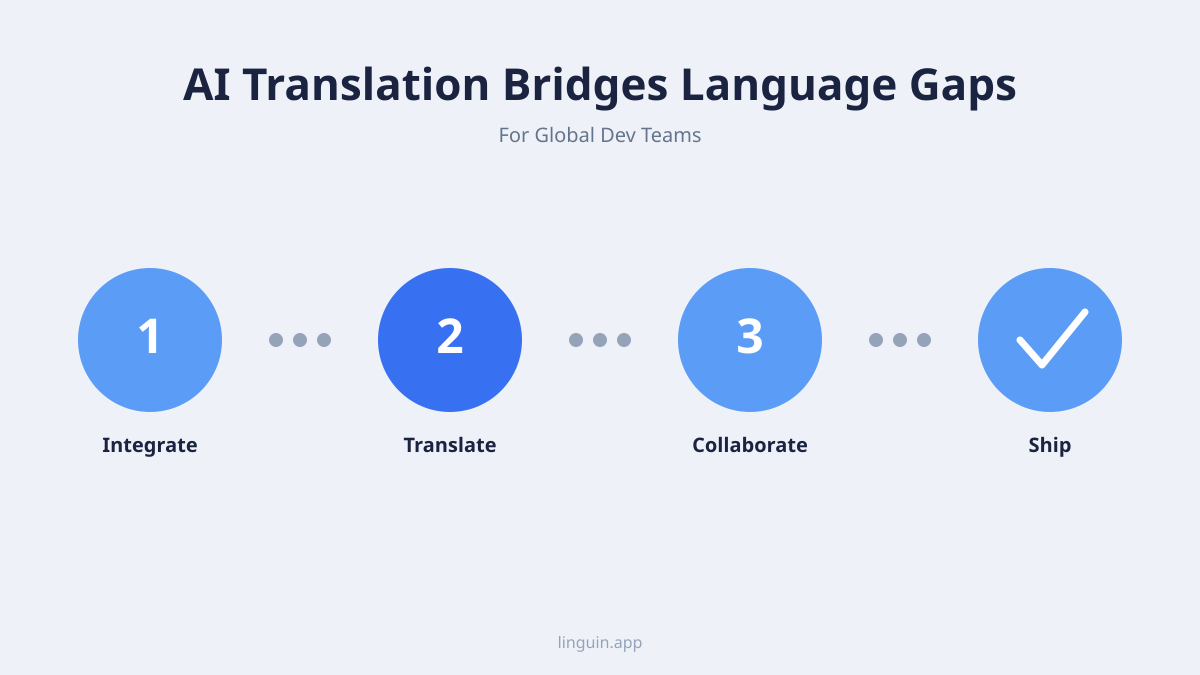
Integrating AI translation into the daily rhythm of a development team can transform collaboration. Its applications touch every stage of the software development lifecycle, making processes more inclusive and efficient.
Daily communication and stand-ups
Real-time translation integrated into platforms like Slack, Microsoft Teams, or Discord allows for spontaneous conversation. Say you’re messaging a colleague in Japan about a database schema issue. They can respond in Japanese, and you read it in English instantly, allowing the technical discussion to flow without delay. During video stand-ups, live transcription and translation can provide subtitles, helping everyone follow along even if the meeting is conducted in a primary language not everyone is fluent in. This reduces the isolation that non-native speakers can feel and encourages more active participation from all team members.
Technical documentation and code comments
Clear documentation is vital for onboarding, maintenance, and knowledge sharing. When documentation is written in one language but needs to be accessible to a global team, AI translation provides a fast, consistent first pass. While technical documentation should ideally be professionally localized for public APIs, for internal team use, AI translation makes existing docs immediately useful. Similarly, it can help developers understand code comments written by peers in another language, making codebases more transparent. For translating highly specialized terms, our article on AI translation for technical jargon offers specific strategies.
Requirement gathering and user stories
Misinterpreted requirements are a primary source of project failure. When product managers, clients, and developers speak different languages, the risk multiplies. AI translation can be used to translate user stories, product requirement documents (PRDs), and client feedback. This ensures that all parties have a shared, linguistically aligned understanding of what needs to be built before a single line of code is written. It allows developers in Berlin to read the original client needs from a stakeholder in São Paulo without a intermediary interpreter, preserving the original intent and nuance.
Enhancing code reviews and quality assurance
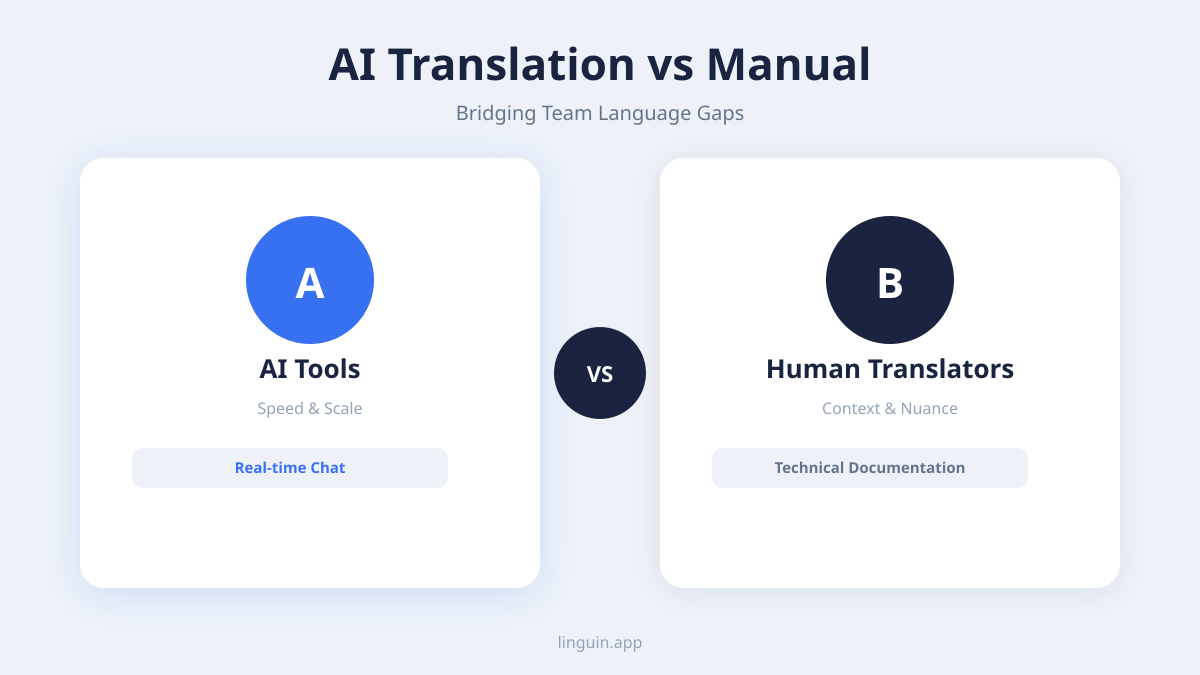
Code review is a cornerstone of software quality, but its effectiveness hinges on clear, constructive communication. A comment like “This could be more efficient” might be intended as a gentle suggestion, but to a non-native speaker, it could be confusing or seem overly critical. AI translation helps by making review comments linguistically accessible. A reviewer can write detailed feedback in their native language, and the reviewee can read it in theirs, ensuring the technical guidance is fully understood.
Furthermore, quality assurance (QA) processes benefit greatly. Bug reports written by testers in one language need to be perfectly clear to developers in another. An ambiguous translation of a bug report step can waste hours of developer time. AI translation ensures that the steps to reproduce, expected behavior, and actual behavior are communicated accurately. This direct line of communication between testers and developers, unmediated by language, leads to faster triaging and resolution of issues. It creates a more cohesive QA pipeline where the focus is on finding and fixing problems, not deciphering reports.
Managing projects and client relations
Project management in a multilingual setting involves coordinating tasks, timelines, and resources across linguistic divides. AI translation tools help project managers create and share project plans, sprint retrospectives, and risk assessments that are understood by all. When updating a client who speaks a different language, managers can translate status reports and presentations, maintaining transparency and trust. This capability is crucial for agencies and consultancies that serve an international clientele.
Client communication itself is elevated. Instead of relying on scheduled interpreter calls or delayed email translations, teams can use AI for more dynamic interaction. Quick clarifications over chat, translated in real-time, keep projects moving forward. It allows for a more personal and responsive relationship, as clients can communicate in their preferred language at any time. For businesses looking to manage complex, multilingual projects, our resource on AI translation for multilingual project management provides a detailed framework.
Selecting and implementing the right AI translation tool
Choosing an AI translation tool for a development team requires more than just picking one with the most languages. Teams should evaluate a few critical features. First, accuracy with technical content is non-negotiable. The tool should be tested with samples of your team’s typical communication, including code snippets, error messages, and technical design documents. Second, ease of integration is key. Look for tools that offer browser extensions, desktop apps, or direct integrations with the communication and development platforms your team already uses, such as GitHub, GitLab, Jira, or your chosen chat app.
Implementation should start with a pilot program. Select a small, cross-language team or a single project to test the tool. Provide clear guidelines on its use. It is important to frame the tool as an aid to understanding, not a replacement for developing language skills or for critical, legally-binding client contracts. Encourage team members to use it for daily communication, document drafting, and reading comprehension. Gather feedback on its accuracy and usability, and be prepared to adjust workflows. The goal is to make the tool a seamless part of the development environment, reducing friction rather than adding a new process.
Frequently asked questions
Can AI translation accurately handle programming code and technical slang?
Yes, advanced AI translation models are specifically trained to recognize and preserve programming syntax, keywords, and common technical slang. They understand that text within backticks or in a code block should not be translated, and they can accurately translate the explanatory sentences around it. The context of the conversation helps the AI determine if “bug” refers to an insect or a software defect. For the most accurate results, using a tool designed for or fine-tuned on technical content is recommended.
Is real-time AI translation reliable enough for important meetings?
Real-time translation for meetings has become highly reliable for conveying the core meaning of technical and project discussions. While it may not achieve perfect, human-interpreter fluency for nuanced philosophical debates, it is exceptionally effective for the structured communication of software development, such as stand-ups, sprint planning, and design reviews. It provides live subtitles or audio translation that allows all participants to follow the conversation in their preferred language, significantly improving meeting inclusivity and comprehension.
How does AI translation protect our proprietary code and business information?
Reputable AI translation service providers implement strong data security and privacy policies. When evaluating a tool, it is crucial to review its data handling practices. Look for providers that offer on-device processing where possible, clearly state that user data is not stored permanently or used for model training without consent, and comply with relevant data protection regulations like GDPR. For translating highly sensitive material, using an enterprise-grade tool with stringent security guarantees is essential.
Will using AI translation discourage team members from learning a common language?
AI translation is best viewed as a productivity tool that removes immediate communication barriers, not as a substitute for language learning. In fact, it can encourage language acquisition by exposing team members to correct, contextual translations in real-time, acting as a learning aid. It reduces the pressure and cognitive load in high-stakes work situations, allowing language skills to develop naturally over time in lower-pressure interactions. The tool supports the team’s primary goal, which is to build software effectively.
Can it translate entire codebases or documentation repositories?
AI translation tools are primarily designed for translating natural language text. While they can handle code comments and documentation files (like Markdown or text files), they are not suitable for translating the actual source code itself, as programming languages are not “translated” but remain in their original syntax. For large-scale documentation translation, many tools offer batch or API processing, which can automate the first draft of translation, but a human review for technical accuracy is always necessary before final publication.
Implementing AI translation in your development cycle
The integration of AI translation into a software development team addresses a fundamental operational hurdle: clear communication across languages. By ensuring technical specifications, code reviews, and daily discussions are accurately understood by all, these tools directly contribute to higher code quality, faster project velocity, and a more inclusive team culture. The key is to view translation not as a post-process step but as an integrated layer within your existing communication and development tools.
The most effective next step is to conduct a focused trial. Identify the most persistent language-based bottleneck in your current workflow, whether it’s understanding client requirements, deciphering code comments, or participating in real-time chats. Introduce a capable AI translation tool like Linguin to that specific scenario for a two-week sprint. Observe the difference in understanding, the reduction in clarification loops, and the overall team dynamic. By starting small and measuring the impact, you can build a compelling case for a broader implementation that empowers every member of your global team to contribute their best work, unhindered by language.