 English
  Español
  Français
  Deutsch
  Português
  Italiano
  Русский
  中文(简体)
  日本語
日本語  한국어
한국어  العربية
  हिन्दी
  Nederlands
  Türkçe
  Polski
To succeed in global markets, your content must be both discoverable and resonant in multiple languages. This is where AI translation transforms multilingual SEO from a technical task into a strategic advantage. For marketers, content creators, and business owners targeting international audiences, the challenge is twofold: you need content that ranks well in local search engines and connects authentically with users. This article will explain how modern AI translation tools go beyond literal word substitution to produce SEO-friendly content that understands cultural context, user intent, and local search behavior. You will get a clear framework for integrating AI translation into your global SEO strategy, ensuring your brand speaks the language of both search algorithms and real people.
Key takeaways
- AI translation tools preserve SEO elements like keywords and meta tags while adapting them for cultural relevance and local search intent.
- Context-aware AI models generate natural, readable translations that improve user engagement metrics, a key SEO ranking factor.
- Automating the translation of large content volumes with AI enables faster, more consistent multilingual site expansion, crucial for capturing global market share.
The multilingual SEO challenge: more than just words
Expanding your online presence into new languages is a proven path to growth, but it introduces complex search engine optimization challenges. Traditional translation methods often fail to address the nuances that make content rank. Search engines like Google, Baidu, or Yandex use sophisticated algorithms to evaluate content quality, user experience, and relevance for each specific language and region. A direct, word-for-word translation can strip out the very elements that make your original content effective. Keywords do not always have direct equivalents, and popular search phrases vary dramatically by culture and locale. Furthermore, search intent-the reason behind a user’s query-can differ. A user searching for “best laptop” in English might prioritize technical reviews, while a user searching for the equivalent term in another language might prioritize local price comparisons or warranty information.
The technical structure of a webpage also needs careful localization. Elements like title tags, meta descriptions, header tags (H1, H2, etc.), image alt text, and URL slugs must be translated and optimized. If these elements are ignored or poorly translated, search engines will struggle to understand the page’s topic, and users will see unappealing snippets in search results. The goal of multilingual SEO is not merely to have a translated page, but to have a page that competes effectively in the local search landscape for that language. This requires a tool that understands both the mechanics of SEO and the art of natural language communication.
How AI translation works with SEO fundamentals
Modern AI translation is built on neural machine translation models trained on vast datasets of high-quality, multilingual text. This training allows the AI to understand context, grammar, and common phrasing. When applied to SEO, this capability is transformative. A sophisticated AI translation tool can analyze your source content and identify key SEO elements. It then works to preserve the intent and search relevance of these elements during the translation process. For instance, a primary keyword phrase in your English content will be translated into its most natural and commonly searched equivalent in the target language, not just a literal dictionary match.
This process extends to all on-page elements. An AI system can be prompted or configured to treat title tags and meta descriptions with special care, ensuring they remain compelling and within character limits. It can generate appropriate URL slugs based on the translated page title. For content within the body, the AI maintains the semantic structure-the relationship between ideas-which is crucial for search engines that use natural language processing to understand topic depth. The output is a translated page that retains the original’s SEO blueprint while adapting its language to feel native. This balance is critical. Search algorithms increasingly prioritize user experience signals like time on page and bounce rate. A clunky, unnatural translation will cause visitors to leave quickly, signaling to search engines that the page is low-quality, regardless of how well the keywords are placed.
Beyond keywords: context, nuance, and user engagement
The true power of AI in multilingual SEO lies in its ability to handle context and nuance. SEO is no longer just about keyword density; it is about satisfying user intent and providing a superior experience. AI models, especially large language models, excel at understanding the broader context of a sentence or paragraph. This allows them to make nuanced decisions that a simple translation tool cannot.
Consider these concrete scenarios. Say you’re an e-commerce business translating product descriptions from English to Spanish. A phrase like “lightweight running shoes” could be translated literally. However, an AI trained on regional dialects might know that in certain Spanish-speaking markets, a more common and engaging phrase exists, which would perform better in local search and resonate more with customers. Similarly, translating a technical support article requires precise handling of industry terminology. An AI tool like Linguin, configured for technical content, can ensure that specific jargon is translated accurately and consistently across all your documentation, building trust and improving the help content’s utility and search ranking.
Another critical area is cultural adaptation. Humor, idioms, and local references in your marketing blog need to be adapted, not just translated. An AI system can recognize an idiom and replace it with a culturally appropriate equivalent that maintains the intended tone or persuasive effect. This level of adaptation leads to content that feels local. When users find content that truly speaks to them, they stay longer, share it more, and convert at higher rates. These positive user engagement metrics are powerful ranking signals for modern search engines. By using AI translation that prioritizes readability and cultural fit, you build content that wins both hearts and algorithms. For more on how AI handles these subtleties, explore our articles on AI translation for idioms and cultural nuances and managing formal and informal tone.
Integrating AI translation into your SEO workflow
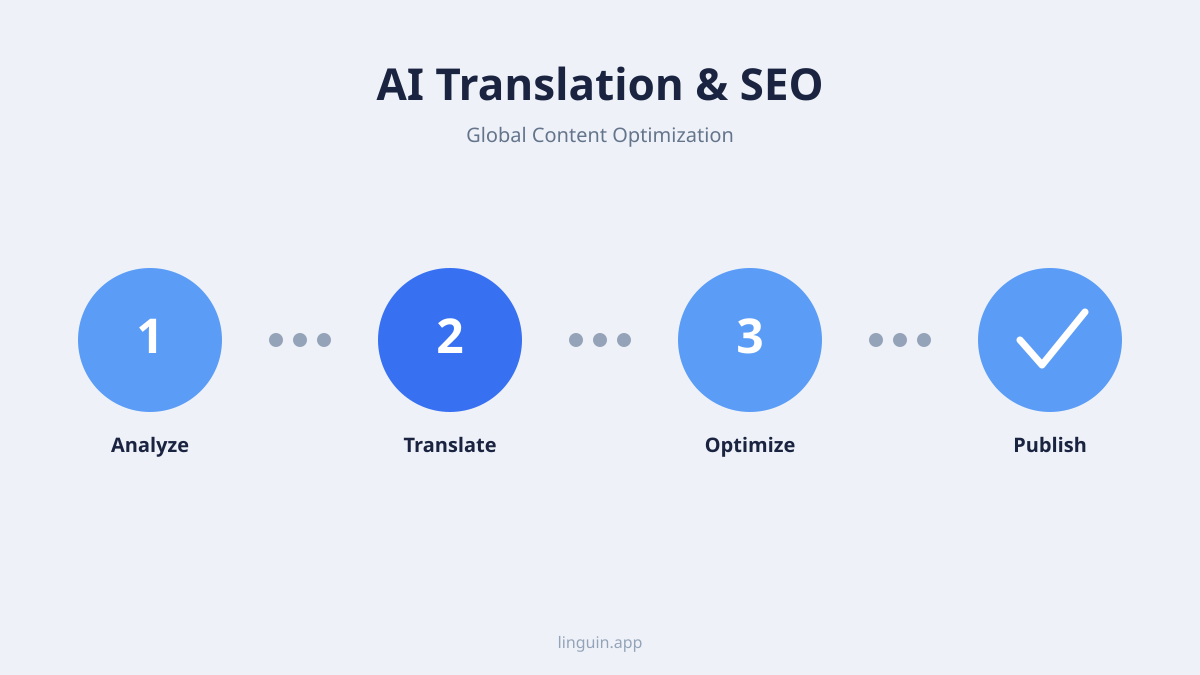
Adopting AI translation for multilingual SEO requires a strategic workflow, not just a one-time project. The goal is to create a scalable, repeatable process that maintains quality and SEO integrity across all languages and content updates. A successful integration involves several key steps.
First, audit and prepare your source content. Ensure your original, often English, content is well-optimized. It should be clear, logically structured, and targeted with well-researched keywords. AI translation amplifies quality, it does not create it from nothing. Clean, strong source material is the best foundation.
Second, select and configure your AI translation tool. Look for a platform that allows for glossary and style guide integration. You can upload a list of branded terms, product names, and preferred terminology to ensure consistency. Some tools allow you to set a preferred tone (formal, conversational, marketing-driven) for different content types. For example, you would use a different configuration for translating legal disclaimers versus social media posts. Linguin offers this level of control across its apps and extensions, allowing for tailored outputs.
Third, implement a human-in-the-loop review process. Even the best AI benefits from human oversight, especially for high-stakes content like cornerstone articles or key landing pages. The reviewer’s role is not to retranslate everything but to perform quality assurance. They should check for:
- SEO element accuracy (title, meta description, headers).
- Cultural appropriateness and brand voice alignment.
- Technical term correctness.
- Overall flow and readability.
This hybrid approach maximizes efficiency while safeguarding quality. Finally, monitor performance. Use analytics tools to track the ranking performance, traffic, and engagement metrics of your translated pages. This data will show you what’s working and where further optimization might be needed. For managing large-scale projects, learn how AI can aid in multilingual project management.
Technical considerations for AI-translated websites
When deploying AI-translated content on your website, several technical SEO considerations are paramount for success. Getting these details right ensures search engines can properly discover, index, and rank your multilingual pages.
The first decision is your site structure. The two main approaches are:
- Country-code Top-Level Domains (ccTLDs): e.g.,
.frfor France,.defor Germany. This is the strongest signal to search engines about geographic targeting but can be the most expensive to maintain. - Subdirectories with language codes: e.g.,
yourdomain.com/es/for Spanish,yourdomain.com/ja/for Japanese. This is easier to set up and manage on a single domain, consolidating domain authority. - Subdomains: e.g.,
es.yourdomain.com. This approach is less common as it can split domain authority and requires more complex configuration.
Whichever structure you choose, you must implement hreflang tags. These HTML tags are critical. They tell search engines like Google which language and geographic variant a page is intended for, preventing issues with duplicate content (e.g., your English page ranking for Spanish searches) and ensuring the correct version appears in the right local search results. Your AI translation workflow should ideally generate or facilitate the correct implementation of these tags.
Another crucial element is the sitemap. You should create and submit separate sitemaps for each language version of your site, or a single sitemap that includes all hreflang annotations. This guides search engine crawlers directly to your translated content. Furthermore, ensure the AI tool correctly localizes all on-page elements. This includes translating and optimizing image file names and alt text, which are important for both accessibility and image search. The goal is to create a technically sound multilingual website where every signal, from the URL to the image descriptions, aligns to support your global SEO strategy.
Measuring the impact on global search performance
After implementing AI-translated content, measuring its impact is essential to validate your strategy and guide future efforts. You need to move beyond simple translation volume metrics and focus on key performance indicators that reflect true SEO and business success.
Track organic search visibility and rankings in each target language. Use SEO platforms to monitor your target keywords’ positions in local Google search results (e.g., Google.fr, Google.co.jp). Are your translated pages ranking for the intended localized keywords? An increase in ranking for relevant terms is a direct sign of successful SEO translation.
Analyze traffic and user behavior. In your web analytics, segment data by language subdirectory or subdomain. Look for:
- Organic traffic growth: Is the translated section attracting visitors from search?
- Bounce rate and time on page: Compare these metrics against your source-language pages. Lower bounce rates and higher engagement times suggest the translated content is relevant and readable.
- Conversion rates: Are visitors in the new language taking desired actions (sign-ups, purchases, inquiries)? This is the ultimate metric for ROI.
Finally, listen to your audience. Monitor social mentions, comments, and support queries in the new languages. Is the feedback positive regarding the language quality? Are there misunderstandings? Direct user feedback can highlight areas where the AI translation, or your human review process, can be refined. This data-driven approach ensures your multilingual SEO investment is delivering tangible results. For insights into how clear communication affects customer relationships, see our article on multilingual customer support.
Future trends: AI, SEO, and the evolving search landscape
The fields of AI translation and search engine algorithms are both advancing rapidly, and their convergence will shape the future of multilingual SEO. Understanding these trends can help you stay ahead.
Search engines are increasingly leveraging AI themselves to understand content. Google’s use of BERT and other AI models means it is getting better at discerning nuance, intent, and content quality. In response, your translated content must be high-quality and context-rich to satisfy these smarter algorithms. Thin, awkwardly translated content will be easier for search engines to identify and deprioritize.
We can also expect more sophisticated personalization. Search results may become more tailored to an individual’s language preferences, dialect, and even personal communication style. AI translation tools will need to adapt, potentially offering more granular control over regional dialects and sociolects. Furthermore, the rise of voice search in multiple languages presents a new frontier. Voice queries are often longer and more conversational. AI translation that excels at natural, spoken language will be key for optimizing content for voice search across different languages.
Finally, the integration of AI translation into content management systems and SEO platforms will become more seamless. Imagine a workflow where you write a piece of content, and an integrated AI tool not only translates it but also suggests locally trending keywords, optimizes meta tags, and even predicts potential performance in the target market. This level of automation will make robust multilingual SEO accessible to more businesses, leveling the global playing field. Staying informed on these trends, perhaps by following discussions on AI translation accuracy, will be crucial for maintaining a competitive edge.
Frequently asked questions
Can AI translation tools handle SEO keywords correctly?
Yes, advanced AI translation tools are designed to recognize and appropriately translate SEO keywords and key phrases. Instead of a literal translation, they aim to find the most natural and commonly searched equivalent in the target language. This process considers context and search intent, which is vital for maintaining the page’s relevance in local search results. However, for best results, it is recommended to provide the AI with a glossary of important branded terms and to have a human review the final keyword choices.
How does AI-translated content affect my website’s loading speed?
AI translation itself does not directly affect your website’s loading speed. The impact comes from how you implement the multilingual content. If you use a dynamic solution that translates content on-the-fly for each user, it could add minimal processing time. The more common and efficient approach is to use AI to create static, translated versions of your pages (e.g., separate HTML files for /es/, /fr/). These static pages load just as quickly as your original content, preserving a positive user experience, which is itself an SEO ranking factor.
Is AI translation good enough for e-commerce product pages?
AI translation is highly effective for e-commerce product pages, especially when combined with a human review for final polish. It can accurately translate product titles, descriptions, specifications, and marketing copy at scale. The key is to ensure consistency for technical terms (like model numbers or material names) and to adapt marketing claims to be culturally appropriate and compliant with local regulations. This balance of speed, consistency, and adaptability makes AI a powerful tool for scaling an e-commerce presence globally.
Do I still need a human translator if I use AI for SEO?
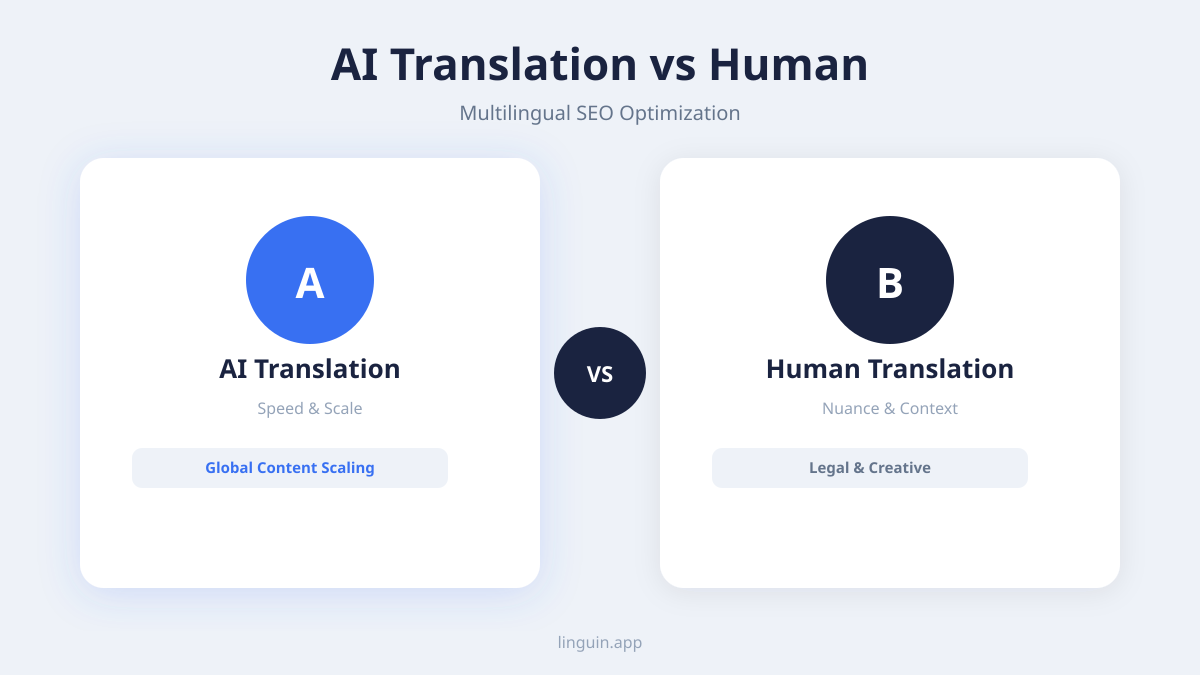
A human-in-the-loop process is still recommended for the highest-quality results, particularly for core landing pages, complex marketing content, and legal text. The human’s role shifts from translating from scratch to editing and quality assurance. They verify cultural appropriateness, brand voice alignment, technical accuracy, and the final SEO elements (like title tags). This hybrid model leverages AI for speed and scale while using human expertise for nuance and brand safety.
Getting started with Linguin for your SEO strategy
Optimizing multilingual SEO with AI translation is a strategic process that blends technology with linguistic insight. The core principle is to move beyond mere word replacement and focus on creating content that feels native, engages users, and satisfies local search intent. By preserving SEO structures while adapting language and context, AI tools enable you to scale your global presence efficiently and effectively.
The next step is to evaluate your current multilingual content and identify one key area for improvement. This could be translating and optimizing your core service pages for a new market or updating the meta descriptions across your existing Spanish-language blog. Choose a focused project to start.
Linguin is designed to support this workflow. Its AI models prioritize natural, context-aware output, which is fundamental for both user experience and SEO. You can use the Linguin macOS app or browser extensions to translate and refine content directly within your workflow, ensuring consistency and saving time. By integrating a tool built for nuance into your process, you take a significant step toward making your global content truly competitive. Explore how Linguin’s translation app can fit into your specific SEO and content localization plans.