 English
  Español
  Français
  Deutsch
  Português
  Italiano
  Русский
  中文(简体)
  日本語
日本語  한국어
한국어  العربية
  हिन्दी
  Nederlands
  Türkçe
  Polski
AI translation is transforming video game accessibility by dismantling language barriers that have long excluded players from global stories and communities. For players, developers, and community managers, this technology means more than just translated text, it means full participation in the digital worlds they love. This article will explain how AI-driven translation works within gaming contexts, its impact on different aspects of the experience, and the practical future it is building for a truly borderless player base.
Key takeaways
- AI translation enables real-time understanding of in-game dialogue, menus, and player interactions, going beyond traditional static localization.
- Modern models handle gaming-specific challenges like character names, invented lore terms, and UI text compression better than older rule-based systems.
- This technology empowers players to access niche or indie games that lack official localizations and fosters inclusive, multilingual online communities.
The language barrier in global gaming
Video games are a dominant form of global entertainment, yet their stories and social spaces are often fragmented by language. A player in Brazil might be unable to follow the intricate plot of a Japanese role-playing game. A strategy game enthusiast in Poland might struggle with the nuanced tooltips of a game developed in English. Traditional localization, the process of manually adapting a game for a new region, is a proven but resource-intensive solution. It involves translating text, recording voice-overs, and sometimes altering cultural references. However, this process is costly and slow, meaning it is typically reserved for games with the largest budgets and market potential. Countless indie titles, older games, and live-service games with constantly updating content fall through the cracks, leaving their narratives and mechanics locked away from a global audience.
The barrier extends beyond the single-player experience. Online multiplayer games and shared virtual worlds are built on communication. Guild coordination in an MMO, tactical callouts in a competitive shooter, or simple social banter in a virtual space all require a common language. When players cannot understand each other, it stifles community formation, creates friction in team-based play, and can even lead to exclusionary behavior. The promise of a globally connected player base is often undermined by this fundamental disconnect. This is where AI translation video game accessibility moves from a convenience to a necessity, offering dynamic solutions that traditional methods cannot match at scale.
How AI translation models understand game contexts
AI-powered translation differs from older, dictionary-based methods by processing language in context. Instead of translating words in isolation, modern neural networks analyze entire sentences, paragraphs, and even the surrounding visual or gameplay context to infer meaning. This is critical for gaming, where language is often tightly coupled with specific mechanics and fictional worlds. For instance, an AI model can learn that the word “mana” in a fantasy game refers to a magic resource pool, not some abstract spiritual force, and translate it appropriately into the target language’s common gaming term. This ability to handle domain-specific terminology is a foundational improvement.
These models are trained on vast datasets that include diverse linguistic patterns, from formal prose to casual internet slang. This allows them to better grapple with the varied text types found in games. They can distinguish between the archaic, formal dialogue of a king character and the clipped, technical jargon of a spaceship’s computer console. Furthermore, advanced models can address the challenge of untranslatable words or concepts unique to a game’s lore. A developer might create a fictional substance called “Aetherium.” A context-aware AI can choose to transliterate the name, add a brief explanatory note, or find a conceptually similar term in the target language, depending on the sentence structure. This nuanced approach preserves the creator’s intent while ensuring comprehension. You can explore how AI handles similar challenges in specialized fields in our article on AI translation for technical jargon and industry terminology.
Real-time translation for live interaction and UI
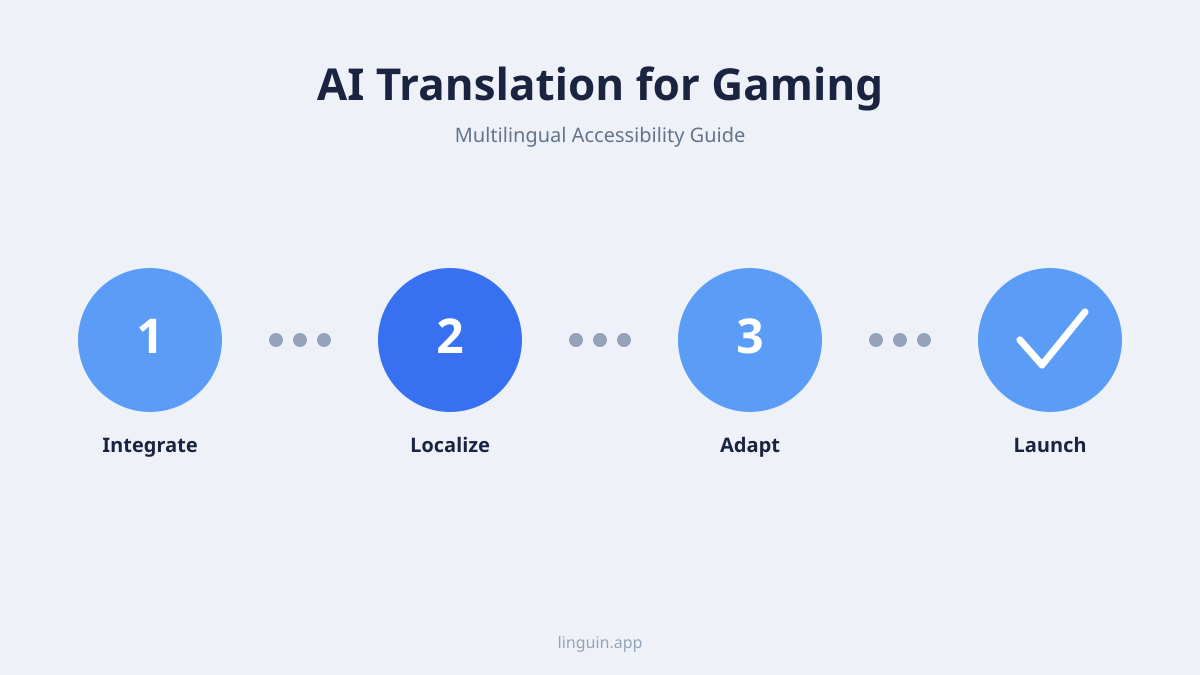
One of the most significant applications of AI translation in gaming is its potential for real-time operation. This functionality can be layered onto the player’s experience in several key areas to create seamless accessibility.
In-game communication translation: Imagine playing an international server of a popular online game. Your teammate, speaking Korean, types a strategy in team chat. An integrated AI translation tool can instantly render that message into your native language, and vice-versa. This goes beyond text chat, voice communication presents a greater challenge but is the next frontier, where speech-to-text combined with AI translation could provide real-time subtitles for voice chat. This application directly builds stronger, more cooperative global communities.
Dynamic user interface and subtitle support: Many players enjoy games with original voice acting but need subtitles in their own language. AI can provide real-time subtitling for in-game cinematics and dialogue. More impressively, it can be applied to dynamic UI elements. For example, an item dropped by another player with a name generated in German could have its tooltip translated on-the-fly for an English-speaking player. This real-time layer ensures that no element of the interactive experience is lost to a language difference. The principles behind this real-time application are similar to those needed for real-time multilingual creative collaboration in other digital fields.
Scenario: You are exploring a player-driven market in a massive online game. Vendor stalls have custom names and item descriptions written by players in a dozen different languages. An AI translation overlay allows you to hover over any text and see an immediate, context-aware translation, enabling you to shop and interact without missing a beat or needing to exit the game to use a separate translation app.
Beyond words: capturing tone, humor, and cultural nuance
The narrative depth of modern games relies heavily on elements that are notoriously difficult to translate: humor, sarcasm, regional dialects, and cultural references. A literal translation can completely deflate a joke or misrepresent a character’s personality. Advanced AI translation models are increasingly adept at cultural contextualization. They can identify a pun based on wordplay and attempt to adapt it, or recognize a culturally specific idiom and replace it with an equivalent that resonates with the target audience. This is vital for preserving the artistic integrity of a game’s writing.
Consider a character who uses specific slang to denote their background, like a cyberpunk street vendor using invented futuristic slang. An AI model trained on diverse linguistic data can better decide whether to translate the slang directly, find analogous modern slang in the target language, or add a slight contextual modifier to convey the same “vibe.” This process is not about erasing cultural specificity, but about transposing it in a way that remains meaningful. The challenges of translating humor and sarcasm are immense, as tone is often conveyed through context and delivery that text alone lacks. AI models that consider broader conversational context make more informed choices here. For a deeper dive into this complex area, read our analysis of AI translation for humor, sarcasm, and tone.
Similarly, games often use regional dialects to flesh out the world, distinguishing a rustic farmer from a noble knight through their speech patterns. A sophisticated AI system can be prompted to translate the farmer’s dialogue into a dialect of the target language that carries similar social and cultural connotations, rather than rendering all characters into a uniform, neutral speech pattern. This level of nuance brings players closer to the intended experience, no matter what language they speak.
Empowering players and indie developers
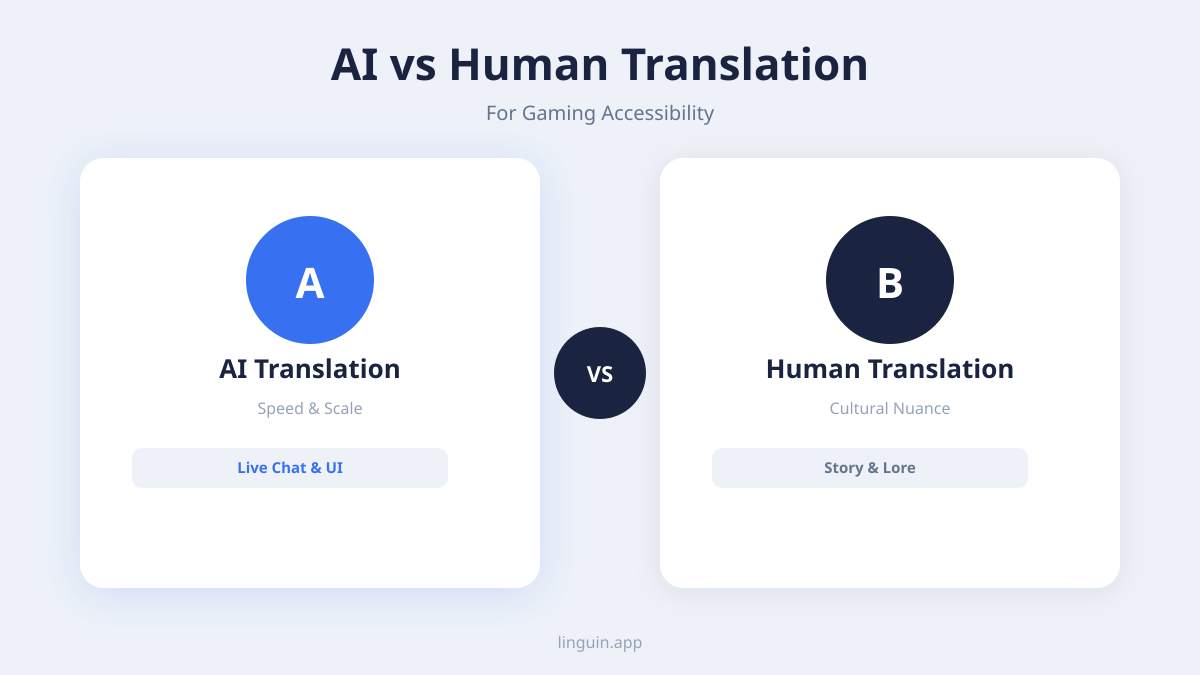
AI translation democratizes access in two powerful directions: for players and for small-scale creators. For players, it acts as a universal key. Modding communities have already begun creating AI-powered fan translation patches for games that never received an official localization. A player can install a community-made mod that uses an AI model to translate all in-game text, opening up entire libraries of niche, indie, or older titles that were previously inaccessible. This player-driven localization extends the life and reach of games immeasurably.
For indie developers and small studios, comprehensive professional localization is often financially impossible. AI translation tools offer a viable first pass or even a full solution for reaching a global audience on a limited budget. A developer can use these tools to generate baseline translations for their game’s script, item descriptions, and UI. This baseline can then be reviewed and polished by a native speaker, a process far less costly than translating from zero. This model allows creative visions to find a worldwide audience without requiring a massive publishing deal. It aligns with the collaborative spirit explored in AI translation for multilingual project management, where technology bridges resource gaps.
Scenario: An independent developer in Finland creates a story-driven adventure game with deep lore. They cannot afford to hire translators for ten languages. By using an AI translation tool to create initial drafts for key languages, they can then engage their existing international community of beta testers to refine the translations, ensuring accuracy and cultural fit. This collaborative, technology-assisted approach makes a multilingual launch feasible.
The current limitations and ethical considerations
While promising, AI translation in gaming is not a perfect, autonomous solution. Understanding its limitations is crucial for setting realistic expectations. Translation accuracy remains a primary concern. Even the best models can make errors, especially with highly ambiguous text, complex poetic language, or entirely novel concepts. In a game, a mistranslated quest objective could lead a player to fail a mission, or a misrepresented story beat could spoil the narrative. Therefore, human review and quality assurance are still essential, particularly for commercial releases. The ongoing quest for better accuracy is detailed in our overview of AI translation accuracy.
Another consideration is the computational resource required for real-time translation, especially for voice or in a resource-constrained environment like a mobile game. Processing language locally on a device versus using a cloud service involves trade-offs between speed, privacy, data usage, and accuracy. Furthermore, the ethical use of AI in this space raises questions. Should fan translators credit or compensate the creators of the AI models they use? How do developers feel about their creative text being used to train these models? Navigating the intellectual property landscape for AI-generated content is an evolving discussion. Finally, over-reliance on AI could potentially homogenize language, smoothing out the unique, quirky, or deliberately awkward speech patterns that give characters and game worlds their distinct flavor.
The future of AI and seamless multilingual gaming
The trajectory points toward increasingly seamless and integrated multilingual experiences. We can anticipate a future where language preferences are a simple menu setting, and the entire game world adapts in real-time. This includes not just text and subtitles, but potentially AI-generated voiceovers that match the original actor’s tone and emotional cadence. Procedurally generated content, such as random item names or dynamic NPC dialogue, could be created in a base language and then instantly localized for each player, making every playthrough personally accessible.
This technology will also fuel new forms of cross-cultural game design. Developers might design narratives that explicitly involve multilingual interaction, knowing that AI tools can facilitate it. Educational and serious games could use real-time translation to create truly global collaborative simulations. The boundary between different linguistic player bases will continue to erode, leading to richer, more diverse, and more interconnected online societies. The underlying technology that makes this possible shares its roots with tools designed for multilingual customer support, where clarity and immediacy are equally critical.
Frequently asked questions
Can AI translation accurately handle video game slang and made-up words?
Yes, modern AI translation models excel at this compared to older systems. They analyze the context in which a made-up word or slang term is used. By processing entire sentences and the game’s genre, an AI can infer that “gil” is currency, “crit” means a critical hit, and “aggro” refers to enemy attention. It then finds the closest equivalent term in the target language’s gaming lexicon or intelligently transliterates the word while maintaining consistency.
How does real-time AI translation work in online game chats?
It typically functions as an integrated overlay or a feature of the game client itself. When a message is sent in a foreign language, the text is captured, sent to a translation API (either locally on your device or in the cloud), and almost instantly replaced with or displayed alongside the translation in your chosen language. This happens with minimal latency, allowing for near-natural conversation flow between players who speak different languages.
Will AI translation make human game localizers obsolete?
No, it will change their role rather than replace it. AI is excellent for generating fast, cost-effective first drafts and handling large volumes of dynamic text. Human localizers will remain essential for quality control, cultural adaptation, creative rewriting of jokes and idioms, and ensuring the translated text matches the game’s artistic vision. Their expertise will shift toward editing, polishing, and directing the AI tools.
Is it legal to use AI for fan translations of games?
The legal landscape is complex and varies by jurisdiction. Fan translations exist in a gray area, often tolerated by developers as non-commercial passion projects. Using AI to create such a patch doesn’t fundamentally change its legal status, but it introduces new questions about the training data used by the AI. It is generally advisable for fan translators to operate non-commercially, respect the original work, and be prepared to take down their project if requested by the copyright holder.
Bringing the world closer through play
AI translation for video game accessibility is more than a technical feature, it is a commitment to inclusivity in one of the world’s most popular pastimes. By breaking down language barriers, it allows stories to be shared, strategies to be coordinated, and friendships to be formed across continents. The core promise is a gaming landscape where the only prerequisite for entry is interest, not linguistic fluency. For players, this means a vast, unlocked library of experiences. For developers, especially smaller ones, it represents a viable path to a global audience.
The next step is to experience this technology for yourself in your daily digital interactions. Tools like Linguin bring sophisticated, context-aware AI translation to your desktop and browser, allowing you to translate text and conversations across websites, documents, and communication apps. By familiarizing yourself with how modern translation works, you gain a deeper appreciation for its potential to connect virtual worlds. Explore how it can simplify your multilingual tasks, and imagine that same seamless integration within your favorite game, making every world truly open to you.