 English
  Español
  Français
  Deutsch
  Português
  Italiano
  Русский
  中文(简体)
  日本語
日本語  한국어
한국어  العربية
  हिन्दी
  Nederlands
  Türkçe
  Polski
AI translation is fundamentally reshaping how educational content and platforms achieve multilingual accessibility. It moves beyond simple word substitution to provide context-aware, natural translations that make learning truly global. For educators, administrators, and platform developers, this technology addresses a core challenge: delivering equitable learning experiences to students regardless of their native language. This article will explain how modern AI translation works within educational contexts, the specific barriers it removes, and the practical benefits it delivers for creating inclusive digital learning environments.
Key takeaways
- AI translation enables real-time comprehension of lectures, discussions, and materials for non-native speakers.
- It allows educational platforms to scale content localization efficiently without proportional increases in cost or time.
- Context-aware AI models preserve educational nuance, technical terminology, and instructional intent better than older tools.
- These tools foster inclusive collaboration by allowing multilingual groups to work together seamlessly.
The evolution from basic translation to contextual AI
The journey to effective multilingual education has been hampered by the limitations of traditional translation tools. Early machine translation operated on a word-for-word or phrase-based model, often resulting in awkward, inaccurate, and confusing outputs. In an educational setting, where precision and clarity are paramount, such errors could completely derail understanding. A mistranslated scientific term, a garbled historical explanation, or a misinterpreted math problem creates more barriers than it removes.
Modern AI translation, powered by neural networks and large language models, represents a paradigm shift. These systems do not just translate words. They analyze entire sentences and paragraphs to understand context, intent, and semantic relationships before generating an equivalent in the target language. This is crucial for educational content, which is rich in specialized jargon, complex sentence structures, and nuanced explanations. The AI learns from vast amounts of multilingual text, allowing it to handle subject-specific terminology in fields like physics, literature, or computer science with greater fidelity.
This contextual understanding directly impacts accessibility. A student reading a translated research paper encounters prose that flows naturally, where concepts are connected logically as intended by the original author. An instructor can provide feedback in their native language, and an AI tool can convey the tone and specific suggestions accurately to a student who speaks another language. This reduces the cognitive load on learners, who can focus on mastering the subject matter instead of deciphering clumsy translations. For a deeper look at how accuracy is achieved, you can read about AI translation accuracy.
The shift also enables a more dynamic learning experience. Educational platforms are no longer static repositories of translated documents. With AI, interactive elements like quizzes, forum discussions, and even video captions can be adapted in real-time or near-real-time. This creates a living, breathing multilingual environment rather than a series of isolated, pre-translated pages. The technology thus supports not just access to information, but active participation in a global learning community.
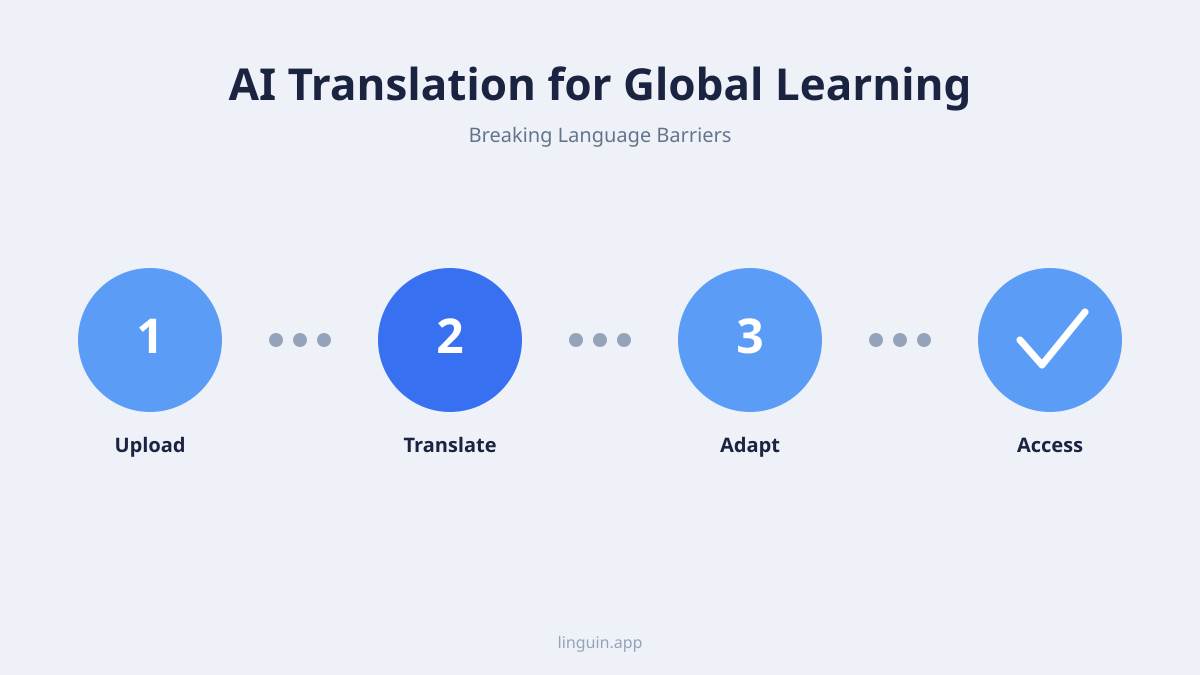
Breaking down specific barriers in digital learning
Educational platforms face distinct accessibility challenges that AI translation is uniquely positioned to solve. These barriers often exist at the points where learning happens: during instruction, in collaboration, and while engaging with materials.
The first major barrier is real-time comprehension. In live or recorded video lectures, traditional subtitling services are slow and expensive. AI-powered speech-to-text and translation can generate live captions in multiple languages, allowing students to follow along in their preferred language. Say an economics student in Brazil is attending a virtual seminar hosted by a professor in Germany. With AI translation integrated into the video platform, they can receive Portuguese subtitles with only a slight delay, grasping complex concepts as they are explained.
The second barrier is asynchronous material access. A vast amount of educational value resides in reading lists, lecture notes, academic articles, and platform documentation. Manually translating these resources for every potential language is impractical. AI translation allows for on-demand or bulk translation of text-based materials. A student can highlight a confusing paragraph in an English journal article and get an instant, contextually accurate translation into Mandarin, complete with proper handling of discipline-specific terms. This empowers self-directed learning and research.
Third, there is the barrier of collaborative isolation. Group projects and peer discussions are key to learning, but language differences can silo students. AI translation facilitates seamless multilingual communication in discussion forums, chat features, and shared documents. Students can post questions or ideas in their native tongue, and peers can read them in theirs, with the AI preserving the conversational tone and intent. This fosters a truly inclusive collaborative environment where knowledge sharing is not limited by language. The dynamics of such teamwork are explored further in our article on AI translation for remote multilingual teams.
Finally, AI helps overcome administrative and navigational hurdles. Platform interfaces, menus, assignment instructions, and institutional communications can be dynamically translated. This ensures that students and parents who are not proficient in the platform’s primary language can still navigate deadlines, requirements, and support services effectively, reducing frustration and dropout rates.
Preserving educational nuance and intent
The core value of education lies in the accurate transmission of knowledge, nuance, and critical thinking. A translation tool that merely conveys words can easily distort this intent. Advanced AI translation models excel by focusing on semantic meaning, tone, and pedagogical context.
Consider the translation of a literature syllabus. A simple tool might translate “irony” or “metaphor” directly, but an AI model, trained on literary corpora, understands these as concepts and can choose the most appropriate term in the target language that carries the same literary weight. In a history lesson discussing “colonialism,” the AI can be sensitive to the term’s connotations and ensure the translation reflects the academic and critical perspective presented in the source material, not a neutral or altered stance.
Technical and scientific education presents another layer of complexity. Jargon and industry terminology must be translated consistently and correctly. An AI system trained on scientific papers and textbooks learns that “neural network” in a computer science course has a specific meaning distinct from a casual reference to brain chemistry. It will maintain that terminological precision across languages. Similarly, in mathematics, the logical structure of a word problem is as important as the words themselves. AI models can parse this logic to ensure the translated problem is solvable and equivalent. For more on handling specialized language, see AI translation for technical jargon and industry terminology.
Instructional tone is also vital. Feedback from an instructor might use encouraging language, cautious criticism, or urgent directives. An effective AI translation captures that tone. “You need to reconsider this hypothesis” carries a different instructional intent than “This hypothesis has some weaknesses.” A context-aware AI discerns this difference, ensuring the student receives not just the message, but the appropriate pedagogical cue. This level of understanding extends to handling the informal grammar and slang that might appear in discussion forums or student-instructor communications, a topic covered in AI translation for informal grammar and slang.
Enabling scalable and cost-effective localization
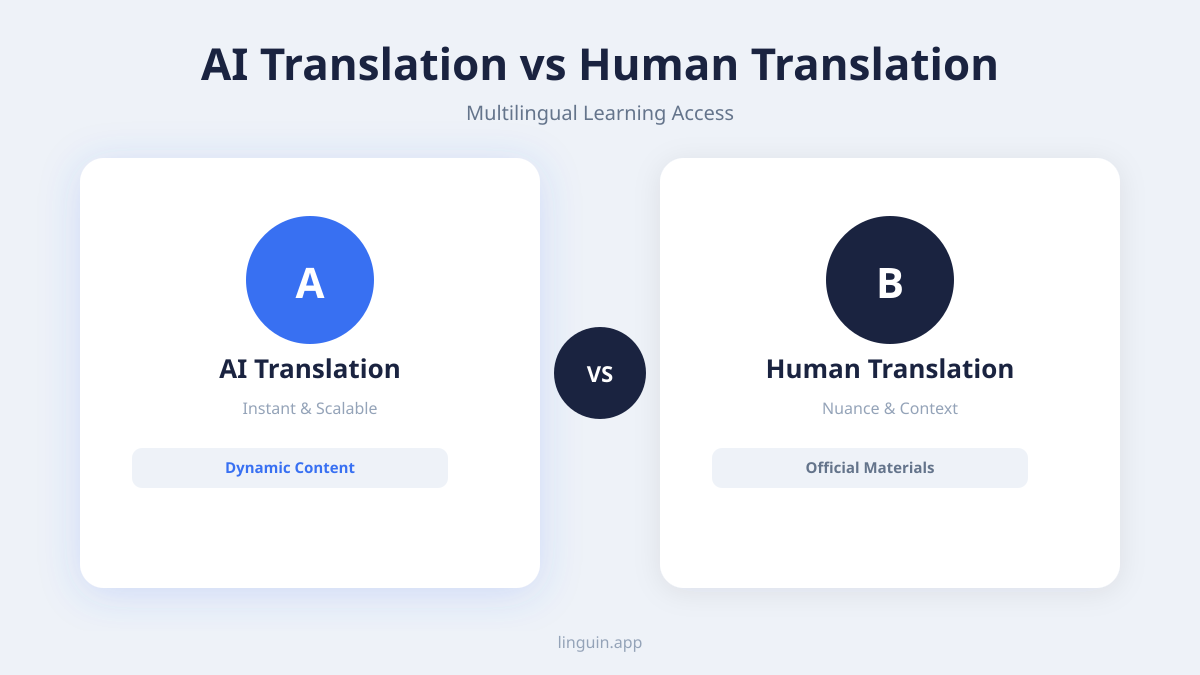
For educational institutions and ed-tech companies, reaching a global audience traditionally required a massive investment in human translation and localization. This process is slow, costly, and difficult to scale, often limiting multilingual offerings to only the most widely spoken languages. AI translation disrupts this model by providing a scalable, efficient, and consistent first layer of translation.
The scalability benefit is clear. An online course platform with 10,000 pages of content can use AI to produce draft translations into dozens of languages in a fraction of the time it would take a human team. This does not eliminate the need for human expertise. Instead, it redefines the role. Human educators or linguists can then act as reviewers and editors, focusing their valuable time on polishing the AI-generated output, checking for subtle cultural or academic nuances, and ensuring absolute quality. This human-in-the-loop model dramatically increases output and reduces costs.
Cost-effectiveness extends beyond simple text translation. Consider the localization of a full Massive Open Online Course (MOOC). It involves video subtitles, interactive quiz questions, assignment rubrics, forum prompts, and help documentation. AI can handle all these content types through a unified pipeline. A tool like Linguin can translate the interface strings, while specialized models handle speech transcription and translation for videos, and others manage the dynamic text in quizzes. This integrated approach makes comprehensive localization projects feasible for organizations with limited budgets.
Furthermore, AI enables continuous localization. As course content is updated or corrected, the corresponding translations can be regenerated or updated efficiently. This ensures that all language versions remain current and synchronized, maintaining a consistent quality of education across all supported languages. This agile approach is essential in fast-moving fields where educational material evolves quickly.
Fostering inclusive global classrooms and collaboration
The ultimate goal of multilingual accessibility is to create inclusive global classrooms where geography and native language are not obstacles to participation. AI translation is the infrastructure that makes this vision practical, transforming educational platforms into hubs for cross-cultural exchange and collaborative learning.
In a global classroom scenario, students from Japan, France, Mexico, and Egypt can work on a joint environmental science project. Using AI-integrated collaboration tools, they can communicate in their group chat, co-edit a shared research document, and present their findings, with language differences seamlessly mediated in real-time. Each student contributes in their language of comfort, and the AI ensures all team members understand each other. This not only completes the project but also provides a profound lesson in intercultural communication and perspective-taking.
For educators, this inclusivity expands their reach and impact. A professor can publish their lecture series, knowing that AI-powered subtitles and transcripts will make it accessible to non-native speakers. They can host Q&A sessions where questions submitted in various languages are translated for them, and their answers are translated back for the audience. This breaks down the one-way flow of information from traditionally dominant languages and enriches the discourse with diverse viewpoints.
This technology also supports lifelong and informal learning. Platforms hosting tutorials, how-to guides, and community forums for skills like coding, design, or music production can integrate translation to serve a global user base. A developer in Nigeria can learn from a tutorial originally written in Korean, and then contribute their own insights back to the community in their local language, which others can then translate. This creates a virtuous cycle of knowledge sharing that is truly democratized. The principles behind managing such multilingual community content are similar to those for AI translation for multilingual social media management.
Implementation considerations for educational platforms
Integrating AI translation into an educational platform requires thoughtful planning to maximize benefits and ensure responsible use. The goal is to enhance learning, not introduce new complexities.
The first consideration is quality and review protocols. While AI translation is highly accurate, it is not infallible, especially for high-stakes assessments, complex literary analysis, or sensitive cultural content. Platforms should establish clear guidelines. For core instructional materials and high-visibility content, a human review step is advisable. For dynamic, user-generated content like forum posts, real-time AI translation with a user-friendly mechanism for reporting inaccuracies can be sufficient. Transparency with users about when and how translation is being applied builds trust.
User control and customization are critical. Learners should have the ability to toggle translations on or off, choose their preferred language for different types of content (e.g., interface vs. lecture content), and in some cases, select between different levels of formality in the translation output. This empowers users to tailor the experience to their proficiency level and learning style. A beginner might want everything translated, while an advanced student might only turn on translation for particularly dense passages.
Data privacy and security are paramount in education. It is essential to choose translation solutions that comply with regulations like FERPA or GDPR. This means understanding where and how translation processing occurs, ensuring student data and submitted work are not stored or used for unintended purposes. On-platform processing or using providers with strong educational data privacy agreements is often necessary.
Finally, consider pedagogical integration. Translation should not be a standalone feature but woven into the learning workflow. This could mean embedding a “translate” button directly next to reading materials, offering multilingual caption tracks on video players, or providing translation options within the grading interface for instructors. The smoother the integration, the more naturally it will be used to support learning objectives.
Frequently asked questions
How accurate is AI translation for complex academic subjects?
AI translation for academic subjects has become highly accurate due to training on specialized corpora like scientific journals, textbooks, and research papers. It excels at handling consistent terminology and formal prose. However, for the highest stakes content, such as official diplomas or nuanced philosophical texts, a human expert review of the AI output is recommended to catch any subtle ambiguities.
Can AI translation handle real-time conversations in a virtual classroom?
Yes, modern AI translation tools can facilitate real-time multilingual conversations. Using speech-to-text, translation, and then text-to-speech or displayed text, they can provide near-simultaneous translation of spoken discussions. This allows students and instructors speaking different languages to interact with minimal delay, making live seminars and group work feasible.
Does using translation tools hinder language learning?
When used strategically, translation tools support rather than hinder language learning. They can serve as a scaffold, helping learners access challenging content in a target language without becoming overwhelmed. The key is for educators and learners to use them as a comprehension aid, not a crutch, and to encourage engagement with the original language when possible to build proficiency.
How do educational platforms manage the cost of translating into many languages?
AI translation dramatically reduces the cost compared to human-only translation. Platforms typically use AI for the initial, bulk translation of content. This scalable first draft is then refined by human editors only where necessary, focusing their expensive time on quality assurance for high-priority materials. This hybrid model makes supporting dozens of languages financially sustainable.
The path toward truly borderless education
AI translation is more than a convenient feature. It is becoming foundational infrastructure for equitable, global education. By breaking down the primary barrier of language, it unlocks human potential on a massive scale, allowing ideas, knowledge, and collaboration to flow freely across borders. The key takeaways are that this technology provides real-time access, preserves critical educational nuance, and does so in a scalable way that institutions can actually implement.
This same technology plays an even more urgent role outside the classroom, and our guide to AI translation in humanitarian crisis response looks at how aid workers use it when every minute counts.
The next step for any educator, administrator, or platform developer is to move from awareness to evaluation. Identify one specific pain point in your current environment, whether it’s inaccessible lecture videos, siloed discussion forums, or overwhelming reading lists for non-native speakers. Explore how a context-aware AI translation tool could address that single issue. Tools like Linguin are designed to integrate seamlessly, providing the accurate and natural translations that modern educational experiences require. By starting with a focused application, you can witness firsthand how AI translation enhances multilingual accessibility and opens up new possibilities for learners everywhere.