 English
  Español
  Français
  Deutsch
  Português
  Italiano
  Русский
  中文(简体)
  日本語
日本語  한국어
한국어  العربية
  हिन्दी
  Nederlands
  Türkçe
  Polski
AI translation is transforming multilingual academic peer review by enabling seamless understanding and feedback across language divides. For researchers, editors, and reviewers worldwide, this technology addresses a critical bottleneck in global knowledge dissemination. This article explains how AI translation tools enhance the peer review process, from manuscript evaluation to collaborative feedback, fostering a more equitable and efficient academic ecosystem. You will learn about the specific applications, benefits, and practical implementation of AI translation in scholarly communication.
Key takeaways
- AI translation allows journals to access a broader, more diverse pool of qualified reviewers, overcoming geographical and linguistic limitations.
- It enables non-native speaking researchers to participate fully in peer review by providing accurate, context-aware translations of complex academic texts.
- Real-time translation of reviewer comments and author rebuttals streamlines the revision process, reducing publication delays.
- Advanced AI models preserve technical terminology and disciplinary nuances, ensuring the intellectual rigor of feedback is maintained across languages.
The language barrier in global peer review
Academic peer review is the cornerstone of scholarly publishing, ensuring quality, validity, and credibility. However, its effectiveness is inherently limited by language. The dominant use of English creates a significant barrier for researchers who are experts in their field but not fluent in academic English. This leads to several systemic issues. High-impact journals often struggle to find enough qualified reviewers for specialized topics, while a vast pool of potential reviewers in non-English speaking regions remains untapped. Authors submitting manuscripts in their second language may receive critiques focused on language issues rather than scientific merit, and reviewers may hesitate to accept invitations due to the cognitive load of evaluating a non-native text.
The consequence is a slower, less inclusive, and potentially biased review process. Groundbreaking research can be delayed or overlooked because it originates from a linguistic context outside the mainstream. The ideal of peer review as a meritocratic system is compromised when language proficiency becomes a prerequisite for participation. AI translation directly addresses this bottleneck. By providing immediate, sophisticated translation of manuscripts, cover letters, and reviewer reports, it levels the playing field. It allows editors to match submissions with the best experts globally, irrespective of their primary language. For a deeper look at how AI handles complex academic texts, consider reading about AI translation for multilingual research papers.
How AI translation works for academic texts
Modern AI translation for academia goes far beyond simple word-for-word substitution. It employs large language models trained on massive datasets that include scholarly publications, technical manuals, and domain-specific corpora. This training allows the AI to understand and replicate the formal tone, complex syntax, and precise terminology characteristic of academic writing. The core capability is context-aware translation. The AI analyzes entire sentences and paragraphs to discern meaning, ensuring that technical terms are translated consistently throughout a document and that ambiguous phrases are resolved based on the surrounding subject matter.
For example, the word “cell” must be translated differently in a biology paper versus a materials science manuscript. Advanced AI models make these distinctions automatically. They also handle challenges like citations, figure legends, and mathematical formulas with greater care, often leaving standard notation and references intact while translating the explanatory text. Furthermore, these systems can be fine-tuned for specific disciplines, improving their grasp of niche jargon. This results in translations that preserve the original argument’s logic, nuance, and rigor, making them reliable enough for the demanding context of peer review. Understanding the mechanisms behind this reliability is key, as explored in our article on AI translation accuracy.
Practical applications in the review workflow
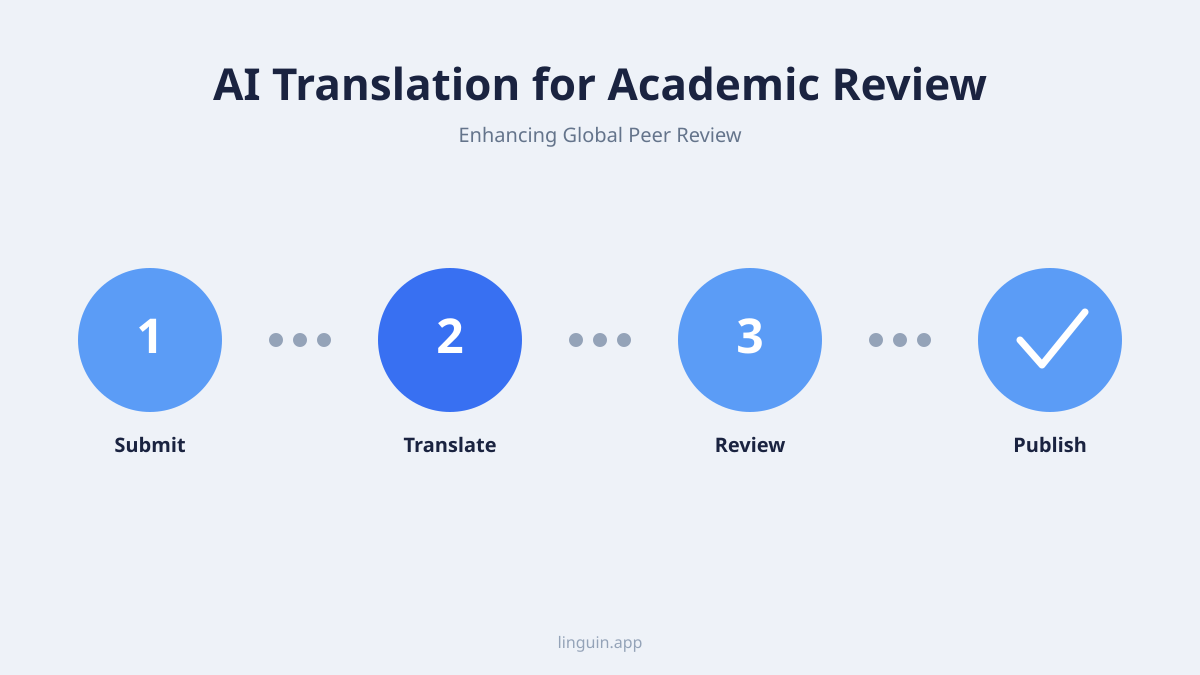
The integration of AI translation can streamline every stage of the peer review lifecycle. Its applications are practical and immediately impactful for editors, reviewers, and authors.
For journal editors and editorial staff: The first challenge is identifying reviewers. Editors can use AI translation to quickly assess the abstracts and keywords of potential reviewers’ published work, even if it is in another language. When sending a review invitation, the editor’s request and the manuscript abstract can be translated into the reviewer’s preferred language, increasing the likelihood of acceptance. Managing the process becomes easier as correspondence with all parties can be conducted in multiple languages seamlessly.
For reviewers: A reviewer fluent in Mandarin but less confident in English can receive the manuscript with a precise, AI-generated translation alongside the original. They can read the translation to grasp the core concepts and methods quickly, then refer to the original text for detailed scrutiny of specific data and phrasing. When writing their report, they can draft comments in their native language and use AI translation to produce a clear, polished English version for the author and editor. This empowers them to provide deeper, more substantive feedback on the research itself rather than struggling with language expression.
For authors: Authors can use AI translation to understand reviewer comments thoroughly. A comment like “The methodology lacks rigor” might have nuanced subpoints that are crucial to address. Accurate translation ensures the author comprehends every critique. In their rebuttal letter, authors can draft responses in their native language, translate them accurately, and ensure their arguments are communicated effectively to the editor and reviewers, facilitating a more productive revision cycle. This collaborative aspect is crucial, as detailed in our piece on AI translation for multilingual research collaboration.
Enhancing feedback quality and inclusivity
The ultimate goal of integrating AI translation is to improve the quality and inclusiveness of scholarly feedback. Quality improves because the best available expertise can be engaged. A leading expert on a specific type of archaeological pottery might publish primarily in Italian. With AI translation, an English-language journal can confidently invite that expert to review a relevant submission, securing feedback that a more readily available, but less specialized, English-speaking reviewer could not provide. The feedback becomes more focused on the discipline’s core intellectual questions.
Inclusivity is enhanced by democratizing participation. Early-career researchers from non-Anglophone institutions can build their peer review portfolios without being penalized for language barriers. This professional development is crucial for their careers and diversifies the perspectives that shape published literature. Furthermore, it encourages the submission of high-quality research from a wider range of countries and institutions, knowing that the review process will be fair and comprehensible. This breaks down the hegemony of English and allows global knowledge production to flow more freely in all directions, enriching all academic disciplines.
Addressing concerns about accuracy and nuance
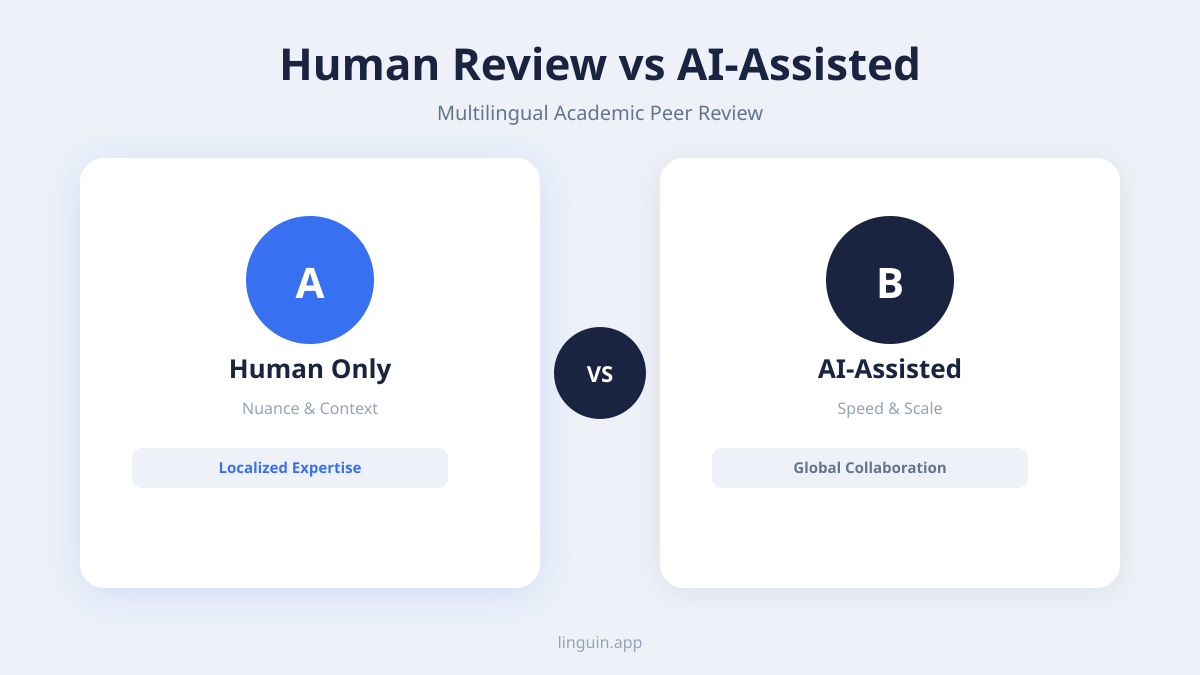
A legitimate concern is whether AI translation can be trusted with the subtle, high-stakes communication of peer review. The fear is that a mistranslated technical term or a softened critical phrase could distort feedback or misrepresent the research. It is important to frame AI translation as an assistive tool, not a replacement for human judgment. The current best practice is a human-in-the-loop model. The AI provides the initial translation, which a human with domain knowledge then verifies. For a reviewer, this might mean skimming the AI-translated manuscript and spot-checking key sections against the original.
The strengths of modern AI mitigate many traditional risks. As mentioned, context-aware models significantly reduce errors with technical jargon. Furthermore, AI does not suffer from fatigue or inconsistency; it applies the same rigorous analysis to the last page as it did to the first. For handling specific linguistic challenges common in academic writing, such as complex idioms or cultural references, AI systems have advanced considerably. While not perfect, the accuracy level is sufficient to convey the substantive content of a manuscript or review report reliably. The human expert provides the final quality check, ensuring that nuance and tone are appropriate. This collaborative approach balances efficiency with the necessary precision for academic integrity. Learn more about how AI handles subtleties in AI translation for idioms and cultural nuances.
Implementation for journals and individual researchers
Adopting AI translation for peer review can be approached at both an institutional and individual level. For journals and publishers, integration can range from simple to sophisticated. A straightforward start is to provide editors and editorial assistants with access to a professional AI translation platform like Linguin. They can use it on an as-needed basis to translate correspondence, reviewer profiles, and parts of manuscripts. A more integrated approach involves partnering with a translation API provider to build features directly into the manuscript submission and review system. This could allow reviewers to toggle a translated view of a manuscript within the editorial portal or automatically translate author rebuttals.
Individual researchers and reviewers can adopt the technology immediately. As a reviewer, you can use a browser extension or desktop app to translate a PDF manuscript you have been assigned. As an author, you can translate reviewer comments before drafting your response. The key is to choose a tool designed for accuracy and formal language, not just casual conversation. Look for features that allow you to compare the original and translated text side-by-side, which is invaluable for verification. Starting with a focused use case, such as understanding the core argument of a non-native manuscript, allows you to build confidence in the technology’s utility for your academic work. For those managing larger projects, the principles in AI translation for multilingual project management can be highly applicable.
The future of multilingual scholarly communication
The trajectory points toward a more deeply integrated, multilingual scholarly ecosystem. AI translation will likely become a standard, background feature of major publishing platforms, much like spell-check is today. We may see the development of specialized translation models for hundreds of scientific sub-disciplines, offering even greater precision. Furthermore, the technology could enable new forms of peer review, such as collaborative, real-time discussions among reviewers from different language backgrounds about a single manuscript, with AI providing live translation.
This evolution supports the broader open science movement by making the process of evaluation more transparent and accessible. It also encourages the growth of respected regional and national journals in languages other than English, as their content can become more easily discoverable and citable globally through high-quality translation. The future is not a single academic language, but a connected network of many languages, where AI translation acts as the vital connective tissue, ensuring that the best ideas can be shared, tested, and refined by the global community best equipped to judge them.
Frequently asked questions
Is AI translation accurate enough for critical academic feedback?
Yes, for conveying substantive content. Modern AI translation models are trained on vast academic corpora, allowing them to handle technical terminology and complex sentence structures with high reliability. They are best used as an assistive tool where a human expert reviews the AI output, especially for nuanced or critical phrasing. This hybrid approach ensures accuracy while leveraging AI for speed and accessibility.
Can AI translation handle highly specialized disciplinary jargon?
Advanced AI systems excel at consistent terminology management within a specific context. They can distinguish between different meanings of the same word based on the academic field, such as “conduction” in physics versus physiology. For the most niche sub-disciplines, the accuracy continues to improve as models are refined, but verification by a subject-matter expert remains a recommended step for critical documents.
How does this differ from using traditional translation services?
AI translation provides instant, on-demand results at a fraction of the cost, making it feasible for the high-volume, time-sensitive peer review process. While human professional translators offer superior nuance for final publication, AI is ideal for the iterative, communicative stages of review. It enables real-time understanding and dialogue that would be prohibitively slow and expensive with human-only translation.
Will this increase the workload for reviewers and editors?
Initially, there may be a learning curve. However, the tool is designed to reduce workload in the long term. It eliminates the time spent deciphering challenging language, allows editors to find reviewers faster, and helps all parties communicate more clearly. The net effect is a more efficient process with fewer misunderstandings and delays.
Are there ethical concerns about using AI in peer review?
The primary ethical consideration is transparency. Journals should have clear policies on the use of AI translation, and it may be appropriate to disclose its use in the review process, similar to disclosures for AI writing assistance. The goal is to use the technology to support human judgment and inclusivity, not to obscure the source of feedback or automate decision-making.
Integrating AI translation into your academic workflow
The evidence is clear that AI translation for academic peer review is a powerful tool for breaking down language barriers, expanding the reviewer pool, and improving the quality of scholarly dialogue. By ensuring that expertise, not language fluency, is the primary criterion for participation, the academic community can become more equitable, efficient, and rigorous. The technology is here, accessible, and mature enough to make a tangible difference.
The most effective next step is to experiment with a specific, real-world task. If you are a reviewer, try using an AI translation tool like Linguin on the next manuscript you receive that is outside your primary language. Use it to gain a quick understanding of the paper’s structure and argument before diving into the original text. If you are an author, use it to ensure you have perfectly understood every point in a reviewer’s report. By integrating this tool into your existing process, you will experience firsthand how it reduces friction and amplifies your ability to engage with global scholarship. Linguin, with its focus on context-aware AI models across 100+ languages, is built to support these precise academic needs.