
 English
  Español
  Français
  Deutsch
  Português
  Italiano
  Русский
  中文(简体)
  日本語
日本語  한국어
한국어  العربية
  हिन्दी
  Nederlands
  Türkçe
  Polski
Translating financial reports is a critical task that demands absolute precision and a deep understanding of financial terminology. For global businesses, investors, and analysts, accurate translation is not just about converting words, it is about preserving the integrity, legal standing, and meaning of complex financial data. This guide is for finance professionals, corporate communicators, and anyone responsible for making financial information accessible across languages. You will get a comprehensive framework for approaching financial translation, from selecting the right tools to implementing rigorous quality checks.
Key takeaways
- Financial translation requires context-aware AI to handle industry-specific jargon, numerical data, and regulatory phrasing.
- A hybrid process combining AI translation with expert human review is the most effective method for ensuring accuracy and compliance.
- Choosing a translation tool with strong data security, format preservation, and glossary support is essential for professional results.
Why financial translation is uniquely challenging
Financial documents are a distinct category of text. Unlike marketing copy or casual correspondence, they carry legal weight, influence investment decisions, and must adhere to strict regulatory standards. A single mistranslated term can alter the perceived risk of an investment, misstate a company’s liabilities, or lead to non-compliance with local financial authorities. The challenge lies in the dense, technical nature of the content.
The primary hurdles include specialized terminology. Terms like “amortization,” “derivative,” “goodwill,” or “EBITDA” have precise, non-negotiable definitions. Translating them requires more than a dictionary equivalent, it demands an understanding of the underlying accounting concept. Furthermore, financial language is full of regulatory boilerplate and standardized disclosures. Phrases from frameworks like IFRS or US GAAP must be translated consistently and correctly to maintain the document’s legal validity.
Nuance and context are paramount. Consider the word “liability.” In a legal section, it might refer to a lawsuit. In the balance sheet, it is an accounting entry. A capable translation system must discern this difference. Numbers, dates, and currencies add another layer. A misplaced decimal in a revenue figure or an incorrect currency symbol (¥ vs. ¥) can have serious consequences. The translator, whether human or AI, must treat numerical data as sacred and untouchable, focusing only on the surrounding explanatory text.
Finally, tone and style are formal and objective. Financial reports avoid ambiguity, persuasion, and creative language. The translation must replicate this neutral, factual tone, avoiding any informal phrasing that could undermine the document’s authority. This requires a tool trained on formal and technical corpora, not just everyday web text.
Core principles for accurate financial translation
To achieve reliable results, you must build your translation process on a few foundational principles. These principles guide tool selection, workflow design, and quality assurance.
The foremost principle is accuracy over fluency. While natural-sounding prose is desirable, perfect fidelity to the original meaning is non-negotiable. It is better to have a slightly clunky but precisely accurate sentence than a graceful one that introduces error. This means prioritizing translation engines that excel at technical and formal content, even if they are less creative with colloquial language.
Consistency is the second pillar. Every instance of a specific term must be translated the same way throughout the document, and ideally, across all of a company’s publications. Inconsistency confuses readers and can be perceived as unprofessional or sloppy. For example, if “cash flow from operations” is translated one way in the executive summary and another in the notes to the financial statements, it erodes trust. Implementing and using a translation glossary or term base is the best way to enforce this.
The third principle is context preservation. Financial statements are interconnected narratives. The income statement, balance sheet, and cash flow statement tell a combined story. Notes explain and qualify the numbers. The translation must maintain these logical links. A translator must see beyond the individual sentence to understand how a note on “lease obligations” relates to the liability line item on the balance sheet. Modern AI translation models that process larger chunks of text are better at maintaining this context than older phrase-based systems.
Security and confidentiality form the critical fourth principle. Financial reports contain sensitive, non-public information. The translation process must guarantee data privacy. This involves understanding where and how your translation tool processes text. Opt for solutions that offer local processing or robust, encrypted cloud environments with clear data governance policies, avoiding tools that might use your data for general model training.
Choosing the right translation tool: AI and beyond
With the principles in mind, selecting the appropriate technology is your next step. The landscape has moved far beyond simple word-for-word substitution. Today’s best tools use large language models (LLMs) and neural machine translation (NMT) that understand context.
For financial content, you need a tool built for domain-specific translation. General-purpose translators often stumble on financial jargon. Look for an application that lets you select a formal or technical translation style, or one that is known for its performance with technical documents. Linguin, for example, offers formal and technical styles on its paid plan that route through a hosted AI model rather than a flat, one-size-fits-all engine. Be aware that not every tool handles file formats like PDFs, Excel spreadsheets, or Word documents directly, Linguin doesn’t, it works with text you paste in, so plan on copying content out of those files rather than uploading them.
A key feature to prioritize is custom term support. Linguin’s paid plan includes a custom dictionary where you save your own word and term replacements, so a company name, internal metric, or branded financial concept always translates the same way. It’s a manual list you maintain yourself rather than an uploaded glossary file, and it doesn’t retrain any underlying model, but it’s an effective way to enforce consistency across everything you translate.
Consider the workflow integration. Are you translating ad-hoc snippets in a web browser, or entire annual reports as documents? A best translation Chrome extension is perfect for quickly checking a foreign financial news article, translating a whole investor relations page in place, or grabbing a quick translation of a specific snippet. For heavier, dedicated work, a dedicated AI translator for Mac is useful for pasting in longer passages section by section, keeping in mind it requires an internet connection for every translation, there’s no offline mode. For comprehensive comparisons of capabilities, reviews like those in best translation apps compared can be helpful.
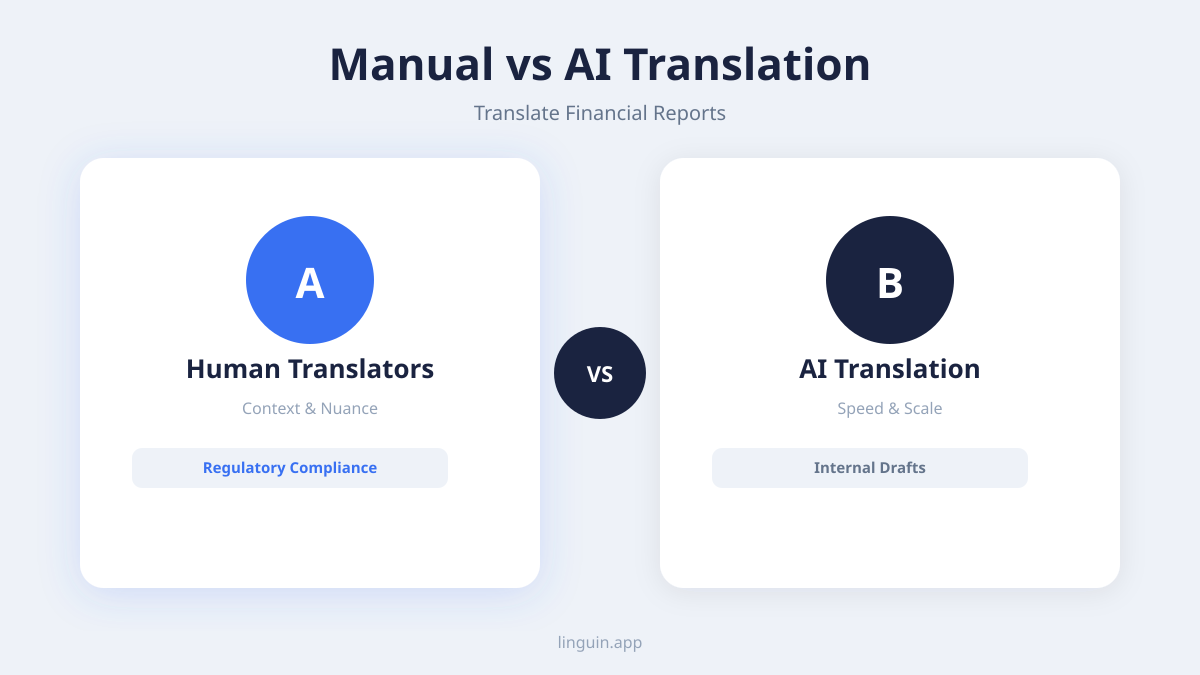
Remember, the tool is an assistant. The optimal setup for mission-critical documents is a hybrid approach: use a high-quality AI tool for the first draft to ensure speed and consistency, then have a human expert-a bilingual financial professional or a specialized translator-review the output. The human reviews for nuance, regulatory alignment, and subtle errors that AI might miss. This combines the scale of AI with the judgment of human expertise.
Step-by-step process for translating a financial report
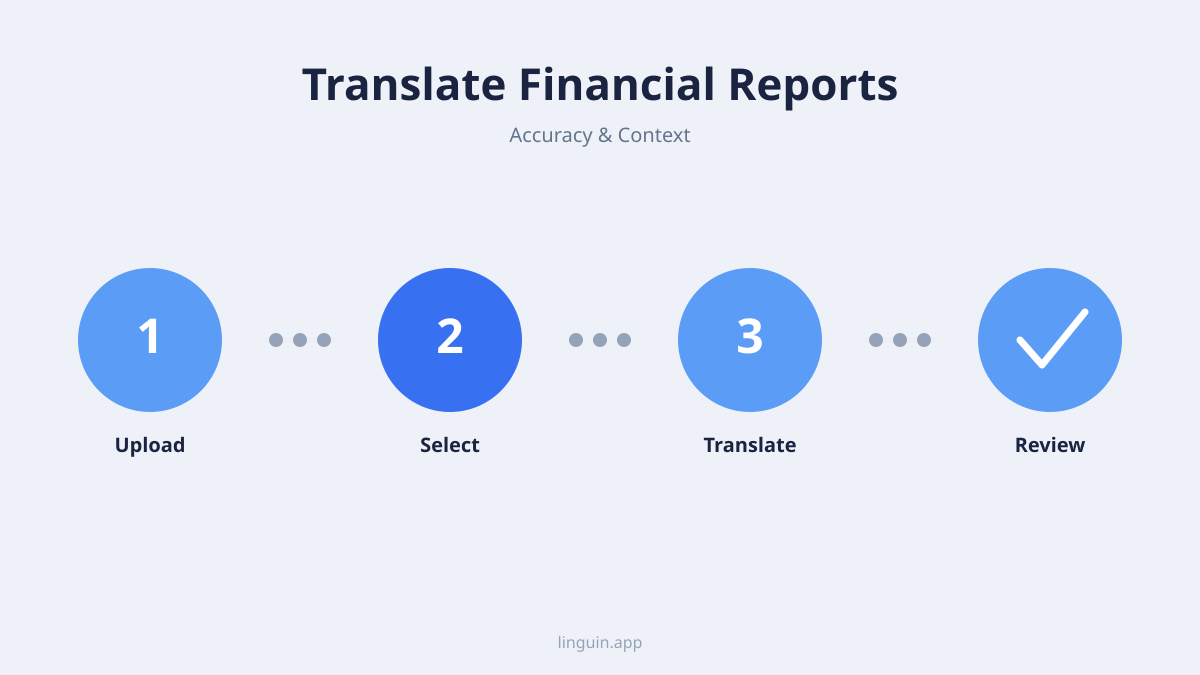
Let’s walk through a practical, end-to-end process you can follow. This process minimizes risk and maximizes the quality of your final translated document.
Step 1: Preparation and glossary creation. Before you translate a single word, gather your reference materials. This includes previous translated reports, a list of company-specific terms, and the original document in its best editable format (e.g., .docx over a scanned PDF). Create or update your translation glossary. Define how mandatory terms like “Board of Directors,” “Annual General Meeting,” and key financial ratios will be rendered.
Step 2: Initial AI translation. Use your chosen translation tool to process the document. If the tool allows, select the “formal” or “business” language style. Ensure the tool is set to preserve numbers, dates, and formatting. For a large report, break it into logical sections (e.g., Management Discussion, Financial Statements, Notes) and translate them separately. This makes the review process more manageable. A service known for best document translation service will typically excel at this stage.
Step 3: Bilingual review for accuracy. This is the most critical quality gate. A reviewer with fluency in both the source and target languages, and knowledge of finance, must compare the original and the translation line-by-line. They check for terminological accuracy, completeness (no skipped sentences), and correct handling of numbers and symbols. They will also verify that the glossary was followed.
Step 4: Monolingual review for readability. A native speaker of the target language, ideally a finance professional, then reads the translated document alone. Their job is to assess clarity, flow, and natural use of financial language in the target culture. Does it sound like a professional financial report written in, say, German, or does it sound like a translation from English? They fix awkward phrasing while ensuring no meaning is altered.
Step 5: Formatting and final validation. Reassemble the reviewed sections into the final document. Meticulously check that all formatting, pagination, table structures, and graphs with text labels are correct. Perform a final spot-check on high-risk areas: the auditor’s opinion, legal disclaimers, and the summary of significant accounting policies.
Say you’re an analyst based in London needing to understand a Japanese company’s quarterly earnings release. You could use a browser extension to get a quick, gist-level understanding of the management commentary. However, for a detailed investment memo, you would follow the full process above, perhaps using the AI for a draft and then consulting a Japanese-speaking colleague for the review of nuanced sections about market risks.
Common pitfalls and how to avoid them
Even with a good process, specific errors commonly creep into financial translations. Being aware of them helps you guard against them.
Literal translation of idioms. Financial English uses idioms like “bottom line,” “cook the books,” or “blue-sky thinking.” Translating these word-for-word will confuse or amuse international readers. The correct approach is to translate the meaning. “Bottom line” becomes “net profit” or “the essential point,” depending on context. A good AI model with strong contextual understanding will often handle this well, but a human reviewer must be vigilant.
Mishandling of proper nouns and regulations. Company names, accounting standard names (e.g., “International Financial Reporting Standards”), and regulatory bodies (e.g., “Securities and Exchange Commission”) often should not be translated. The acronyms IFRS and SEC are used globally. The translator must recognize which proper nouns to leave in the original form. Similarly, translating the name of a law or act without verification can lead to inaccuracies.
False friends and decimal conventions. “Billion” in US English (10^9) is not the same as a “billion” in some European languages (10^12). This is a classic false friend with monumental consequences. Furthermore, decimal separators differ: 1,000.50 in English becomes 1.000,50 in many European languages. A robust translation tool should preserve the numerical value but may need guidance on local formatting conventions for the final presentation.
Overlooking cultural and legal nuances. Disclosure requirements and the expected tone of a financial report can vary by country. What is considered a standard risk warning in one jurisdiction might be seen as overly alarming or insufficiently cautious in another. While a translation tool cannot navigate this alone, being aware of this pitfall prompts the human reviewer to consider if the translated text meets the target audience’s cultural and legal expectations.
Integrating translation into your financial workflow
For finance teams that regularly produce multilingual content, ad-hoc translation is inefficient. The goal is to integrate translation seamlessly into your document creation and publishing workflow.
Start by standardizing your source documents. Use clear, unambiguous language in the original report. Avoid slang, complex sentence structures, and cultural references. This “controlled English” makes the translation task easier and more accurate for both AI and human translators. Establish templates for recurring sections like the notes to the financial statements.
Leverage technology stacks. Many modern content management and investor relations platforms have APIs that can connect to translation services. This allows for smoother handoffs. You could automate the first-pass translation of press releases or quarterly summaries as soon as they are approved for release, speeding up time-to-market for global audiences.
Build a review squad. Identify in-house bilingual subject matter experts or partner with a trusted external translation agency that specializes in finance. Make them part of your process early. Their feedback can also be used to continuously refine your AI tool’s glossary and settings, creating a virtuous cycle of improvement. Understanding the ongoing advancements in the field is useful, as covered in articles like AI translation accuracy 2026.
Finally, audit and iterate. After each major translation project, conduct a brief retrospective. What errors were caught late? Which terms caused confusion? Use these insights to update your glossary and process guidelines for the next cycle. This continuous improvement turns translation from a cost center into a reliable component of your global communication strategy.
Frequently asked questions
Can AI accurately translate complex financial tables?
It depends on the tool. Some document-translation services include OCR and layout preservation and can translate text within a table while leaving numbers and structure intact. Linguin doesn’t read files or images, it translates text you paste in, so for a table-heavy report the practical approach is to copy the line-item labels out of the table, paste them into Linguin, and place the translated labels back into your original table by hand. A human should always verify data alignment regardless of which tool produced the draft.
How do I handle translations for legally binding documents like annual reports?
For legally binding documents, AI translation should be used only as a powerful first-draft assistant. The final output must undergo a rigorous review and sign-off by qualified human professionals. This often means using a certified legal or financial translator who can attest to the accuracy of the translation. The human is responsible for ensuring the translation meets all jurisdictional legal requirements, which is a liability AI cannot currently assume.
What is the biggest risk of using free online translators for financial data?
The biggest risks are data privacy and inconsistent accuracy. Free tools may not have robust security measures, and their terms of service might allow them to use your submitted text to train their public models, potentially exposing sensitive financial data. Their translation models are also generalized and may not handle financial terminology well, leading to unpredictable errors and a lack of glossary support for consistent term use.
Is it necessary to translate all parts of a financial report?
Not always. The core financial statements (balance sheet, income statement, cash flow) are often presented with numbers that are universally understood, but their line-item descriptions need translation. The management commentary, notes to the accounts, auditor’s report, and legal notices almost always require full translation to be meaningful to a foreign reader. The decision should be based on the needs of the target audience and any regulatory requirements for disclosure in that language.
Final thoughts on modern financial translation
Translating financial reports is a high-stakes endeavor that blends linguistic skill with deep financial expertise. The core goal remains unchanged: to produce a document in a new language that is as precise, reliable, and legally sound as the original. What has changed is the toolkit available. AI-powered translation acts as a force multiplier, handling the bulk of the work with impressive speed and consistency, while human experts provide the indispensable layer of nuanced review and professional judgment.
The most successful approach is a hybrid one. Start with a capable, secure AI tool that understands formal context and supports your terminology. Follow a disciplined process of preparation, AI-assisted drafting, and multi-stage human review. By integrating these steps into your financial workflow, you turn a daunting challenge into a manageable, repeatable operation.
A practical next step is to test the process with a lower-stakes document, such as an internal financial summary or a public earnings press release. Use a dedicated tool like Linguin to see how context-aware AI handles the specific jargon and format of your content. This hands-on experience will show you where the technology excels and where your expert review is most valuable, allowing you to scale the process confidently to your most critical reports.
-vs-translator.png)