 English
  Español
  Français
  Deutsch
  Português
  Italiano
  Русский
  中文(简体)
  日本語
日本語  한국어
한국어  العربية
  हिन्दी
  Nederlands
  Türkçe
  Polski
Need to understand French audio in English? You can translate french to english audio by converting the spoken French into English text or speech. This capability is vital for anyone consuming French media, collaborating with French speakers, or traveling. Whether you’re a student, a professional, or a curious listener, this guide will walk you through the most effective methods and tools for achieving accurate and natural-sounding translations.
Key takeaways
- AI-powered tools can transcribe French audio to text and then translate it to English in a single, seamless process.
- The accuracy of audio translation depends heavily on audio quality, speaker clarity, and the AI model’s understanding of context and dialects.
- For the best results, use tools designed for real-time conversation translation or batch processing of audio files, depending on your specific need.
What is audio translation?
Audio translation is the process of converting spoken language from one tongue into written or spoken language in another. It involves two core steps: speech recognition and language translation. First, an automatic speech recognition (ASR) system transcribes the spoken French audio into French text. Second, a machine translation engine converts that French text into English text. Some systems add a third step: text-to-speech synthesis to produce spoken English audio from the translated text. This end-to-end process allows you to hear French and understand it in English almost instantly.
The primary challenge in audio translation is that speech is messy. Unlike clean text, audio contains accents, regional dialects, background noise, overlapping speakers, and informal grammar. A robust audio translation system must handle these variables to produce a coherent and accurate result. Modern AI models are trained on vast datasets of spoken and written language, enabling them to navigate these complexities better than older, rules-based systems.
Common use cases for translating French audio to English are diverse. A student might use it to understand a French lecture or podcast. A business professional could translate a recorded meeting with a Paris-based team. A traveler might use it to decipher announcements or have a real-time conversation. The need spans from pre-recorded media to live, interactive dialogue.
Methods for translating French audio to English
You have several pathways to translate french to english audio, each with its own strengths. The method you choose depends on factors like whether the audio is live or recorded, your need for speed versus accuracy, and the tools at your disposal.
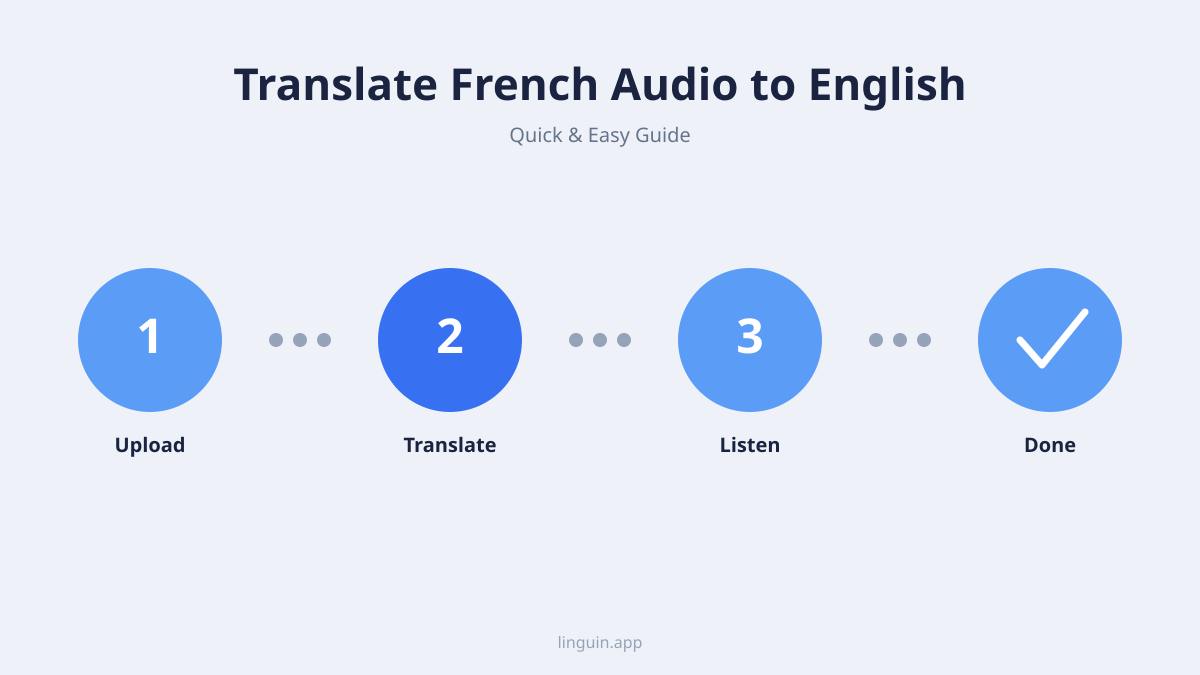
The first method is a manual, two-step process. You can use a speech-to-text tool to generate a French transcript, then paste that transcript into a text translation tool. This approach offers control, as you can review and edit the transcript for errors before translation. It is suitable for important, pre-recorded audio where precision is critical, such as legal proceedings or academic materials. However, it is time-consuming and not feasible for real-time needs.
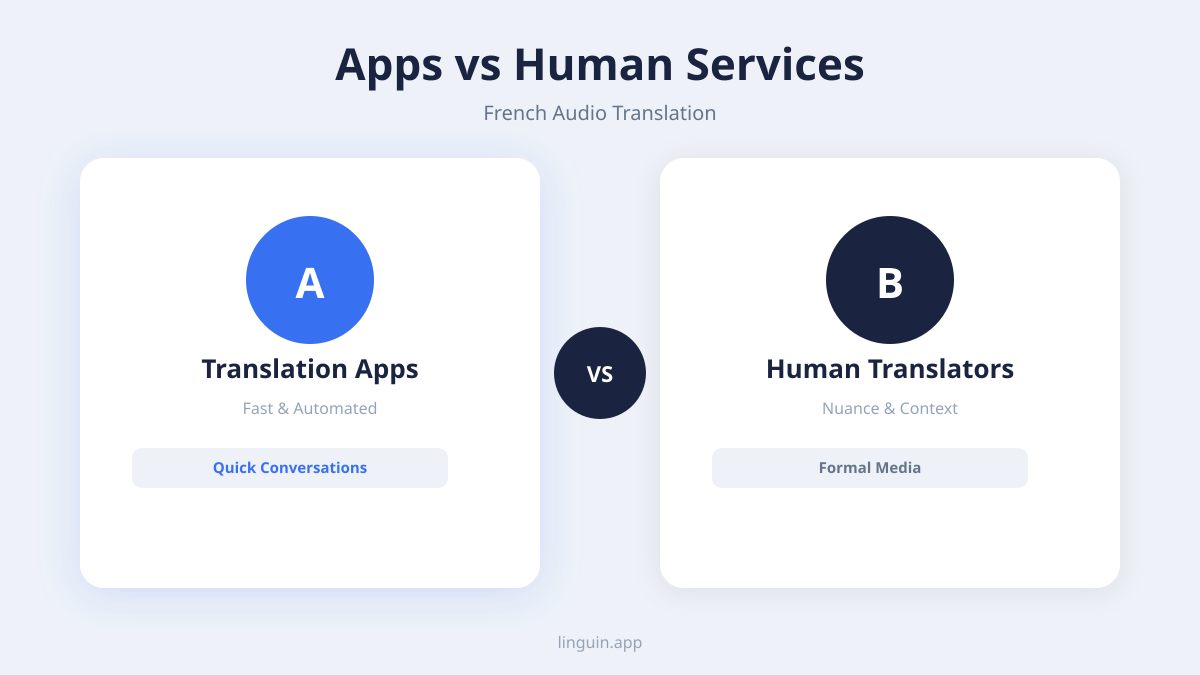
The second, more efficient method is using an integrated AI translation app. These tools combine speech recognition, translation, and often text-to-speech into one action. You speak or play French audio into the app, and it outputs English text or speech directly. This is ideal for live conversations, customer support calls, or quickly understanding media. The integration ensures faster results and often benefits from context-aware AI that improves as the conversation continues.
A third method involves specialized software for batch processing. If you have many audio files-like a series of French interviews or podcasts-batch tools can process them all at once, outputting translated transcripts or subtitles. This is powerful for content creators, researchers, or project managers handling large volumes of audio data.
Key challenges in French to English audio translation
Translating audio is inherently more complex than translating text. When the source is French audio, specific linguistic and technical hurdles arise that can impact the quality of your English output.
Accents and dialects present a major challenge. French spoken in Paris differs from that spoken in Marseille, Quebec, or Dakar. Variations in pronunciation, vocabulary, and rhythm can confuse speech recognition engines. An AI model trained predominantly on Metropolitan French might stumble with a strong Québécois accent, leading to transcription errors that cascade into the translation. Choosing a tool with a broad training dataset that includes diverse French accents is crucial for reliable results.
Audio quality and background noise are critical factors. Poor recording quality, low microphone levels, or ambient sounds like traffic or music can garble the speech signal. Clear, well-recorded audio from a single speaker yields the best outcomes. For live translation, speaking clearly and minimizing background noise is a simple but effective best practice.
Linguistic nuances like idioms, humor, and cultural references are difficult to capture. A French idiom translated literally into English may be nonsensical. Advanced AI translation tools now use context-aware models to interpret the intended meaning, not just the literal words. For a deeper dive into how AI handles these subtleties, read our guide on AI translation for idioms and cultural nuances. Furthermore, the tone and formality of the speech must be preserved. Translating a casual conversation between friends requires a different approach than translating a formal business presentation. Our article on managing formal and informal tone in emails explores this challenge in written form, with principles that apply to speech.
Top tools for French audio translation
Selecting the right tool is essential for an effective workflow. The best tool for you depends on whether you need real-time conversation translation, offline capability, or batch processing of files.
Dedicated translation apps like Linguin are built for this specific task. Available across macOS, iOS, and as browser extensions, they allow you to translate live speech, audio files, and even text within other apps. The key advantage is integration; the transcription and translation happen in a unified environment, often with features like conversation mode (where the app listens and translates alternating speakers) and the ability to copy or speak the translated output. This seamless experience is ideal for dynamic, real-world use.
Browser-based tools are convenient for quick, one-off translations without installing software. You upload an audio file or grant microphone access on a website, and it processes the audio in the cloud. These are useful for translating short clips or for users on shared computers. However, they require a stable internet connection and may have file size or length limitations.
Professional transcription services with translation add-ons offer human-reviewed accuracy. You upload your French audio file, and the service provides a professionally transcribed and translated English transcript. This is the gold standard for high-stakes audio like legal depositions, medical records, or published content where absolute accuracy is non-negotiable. It is, however, the most expensive and slowest option, unsuitable for real-time needs.
For scenarios involving specialized vocabulary, such as in academic or technical fields, general tools may falter. In these cases, look for tools that allow custom glossaries or that are trained in specific domains. For instance, translating a French physics lecture requires different terminology than translating a French film.
Best practices for accurate audio translation
To get the best possible English output from your French audio, follow these operational and technical guidelines. Good practices can significantly improve the accuracy and usefulness of the translated result.
First, optimize your source audio. If you are recording speech for translation, use a good quality microphone in a quiet room. Speak clearly at a moderate pace. If you are working with existing audio, use audio editing software to reduce background noise, normalize volume, and trim silences before feeding it into the translation tool. Clean audio input is the most effective way to prevent errors.
Second, provide context when possible. Many advanced AI translation tools allow you to give a hint about the subject matter. Specifying that the audio is a “technical engineering discussion” or a “casual restaurant conversation” helps the AI choose the appropriate vocabulary and tone. This context is especially valuable for handling words with multiple meanings.
Third, review and edit the output. Even the best AI can make mistakes with homophones, proper names, or fast speech. Always review the translated English text for any obvious errors. If the tool offers a text-to-speech output, listen to it to ensure it sounds natural. For critical projects, a human review step is indispensable.
Consider this scenario: You are a project manager on a multilingual team. You receive a voice message from a French colleague detailing updates. To ensure you understand every nuance, you use an app to translate the audio, but you also skim the transcript for any technical terms that might have been misheard. This combination of tool use and human oversight guarantees clear communication.
Another scenario involves media consumption. You are watching a French news report. Using a browser extension with translation capabilities, you get real-time English subtitles. To improve accuracy, you ensure the video’s audio is playing clearly through your device’s speakers, not from a poor-quality laptop microphone picking up room noise.
Applications and use cases
The ability to translate french to english audio unlocks possibilities across education, business, media, and daily life. Understanding these applications helps you leverage the technology effectively.
In education and research, students and academics use audio translation to access French-language lectures, conferences, and interviews. This breaks down language barriers in global scholarship. A researcher can quickly grasp the key points from a French podcast in their field without needing fluency. For collaborative academic work, this technology is transformative. Learn more about its impact in our article on AI for multilingual academic research collaboration.
In business and global commerce, professionals use it for multilingual meetings, investor calls, and customer support. A support agent can use real-time translation to assist a French-speaking customer, improving response times and satisfaction. For e-commerce, understanding customer feedback from French audio reviews is invaluable. Explore how translation powers multilingual customer support in detail.
For media and content creation, the applications are vast. Content creators can translate French podcasts or video dialogues to create English subtitles or dubbed versions, expanding their audience. Film enthusiasts can enjoy French cinema with accurate, real-time subtitles. Our guide on translating and localizing multilingual podcasts covers this process.
In travel and personal use, audio translation acts as a real-time interpreter. Navigating a French train station, ordering at a restaurant, or having a friendly conversation becomes manageable. It empowers travelers to engage more deeply with the culture without being hindered by language.
For accessibility, this technology is a boon. It can make French-language audio content accessible to English-speaking individuals who are deaf or hard of hearing by providing real-time translated captions. Similarly, it can aid in language learning by providing immediate, spoken translations for comprehension practice.
The role of AI in modern audio translation
Artificial intelligence has fundamentally changed audio translation, moving it from a clunky, phrasebook-style process to a fluid, context-aware experience. Modern AI models, particularly large language models (LLMs), are at the heart of this shift.
These models are trained on petabytes of text and speech data, allowing them to learn patterns of language, including grammar, slang, and stylistic variation. When applied to audio translation, this means the AI doesn’t just translate words; it translates meaning. It can infer the intent behind a poorly enunciated phrase or choose the correct English equivalent for a French word with multiple meanings based on the surrounding sentences. For an exploration of how AI achieves this, read about AI translation accuracy and its evolution.
A key advancement is end-to-end learning. Instead of having separate, disconnected models for speech recognition and text translation, some systems now use a single neural network trained to perform both tasks together. This integrated approach allows information from one task to inform the other, potentially reducing errors that occur when the processes are separate.
Furthermore, AI enables real-time translation with low latency. This is critical for conversational use. The models are optimized to process streaming audio, providing incremental translations as speech is detected, rather than waiting for a full sentence to end. This creates a more natural flow in dialogues.
However, AI is not infallible. It can still be tripped up by strong accents, highly technical jargon, or audio with very poor quality. The technology is a powerful assistant, not a perfect replacement for human translators in all scenarios. Its strength lies in speed, scalability, and accessibility for everyday use.
Frequently asked questions
Can I translate French audio to English speech in real time?
Yes, many modern translation apps offer real-time functionality. You speak French into your device’s microphone, and the app outputs spoken English translation with only a slight delay. This is perfect for live conversations, phone calls, or interpreting speeches as they happen.
How accurate is AI at translating French audio with background noise?
Accuracy decreases significantly with background noise. AI speech recognition struggles to isolate the primary speaker from competing sounds. For the best results, use a quiet environment or pre-process the audio with noise reduction tools. Clear audio is the single biggest factor in achieving a reliable translation.
What is the best way to translate a long French podcast to English?
For long-form audio like podcasts, use a tool that supports batch processing or file upload. Upload the podcast audio file, and the tool will generate a full English transcript. Some services also can create a synthesized English voiceover of the entire episode. For important content, consider a professional human translation service after the AI-generated transcript for final polishing.
Does it work with different French accents, like Canadian French?
It depends on the AI model’s training data. Most major tools are trained on a mix of accents, but some may perform better with European French than with Québécois or African accents. Check the tool’s specifications or test it with a short sample of the accent in question to evaluate its performance.
Can I use audio translation offline?
Some apps offer offline translation packs that you can download. This is useful for travel or situations without internet access. However, offline models are often less powerful than their online counterparts, which leverage cloud computing, so expect a potential trade-off in accuracy and speed.
Getting started with Linguin
Translating French audio to English is a powerful skill that bridges communication gaps in our interconnected world. The core points to remember are the importance of clean source audio, the value of context-aware AI tools, and the necessity of reviewing outputs for critical tasks. Whether for business, education, or personal enrichment, this technology makes French-language audio accessible.
A practical next step is to test the process with a short, clear French audio clip. Use a tool like Linguin, available on your preferred platform, to experience the translation workflow firsthand. Pay attention to how the tool handles speech recognition and how natural the final English output sounds. By integrating these tools into your routine, you can seamlessly understand and engage with French audio content, unlocking a wealth of information and connection without language being a barrier.