
 English
 Español
 Français
 Deutsch
 Português
 Italiano
 Русский
 中文(简体)
 日本語
 한국어
 العربية
 हिन्दी
 Nederlands
 Türkçe
 Polski
You can translate english to serbian by using an AI translation tool, pasting your text, checking the output, and adjusting tone for the reader. The right approach depends on whether the text is a quick message, a work email, a legal document, a website, or a spoken conversation. Serbian has two scripts, complex grammar, and strong expectations about politeness, so a literal English rendering can be understandable and still feel wrong. This guide is for students, remote workers, support teams, travelers, and anyone who needs English content to read like it was written for Serbian speakers. You will learn the main translation methods, the language features that most often break machine output, how to compare tools, and when to add human review. By the end, you should be able to choose a workflow that saves time while keeping meaning, tone, and clarity intact. Linguin can fit this workflow by translating text and conversations across platforms, but the principles apply to any AI translation tool.
Key takeaways
- translate english to serbian by choosing an AI tool that understands context, then reviewing script, grammar, and tone.
- Serbian uses Latin and Cyrillic scripts, so specify which one you need before publishing.
- grammatical case, gender, verb aspect, and word order affect natural phrasing more than word-for-word accuracy.
- documents, emails, and live chats each need a different workflow, from full-text review to short message checks.
- support, free limits, and pricing vary by tool, so compare your own text before choosing a workflow.
how to translate english to serbian step by step
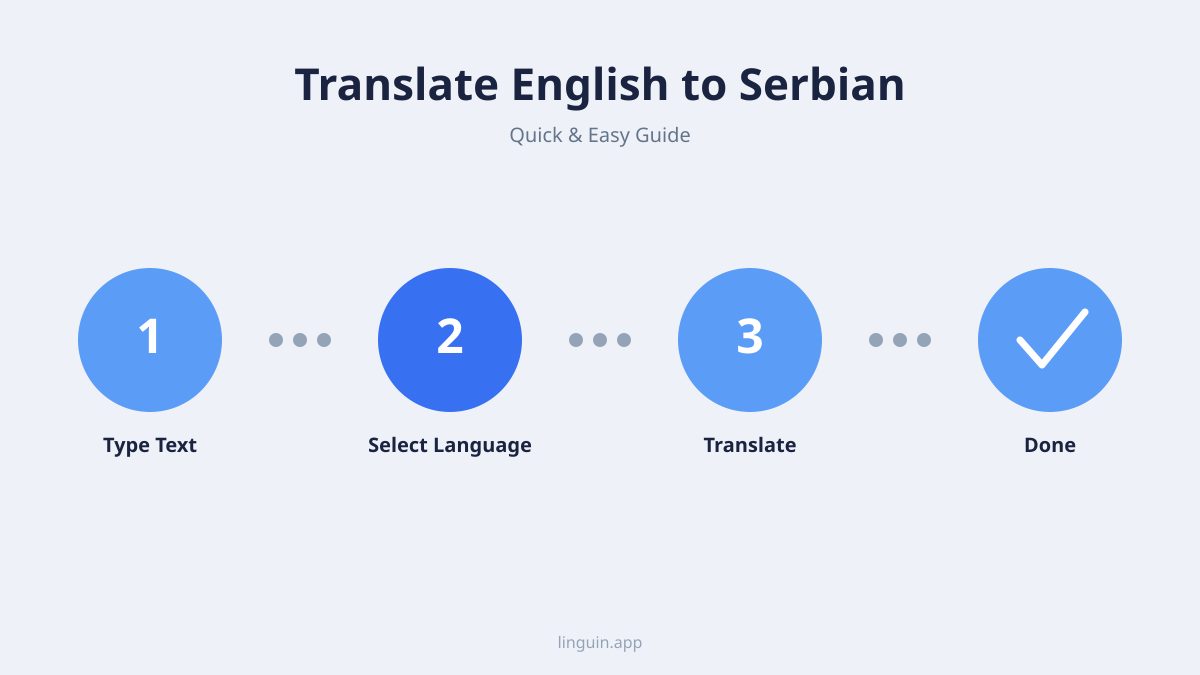
The basic workflow is short, but each step prevents a different kind of error. Start with a clean source text. Remove slang, ambiguous pronouns, and long chains of clauses. If you are translating a support reply, write the English in short sentences first. Then choose the target script: Serbian can be written in Latin or Cyrillic, and many readers expect one or the other depending on the platform, region, and audience.
Paste the text into an AI translation tool and ask for natural phrasing, not a literal copy. If the tool allows context, add the audience, purpose, and tone. For example, a note to a landlord should sound polite, while a product description can sound energetic. Review the output for script, grammar, and tone. Check that names, numbers, and addresses are unchanged. If the translation uses a formal or informal pronoun, make sure it matches the relationship.
A common failure happens when a user trusts the first draft. Serbian endings change by gender, number, and case, so a translated adjective may agree with the wrong noun. A second pass should compare the English intent with the Serbian sentence, not word by word. If the text is public, read it aloud or ask a native speaker to check the opening line. That small step catches awkward phrasing before it reaches customers or colleagues.
Linguin is one option for this workflow because it handles text and conversation translation across macOS, iOS, Chrome, and Safari. If you need to translate a page while browsing, see how to translate a page in Chrome. If the task is a document, follow a fuller checklist in how to translate a document.
what makes an english to serbian translation sound natural
Natural output comes from matching how Serbian speakers build sentences, not from preserving English word order. Grammatical case is the first major difference. Serbian uses cases to show the role of a noun in a sentence, so endings change for subject, object, possession, direction, and indirect object. A translator that ignores case can produce a sentence where the noun sounds like the wrong participant in the action.
Gender and number also matter. Adjectives, past tense verbs, and some pronouns must agree with the noun they refer to. If the English sentence has a collective noun or a neutral pronoun, the AI may choose the wrong form. Ask for the intended referent when context is unclear. For example, “team” can be treated as singular or plural depending on style, and the Serbian translation should stay consistent.
Verb aspect is another common issue. English may use simple present or future forms, while Serbian distinguishes completed and ongoing action. A request, a habit, and a one-time event can require different aspect choices. If the text describes a process, keep the aspect aligned with whether the action is finished, repeated, or in progress.
Word order is flexible, but not random. Serbian often places new or emphasized information later in the sentence. English usually follows a stricter subject-verb-object pattern. A natural translation may move a phrase to the front for contrast or to the end for focus. Do not treat reordering as an error if the meaning stays clear.
Register is the last layer. Formal writing uses Vi and more complete sentence structures, while casual messages may use ti and shorter forms. A translation that mixes these levels can sound cold, overly intimate, or old-fashioned. For customer support, choose one register and keep it through greetings, apologies, and calls to action. If the text includes a call to action, check that the verb form matches the expected level of directness.
tools for english to serbian translation
Different tools fit different jobs. A browser translator is useful for reading a page, a desktop or mobile app is better for writing replies, and an API is best when translation is embedded in a product. Before choosing a tool, check whether it supports Serbian as a target language, whether it keeps formatting, and whether it lets you control script and tone.
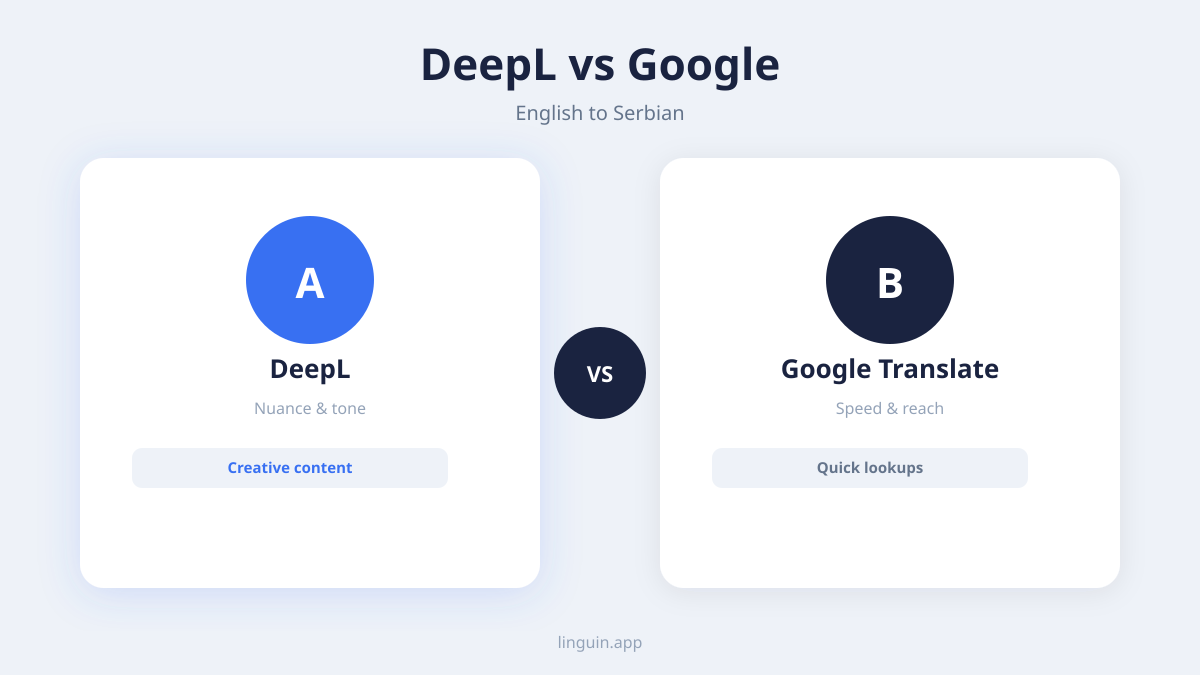
Support lists can differ. According to agenti.rs, DeepL currently supports Serbian as both a source and target language, while Supertext says DeepL does not offer Croatian or Serbian. If a feature matters for your workflow, test it with your own text rather than relying on a single overview page.
Free limits also vary. According to agenti.rs, DeepL’s free version offers 50,000 characters per month, one file translation up to 5 MB and one saved glossary. According to OpenL, OpenL advertises translation from 50+ languages to Serbian and a daily free quota of 3 text translations. According to Supertext, its language AI now translates into 28 languages, including Serbian, Albanian and Croatian.
For developers, according to agenti.rs, Google Cloud Translation API gives a monthly free credit of 500,000 characters and charges 20 dollars per million characters for the standard NMT model. For managed translation services, according to Gengo, English to Serbian Standard is listed at API: 0.05 dollars and WEB: 0.06 dollars, and Business at API: 0.11 dollars and WEB: 0.12 dollars. According to Intento, the cheapest solution meeting every Standard requirement in its English-to-Serbian benchmark costs 16.90 dollars per million characters, and the fastest solution meeting every Standard requirement takes 62 seconds per 1,000 words.
A practical choice depends on volume and risk. For quick drafts, a general AI tool may be enough. For contracts, medical advice, or public brand copy, use a tool that supports review and, if possible, a glossary. Also check whether the tool can preserve paragraphs, headings, and line breaks, because layout errors can make a good translation look unprofessional.
common mistakes when translating english to serbian
Most translation errors come from treating Serbian as a direct mirror of English. The first mistake is ignoring script. A Latin Serbian text may be fine on a social app, while a formal public document may need Cyrillic. If the reader expects one script, the other can feel informal or foreign.
The second mistake is using the wrong pronoun. Serbian distinguishes formal and informal address. A customer support message that switches from formal to informal can sound inconsistent. A marketing text that is too formal can feel distant. Decide the relationship before translating and keep it stable.
The third mistake is letting English idioms pass through. Phrases such as “touch base,” “circle back,” or “run it up the flagpole” may be translated word for word and confuse the reader. Use plain English first, then translate the intent. If the idiom is central to the message, replace it with a Serbian expression that carries the same tone.
Say you are translating an email to a vendor. The English says, “Let’s touch base next week to circle back on pricing.” A literal translation may sound odd. A better source sentence is, “Can we speak next week about the price?” The translation then has a clear request, a clear time frame, and a polite tone.
The fourth mistake is changing names, numbers, or units without checking them. Phone numbers, dates, and currency formats can be misread. If the text includes a Serbian name, check the diacritics. Missing letters such as č, ć, ž, š, and đ can change meaning or look careless.
The fifth mistake is reviewing only the final draft. Read the opening sentence, the instructions, and the closing call to action separately. These parts carry the most weight. For emails, use a checklist like the one in how to translate an email. Also check whether the translation has accidentally added a new promise, deadline, or apology that was not in the English source.
translating documents and conversations
Documents and conversations need different quality standards. A document can be revised before it is sent, so you can spend time on layout, terminology, and consistency. A conversation moves quickly, so the goal is to keep meaning clear without freezing the exchange.
For documents, keep the source simple. Long English sentences often become hard to follow in Serbian because subordinate clauses can multiply. Break sentences into shorter units. Keep headings parallel. If the document has a table, make sure translated labels still fit the layout. For a Word file, a structured workflow helps more than a single paste, as described in how to translate a Word document.
For live chats, use shorter prompts. If a customer writes a long complaint, translate the key request first, then reply in Serbian. If you are speaking with a colleague, keep the tone direct and avoid idioms. A translation tool that works across devices can help when you move between a desktop email and a phone message.
For meetings, prepare a glossary of terms before the call. Names, product terms, and internal acronyms should be translated consistently. If the tool supports saved terminology, add the Serbian form for each English term. If not, keep a short note beside the chat window and correct the translation as it appears. For recurring customer questions, save the approved Serbian reply and update it when the product or policy changes.
For formal documents, do not rely on machine output alone. Contracts, certificates, and official forms need review by someone who understands both the language and the document type. If the file has stamps, signatures, or numbered clauses, check that the translated version keeps the same order and reference numbers. For PDFs and printed forms, test the translated text in a preview before sending it to the recipient. Small layout shifts can make a table row or signature line look wrong.
how to check quality and tone
Quality checking is not only looking for obvious errors. It means asking whether the Serbian text does the job the English text was supposed to do. Start with meaning. Cover the English text and read only the Serbian. Can you identify the subject, the action, the time frame, and the request? If a key detail is missing, the translation may be fluent but incomplete.
Then check consistency. If the text uses a formal address, every sentence should keep it. If a product name appears with a description, use the same translation each time. If the document mentions a date, use one format throughout. In Serbian, date order and punctuation can vary by context, so choose the format your audience expects and stay with it.
Tone is the next test. A legal notice should be precise and impersonal. A support message should be calm and clear. A marketing line should sound natural, not translated. Read the first sentence aloud. If it sounds like a dictionary entry, rewrite the English source and translate again. This is often faster than editing a bad Serbian draft.
For longer text, create a short review checklist. Include script, pronoun, grammar agreement, numbers, names, and call to action. For team use, keep the checklist in the same place as the glossary. If the tool allows saved terms, add approved Serbian equivalents. This reduces the chance that a translator or AI model will invent a new phrasing for the same concept.
If you compare machine options, read Google Translate versus AI translator. A side-by-side test with one hard email and one short product description will reveal which tool handles context, endings, and register more reliably. When reviewing a translated page, also check links, buttons, and labels, because short UI strings often need more editing than full paragraphs.
when to use ai and when to ask a human
AI works best when the text is routine, reversible, and clear. Internal notes, product updates, simple support answers, and short messages can often be translated in seconds. The cost is low because a reviewer can scan the result and fix a few words. AI also helps when you need to understand a page or document quickly, even if you will not publish the translation.
Human review becomes important when the text has legal, medical, financial, or reputational weight. A contract clause that looks fluent may still change liability. A medical instruction that sounds natural may still be unsafe. A public apology may be grammatically correct but emotionally wrong. In those cases, the reviewer needs to understand the audience and the consequences, not only the language.
A hybrid workflow is often the best choice for business teams. Use AI to produce the first draft, then ask a native speaker or professional translator to check the opening, the instructions, and any specialized terms. If the text is part of a recurring workflow, build a glossary. If the text is one-off, a short review may be enough.
Say you are preparing a job posting for Belgrade. The AI can translate the duties and qualifications quickly. A human check can confirm that the tone is welcoming, that the pronoun matches the company culture, and that the benefits language is normal for local readers. That small review can prevent a serious message from sounding bureaucratic or too casual.
For teams, decide the threshold before the work starts. Ask: what happens if the translation is wrong? If the answer is embarrassment, delay, or a wrong customer expectation, use review. If the answer is a quick correction, AI is enough. For public-facing copy, also check whether the translation preserves the brand voice, not only the literal meaning. For internal teams, record the decision in a simple rule: AI first for drafts, human check for external copy, and legal review for contracts.
common questions
can i translate english to serbian for free?
Yes. Many web and app translators offer free tiers, but limits and quality vary. According to agenti.rs, DeepL’s free version offers 50,000 characters per month, one file translation up to 5 MB and one saved glossary. According to OpenL, OpenL advertises a daily free quota of 3 text translations. For important text, test the free output before relying on it.
does serbian use cyrillic or latin script?
Serbian uses both. The Latin script is common in everyday writing, websites, and many business contexts. Cyrillic is also official and may be expected in government, education, or formal publications. Choose the script before translating and keep it consistent across the text.
how do i make the translation sound formal?
Use a formal pronoun and avoid casual greetings. Keep sentences complete and polite. If the tool allows tone instructions, ask for a formal business style. Then review the first and last lines, because those are where register mistakes are most noticeable.
can ai translate a serbian name correctly?
It can, but check diacritics and spelling. Serbian names often include letters such as č, ć, ž, š, and đ. A machine translation may drop or change them if the source text is unclear. For legal or official documents, verify every name against the original.
should i choose cyrillic or latin for a website?
For most modern websites, Latin is the safer default unless the brand, institution, or audience expects Cyrillic. If the site is aimed at users in Serbia and includes official or educational content, Cyrillic may feel more natural. Test both scripts with your own copy and choose the one your target readers understand and trust more.
getting started with linguin
To translate english to serbian well, choose the workflow first. Quick messages need speed and tone, while documents need consistency, script control, and review. The biggest quality gains come from simple source text, a clear target script, and a second pass that checks grammar, register, and numbers.
Start with one real text today. Paste a short email or support reply into your translator, specify Latin or Cyrillic, and review the opening line. If you need to compare options, save a short glossary of recurring terms and test the same text in two tools. The differences will show up quickly in tone, case endings, and clarity. For team use, create a simple checklist: script, pronoun, numbers, names, and call to action.
If you work on a Mac, Linguin for Mac can help you move between translation, checking, and editing without leaving your workflow. Keep the first version short, then refine the phrasing until it sounds like something a Serbian reader would expect from the situation.