 English
  Español
  Français
  Deutsch
  Português
  Italiano
  Русский
  中文(简体)
  日本語
日本語  한국어
한국어  العربية
  हिन्दी
  Nederlands
  Türkçe
  Polski
Modern AI translation tools do not just convert words from one language to another. They are designed to preserve the crucial distinction between formal and informal tone, a core requirement for effective business email communication. For professionals navigating global markets, the tone of an email can be as important as its content. A misjudged register can damage relationships, undermine authority, or create confusion. This article explains the mechanics behind how AI translators analyze context, adapt language, and maintain the appropriate level of formality or informality in your translated correspondence, ensuring your intent is perfectly conveyed across languages.
Key takeaways
- AI translators use contextual analysis and training on vast datasets to recognize linguistic cues that signal formality, such as salutations, verb forms, and specific vocabulary.
- The best tools allow users to specify a desired tone or automatically infer it from the source text’s structure and content, providing tailored output.
- Preserving tone requires understanding cultural nuances beyond direct translation, where AI models adapt idioms, honorifics, and sentence structure to fit the target language’s conventions.
Why tone is everything in business emails
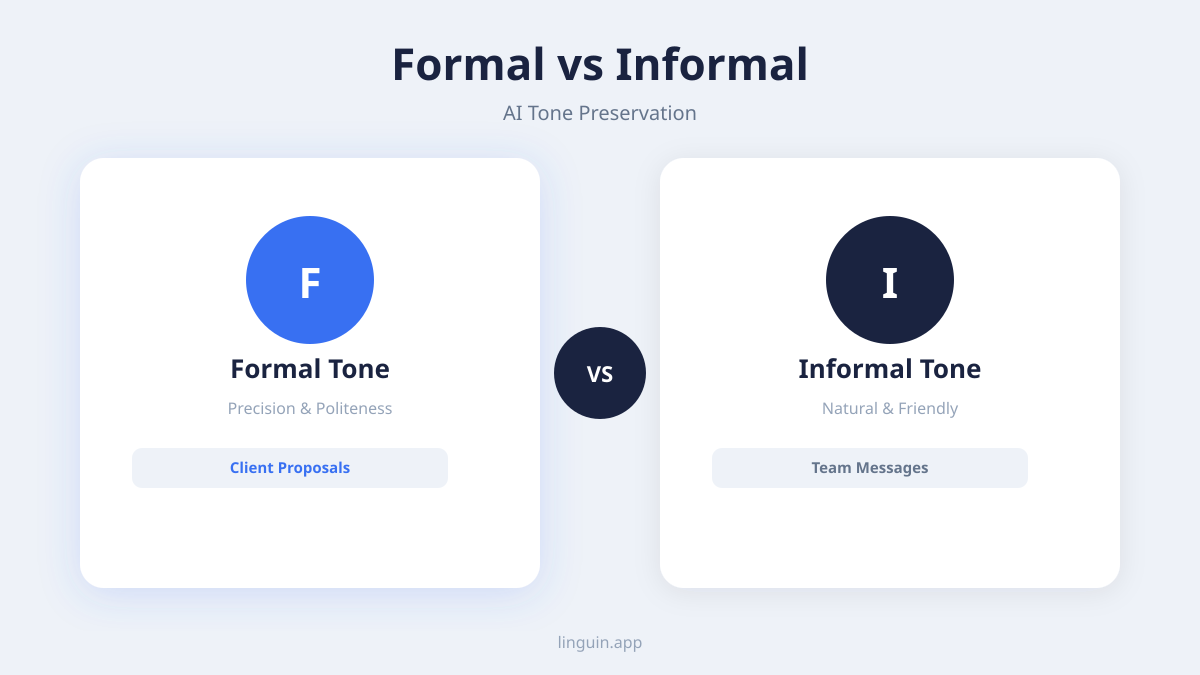
In business communication, tone establishes the relationship. A formal tone conveys respect, professionalism, and distance, which is appropriate for initial contact, communication with superiors or clients, and official agreements. An informal tone builds rapport, suggests collegiality, and fosters a collaborative atmosphere, which is suitable for teammates, established partners, and internal discussions. The wrong tone can send unintended messages. A formal email to a close colleague may seem cold or distrustful, while an informal email to a new CEO can appear disrespectful or unprofessional.
This challenge multiplies when translation is involved. Different languages have unique and often complex systems for signaling formality. For example, many languages use specific verb conjugations (like the French vous vs. tu or the German Sie vs. du), specialized vocabulary, and different levels of politeness particles (like Japanese -san, -sama). A direct, word-for-word translation can completely erase these signals or, worse, create a contradictory tone. The goal of a capable AI translator is to map the formality level of the source text onto the appropriate linguistic framework of the target language.
The stakes are high. Consistent, appropriate tone in multilingual emails protects your brand’s voice, ensures clear expectations, and facilitates smoother international operations. It removes a significant layer of friction from global business, allowing teams to focus on the message itself rather than worrying about accidental offense or miscommunication. Understanding this foundation is key to leveraging AI translation effectively.
How AI detects and classifies tone
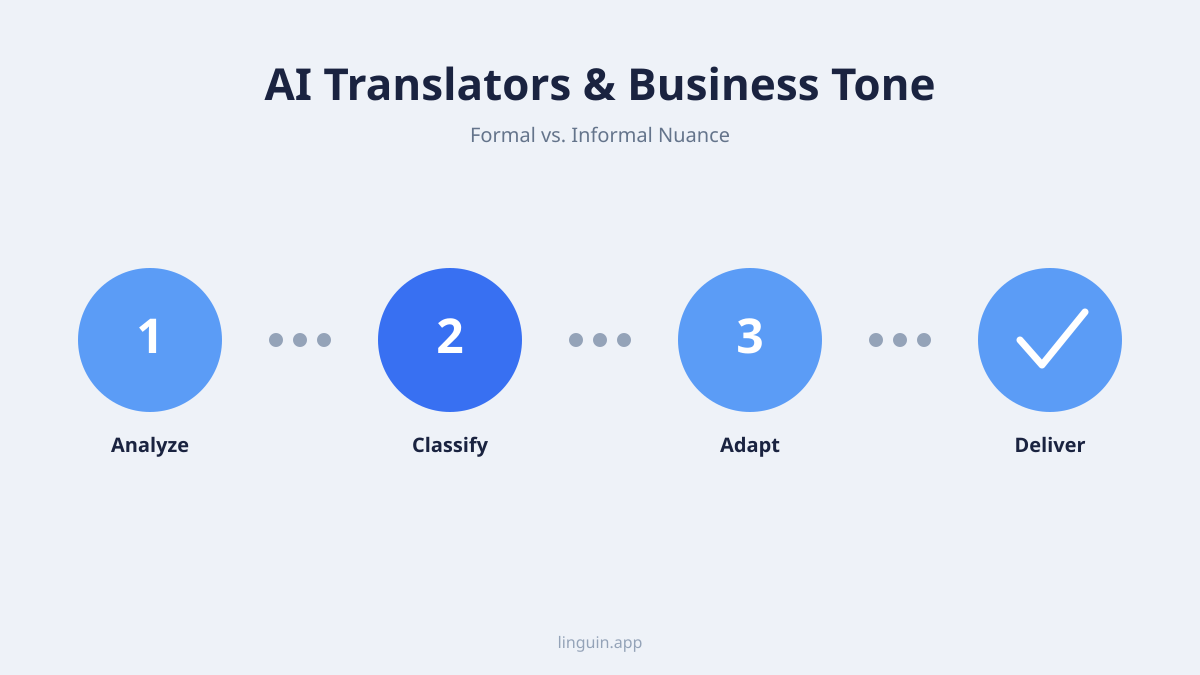
AI translation models are trained on massive datasets containing text from diverse sources, including formal documents, business correspondence, casual forums, and literature. Through this training, they learn patterns and correlations. They do not understand “tone” in a human emotional sense, but they become exceptionally good at recognizing the linguistic markers associated with different registers. This process involves several layers of analysis.
First, the model performs contextual analysis on the input text. It looks at the structural components. A formal email typically includes a formal salutation (e.g., “Dear Dr. Schmidt”), a clear subject line, structured paragraphs, and a formal closing (e.g., “Sincerely,”). An informal email might start with “Hi Alex,” use contractions (“I’m,” “can’t”), include colloquial phrases, and end with “Best,” or “Thanks!”. The AI identifies these patterns as strong indicators of the intended register.
Second, it analyzes lexical and grammatical cues. This includes the choice of words. Formal language uses Latinate vocabulary, avoids slang, and employs full verb forms. Informal language uses simpler, Anglo-Saxon words, phrasal verbs, and slang. Grammatically, the model checks for sentence mood (imperative vs. interrogative), use of passive voice (more formal), and modal verbs. For instance, “Could you possibly provide the report?” is formal, while “Can you send me the report?” is informal. The AI maps these source-language cues to equivalent cues in the target language.
Finally, advanced models use pragmatic inference. This means they consider the implied meaning and relationship. If an email’s body discusses contract terms and uses titles, the AI infers a formal context even if the salutation is slightly ambiguous. This holistic view allows the system to make a confident classification of the required tone before the translation process even begins, setting the parameters for how the output will be generated. For a deeper look at how context drives accuracy, read about context-aware translation.
The translation process: adapting formality across languages
Once the tone is identified, the real work of adaptation begins. Translating tone is not a simple substitution of formal words for formal words. It requires a cultural and linguistic transformation to meet the expectations of the target audience. A capable AI translator navigates this by having a nuanced understanding of the target language’s politeness systems.
The process often involves syntactic and morphological adjustment. In languages with a T-V distinction (formal vs. informal “you”), the AI must correctly choose the pronoun and all associated verb conjugations. Translating a formal English email that uses “you” into Spanish requires selecting “usted” and the corresponding verb forms. For Japanese or Korean, the AI must decide on the appropriate level of honorifics and sentence-ending particles to match the source’s formality.
Another key aspect is phraseology and idiom adaptation. A formal English phrase like “We respectfully request your consideration” cannot be translated literally into many languages without sounding stilted. The AI finds a functionally equivalent expression that carries the same weight of formality in the target culture. Similarly, an informal sign-off like “Chat soon!” needs to be rendered as a culturally appropriate informal closing in the target language, which may not involve the concept of “chatting” at all.
Say you’re messaging a colleague in Japan you’ve worked with for years. Your English source says, “Hey Ken, got a minute to jump on a quick call about the Q3 data?” An effective AI translation would use Ken’s first name without an honorific (or with a casual one like -san if the relationship allows), choose plain-form verbs, and translate “jump on a quick call” into a natural, colloquial Japanese phrase for an impromptu meeting. The output feels like a message from a peer, not a stilted translation. This level of adaptation is what separates basic translation from true communication.
Formal vs. informal: clear examples in translation
Seeing side-by-side examples makes the abstract concepts concrete. Let’s examine how an AI translator might handle the same core message in formal and informal registers across different language pairs.
Scenario: Requesting a document review.
-
Formal English Source: “Dear Ms. Chen, I am writing to request your review of the attached proposal at your earliest convenience. Your expert feedback would be greatly appreciated. Please let me know if you require any additional information. Sincerely, [Your Name]”
-
Formal German Translation: “Sehr geehrte Frau Chen, ich schreibe Ihnen, um Sie zu bitten, den beigefügten Vorschlag bei Gelegenheit zu prüfen. Über Ihr fachkundiges Feedback wären wir sehr dankbar. Bitte lassen Sie mich wissen, falls Sie weitere Informationen benötigen. Mit freundlichen Grüßen, [Ihr Name]”
- Note: Use of “Sie,” formal salutation “Sehr geehrte,” and structures like “bei Gelegenheit” (at your convenience).
-
Informal English Source: “Hi Wei, could you take a look at the proposal draft when you get a chance? Let me know what you think. Thanks! [Your Name]”
-
Informal German Translation: “Hallo Wei, könntest du dir den Vorschlagsentwurf mal ansehen, wenn du Zeit hast? Sag mir bitte, was du denkst. Danke! [Dein Name]”
- Note: Use of “du,” casual “Hallo,” and phrasing like “mal ansehen” (take a look).
Scenario: Following up on a meeting action item.
-
Formal English Source: “Dear Team, Pursuant to our discussion this morning, I have circulated the updated project timeline for your review. Kindly submit any comments by end of day Friday. Best regards, [Your Name]”
-
Formal Spanish Translation: “Estimado equipo, conforme a lo discutido esta mañana, he circulado el cronograma actualizado del proyecto para su revisión. Les ruego que envíen cualquier comentario antes del final del día viernes. Atentamente, [Su nombre]”
- Note: Use of formal “Les ruego que” (I request that you), “su,” and the formal closing “Atentamente.”
-
Informal English Source: “Team, following up from our chat earlier. The updated timeline is in the shared folder. Give it a look and shout with any feedback by Friday. Cheers, [Your Name]”
-
Informal Spanish Translation: “Hola equipo, siguiendo lo que hablamos antes. La cronograma actualizada está en la carpeta compartida. Echadle un vistazo y decídme lo que pensáis antes del viernes. Saludos, [Tu nombre]”
- Note: Use of informal plural “vosotros” forms (“echadle,” “decídme,” “pensáis”), casual “Hola,” and “Saludos.”
These examples show the AI’s role in selecting the correct pronouns, verb forms, vocabulary, and sentence structures to mirror the source tone. The difference is not just in the words but in the entire grammatical and pragmatic framework. For more on handling nuanced language, explore our article on AI translation for idioms and cultural nuances.
Best practices for using AI to translate emails
To get the most reliable results for tone preservation, users should adopt a few strategic practices. These steps guide the AI and provide the necessary context for optimal output.
1. Provide clear source context. The quality of the input dictates the quality of the output. Write your source email with a consistent, clear tone. If you are formal, be consistently formal throughout. Avoid mixing registers, as this can confuse the AI. A well-structured source email gives the AI a strong pattern to follow.
2. Use available tone guidance features. Many advanced AI translators, like Linguin, offer settings or prompts for tone. If you can specify “formal,” “informal,” or “professional,” use that option. It gives the model a direct instruction, prioritizing that dimension in its translation choices. This is especially useful for short texts where contextual clues are minimal.
3. Review and calibrate for key relationships. For critical contacts, take a moment to review the AI’s output. Check the salutation, the pronoun choices, and the closing. Does it match the level of familiarity in your relationship? A quick sense-check can prevent a tonal misstep. Over time, you will learn to trust the AI’s judgment for specific languages and contacts.
4. Be mindful of cultural specificities. Understand that formality manifests differently. In some cultures, a direct translation of a moderately formal English email may need to be elevated to a higher level of politeness to achieve the same perceived respect. While AI handles much of this, being aware of these differences helps you interpret the output and make final adjustments if necessary. This is crucial for languages with complex honorific systems.
Say you’re onboarding a new vendor in Brazil. Your first email should be formally translated into Portuguese. However, after several successful projects, your communication may naturally become more informal. An AI tool that learns from context or allows you to set a profile for that contact can help maintain this evolving tone, ensuring your emails always match the stage of the business relationship.
Limitations and the human review advantage
While AI translation for tone has advanced dramatically, it is not infallible. Understanding its limitations is part of using it effectively. The primary challenge remains highly nuanced or ambiguous source text. If an email uses sarcasm, subtle humor, or mixed signals, the AI may default to a neutral or incorrectly classified tone. It interprets explicit linguistic markers better than implied emotional subtext.
Another limitation is with rare or highly specialized jargon in specific formal or informal contexts. If the training data lacks examples of a particular industry’s casual slang or its ultra-formal legal phrasing, the model may not find the perfect equivalent, potentially defaulting to a more standard register that feels slightly off.
This is where the human review advantage becomes critical. For the most important communications, a final review by a bilingual speaker familiar with the business context is invaluable. They can catch subtle tonal mismatches, adjust a phrase to better fit cultural expectations, or ensure that a specific term of art is correctly translated. The AI does the heavy lifting of producing a contextually accurate draft, and the human provides the final polish for perfection.
This collaborative model is the most efficient path forward. It leverages AI for speed, consistency, and scalability while reserving human expertise for high-stakes judgment calls. For a balanced perspective on this partnership, consider reading about AI vs. human translation. Tools designed for business, like Linguin’s translator for Mac, integrate seamlessly into your workflow to facilitate this review process.
Frequently asked questions
Can AI translators automatically detect if my email should be formal or informal?
Yes, modern AI translators are designed to automatically detect the likely tone by analyzing the vocabulary, grammar, and structure of your source text. They look for clear indicators like salutations, use of contractions, sentence complexity, and specific word choices. For the best results, ensure your original email has a consistent tone to give the AI a strong signal to interpret.
How do AI tools handle languages with multiple levels of formality, like Japanese or Korean?
Advanced AI models are trained on datasets that include these multiple levels. They learn to map the formality level of the source text to the appropriate tier in the target language. This involves selecting the correct honorifics, speech levels, and sentence-ending particles. The output aims to achieve the same perceived level of respect and politeness as the original, even if the linguistic mechanisms are completely different.
Is it safe to use AI translation for sensitive or confidential business emails?
The safety depends on the specific AI translation service and its data privacy policy. Reputable business-focused tools often have strict policies where your text is not stored or used for training after the translation is complete. Always review the privacy terms of your chosen service. For highly sensitive information, you may consider using an offline translation tool or ensuring the provider offers end-to-end encryption.
What should I do if the translated tone doesn’t seem quite right?
First, check your source text for consistency. If the source tone is mixed, the output may be confused. Second, see if your translation tool has a setting to manually specify a formal or informal tone; use it to override the automatic detection. Finally, for crucial emails, a quick review by a colleague familiar with the target language and culture is the most reliable way to calibrate the tone perfectly.
Ensuring your global voice is heard correctly
Mastering tone in multilingual emails is a non-negotiable skill in global business. AI translation has evolved from a simple word converter to a sophisticated tool capable of preserving the formal and informal registers that define professional relationships. By understanding how these tools detect tone through contextual and grammatical analysis, and how they adapt it across different linguistic systems, you can use them with greater confidence and effectiveness.
Remember the two most important points: provide a clear, consistent source text to guide the AI, and always consider the cultural nuances of your target audience, as formality is culturally relative. The next step is to put this knowledge into practice. Try translating a few sample emails, both formal and informal, with a capable AI tool and compare the outputs. Observe how pronouns, verb forms, and phrasing change to match the register.
Linguin is built to handle these subtleties, offering tone-aware translation across devices and browsers to ensure your professional voice remains intact, whether you’re closing a deal or collaborating with a remote team. Start paying attention to tone in your next translation, and experience how precise communication builds stronger international connections.