 English
  Español
  Français
  Deutsch
  Português
  Italiano
  Русский
  中文(简体)
  日本語
日本語  한국어
한국어  العربية
  हिन्दी
  Nederlands
  Türkçe
  Polski
AI translation tools tackle idioms and cultural nuances by moving beyond word-for-word substitution to analyzing context and intent. This is the core challenge that separates basic translation from truly effective communication across languages. For professionals, travelers, and anyone engaging with global content, understanding this capability is key to using these tools effectively. This article explains the mechanisms behind AI-powered cultural translation, its current capabilities, and practical strategies for achieving the most natural results.
Key takeaways
- Modern AI translators use large language models trained on vast, diverse datasets to recognize and interpret idiomatic expressions.
- Context is the most critical factor, with the best tools analyzing entire sentences or conversations to infer meaning.
- While highly advanced, AI may still require human oversight for high-stakes translations involving deep cultural subtleties or humor.
- You can improve AI translation results by providing clear context and avoiding overly ambiguous phrasing.
The challenge of idioms and cultural context
Idioms, colloquialisms, and culturally specific references are the final frontier for machine translation. A phrase like “break a leg” has nothing to do with orthopedic injury, and “it’s raining cats and dogs” describes heavy rain, not a pet shower. These expressions are deeply woven into the fabric of a language and its culture. For decades, rule-based and statistical machine translation systems struggled immensely with them, often producing confusing or humorous literal translations that failed to convey the intended meaning.
The problem extends beyond fixed phrases. Cultural nuances encompass values, social norms, historical references, and humor. A simple word like “family” can carry different connotations and structural implications across cultures. Translating a polite request from English to a language with intricate levels of formality requires the AI to understand the social relationship between speakers. Without this cultural layer, communication can become awkward, offensive, or simply nonsensical, even if every word is technically translated correctly.
This challenge matters because effective communication is rarely about dictionary definitions. It is about conveying intent, emotion, and shared understanding. When you message a colleague in Japan, using an idiom like “let’s touch base” requires the translation to capture the concept of a brief meeting or check-in, not a physical touch. Similarly, marketing slogans, literary works, and legal documents are minefields of implicit meaning that demand more than a superficial translation.
How modern AI translation models work
Modern AI translators, like those powering Linguin, are built on large language models. Unlike their predecessors, these models are not simple phrasebooks. They are trained on enormous datasets containing billions of words and sentences from books, websites, film subtitles, and translated documents across over 100 languages. This training allows them to learn patterns, not just vocabulary. They learn how words combine, how sentences are structured, and, crucially, how meaning changes in different contexts.
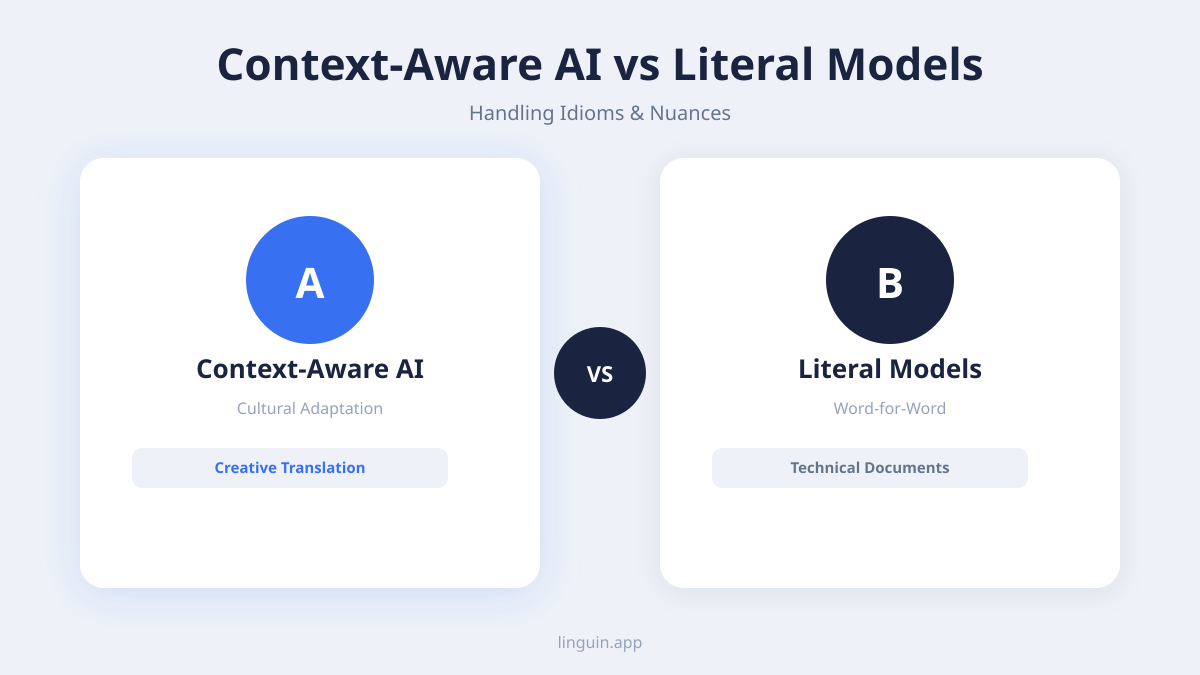
The key mechanism is contextual analysis. When you input text, the AI doesn’t look at each word in isolation. It processes the entire sentence, paragraph, or even the entire conversation thread. It evaluates the surrounding words to disambiguate meaning. For instance, the word “bank” could mean a financial institution or the side of a river. The AI uses the context (“I deposited money at the bank” vs. “We sat on the river bank”) to choose the correct translation in the target language. This same principle applies to idioms; the model searches its training data for similar contextual patterns where a non-literal meaning was used.
Furthermore, these models employ neural machine translation architectures. Think of a vast, multi-layered network that encodes the meaning of the source sentence into a dense, abstract representation and then decodes it into the target language. This process allows for more fluid and natural sentence construction in the output, often rephrasing ideas to match the target language’s natural flow rather than sticking to the source sentence’s rigid structure. This is essential for idioms, as the goal is to find an equivalent feeling or meaning, not a word-for-word match.
From literal meaning to intended meaning
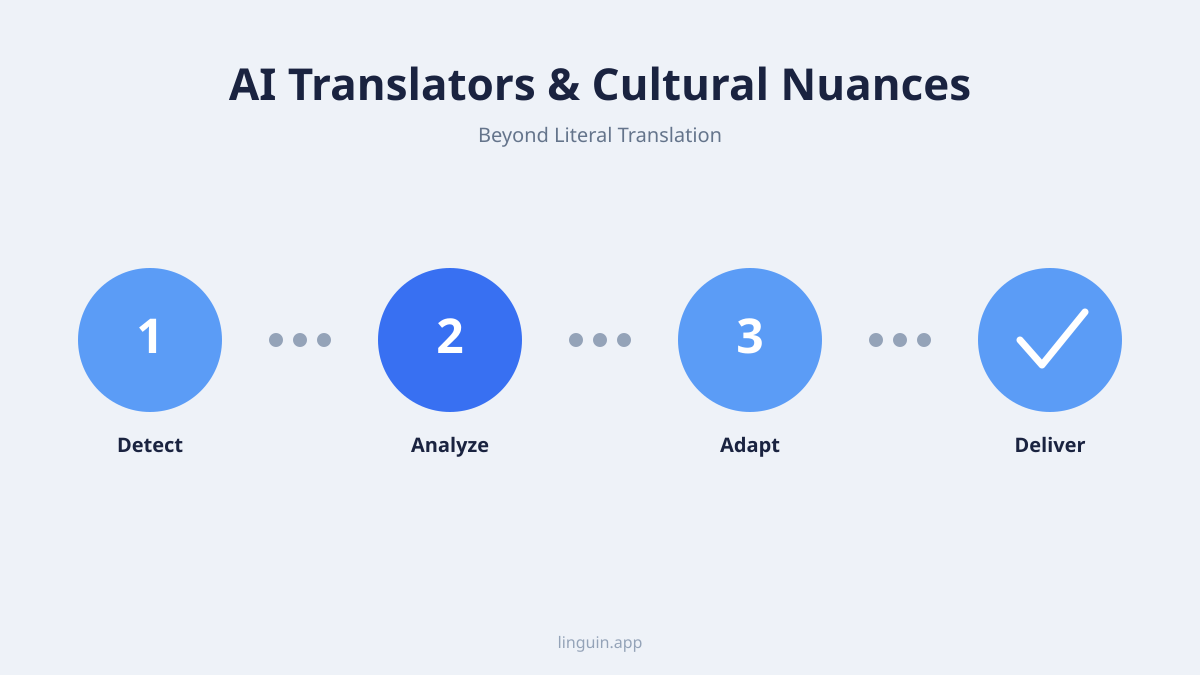
The leap from translating words to conveying intended meaning is where AI has made significant strides. The process involves several layers of understanding. First, the model must detect that an idiomatic expression is present. It does this by recognizing that a sequence of words, when taken literally, does not make logical sense or is statistically unusual compared to its training data. Once flagged, the model then searches its knowledge for the most likely intended meaning within the given context.
This often results in a dynamic equivalence translation. Instead of translating “spill the beans” directly, which would be meaningless in many languages, the AI seeks a phrase that conveys “reveal a secret.” In Spanish, it might output “contar el secreto” (tell the secret) or use a culturally analogous idiom like “soltar la sopa” (let go of the soup). The choice depends on the model’s training and the formality of the context. This ability to substitute culturally appropriate equivalents is a hallmark of advanced AI translation.
However, the path isn’t always straightforward. Some idioms are culturally bound and lack direct equivalents. Consider the English idiom “the elephant in the room.” This refers to an obvious problem everyone avoids discussing. An AI translator must first understand this abstract concept. It might translate it literally if the target culture understands that metaphor, or it might opt for a descriptive phrase like “the obvious unmentioned problem.” The best tools will consider the readability and naturalness of the output for the target audience. For more on how accuracy is achieved in such scenarios, read about AI translation accuracy.
Real world scenarios and practical applications
Seeing how AI handles idioms in practice clarifies its strengths and limitations. Let’s explore two common scenarios.
Scenario 1: Cross-cultural business communication. You are emailing a potential partner in France. You want to write, “Let’s not reinvent the wheel on this proposal; we should leverage our existing work.” A primitive translator might produce a confusing literal translation about inventing wheels. A context-aware AI translator, however, will recognize “reinvent the wheel” as an idiom for unnecessary duplication of effort. It would likely translate the sentiment to something like, “Évitons de refaire le travail à partir de zéro sur cette proposition; nous devrions capitaliser sur notre travail existant.” This conveys your core message of efficiency and builds professional rapport.
Scenario 2: Consuming foreign media and literature. You’re watching a German film with AI-generated subtitles. A character says, “Das ist nicht mein Bier,” which literally means “That is not my beer.” A good AI subtitle translator, analyzing the scene’s context (likely someone refusing responsibility), will translate it to the idiom “That’s not my cup of tea” or, more universally, “That’s not my problem.” This preserves the character’s dismissive tone and the scene’s meaning, allowing you to enjoy the narrative flow without confusion.
In daily use, from translating business documents to chatting with friends abroad, this capability smooths communication. It allows the AI to function not as a rigid dictionary, but as a flexible communication aid that prioritizes understanding over lexical precision. For travelers using a translation app to navigate local markets or understand menus, this difference is between a functional interaction and a confusing one.
Limitations and when human nuance is essential
Despite remarkable progress, AI translation of cultural content has boundaries. The most significant limitation is the lack of deep cultural lived experience. AI models learn from existing text, but they don’t “understand” culture in the human sense. They can’t always grasp the emotional weight, historical trauma, or subtle sarcasm embedded in certain phrases. A phrase might be technically translated correctly but still feel “off” or insensitive to a native speaker because the AI missed a nuanced connotation.
Humor, satire, and poetry are particularly challenging domains. Puns rely on double meanings or similar-sounding words that rarely align across languages. A joke that works in English may have no equivalent structure in Mandarin, and an AI might translate the words but completely miss the comedic timing or intent, resulting in a confusing statement. In these cases, human translators who understand the cultural subtext and creative intent are indispensable.
High-stakes domains like legal contracts, medical advice, and diplomatic communications also necessitate human review. An idiom or ambiguous phrase in a contract could lead to serious misinterpretations with financial or legal consequences. While AI can provide a excellent first draft and handle routine phrases, the final responsibility for accuracy in these contexts must lie with expert human translators who can ensure the translation is not only linguistically correct but also culturally and legally precise. This principle is central to effective app localization and professional translation services.
Best practices for using AI translators effectively
You can significantly improve the output of any AI translator by adapting how you interact with it. The goal is to provide the AI with as much contextual clarity as possible. This empowers the model to make better decisions about meaning, especially for ambiguous or idiomatic language.
- Write and speak with clear context. Instead of translating an isolated idiom like “it’s a piece of cake,” include it in a full sentence: “Don’t worry about the exam; it’s a piece of cake.” The surrounding words (“don’t worry,” “exam”) give the AI strong clues that this is an idiom about ease, not dessert.
- Avoid overly vague pronouns. Sentences like “She told her it was fine, but it wasn’t” are difficult even for humans without context. Specifying the subject helps: “Maria told her manager the report was fine, but the report was actually incomplete.”
- Paste more surrounding text, not just one sentence. Linguin translates whatever text you paste in, so pasting an entire paragraph or email thread instead of one isolated line gives the model a larger window of context. This tends to produce more consistent, accurate results for idioms than translating each sentence separately. (Note that Linguin doesn’t have a separate “document” upload mode, this is just pasting more text at once; the free tier caps a single translation at 500 characters, and Premium removes that cap.)
- When in doubt, rephrase. If you suspect a phrase is highly cultural or slang-heavy, consider simplifying it before translation. Instead of “That marketing plan is dead in the water,” you could write “That marketing plan has failed and cannot proceed.” The AI will translate the clearer version more reliably.
- Review the output for sense. Always take a moment to read the translated text. Does it make logical sense in the context of your conversation? If it seems odd, it might be a literal translation of an idiom. This is where you can step in, use a different phrasing, or consult a human.
Following these practices turns the AI translator from a black box into a collaborative tool. For more comparisons on how different tools handle these tasks, explore our analysis of the best AI translation apps.
The future of culturally aware AI translation
The trajectory for AI translation is toward even greater contextual and cultural sensitivity. Future models will likely move beyond analyzing just the text you provide. They may integrate knowledge graphs containing cultural facts, historical data, and information on social etiquette. Imagine a translator that knows translating a dinner invitation for “7pm” to a culture with more fluid time perceptions might benefit from a slight adjustment or note.
Another frontier is personalized translation models. These could learn your specific communication style, the jargon of your industry, and the typical context of your conversations. If you frequently talk about software development, the model would learn that “bug” refers to a coding error, not an insect, more quickly and accurately. This personalization would make translations feel more natural and tailored.
Furthermore, research into multimodal AI-systems that process text, audio, and visual cues together-promises better understanding. Translating a scene from a video, the AI could use visual context (a character’s facial expression, the setting) to disambiguate whether a statement like “That’s great” is sincere or sarcastic. This holistic approach mirrors human understanding more closely and could dramatically improve the translation of nuanced dialogue in films, meetings, and everyday conversations.
Frequently asked questions
Can AI translators perfectly translate jokes and puns?
No, AI translators often struggle with jokes and puns because humor heavily relies on linguistic nuances, double meanings, and cultural context that don’t transfer directly between languages. An AI might translate the words of a pun correctly but completely miss the comedic element, resulting in a confusing or flat statement. For perfect comedic translation, human creativity is still essential.
How do I know if an idiom was translated correctly by AI?
Review the translated output for logical sense within the full context. If the translation seems strangely literal or unrelated to the topic (e.g., talking about “breaking legs” in a context about a performance), the idiom may have been mistranslated. Cross-checking with a second tool or searching for the idiom’s meaning in the target language can provide clarity. Providing more context in your original text is the best preventative measure.
Are some languages harder for AI to translate than others regarding idioms?
Yes, languages with very different cultural foundations and linguistic structures from the source language present a greater challenge. Translating idioms between English and French, which share some historical roots, can be easier than between English and Mandarin Chinese, where cultural references and conceptual metaphors often differ significantly. The availability and quality of training data for a language pair also greatly influence performance.
Should I avoid using idioms altogether when using an AI translator?
Not necessarily. Modern AI translators handle many common idioms well. However, for critical communications, it is prudent to use clear, straightforward language or to explain idioms in parentheses. For casual conversation, using idioms is fine, but be prepared to rephrase if the translation seems off. The best practice is to use them within clear, contextual sentences.
Unlocking natural global communication
The ability of AI to navigate idioms and cultural nuances marks a shift from mechanical translation to intelligent interpretation. By leveraging vast datasets and contextual analysis, tools like Linguin bridge gaps in understanding, allowing for more natural and effective communication across over 100 languages. While the technology continues to evolve, its current state already empowers users to connect, work, and create without language being a rigid barrier.
The most important points to remember are that context is king for accurate translations, and a proactive approach to providing clear input will always yield better results. As you engage with global content, whether for business, travel, or personal enrichment, these AI tools become powerful allies. To experience this context-aware translation firsthand, you can explore Linguin’s AI translator for Mac or try the Chrome extension to see how it handles the nuances in your daily browsing and communication.