 English
  Español
  Français
  Deutsch
  Português
  Italiano
  Русский
  中文(简体)
  日本語
日本語  한국어
한국어  العربية
  हिन्दी
  Nederlands
  Türkçe
  Polski
When a crisis strikes, clear communication across language barriers is not just helpful, it is a matter of life and death. AI translation for humanitarian aid transforms how first responders, aid organizations, and affected communities connect, share vital information, and coordinate relief efforts. This article is for humanitarian professionals, NGO staff, and anyone interested in how technology can bridge divides in the world’s most challenging moments. You will learn how AI translation tools work in crisis scenarios, the specific challenges they overcome, and how they are shaping a more responsive and inclusive future for global aid.
Key takeaways
- AI translation enables real-time, on-the-ground communication between aid workers and local populations, regardless of the languages spoken.
- These tools help process and translate vast amounts of critical documentation, from medical instructions to supply lists, with speed and consistency.
- By understanding cultural context and local dialects, AI helps ensure that messages of safety and support are not just translated, but are accurately understood.
The language barrier in humanitarian crises
In the chaotic aftermath of a natural disaster, during a complex refugee relocation, or in the midst of a public health emergency, information is the most critical resource. Aid workers need to assess needs, distribute supplies, and provide medical care. Affected communities need to understand safety procedures, access services, and report their situations. When these groups do not share a common language, every interaction becomes slower, more prone to error, and potentially dangerous. Traditional solutions, like hiring human interpreters for every language pair, are often logistically impossible and too slow to scale in a sudden crisis. Pre-translated materials may not cover the specific local dialects or the unique, evolving circumstances of the event. This language gap can delay aid, misdirect resources, and leave vulnerable populations without a voice. The core challenge is achieving speed, scale, and accuracy simultaneously in unpredictable, high-stakes environments.
AI translation directly addresses this trilemma. Unlike static phrasebooks or overburdened human translation teams, AI models can be deployed instantly across digital platforms. A field worker can use a smartphone app to translate a question for a survivor. An operations center can run incoming reports through a translation system to understand needs across multiple regions. The technology acts as a force multiplier, allowing a single aid worker to communicate effectively with people speaking dozens of different languages. This immediacy turns communication from a bottleneck into a conduit. Furthermore, modern AI translation is built on neural machine translation models that process full sentences and paragraphs for meaning, rather than translating word-for-word. This results in more natural, readable output that is crucial for conveying complex or sensitive information about health, safety, and logistics.
Core applications of AI translation in aid work
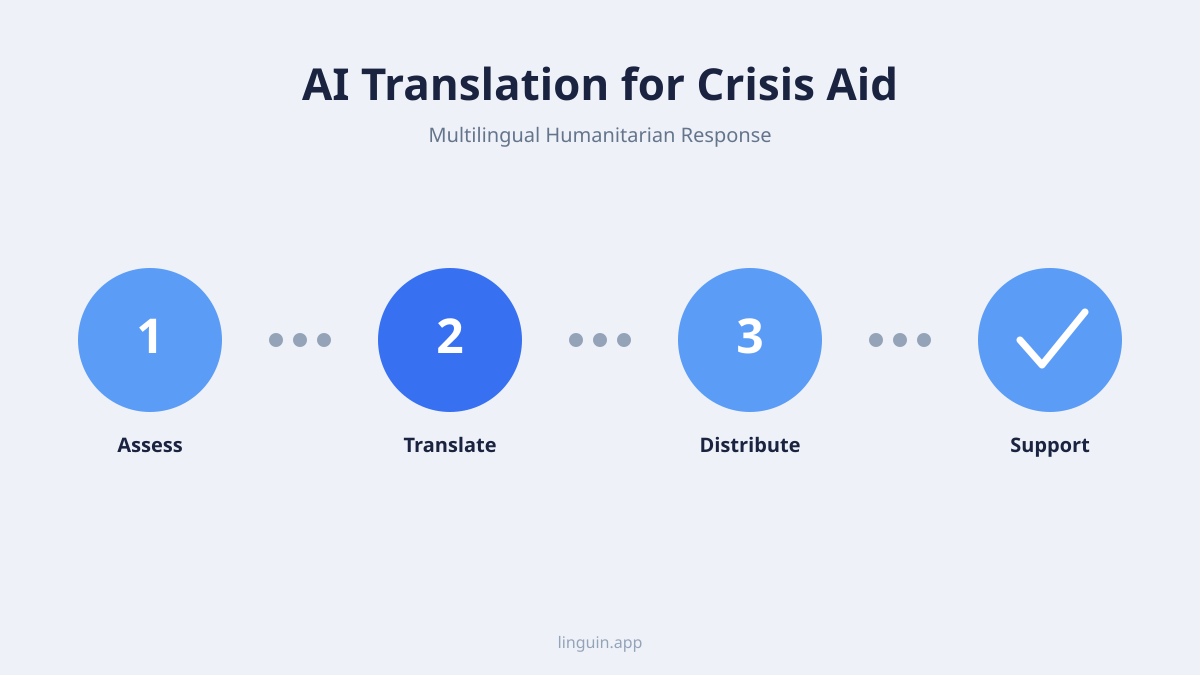
The use of AI translation for humanitarian aid spans the entire lifecycle of a crisis response, from initial assessment to long-term recovery. Its applications fall into several key operational areas that define modern humanitarian logistics.
Real-time field communication and triage
The most immediate application is in direct, person-to-person communication. Imagine a medical team arriving at a temporary shelter after an earthquake. They need to quickly ask survivors about injuries, allergies, and pre-existing conditions. Using an AI translation app on a tablet or phone, a doctor can speak or type a question in English and have it read aloud in the local language. A survivor can respond in their own language, and the aid worker receives an instant translation. This enables rapid triage, ensuring the most critical cases are identified first. Similarly, aid distributors can explain ration procedures, and search-and-rescue teams can coordinate with local volunteers. This real-time capability eliminates the wait for an interpreter and empowers frontline workers to act with confidence and clarity.
Translation of critical documents and broadcasts
Crises generate a flood of essential documents that must be understood across linguistic lines. These include medical guidelines, disease prevention pamphlets, evacuation maps, legal forms for aid distribution, and supply manifests. Translating these manually for multiple language groups would take days. AI translation systems can process these documents in batches, providing consistent, immediate drafts that human experts can then review and finalize at a much faster pace. Public information is equally vital. Emergency broadcasts, SMS alerts, and social media updates from authorities need to reach everyone. AI allows for the near-simultaneous translation of these alerts into all relevant languages, ensuring that a tsunami warning or a curfew notice is universally understood. For instance, an organization managing a refugee camp can use AI to quickly translate daily bulletins about food distribution times or health clinic hours into the five most common languages among the camp residents.
Training and capacity building for local staff
Sustainable response often depends on training local community members to assist in the aid effort. Training materials, safety protocols, and equipment manuals are frequently in English or another major language. AI translation accelerates the localization of these materials, enabling faster and more effective training of local volunteers and staff. This builds in-country capacity and ensures that knowledge transfer is not hindered by language. A workshop on clean water purification techniques can be made accessible to local engineers in their native tongue, creating a lasting impact beyond the immediate crisis.
Overcoming the unique challenges of crisis translation
Humanitarian contexts present specific, high-stakes challenges for any translation system. Accuracy is non-negotiable, but the definition of accuracy expands to include cultural appropriateness, dialect sensitivity, and emotional tone. Generic translation tools often fail here, but AI systems designed with these contexts in mind can succeed.
Technical and specialized terminology is rampant. Medical triage involves precise terms for symptoms and injuries. Logistics coordination uses specific jargon for supplies and transportation. Legal aid involves nuanced concepts. A mistranslation of a medical instruction or a legal right can have severe consequences. Advanced AI translation models can be fine-tuned on specialized glossaries and parallel texts from the humanitarian domain, learning the correct equivalents for terms like “oral rehydration salts,” “non-food items,” or “protection monitoring.” This leads to far greater precision than a general-purpose translator. For more on handling specialized language, see our article on AI translation for technical jargon and industry terminology.
Cultural context and sensitivity are paramount. Direct, literal translations can be ineffective or offensive. Health messages about sanitation or disease prevention must align with local customs and beliefs to be adopted. Instructions must be framed in a way that respects community hierarchies and decision-making processes. Modern AI models are increasingly capable of context-aware translation, where the system considers the broader situation and intended audience to produce a culturally apt message. This might mean choosing a more formal register when addressing community elders or adapting a metaphor to one that resonates locally. Understanding these nuances is critical, as explored in our guide to AI translation for idioms and cultural nuances.
Low-resource languages and dialects are a major hurdle. Major crises often affect regions where local languages or dialects have limited digital presence. Standard translation tools may not support them at all. The AI field is making progress in this area through techniques like transfer learning, where a model trained on a related, higher-resource language can be adapted to a lower-resource one. For aid organizations, this means the potential to communicate in the heart language of affected communities, which builds immense trust and ensures comprehension. This effort aligns with the broader mission of AI translation for endangered languages preservation.
Integrating AI translation into humanitarian workflows
For AI translation to be effective, it must be seamlessly integrated into the existing tools and protocols used by aid organizations. This is less about a single app and more about creating a translation layer across the digital ecosystem of a crisis response.
Many organizations use platforms like Slack, Microsoft Teams, or dedicated crisis management software for internal coordination. AI translation extensions or bots can operate within these platforms, allowing team members from different language backgrounds to collaborate in real time. An engineer in Geneva can instantly understand a field report written in Spanish from Guatemala, and respond in French, with all parties reading the conversation in their preferred language. This breaks down silos within international organizations. Externally, AI can be integrated into hotline systems, allowing operators to receive calls in multiple languages and get real-time transcriptions and translations. It can also power multilingual chatbots on aid organization websites, providing 24/7 answers to common questions about eligibility for services, location of shelters, or application processes.
The key to successful integration is ensuring the technology is accessible and reliable in field conditions. This means offline functionality for areas with poor connectivity, simple user interfaces that can be operated under stress, and compatibility with low-bandwidth communication channels like SMS. Furthermore, data privacy and security are critical. Translations of sensitive personal data from survivors must be handled with the utmost care, requiring AI systems that can operate with robust data governance, possibly on secure, local servers.
The future of AI-powered multilingual aid
The trajectory of AI translation points toward even more integrated and intelligent systems for humanitarian use. We are moving toward a future where language is no longer a barrier to empathy and efficiency in crisis response.
One developing area is the combination of AI translation with other forms of AI, like computer vision and automatic speech recognition. Imagine a system where a field worker can point their phone’s camera at a damaged building with foreign-language signage. The app could translate the sign, while simultaneously using object recognition to assess the type of damage. Or, consider a meeting between aid agencies and community leaders where speech is automatically transcribed, translated, and summarized into minutes in multiple languages, capturing agreements and action items accurately. This multimodal approach creates a richer, more contextual understanding of the situation.
Another future direction is the development of adaptive translation models specifically for crises. These models could be quickly fine-tuned at the onset of an event using any available localized data, such as previous translations from similar contexts, official glossaries from responding agencies, or even social media chatter in the affected area. This would allow the AI to rapidly adapt to the unique linguistic landscape of each new crisis, whether it involves specific local place names, emerging slang related to the event, or the particular terminology of a new disease outbreak. The goal is a translation tool that learns and evolves with the crisis itself.
Ethical considerations and the human-in-the-loop model
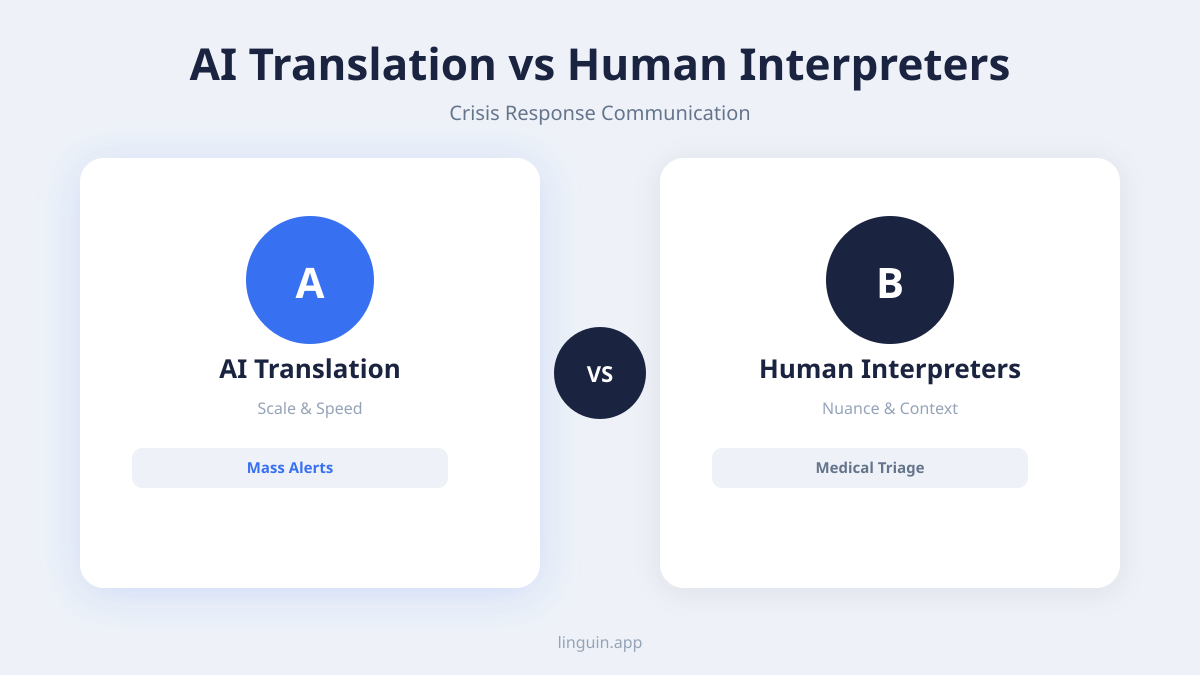
While powerful, the deployment of AI in humanitarian settings must be guided by strong ethical principles. Translation errors in this context can cause direct harm. Therefore, the most effective and responsible model is a human-in-the-loop system. In this model, AI handles the initial, heavy-lifting translation to achieve speed and scale, but human experts-professional translators or bilingual aid workers-review and validate critical outputs.
This is especially important for sensitive communications regarding legal rights, medical diagnoses, mental health support, and official directives. The human reviewer ensures cultural appropriateness, corrects any subtle errors, and adds the layer of empathy that AI cannot replicate. The AI becomes a collaborative tool that augments human capability rather than replacing it. This hybrid approach balances the urgent need for speed with the non-negotiable requirement for accuracy and ethical responsibility. It also builds local capacity by involving linguists from the affected communities in the review process, ensuring their expertise shapes the communication.
Frequently asked questions
How accurate is AI translation for critical medical or safety instructions?
For general instructions, modern AI translation is highly accurate, especially for languages with ample training data. However, for critical, life-saving information, a human-in-the-loop model is essential. The AI provides a fast, reliable first draft that a medical professional or translator can quickly verify and adjust. This combination ensures both speed and the highest possible accuracy for sensitive content.
Can AI translation work offline in disaster zones with no internet?
Yes, this is a crucial feature for humanitarian tools. Many professional AI translation applications, including Linguin, offer offline translation packs that can be downloaded in advance. This allows aid workers to perform translations directly on their device without any network connection, which is vital in areas where infrastructure is damaged.
Does AI translation support rare dialects spoken in crisis regions?
Support varies. Major AI platforms cover dozens of widely spoken languages well. For many regional dialects or low-resource languages, coverage may be limited or less accurate. The field is actively improving through specialized models. The best practice is to test the tool with the specific language or dialect before field deployment and have a backup plan, such as a community interpreter, for critical communications.
How do aid organizations ensure cultural appropriateness in AI-translated messages?
Leading organizations use AI systems that emphasize context-aware translation and allow for customization. They can input style guides, preferred terminology, and cultural notes into the system. Furthermore, by employing the human-in-the-loop model, local cultural experts review and refine all public-facing translations to ensure they are respectful, appropriate, and effective for the target community.
What are the data privacy concerns when using AI translation with survivor information?
Reputable AI translation services for professional use prioritize data security. Organizations should look for services that offer on-device processing (where translation happens locally on the phone or tablet, and data is not sent to the cloud) or enterprise-grade cloud solutions with strong encryption and clear data retention policies. It is vital to never use consumer-grade, free translation tools for handling sensitive personal data from survivors.
Building a more responsive future with language technology
The potential of AI translation for humanitarian aid is clear. It transforms language from a barrier into a bridge, enabling faster, more accurate, and more empathetic communication when it matters most. By facilitating real-time field dialogue, accelerating document processing, and respecting cultural nuance, these tools are becoming indispensable in the toolkit of modern crisis response. The path forward combines the speed and scale of AI with the critical judgment and cultural expertise of human professionals.
The same accessibility mindset applies to video content too, and our piece on how AI translation makes video accessible globally covers captioning and dubbing for audiences who don’t share a language with the creator.
For teams working across languages, whether in disaster response, international development, or community outreach, integrating a reliable translation tool is a strategic step toward greater impact. Exploring a dedicated solution that offers offline capability, support for a wide range of languages, and a focus on accurate, context-aware output can prepare your organization for more effective multilingual engagement. Linguin is built to provide this kind of robust, accessible translation power directly on your devices, helping teams focus on their vital mission without being held back by language.