 English
  Español
  Français
  Deutsch
  Português
  Italiano
  Русский
  中文(简体)
  日本語
日本語  한국어
한국어  العربية
  हिन्दी
  Nederlands
  Türkçe
  Polski
AI translation for video accessibility is transforming how content reaches global audiences, moving beyond simple subtitles to create truly inclusive viewing experiences. For creators, educators, and businesses, this technology solves the fundamental challenge of a fragmented, multilingual internet. Whether it’s a tutorial, a corporate presentation, or an entertainment vlog, video is the dominant medium for communication today. Yet its impact is limited if viewers cannot understand the language being spoken. This article is for anyone who creates video content or manages digital platforms where video is key. You will learn how modern AI translation tools work, the specific ways they enhance accessibility, and practical strategies for implementing them to connect with a worldwide audience.
Key takeaways
- AI translation enables real-time, context-aware subtitles and dubbing, making live streams and on-demand videos accessible to non-native speakers instantly.
- It allows content creators and organizations to scale their multilingual outreach without the proportional cost and time of traditional human translation.
- Advanced models handle conversational speech, industry-specific jargon, and cultural references, preserving the original meaning and intent of the video content.
The evolution of video accessibility
Video accessibility has traditionally meant providing subtitles or closed captions for the deaf and hard of hearing. While this remains crucial, the definition of accessibility is expanding. True accessibility now also means breaking down language barriers. For decades, adding another language to a video was a slow, expensive process involving human translators, transcriptionists, and audio engineers for dubbing. This created a significant gap: high-budget productions could afford it, but the vast majority of video content creators, from indie filmmakers to small businesses and educators, could not.
The shift began with basic automated subtitling tools, but early systems were plagued by inaccuracies, especially with poor audio quality, multiple speakers, or specialized vocabulary. They treated translation as a simple word-for-word substitution, missing context, tone, and nuance. The arrival of sophisticated AI translation models changed this landscape. These systems use neural networks trained on massive datasets of parallel text and speech, allowing them to understand context, discern between homophones, and even recognize different speaker emotions. This means the translation output is not just a string of words, but a coherent, natural-sounding interpretation of the original speech.
This evolution marks a move from accessibility as a compliance checkbox to accessibility as a core strategy for audience growth and inclusion. A viewer in Brazil can now follow a software tutorial created in Korean. A student in France can access lecture series from universities in Japan. The barrier is no longer the content’s origin, but the viewer’s internet connection. For platform owners and content strategists, this represents a paradigm shift. The potential audience for any single piece of video content is no longer confined to a single language group, but is effectively the entire online world. Understanding this shift is the first step in leveraging the tools that make it possible.
How AI translation tools process video content
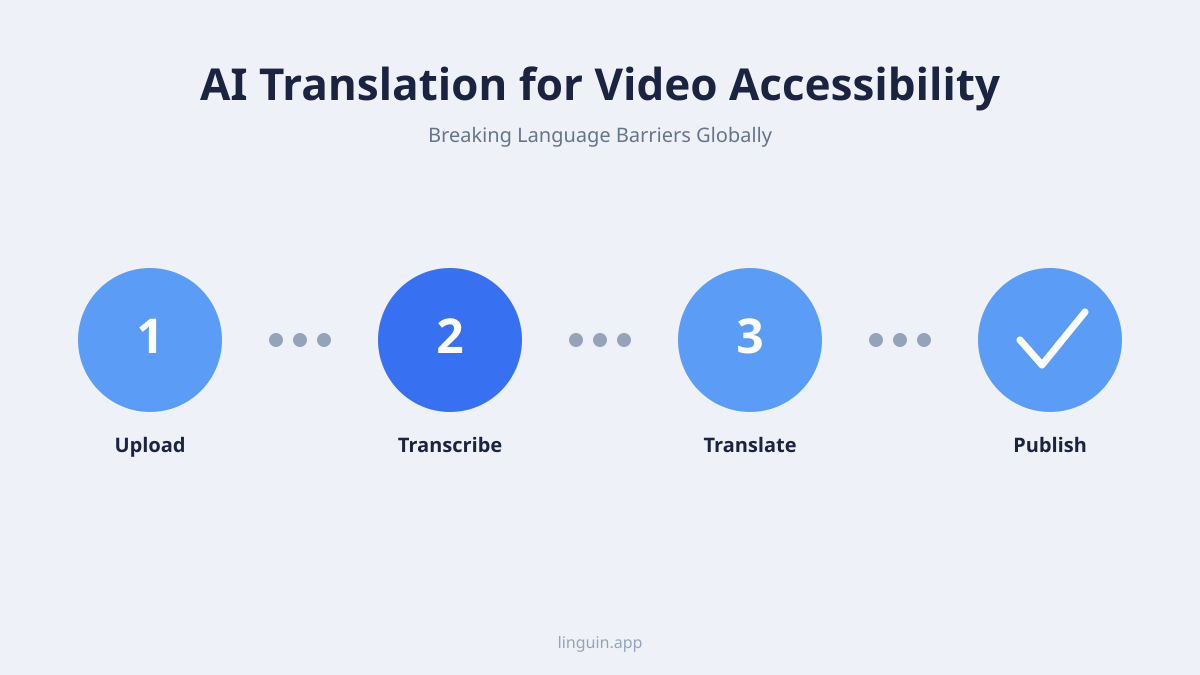
Modern AI translation for video is a multi-stage process that happens rapidly, often in near real-time. It begins with automatic speech recognition (ASR). The AI listens to the audio track, converting spoken words into text in the original language. This is a complex task in itself, as the system must handle accents, background noise, cross-talk, and varying speech speeds. Advanced ASR models are now robust enough to provide accurate transcripts even from less-than-perfect audio sources, which is common in user-generated content like vlogs or webinar recordings.
Once a transcript is generated, the machine translation (MT) engine takes over. This is where context-aware AI proves its worth. Unlike older statistical models, modern neural machine translation considers entire sentences and paragraphs for context. It understands that the word “bank” in a financial tutorial has a different meaning than in a video about fishing. This contextual understanding is critical for accuracy. The system also handles challenges like idioms and cultural references, translating the intended meaning rather than the literal words. For instance, an English speaker saying “that’s a piece of cake” in a how-to video would have the idiom translated into an equivalent expression for “easy” in the target language, not a confusing mention of dessert.
The final step is synchronization and output. The translated text must be perfectly timed to the speaker’s pace and inserted into the video. For subtitles, the AI breaks the translation into readable chunks that match the on-screen speech. For dubbing, more advanced systems can even generate synthetic voiceovers in the target language that mimic the original speaker’s intonation and emotional cadence. Some tools offer a choice of output: viewers can select from subtitles in multiple languages or choose an AI-dubbed audio track. This end-to-end pipeline, from speech to final accessible asset, is what makes scalable multilingual video possible. It empowers creators to focus on their content, knowing the technology can handle the complex task of making it globally understandable.
Key accessibility features powered by AI
The practical application of AI translation results in specific features that directly enhance viewer experience and content reach. The most common is real-time multilingual subtitling. This is transformative for live video content such as webinars, product launches, or live streams on platforms like YouTube or Twitch. Viewers can select their preferred language from a menu, and subtitles generated by AI appear with just a few seconds of latency. This turns a live event from a local occurrence into a global one, fostering real-time engagement from an international audience.
Another powerful feature is on-demand subtitle generation and translation. For pre-recorded videos, creators can upload a file and receive accurate, time-coded subtitles in dozens of languages within minutes. This eliminates the need for manual transcription and translation services, which could take days or weeks. For example, a company with a library of training videos can make its entire catalog accessible to its global workforce almost overnight. This feature is a cornerstone of inclusive learning and development programs in multinational organizations.
Beyond subtitles, AI is advancing voice cloning and dubbing. While fully synthetic dubbing is an evolving field, current tools can provide surprisingly natural-sounding voiceovers by adapting pre-existing voice models or using carefully controlled text-to-speech systems aligned with the translation. This is particularly valuable for content where viewing the screen is essential, such as software demos or hands-on tutorials, as viewers don’t need to split their attention between reading subtitles and watching the action.
Finally, AI enables interactive translation within video players. Imagine an educational platform where a student can click on a specific term spoken in a lecture video and get an instant definition or translation in their native language, without pausing the video. Or a customer support portal where video guides automatically display subtitles in the user’s browser language, detected from their system settings. These contextual, integrated features, powered by AI, move accessibility from a static add-on to a dynamic, interactive layer of the viewing experience itself.
Benefits for content creators and organizations
The advantages of implementing AI translation for video extend far beyond simple accessibility compliance. The primary benefit is exponential audience growth. By removing the language barrier, content can travel organically across borders. A cooking channel on YouTube, a tech review blog with video components, or a nonprofit’s awareness campaign can find relevant viewers anywhere in the world. This organic discovery is fueled by platform algorithms that promote engagement, and videos with multiple language options inherently have a higher potential for watch time and shares across different regions.
For businesses, the return on investment is clear in enhanced global communication and training. Multinational companies spend significant resources on translating internal communications, training materials, and all-hands meetings. AI translation streamlines this process dramatically. A CEO’s quarterly update can be broadcast live with real-time subtitles in ten languages, ensuring every employee receives the message simultaneously and consistently. Similarly, product training videos for a new software rollout can be localized quickly, speeding up adoption and reducing errors in global teams. This leads to a more aligned, informed, and efficient organization.
There is also a significant competitive advantage to be gained. In crowded marketplaces, being the first or only provider to offer content in a viewer’s native language builds immediate trust and preference. For e-learning platforms, SaaS companies with video tutorials, or media outlets, this can be a key differentiator. It demonstrates a commitment to inclusivity and customer-centricity. Furthermore, it future-proofs content libraries. As a creator or business expands into new markets, a foundational library of videos is already accessible, requiring minimal additional investment compared to starting translation efforts from scratch.
Finally, AI translation fosters community and collaboration. In educational and open-source project settings, video tutorials and discussions are vital. When these are accessible in multiple languages, it lowers the barrier to entry for contributors and learners from diverse backgrounds. This democratizes knowledge sharing and innovation, allowing the best ideas and instructions to flow freely, not limited by the creator’s native tongue. The benefit is a richer, more diverse, and more collaborative global community around any given topic or project.
Implementing AI translation in your video workflow
Integrating AI translation for video accessibility does not require a complete overhaul of your production process. A practical first step is to audit existing content. Identify high-performing or evergreen videos that would have the greatest impact if made multilingual. This could be a flagship product demo, a popular tutorial series, or foundational company culture videos. Starting with a pilot project allows you to test quality, gather viewer feedback, and measure engagement metrics like watch time and shares from new geographic regions.
The next step is choosing the right tools and integration points. Many video hosting platforms, like YouTube and Vimeo, offer built-in automatic captioning and translation features. These are excellent starting points. For more control, higher accuracy needs, or custom implementations, dedicated AI translation platforms and APIs can be integrated into your content management system or video player. These tools often provide more language options, better handling of specialized terminology, and workflows for human review and editing. For instance, you might use an AI to generate the first draft of subtitles, then have a native speaker do a quick review for nuance in critical marketing videos, a process known as post-editing.
A crucial implementation strategy is optimizing source audio for translation. Since AI translation starts with speech recognition, the clearer the original audio, the better the results. Simple practices can make a big difference:
- Using a good quality microphone to reduce background noise.
- Encouraging speakers to articulate clearly and avoid speaking over one another.
- Providing the AI with a glossary of brand names, product terms, or industry-specific jargon you use frequently. Many advanced translation tools allow for custom dictionaries to ensure consistency.
Finally, promote your multilingual accessibility. Don’t assume viewers will find the language options. Clearly label your videos with available languages in the title or description (e.g., “Subtitles available in Español, Français, and 日本語”). Use thumbnails or on-screen graphics at the start of a video to indicate multilingual support. On your website or platform, include language selection as a prominent feature of the video player. Making the accessibility feature visible is key to ensuring it gets used and valued by your global audience. For more on integrating translation into daily workflows, see our guide on using an AI translator for Mac for content creation.
Challenges and considerations for quality
While AI translation for video is powerful, it is not a flawless, set-and-forget solution. Understanding its limitations is key to using it effectively. One ongoing challenge is the accurate handling of highly nuanced or creative language. Sarcasm, humor, and poetry rely on cultural context and linguistic subtlety that can be difficult for even advanced AI to interpret perfectly. In a comedic skit or a movie review filled with irony, a literal translation might miss the point entirely. For such content, a hybrid approach using AI for a draft followed by human refinement is often the best path to preserve the creator’s voice.
Another consideration is technical and domain-specific jargon. An AI model trained on general web text might struggle with the specialized vocabulary of a medical procedure video, a deep dive into quantum computing, or a tutorial on niche engineering software. The solution here is to use translation tools that allow for customization or that are specifically fine-tuned for technical fields. Providing context or using tools that can learn from your specific corpus of text can dramatically improve accuracy for specialized content. Learn more about this in our article on AI translation for technical jargon and industry terminology.
Audio quality remains a fundamental bottleneck. Poor recording quality, strong accents, background music, or multiple people speaking simultaneously can degrade the initial speech recognition, causing a cascade of errors in the translation. Creators must prioritize clean audio capture. Furthermore, regional dialects and slang present a challenge. A model trained on standard Spanish may not perform as well with certain regional dialects from Chile or Argentina. Similarly, internet slang and neologisms evolve faster than some models can be updated. Being aware of your primary audience’s dialect and potentially reviewing outputs for those regions is a prudent step. For a deeper look at this challenge, explore our piece on AI translation for regional dialects in business.
Finally, there is the ethical and cultural dimension. Translation is not just about words, but about meaning in context. An AI might accurately translate a phrase that is culturally insensitive or inappropriate in the target language. Responsible implementation involves having cultural checkpoints, especially for content aimed at broad public consumption or sensitive topics. The goal is not just linguistic accuracy, but cultural appropriateness and respect, ensuring the translated content builds bridges rather than inadvertently causing offense.
Frequently asked questions
How accurate is AI translation for video compared to human translation?
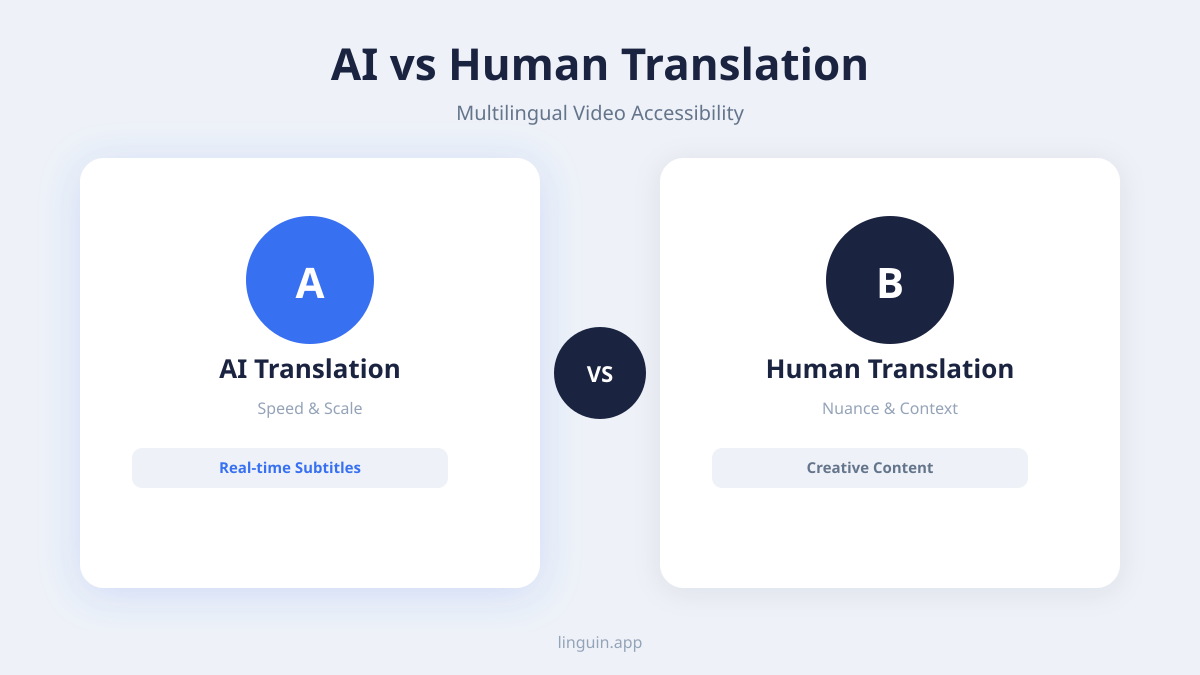
For clear, standard language in videos with good audio quality, modern AI translation can achieve very high accuracy, often above 90-95% for many language pairs. It excels at speed, scale, and cost-effectiveness. However, for content requiring deep cultural nuance, creative expression, or specialized subject matter, human translators still provide superior understanding and adaptability. The best practice is often a hybrid approach, using AI for the bulk of the work and humans for quality assurance and refinement of critical content.
Can AI translation handle live video streams in real time?
Yes, this is one of its most impactful applications. With a slight delay of a few seconds, AI systems can generate and display translated subtitles for live video. The technology combines real-time speech recognition with fast neural machine translation. The accuracy for live translation is continually improving, though it may be slightly lower than for pre-recorded content due to the lack of opportunity for processing context from future speech.
What is the difference between AI-generated subtitles and AI dubbing?
AI-generated subtitles provide translated text on the screen, synchronized with the original audio. AI dubbing (or voiceover) replaces the original spoken audio with a synthetic voice speaking the translation. Subtitles are less intrusive to the original production and easier for AI to generate with high quality. Dubbing is more complex, as it must match lip movements (in advanced cases) and convey emotion through synthetic speech, but it offers a more immersive experience for viewers who prefer not to read.
Do I need technical expertise to add AI translation to my videos?
Not necessarily. Many consumer-facing platforms have built-in, user-friendly tools. On YouTube, for example, you can enable automatic captions and then use the platform’s translation tool to create subtitles in other languages with a few clicks. For more advanced, customized, or high-volume needs, using a dedicated translation service or API might require some integration work, but many providers offer simple interfaces and clear documentation to get started.
Getting started with AI-translated video content
The journey to making your video content globally accessible begins with a single step. The core principle to remember is that AI translation for video is no longer a futuristic concept but a practical, available tool that can dramatically expand your reach and impact. By understanding how it works, from speech recognition to contextual translation, you can make informed decisions about integrating it into your workflow. The benefits are clear: from audience growth and competitive advantage to more effective global communication and inclusive community building.
Start by selecting one piece of content that has lasting value. This could be an introductory video for your service, a key tutorial, or a foundational presentation. Use a readily available tool, like the automatic translation features on your video hosting platform, to generate subtitles in one additional language. Share it with a test audience or colleague who speaks that language and solicit feedback on clarity and accuracy. This hands-on experiment will give you immediate, concrete insight into the process and the results.
The same real-time techniques carry over to interactive media, and our guide on AI translation for video game accessibility looks at how games apply this to dialogue, subtitles, and player chat.
For creators and teams looking to seamlessly incorporate translation into their daily digital environment, tools like Linguin provide AI-powered translation directly within your macOS, iOS, and browser workflow. This allows for quick translation of text from scripts, video descriptions, and viewer comments, complementing your video localization efforts. Explore how translation can enhance not just your videos, but all your multilingual communications to build a truly borderless digital presence.