 English
  Español
  Français
  Deutsch
  Português
  Italiano
  Русский
  中文(简体)
  日本語
日本語  한국어
한국어  العربية
  हिन्दी
  Nederlands
  Türkçe
  Polski
AI translation for e-commerce product listings directly addresses the core challenge of scaling your store to a global audience with speed, consistency, and cultural intelligence. For online retailers, breaking language barriers is no longer a luxury but a necessity to tap into international markets and connect with customers in their native language. This article explains how modern AI translation tools move beyond literal word substitution to optimize product listings for clarity, conversion, and local relevance. You will get a practical guide to implementing AI translation workflows that enhance your global e-commerce strategy, from product titles to detailed specifications.
Key takeaways
- AI translation provides scalable, consistent translation of large product catalogs, overcoming the speed and cost limitations of manual processes.
- Advanced models analyze context to produce natural-sounding product descriptions that respect local linguistic norms and shopping behaviors.
- Proper implementation includes post-translation review for brand voice alignment and keyword integration for multilingual SEO.
- AI-powered translation supports dynamic content updates, ensuring all market listings stay synchronized during sales, inventory changes, or feature updates.
The global e-commerce imperative and the language barrier
Expanding an online store beyond domestic borders presents a significant opportunity for revenue growth. However, the most immediate and formidable obstacle is language. A customer shopping in their native language is more comfortable, trusts the product information more readily, and is far more likely to complete a purchase. Studies consistently show that shoppers prefer to buy from websites in their own language, and they often abandon carts when faced with a foreign language interface. For e-commerce managers, this translates to a clear business requirement: product listings must be comprehensible and compelling in every target market.
Traditional methods of overcoming this barrier, such as hiring human translators for an entire catalog, are often impractical. They are time-consuming, expensive, and difficult to scale, especially for stores with thousands of SKUs that are frequently updated. The result is a stalled international strategy or a patchwork approach where only flagship products are translated, leaving vast sections of the catalog inaccessible. This is where AI translation becomes a critical operational tool. It automates the heavy lifting of initial translation, allowing teams to focus their human expertise on refinement, quality assurance, and cultural tuning.
The goal is not to replace human oversight but to augment it with powerful technology. By using an AI-powered tool like Linguin, e-commerce teams can generate first-draft translations for all product content-including titles, descriptions, bullet-point features, specifications, and even size guides-across 100+ languages simultaneously. This establishes a foundational multilingual presence that can be built upon and polished, making global expansion a feasible project rather than an overwhelming burden. It turns the language barrier from a wall into a manageable gateway.
How AI translation differs from traditional tools for product content
Understanding the distinction between basic machine translation and modern AI translation is crucial for e-commerce success. Older, rule-based translation systems often produced stiff, literal, and sometimes inaccurate output. They struggled with the nuanced language of marketing and sales, where emotional triggers, persuasive copy, and technical accuracy must coexist. A product description for a piece of athletic wear isn’t just a list of materials, it’s a promise of performance, comfort, and style. A literal translation might convey the facts but miss the feeling.
Modern AI translation models, particularly large language models (LLMs), are trained on vast corpora of human-written text. This allows them to grasp contextual meaning and generate translations that sound natural and idiomatic in the target language. For instance, an AI model can understand that “breathable fabric” in a sports context should be translated with a term that evokes airiness and comfort in the target language, not just a direct dictionary equivalent. It can handle product-specific jargon, like “non-comedogenic” in skincare or “tactile feedback” in electronics, with greater accuracy.
Consider a usage scenario for a home goods store expanding to Italy. A product description for a ceramic vase mentions it’s “a stunning centerpiece for your dining table.” A basic tool might translate “centerpiece” literally, which could be awkward. An AI model, understanding the decorative and social context of a dining table, would likely choose an Italian term that conveys an object of beauty meant to be displayed and admired during meals. This subtle shift makes the description feel native-written.
Furthermore, these systems excel at maintaining consistency. In e-commerce, using the same term for a product feature across hundreds of listings is vital for professionalism and searchability. AI translation tools can be guided to use preferred terminology, ensuring that “wireless charging” is always translated the same way in German listings, and “organic cotton” is consistent across French pages. This level of consistency is incredibly difficult to maintain manually at scale. For more on how AI achieves this accuracy, you can read about AI translation accuracy.
Key components of a product listing to translate
A complete multilingual product page requires more than just translating the main description. To provide a seamless and trustworthy shopping experience, every textual element must be addressed. A strategic approach to AI translation for e-commerce product listings involves breaking down the page into its core components and prioritizing their translation.
First, the product title and variant names are critical. They are often the first thing a customer sees in search results and on the page itself. Titles must be clear, include key attributes (color, size, model), and be optimized for both readability and search. AI can quickly generate title translations that incorporate these elements naturally.
Second, the short description and bullet-point features. This scannable content highlights key selling points and technical specifications. AI translation ensures these concise, impactful statements are preserved in meaning and punch. For example, translating “Lightweight design for all-day comfort” requires the model to balance the technical (“lightweight”) with the benefit (“all-day comfort”) in a succinct way.
Third, the long-form product description. This is where brand storytelling, detailed benefits, and usage scenarios are presented. AI models handle this narrative content well, maintaining the flow and persuasive tone of the original. This is also where cultural context becomes paramount. A description referencing a “Fourth of July barbecue” for a grill might need adaptation for a UK audience to a “summer garden party” reference. Our guide on AI translation for cultural context in marketing delves deeper into this.
Other essential elements include:
- Specifications and size charts: Technical data must be translated accurately, with units converted where necessary (e.g., inches to centimeters).
- Warranty information and care instructions: Legal and safety-related text requires precise translation. While AI provides a strong draft, a legal review for key markets is advisable.
- Category names and filter labels: Navigation elements must be translated so users can browse effectively.
- Call-to-action buttons and form fields: “Add to Cart,” “Checkout,” and “Email address” need standard, recognizable translations.
- SEO metadata: Translating page titles and meta descriptions is vital for visibility in local search engines.
Integrating multilingual SEO with AI translation
Translating product listings is only half the battle. To attract customers from international search engines like Google, Yandex, or Baidu, those listings must be discoverable. This is where multilingual SEO intersects directly with AI translation. The process involves more than translating existing keywords, it requires understanding what potential customers in each locale are actually searching for.
AI translation tools can play a pivotal role in this research and implementation phase. Start by identifying your primary keywords and key phrases in your source language. An AI tool can then provide accurate translations for these terms. However, the crucial next step is to use these translated terms as seeds for local keyword research. The direct translation of “running shoes” might not be the most common search term in another language; searchers might use a phrase meaning “sports shoes for jogging” or a specific brand-centric term.
A practical usage scenario involves a cosmetics brand entering the Korean market. Their US keyword might be “hydrating serum.” The AI provides the Korean translation. The e-commerce team then uses that term in local SEO tools to find related, high-volume queries, such as terms for “glass skin serum” or “lightweight hydration essence,” which are culturally relevant trends. These locally-researched terms can then be fed back into the AI translation workflow. You can instruct the model to naturally incorporate these target keywords into the translated product descriptions and metadata, ensuring the content is both readable and optimized. For a broader look at this topic, explore our article on AI translation for multilingual SEO content.
Furthermore, AI aids in creating unique, region-specific metadata for each language version of a product page. Duplicate meta descriptions across languages can harm SEO efforts. AI can generate varied, compelling meta descriptions based on the translated product copy, improving click-through rates from search results. The integration ensures your investment in translation directly contributes to organic growth in each new market.
Maintaining brand voice and quality across languages
A brand’s voice-its personality, tone, and style-is a key differentiator. Whether it’s friendly and playful, authoritative and technical, or luxurious and elegant, this voice must resonate consistently across all markets. A common pitfall in multilingual e-commerce is a disjointed brand experience where the original site feels premium but the translated versions sound generic or robotic. AI translation, when guided correctly, is a powerful tool for brand voice localization.
The first step is to define your brand voice guidelines clearly in your source language. What adjectives describe it? What is the sentence structure like? Are contractions used? Once defined, these guidelines can be communicated to the AI system through the use of custom instructions or style guides. Many advanced AI translation platforms allow you to input prompts like “Translate in a warm, conversational, and encouraging tone” or “Use formal, technical language suitable for B2B professionals.” By setting these parameters, the AI generates translations that align more closely with your desired character.
For example, a brand selling adventure travel gear with a rugged, inspirational voice would need its Japanese translations to evoke a similar sense of exploration and capability, not just state product facts. The AI can be prompted to use language that conveys resilience and the spirit of discovery, which may differ from a direct translation of the English adjectives. It’s also important to review outputs for cultural alignment. An enthusiastic, boastful tone that works in the US might need tempering for a market that values modesty and subtlety. This review process, where human editors refine AI output against brand and cultural standards, is where quality is cemented.
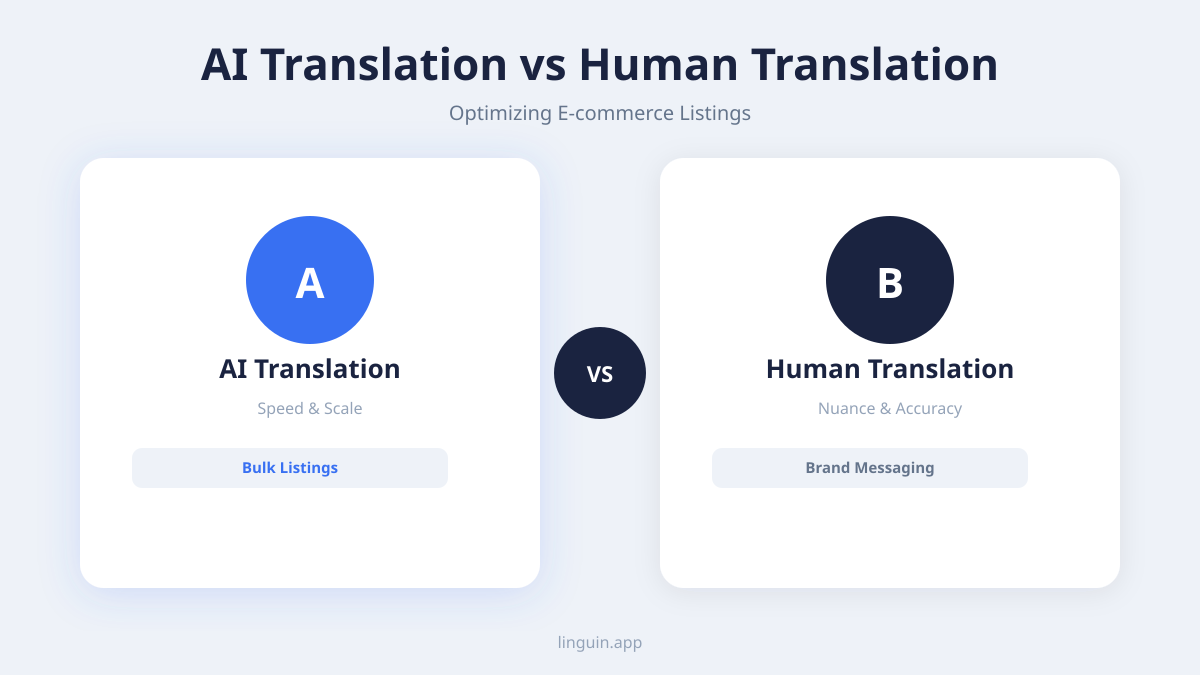
This human-in-the-loop model is efficient. The AI produces the bulk of the translation in the correct style direction, and human reviewers focus on nuance, cultural fine-tuning, and ensuring specific brand terms are handled perfectly. This collaborative approach scales your brand’s unique personality globally without requiring a team of native copywriters for every language from scratch. Learn more about managing tone in AI translation for formal and informal tone in emails, principles that apply to product copy as well.
Workflow implementation for scalable listing management
For e-commerce teams, efficiency is everything. A successful AI translation strategy must be integrated into a repeatable, scalable workflow that fits into existing product information management (PIM) systems, e-commerce platforms, and content schedules. A haphazard approach leads to inconsistency, errors, and management overhead.
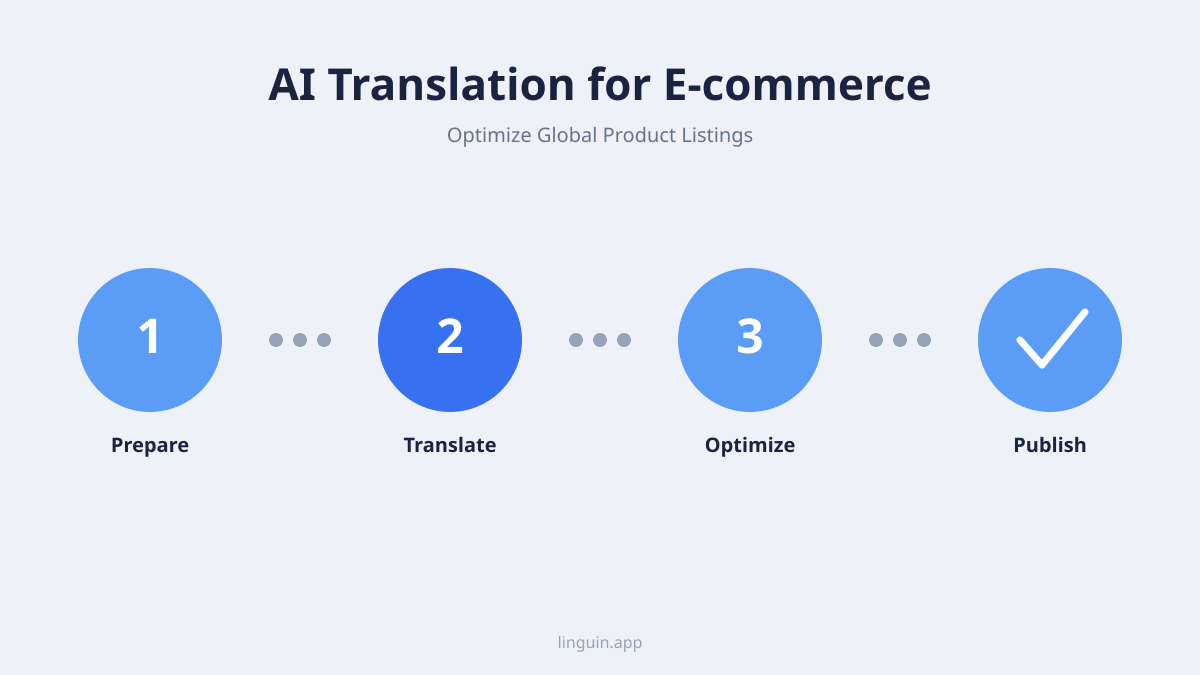
An optimal workflow follows these key stages:
- Content Preparation and Export: Compile all source product listing text (titles, descriptions, specs, etc.) into a structured format, such as a CSV, JSON, or via a platform API. Ensure the source text is well-written and clear, as AI translation quality is directly dependent on input quality.
- Batch AI Translation: Use an AI translation tool like Linguin that supports batch processing. Upload your structured file, select your target languages, and apply any pre-configured style guides or glossary terms. Execute the translation job for the entire catalog or selected batches.
- Post-Translation Review and Editing: Import the translated content into a review environment. This stage involves native-speaking reviewers or regional managers checking for accuracy, brand voice alignment, cultural appropriateness, and SEO keyword placement. They make necessary edits directly.
- Integration and Publishing: The approved translations are integrated back into your e-commerce platform, either manually, via import file, or through an automated connector. Each language version becomes a dedicated storefront or product variant.
- Update and Synchronization Cycle: Establish a process for ongoing updates. When a new product is added, a description is revised, or a sale price is announced, the source change triggers a new AI translation request for all active languages. This keeps all market listings synchronized with minimal delay.
This workflow turns translation from a one-time, monumental project into a continuous, manageable part of the content lifecycle. It allows for rapid entry into new markets, as the initial translation of a core catalog can be accomplished in days, not months. Furthermore, it future-proofs the operation. As AI models improve, reprocessing older listings with newer models can yield quality enhancements across the entire global catalog over time.
Cost and ROI considerations
Investing in AI translation for e-commerce product listings is fundamentally an investment in market access and operational scalability. The cost structure is markedly different from traditional human translation. Instead of paying per word or per hour for a limited number of listings, AI translation typically operates on a subscription or volume-based model that allows for translating entire catalogs within predictable budgets.
The return on investment (ROI) is measured across several dimensions. The most direct is increased sales revenue from previously inaccessible markets. By presenting a professionally translated, locally resonant storefront, you convert international traffic that would have otherwise bounced. Secondary financial benefits include reduced operational costs. The speed of AI translation eliminates the bottleneck of human translation timelines, allowing faster product launches and promotions globally. It also reduces the internal management burden of coordinating with multiple translators or agencies.
Perhaps the most significant ROI component is risk mitigation. Inaccurate or culturally insensitive translations can damage brand reputation. While AI is not infallible, the consistency and contextual awareness of modern models, combined with a streamlined human review process, significantly lower the risk of embarrassing or costly errors reaching the public. This protects brand equity in sensitive new markets.
When evaluating solutions, consider not just the per-word or monthly cost, but the total cost of ownership. This includes the time saved in management, the value of faster time-to-market, and the platform’s ability to integrate with your existing tech stack (like Shopify, WooCommerce, or a custom PIM). A tool that fits seamlessly into your workflow, like the Linguin AI translator app, provides efficiency gains that compound over time, making the expansion into each subsequent new language market easier and more cost-effective than the last.
Frequently asked questions
Can AI translation handle technical product specifications accurately?
Yes, modern AI translation models are trained on diverse text corpora, including technical and scientific documents. They can accurately translate industry-specific terminology, material compositions, dimensions, and performance metrics. For optimal results, providing the AI with context (e.g., “translate this as a technical specification sheet for industrial machinery”) helps. However, for highly specialized or safety-critical specifications, a final review by a subject matter expert in the target language is recommended.
How do I ensure my translated listings sound natural and not robotic?
The key is to use AI models designed for natural language generation and to provide clear stylistic guidance. Before translating your catalog, feed the AI examples of your desired brand voice and tone. Many platforms allow you to create a custom style guide or glossary. After the AI generates the first draft, a crucial step is having a native speaker review the content for flow, idiom, and local colloquialisms. This human-AI collaboration produces the most natural-sounding results.
Is AI translation for e-commerce good enough to replace human translators entirely?
For the vast majority of product listing content-descriptions, features, titles-AI translation provides a high-quality foundation that is efficient and scalable. It replaces the initial, time-consuming draft creation. However, for final-mile quality, brand voice perfection, and nuanced cultural adaptation, human oversight remains valuable. The most effective model uses AI for scale and speed, and human experts for strategic review and refinement, especially for marketing copy and legal text. Our analysis of AI vs. human translation explores this balance in detail.
How do I manage translations when I update my original product descriptions?
A robust AI translation workflow includes a synchronization process. When you update a source product description in your main language, your system should flag it for re-translation. Using an AI translation platform with API connectivity, this can be automated. The updated content is sent for translation into all active target languages, and the new versions are routed for a quick review before publishing, ensuring all your global listings stay current.
Implementing AI translation in your e-commerce strategy
Adopting AI translation for your product listings is a strategic decision that unlocks global growth. The process begins with recognizing that language is the bridge to customer trust and conversion in any market. By leveraging AI, you build that bridge with unprecedented speed and consistency, transforming your catalog into a multilingual asset. The core benefits are clear: scalable content creation, maintained brand voice across borders, and integrated SEO for international discoverability.
The most important next step is to start with a pilot. Select a segment of your catalog, perhaps a best-selling category or a new product line destined for international release. Use a capable AI translation tool to translate this content into one or two key target languages. Then, implement a focused review process with your team or a local expert to evaluate the output for accuracy, tone, and cultural fit. This hands-on test will provide concrete insights into the workflow adjustments needed and the potential ROI for your specific business.
Tools like Linguin are designed to integrate into this workflow, offering the context-aware AI models and management features necessary for e-commerce scale. The goal is to make multilingual listing management a seamless, almost automatic part of your operations, freeing you to focus on the strategic aspects of global market expansion. By optimizing your product listings with intelligent translation, you are not just changing words, you are opening doors to millions of new customers worldwide.