 English
  Español
  Français
  Deutsch
  Português
  Italiano
  Русский
  中文(简体)
  日本語
日本語  한국어
한국어  العربية
  हिन्दी
  Nederlands
  Türkçe
  Polski
Translating English to Hindi in voice audio is the process of converting spoken English into spoken Hindi in real time or near real time. This capability transforms how we communicate across language barriers, making interactions more natural and immediate than ever before. This is essential for travelers, professionals collaborating with Hindi-speaking teams, students, and anyone consuming media or connecting with friends and family. In this guide, you will learn how voice translation works, its practical applications, and how to leverage it effectively.
Key takeaways
- Voice translation combines speech recognition, machine translation, and text-to-speech synthesis to create a seamless audio pipeline.
- It enables real-time, hands-free communication, which is crucial for travel, customer support, and inclusive content access.
- The quality of the translation depends heavily on the AI model’s understanding of context, accents, and conversational nuance.
How does english to hindi translate in voice audio work?
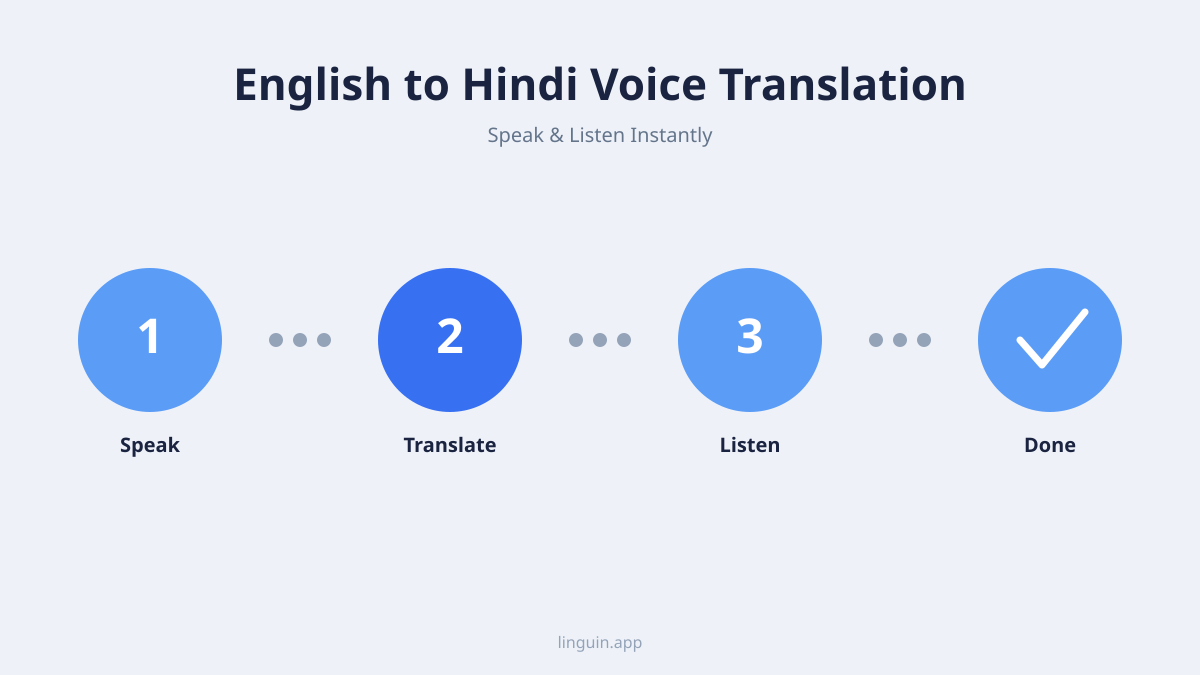
The process of translating spoken English into spoken Hindi involves a sequence of sophisticated technologies working in concert. It begins with speech recognition, where an AI model listens to the audio input and converts the spoken English words into text. This step must handle various accents, speaking speeds, and background noise. The accuracy here is foundational, as any error is carried forward.
Next, the recognized English text is passed to a machine translation engine. Modern engines, especially those powered by advanced AI, do not translate word-for-word. Instead, they analyze the full context of the sentence to produce a Hindi translation that is natural and grammatically correct. This involves understanding idioms, cultural references, and sentence structure, which you can explore further in our article on AI translation for idioms and cultural nuances.
Finally, the translated Hindi text is converted back into audio using text-to-speech synthesis. A high-quality TTS system will produce speech that sounds fluid and human-like, with appropriate intonation and rhythm for Hindi. The entire pipeline-from listening to speaking-can happen in seconds, enabling a fluid conversation.
Key benefits of using voice audio translation
The primary advantage of voice translation is the dramatic reduction in communication friction. It allows for spontaneous dialogue without the need to type, look at a screen, or manually swap between apps. This hands-free, eyes-free operation is invaluable in situations like driving, navigating a busy market, or when your hands are occupied.
It also promotes greater accessibility. Individuals with visual impairments or literacy challenges can engage with information and people in a language they understand. Furthermore, it captures the nuance of spoken language-tone, hesitation, and emphasis-that can be lost in text. This leads to more empathetic and effective communication, whether in a business negotiation or a personal call.
For learning and content consumption, voice translation opens doors. A student can listen to an English lecture and get a real-time Hindi audio translation to aid comprehension. Similarly, someone can enjoy Hindi podcasts, news, or audiobooks translated from English, broadening their access to global knowledge and entertainment without a textual intermediary.
Essential tools and apps for voice translation
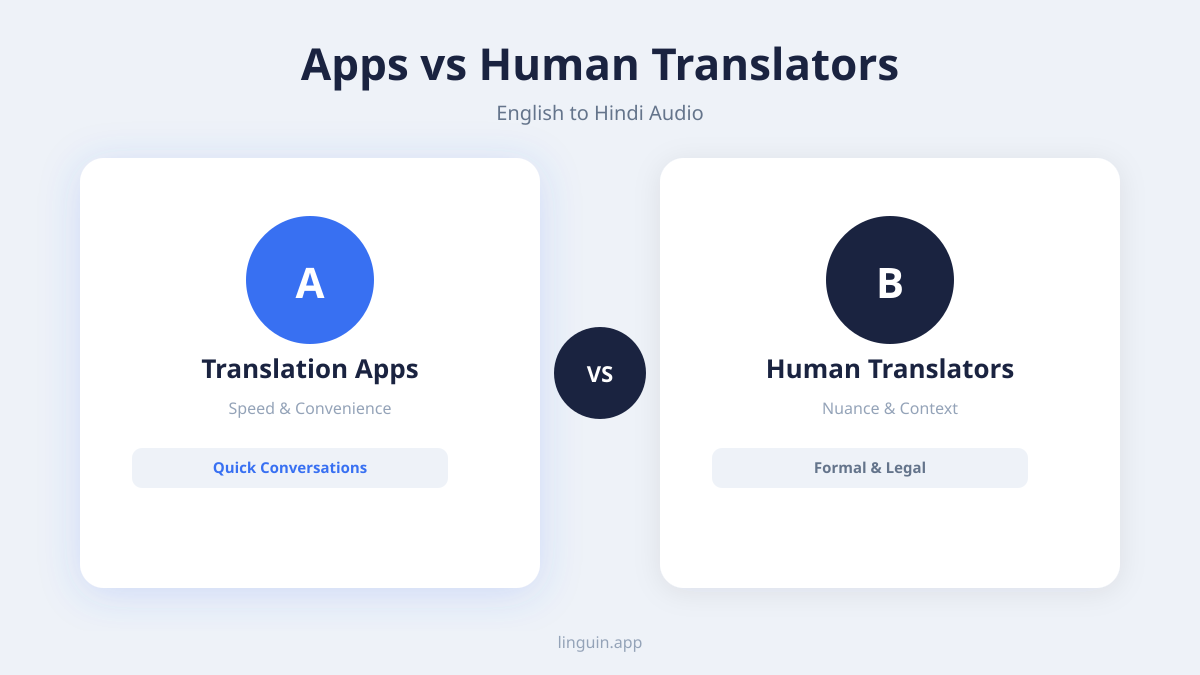
Choosing the right tool depends on your specific need: is it for real-time conversation, media consumption, or professional use? Dedicated translation apps often offer a conversation mode where two people speak into the same device, and it translates each utterance aloud. These are excellent for travel and informal chats.
Browser extensions, like those offered by Linguin, are powerful for translating spoken audio from videos, podcasts, or live streams directly within your browser. This is perfect for consuming online content. For integrated workflows, some communication and productivity platforms are beginning to bake live translation features into video calls and messaging.
When evaluating a tool, consider these critical features:
- Offline functionality: Crucial for travel where internet access is unreliable.
- Dialect and accent support: Hindi has many dialects; a good tool should handle major variations.
- Customization: The ability to adjust the speed of the spoken output or choose a different voice.
- Privacy: Understanding whether your audio data is processed locally on your device or on a remote server.
No single tool is perfect for every scenario. For instance, a quick phrase translation might suit a simple app, while collaborating on a multilingual project might require a more robust solution like Linguin, which integrates across macOS, iOS, and browsers.
Practical use cases and scenarios
Voice translation moves from a novel feature to an indispensable tool in concrete situations. Here are two detailed scenarios.
Scenario 1: Remote customer support. Imagine you run an online service with customers in India. A Hindi-speaking customer calls with a technical issue. Your English-speaking support agent can use a voice translation tool in real-time during the call. The agent speaks in English, the customer hears in Hindi, and vice-versa. This resolves issues faster, improves customer satisfaction, and eliminates the need for a dedicated bilingual staffer for every call. This mirrors the principles discussed in our guide to AI translation for multilingual customer support.
Scenario 2: Academic research collaboration. A researcher in Delhi is co-authoring a paper with a team in London. They hold weekly video calls to discuss findings. Using a tool that provides live audio translation, the Hindi-speaking researcher can follow the English discussion seamlessly and contribute in Hindi, which is translated for the team. This breaks down language barriers in critical knowledge-sharing environments, a topic explored in AI translation for multilingual academic collaboration.
Other common use cases include navigating public transport in a Hindi-speaking region, enjoying English-language films with Hindi audio dubbing on the fly, and helping elderly relatives who are more comfortable with Hindi to understand voice instructions from smart home devices in English.
Overcoming common challenges in voice translation
While the technology is impressive, users should be aware of its current limitations to set realistic expectations. Background noise is a significant hurdle. A crowded room or traffic sounds can interfere with the initial speech recognition, leading to garbled input and a faulty translation. Speaking clearly and using a tool with noise-cancellation features can mitigate this.
Accents and colloquialisms present another challenge. A strong regional English accent or the use of slang may not be recognized correctly. Similarly, translating cultural concepts or humor directly is complex for AI. For more on this, see our article on AI translation for humor and sarcasm. The solution is to use tools trained on diverse, real-world data and to speak in a more standardized, clear manner when precision is key.
Finally, the flow of conversation can be disrupted by latency. A delay of even a few seconds between speaking and hearing the translation can make a natural back-and-forth dialogue feel stilted. Choosing tools optimized for low-latency processing is essential for conversational use. Understanding these challenges helps you use the technology more effectively and know when a follow-up clarification might be needed.
The role of AI in improving voice translation quality
The leap in voice translation quality in recent years is largely due to advances in AI and neural machine translation. Earlier rule-based systems struggled with the complexity of language. Modern AI models learn from vast datasets of parallel text and audio, allowing them to grasp context, intent, and the subtle differences between formal and informal speech.
A key innovation is context-aware translation. The AI doesn’t just look at a single sentence. It can use the preceding sentences in a conversation to determine the correct meaning of ambiguous words. For example, it can distinguish whether “bank” refers to a financial institution or the side of a river based on the ongoing dialogue. This leads to translations that are coherent over longer passages.
Furthermore, AI is improving the naturalness of the final audio output. Text-to-speech models are now capable of generating speech with emotional inflection and pauses that match the content, moving beyond the robotic monotone of the past. This makes the listening experience in Hindi more engaging and less fatiguing. The continuous learning nature of AI means these systems are constantly evolving, as detailed in our overview of AI translation accuracy.
english to hindi translate in voice audio FAQ
Is real-time english to hindi voice translation accurate enough for business meetings?
For most business contexts, yes, especially for grasping the general flow of discussion and key points. While it may not be perfect for translating highly technical jargon or nuanced contractual language without review, it is highly effective for daily stand-ups, project updates, and relationship-building conversations. It’s advisable to confirm critical details in writing afterward.
Can I use voice translation without an internet connection?
This depends entirely on the application you choose. Some advanced tools require a constant internet connection to leverage powerful cloud-based AI models. Others offer downloadable language packs that allow for offline translation, which is a vital feature for travelers. Always check the app’s specifications for offline capability before you rely on it in a low-connectivity area.
How does voice translation handle different Hindi dialects?
The capability varies. Leading tools are typically trained on a standard, widely understood form of Hindi (often based on the Khari Boli dialect). They may struggle with strong regional dialects like Bhojpuri, Marwari, or heavily accented speech. For best results, users are encouraged to speak in a more neutral, standardized Hindi when using translation tools.
What’s the difference between voice translation and transcription translation?
Voice translation gives you an immediate spoken result. Transcription translation first converts speech to text, then translates that text, and you read the result. Voice translation is faster and allows for eyes-free interaction, while transcription provides a written record you can review and edit, which is better for accuracy-critical tasks like multilingual legal document review.
Integrating voice translation into your daily life
The true power of translating English to Hindi in voice audio is realized when it becomes a seamless part of your routine. Start by identifying one or two recurring situations where a language barrier exists, such as weekly calls with family or consuming English tech tutorials. Experiment with a reliable tool like Linguin in that specific scenario to build comfort.
Remember that the technology is an aid, not a replacement for human understanding. Use it to bridge gaps, but remain mindful of its limitations with complex topics or cultural subtleties. The goal is smoother communication, not perfect translation. As these tools evolve, they will continue to shrink the world, making cross-cultural connections more immediate and authentic.
Your next step is simple: choose one of the use cases mentioned here and try it. Whether you install a browser extension to translate a video or use a mobile app’s conversation mode on your next trip, taking that first practical action will demonstrate the value directly. With practice, you’ll find new and innovative ways to make voice translation work for you.