 English
  Español
  Français
  Deutsch
  Português
  Italiano
  Русский
  中文(简体)
  日本語
日本語  한국어
한국어  العربية
  हिन्दी
  Nederlands
  Türkçe
  Polski
A multilingual content strategy is a structured plan to create, adapt, and manage your message across different languages. It is a foundational requirement for any business or creator looking to connect with a global audience. In a digital world where language remains the primary gatekeeper to information and community, operating in only one language limits your reach and impact. This guide is for marketers, business owners, and content creators who are ready to move beyond borders. You will learn how to build a framework that respects cultural nuances, leverages modern technology, and delivers your content effectively to every corner of your target market.
Key takeaways
- A successful strategy starts with audience research and clear goals, not just translating existing content.
- Quality translation requires an understanding of context and cultural nuance that goes beyond direct word-for-word substitution.
- AI-powered tools can manage the scale and speed of multilingual content creation while maintaining consistency.
- Your strategy must include a plan for ongoing maintenance, updates, and measuring performance across all language versions.
What is a multilingual content strategy?
A multilingual content strategy is a comprehensive framework for producing and distributing content in multiple languages to achieve specific business or communication objectives. It is not merely translation. It is the intentional planning of what to say, how to say it, and where to publish it for audiences who speak different languages. The core purpose is to make your message accessible, relevant, and engaging to people regardless of their native tongue.
This strategy encompasses everything from your website and blog to marketing emails, social media posts, product documentation, and customer support. It considers the entire content lifecycle in each language, from creation and adaptation to publication, promotion, and analysis. The alternative-creating content in one language and hoping machine translation or user goodwill will bridge the gap-often leads to misunderstandings, a poor user experience, and missed opportunities.
A true strategy involves deliberate choices. You must decide which languages to prioritize based on your audience and goals. You need to establish processes for adapting content culturally, not just linguistically. This means considering local idioms, values, legal requirements, and search behaviors. Finally, you need systems to ensure consistency and quality across all your multilingual assets, turning a potential operational challenge into a scalable competitive advantage.
The core benefits of going multilingual
Expanding your content into new languages offers tangible advantages that directly affect your reach, reputation, and revenue. The first and most evident benefit is audience expansion. You immediately remove the largest barrier to entry for potential customers or followers. By communicating in someone’s preferred language, you signal that you value their engagement and have designed your offerings with them in mind. This can open up entirely new markets and customer segments that were previously inaccessible.
The second major benefit is enhanced trust and credibility. Providing native-language content demonstrates professionalism and commitment. It shows you have invested in understanding and serving that audience. This builds a stronger, more authentic connection than relying on a visitor’s second-language skills or a browser’s instant translation. For businesses, this trust translates directly into higher conversion rates, increased customer loyalty, and positive brand perception. Users are more likely to purchase, subscribe, or engage when they feel understood.
Third, a multilingual presence significantly improves your search engine visibility on a global scale. Search engines like Google prioritize content that matches the user’s language and regional intent. By creating dedicated content for different languages and locales, you can rank for relevant keywords in each market. This generates organic traffic from multiple sources, diversifying your audience acquisition channels. Furthermore, it protects your brand in foreign markets by ensuring your official, high-quality content is what users find first, not potentially inaccurate or unofficial translations.
Finally, operating multilingually provides a competitive edge. In many industries, competitors may still be operating primarily in one language. By being the first or best to serve a particular language community, you can establish yourself as the go-to authority in that space. This early-mover advantage can be difficult for others to overcome once you have built rapport and loyalty with that audience.
Planning your strategy: where to begin
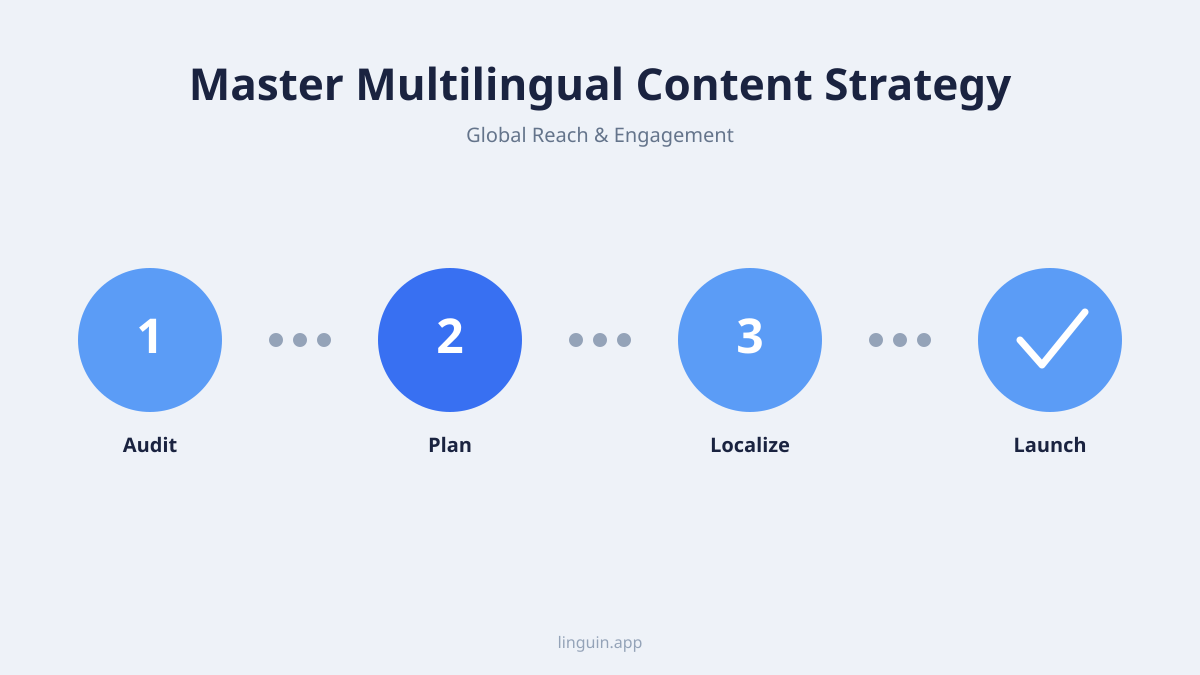
A successful multilingual content strategy starts with a plan, not with translation. Rushing into converting your existing content without a framework leads to disjointed results and wasted resources. The first critical step is audience and market research. You must identify which language communities are most valuable to your goals. Analyze your website analytics to see where your current international traffic originates. Research market size, growth potential, and competition in specific regions. Understand not just what languages people speak, but what content formats and topics resonate within those cultures.
Next, define your strategic goals and key performance indicators (KPIs). What do you want to achieve? Common goals include increasing market share in a specific country, boosting international sales, improving global brand awareness, or providing better support to a diverse user base. Your goals will dictate your priorities. For example, if the goal is sales, you might prioritize translating product pages and checkout flows. If it’s support, you would focus on help documentation and knowledge bases. Attach measurable KPIs to each goal, such as traffic growth from a region, conversion rate for a language-specific landing page, or reduced support tickets in a language.
The third planning phase is content audit and prioritization. Take inventory of all your existing content. Not all of it needs to be translated immediately or at all. Use a simple framework to prioritize:
- High Priority: Core, evergreen content that drives conversions or explains your fundamental value (homepage, key product pages, flagship blog posts).
- Medium Priority: Supporting content that aids the user journey (feature details, case studies, FAQ sections).
- Low Priority: Time-sensitive or niche content (news updates, very specific blog posts).
Start with high-priority content for your primary target language. This creates a solid foundation that delivers the most value quickly. Also, consider the content’s adaptability. Some concepts or jokes may not translate well and might need to be replaced with locally relevant examples, a process known as transcreation.
Choosing the right languages and content
Selecting which languages to support is a strategic decision with long-term implications. The choice should be data-driven, not based on assumptions. Begin by analyzing your existing customer base, website traffic, and social media followers for geographic and linguistic signals. Tools like Google Analytics can show you the countries of your visitors, and social media insights can reveal the languages of your engaged followers. This data points to existing demand.
Then, look outward to market opportunity. Research industries and regions that align with your product or content. Are there emerging markets with high internet penetration and a need for what you offer? Is there a language community that is large but currently underserved by your competitors? For instance, a business tool might find significant opportunity in localizing for German-speaking professionals, while a lifestyle blog might see engagement potential in Spanish or Portuguese.
Consider the resource commitment for each language. Some languages require more than translation; they require adaptation for different scripts (like Arabic or Hindi) or complex character sets (like Chinese or Japanese), which can affect website design and functionality. Also, think about ongoing maintenance. Adding a language is a commitment to produce new content and update old content in that language consistently. It is often better to excel in two or three languages than to do a poor job in ten.
Once languages are chosen, you must decide what content to translate and adapt first. A common and effective approach is to map the customer journey for each target audience. Identify the key touchpoints where language is critical:
- Awareness: Landing pages, blog content, and social media that attract new visitors.
- Consideration: Product/service pages, comparison guides, and testimonials.
- Decision: Pricing pages, sign-up flows, and checkout processes.
- Retention: Onboarding materials, help documentation, and customer support.
By aligning your initial multilingual content with this journey, you ensure a seamless experience that guides the user from discovery to loyalty. For example, translating your checkout process (Decision stage) has a more direct impact on revenue than translating an archival blog post.
The translation process: quality and consistency
The execution phase is where your strategy meets reality. Ensuring quality and consistency across all your translated content is paramount. The cornerstone of this is a centralized glossary and style guide. Before any translation begins, create a glossary of key company terms, product names, and industry jargon. Define how these should be translated-or if they should not be translated at all. A style guide for each language should cover tone of voice, formality, punctuation preferences, and formatting rules. This prevents different translators from rendering your brand name or core message in different ways.
The choice of translation method is critical. You generally have three options, often used in combination:
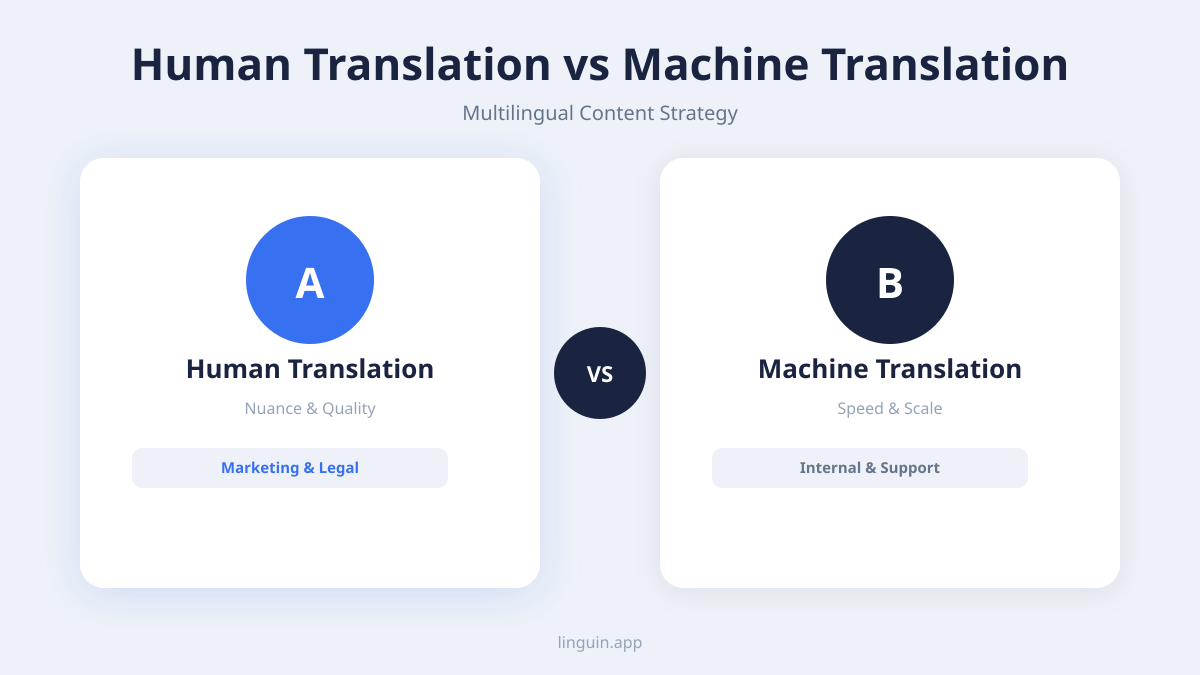
- Professional Human Translation: Best for high-stakes, creative, or legally sensitive content (marketing slogans, legal terms, brand stories). It captures nuance and cultural context but is slower and more expensive.
- AI-Powered Translation: Ideal for scaling large volumes of content quickly while maintaining good quality. Modern AI translation tools, like Linguin, go beyond simple phrase substitution to understand context, producing more natural-sounding output. This is excellent for blog posts, documentation, and internal communications.
- Post-Editing by Humans (MTPE): A hybrid model where AI provides a draft translation, and a human editor reviews and refines it. This balances speed, cost, and quality, ensuring the final text meets your brand standards.
For most dynamic content strategies, AI-powered translation with strategic human oversight provides the best balance. A tool like Linguin can handle the bulk of the work across over 100 languages, allowing your team to focus on editing and cultural fine-tuning.
Finally, implement a rigorous quality assurance (QA) process. This should include:
- Linguistic review by a native speaker for fluency and accuracy.
- Functional testing to ensure all links, buttons, and forms work in the translated version.
- Design review to confirm the layout accommodates text expansion or contraction (some languages use 30% more words than English).
- Consistency checks against your glossary and style guide.
Say you’re launching a new software feature with accompanying documentation. Using an AI translator, you can quickly produce drafts in five key languages. Your regional team leads then perform a post-edit, ensuring the technical terms match local conventions and the instructions are clear. This process is far faster than starting from scratch but maintains the quality users expect.
Tools and technology for execution
Managing a multilingual content strategy at scale requires the right technological foundation. The core of this is a Content Management System (CMS) with robust multilingual support. Modern CMS platforms allow you to create content relationships between different language versions, manage workflows for translators and editors, and publish updates synchronously or as needed. This centralized approach prevents the chaos of managing separate websites or documents for each language.
Translation Management Systems (TMS) and AI translation APIs are the engines of scalability. A TMS integrates with your CMS and automates the workflow: it sends new content for translation, routes it to the appropriate translator or AI engine, and returns the finished translation for review and publication. When paired with a sophisticated AI translation tool, this process becomes highly efficient. For instance, using an AI translator for Mac or a Chrome extension like Linguin allows content creators to translate text directly within their workflow, whether they are writing an email, drafting a document, or reviewing a web page.
The technology stack should also include tools for quality and consistency. This includes terminology management databases to store your approved glossaries, and style guide platforms that are accessible to all contributors. Some AI translation tools offer customization features, allowing you to fine-tune the AI’s output to prefer your company’s specific terminology, which greatly improves initial translation quality and reduces editing time.
Consider this scenario: Your marketing team writes a blog post in English. With the right setup, they can publish it to a “Ready for Translation” queue in your CMS. Your TMS automatically picks it up and sends it to Linguin’s AI for translation into Spanish, French, and Japanese. The drafts are returned and assigned to in-country reviewers for post-editing. Once approved, the translations are published to the respective language versions of your blog, all from a single dashboard. This seamless integration is what makes a large-scale strategy operationally possible. For comparing the capabilities of different AI solutions, our analysis of DeepL vs Google Translate provides useful insights.
Maintaining and measuring your multilingual content
Launching your multilingual content is only the beginning. A sustainable strategy requires ongoing maintenance and performance measurement. Content is not static; your English-language website evolves, and so must all its translated counterparts. Establish a clear process for updates and synchronization. When a core product page, pricing, or legal term is updated in the source language, trigger an immediate translation update for all target languages. Use version control and content calendars to track what has been updated and what is still pending. Letting translations become outdated damages credibility more than not having them at all.
The second pillar of maintenance is community and feedback. Encourage feedback from your multilingual users. Provide easy ways for them to report translation errors or suggest improvements. This not only improves your content but also fosters a sense of community and co-creation. Consider engaging native speakers as moderators or contributors for forums, social media, or comment sections in their language.
Measuring success is critical to proving ROI and guiding future efforts. Your KPIs, defined in the planning stage, should be tracked diligently. Use analytics segmented by language and region to monitor:
- Traffic Metrics: Visits, unique visitors, and pageviews per language.
- Engagement Metrics: Bounce rate, time on page, and pages per session to gauge content relevance.
- Conversion Metrics: Goal completions, sign-ups, or sales attributed to each language version.
- SEO Performance: Search rankings for target keywords in each language and organic traffic growth.
Analyze this data regularly to understand what is working. Perhaps your German-language blog has a high engagement time but low conversions, indicating the content is good but the call-to-action needs cultural adjustment. Or maybe your Japanese landing page has a high bounce rate, suggesting a problem with the page load speed or initial translation quality. This data allows you to iterate and optimize your strategy continuously, shifting resources to the most effective languages and content types. For deep dives into translation accuracy, which underpins all these metrics, explore our articles on AI translation accuracy and the ongoing AI vs human translation discussion.
Frequently asked questions
How many languages should I start with?
Start with one or two languages beyond your source language. Choose these based on clear data showing high potential audience size, existing traffic, or strategic market importance. It is more effective to execute a complete, high-quality strategy in a few languages than to spread your resources too thinly. You can always add more languages as you refine your process and demonstrate success.
Is machine/AI translation good enough for professional content?
Modern AI translation has advanced significantly and is suitable for a wide range of professional content, especially when context is understood. It excels at translating informative content like blog posts, documentation, and internal communications quickly and consistently. For marketing copy, legal documents, or culturally sensitive material, a hybrid approach-using AI for the draft and a human for post-editing-is often the best practice. The key is choosing a capable AI tool and having a quality assurance process.
How do I handle idioms and cultural references?
Idioms and cultural references often cannot be translated directly. The solution is transcreation. This means recreating the content’s intent, tone, and impact for the target culture. A skilled translator or local expert should identify these elements and replace them with an equivalent concept or phrase that resonates locally. For example, the English idiom “beat around the bush” might be translated to a culturally appropriate phrase in Spanish that conveys indirectness.
How much does a multilingual content strategy cost?
Costs vary widely based on scope, languages, and method. Primary costs include translation (AI services, human translators, or both), technology (CMS/TMS tools), and human resources for project management and editing. An AI-powered strategy can significantly reduce per-word translation costs and increase speed, making it a cost-effective solution for scaling. The investment should be weighed against the potential revenue from new markets and the brand value of a global presence.
Implementing your strategy with the right tools
Building a multilingual content strategy is a journey that expands your influence and deepens your connections. The most important steps are to start with research and clear goals, prioritize your audience and content thoughtfully, and insist on a process that ensures quality and consistency. Remember, this is not a one-time project but an ongoing commitment to communicating with your global audience in a language they understand and appreciate.
The right technology is what makes this commitment sustainable. AI-powered translation tools have transformed this field, making it possible for teams of any size to manage content across dozens of languages without prohibitive cost or delay. By integrating these tools into your workflow, you can focus on strategy, creativity, and community building, while the heavy lifting of linguistic conversion is handled efficiently.
A practical next step is to audit one key piece of your customer journey-perhaps your homepage or a top-performing blog post-and explore how it might be adapted for one of your target languages. Use a tool like Linguin to get a draft translation and assess the effort involved in post-editing. This hands-on exercise will clarify the process, reveal potential challenges, and help you build a realistic plan for a full-scale multilingual content strategy that grows your reach and reinforces your brand on a global stage.