 English
  Español
  Français
  Deutsch
  Português
  Italiano
  Русский
  中文(简体)
  日本語
日本語  한국어
한국어  العربية
  हिन्दी
  Nederlands
  Türkçe
  Polski
AI translation technology is emerging as a powerful tool in the global effort to preserve endangered languages. This is a critical mission for linguists, community activists, and anyone concerned with cultural heritage. When a language disappears, it takes with it a unique worldview, cultural knowledge, and historical identity. This article explores the specific ways AI can assist in documenting, teaching, and revitalizing languages at risk of extinction, and outlines both the opportunities and the ethical considerations involved.
Key takeaways
- AI can rapidly process and analyze sparse linguistic data to create foundational digital resources like dictionaries and grammar guides.
- Machine learning models help linguists identify patterns and structures in endangered languages more efficiently than manual methods alone.
- AI translation tools can provide real-time, contextual translations that support everyday use and intergenerational communication within communities.
- The success of AI in this field depends on collaborative, ethical partnerships with native speaker communities to ensure accuracy and cultural respect.
The silent crisis of language extinction
Languages are more than just words. They are vessels of culture, history, and identity. When a language falls silent, it signifies the loss of a unique way of understanding the world. An endangered language is one that is at risk of no longer being spoken by any living person. This process of language death is accelerating globally, with experts estimating that a significant percentage of the world’s languages could disappear within the next century.
The primary driver of language extinction is the dominance of global languages like English, Mandarin, and Spanish in education, media, and commerce. Younger generations often shift to these majority languages for perceived economic and social advantages, leading to a breakdown in intergenerational transmission. When elders pass away, they take their fluency with them, leaving a cultural void. This loss is not just sentimental. Indigenous languages often contain intricate knowledge about local ecosystems, medicinal plants, and sustainable practices that are not recorded elsewhere.
Preserving these languages is therefore an urgent task of cultural and intellectual conservation. The goal is not merely to document grammar and vocabulary but to keep the language alive as a living, spoken medium. This requires a multi-pronged approach that includes education, community engagement, and increasingly, technology. AI translation offers a new set of tools to support these efforts, providing scalable ways to tackle challenges that have historically been constrained by limited resources and time.
How AI translation works with sparse data
Traditional AI translation models, like those used for common language pairs such as English to Spanish, are trained on massive datasets comprising millions of translated sentences. This abundance of data allows the AI to learn complex patterns, nuances, and contextual meanings. However, this data-rich environment does not exist for endangered languages. Many have only a few hundred or thousand speakers, with limited written records, making the task fundamentally different.
To address this challenge, AI researchers use techniques tailored for low-resource scenarios. One key approach is transfer learning. In this method, a model is first pre-trained on a high-resource language pair to understand general translation concepts. It is then fine-tuned on the small amount of available data for the endangered language. This process gives the AI a head start, allowing it to apply broad linguistic principles to a specific, data-scarce context.
Another critical technique involves leveraging related languages. If an endangered language belongs to a known language family, data from its linguistic relatives can be used to bootstrap the model’s understanding. For instance, an AI trained on several Romance languages might more easily learn a lesser-known dialect within that family by recognizing shared grammatical structures and vocabulary roots.
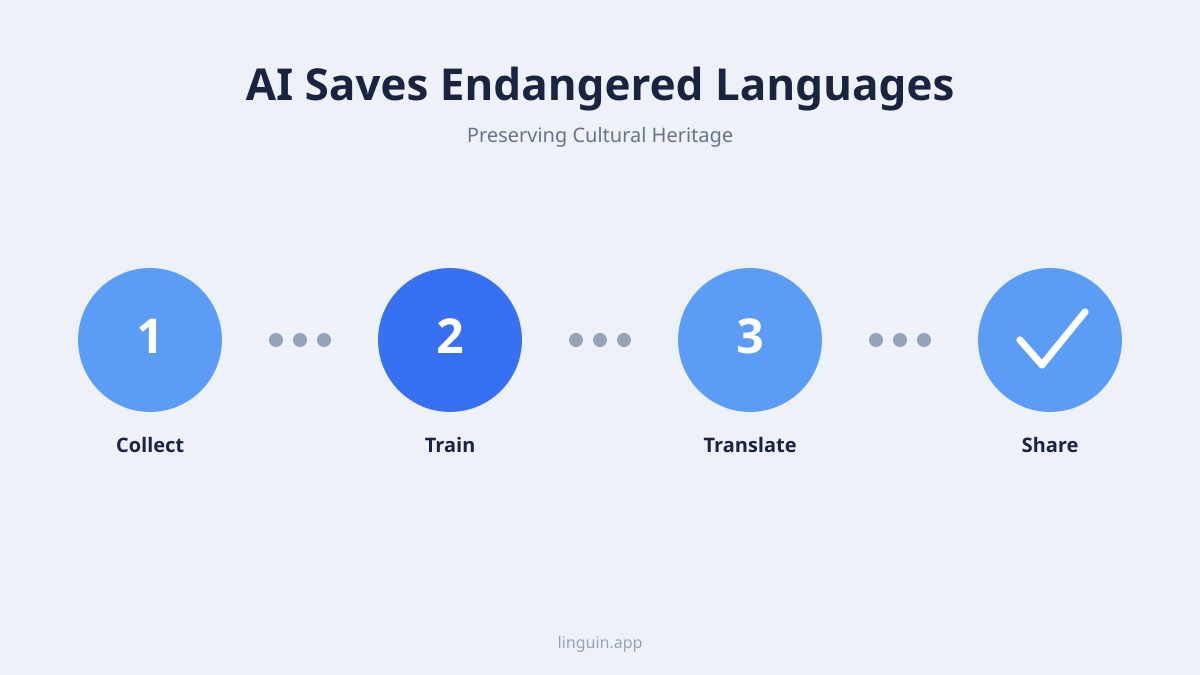
The process typically involves several steps:
- Data collection and digitization: The first step is to gather all available resources, which may include handwritten notes, audio recordings of elders, and existing dictionaries. This analog data must be painstakingly digitized.
- Corpus creation: The digitized data is organized into a structured corpus, which is a collection of texts and translations that the AI can learn from.
- Model training and fine-tuning: Using the techniques mentioned above, a specialized translation model is trained on this corpus.
- Iterative refinement: The initial outputs from the AI are reviewed by native speakers and linguists. Their corrections are fed back into the model to improve its accuracy over time. This human-in-the-loop approach is essential for quality.
As we explore in our article on AI translation accuracy, the goal with endangered languages is not perfection but creating a useful assistive tool that improves with community input.
Documenting and analyzing linguistic structures
One of the most immediate applications of AI in language preservation is in the field of documentation and analysis. For linguists working to record an endangered language, AI can act as a powerful assistant, accelerating tasks that would otherwise take years of manual labor. The ability to quickly process and identify patterns in audio and text data is a game-changer for understanding a language’s core mechanics.
A primary task is the creation of a comprehensive digital dictionary. AI tools can analyze a corpus of text and audio transcripts to automatically identify potential word roots, their variations, and common phrases. While a human linguist must still verify meanings and usage, the AI can drastically reduce the initial legwork. It can also help identify different morphological forms of a word, helping to map out complex conjugation or declension patterns that are not immediately obvious.
Similarly, AI can assist in modeling the language’s grammar. By analyzing sentence structures, the software can hypothesize rules for syntax, word order, and grammatical cases. For example, it might detect that the object of a sentence consistently comes before the verb, a key insight into the language’s structure. This automated analysis provides a foundational sketch that linguists can then refine through direct work with speakers, making their fieldwork more focused and efficient.
Another powerful application is in phonetic analysis. AI-powered speech recognition models can be trained on audio recordings of native speakers to create a detailed map of the language’s sound system. This helps in standardizing pronunciation guides and can be particularly useful for languages with sounds that are unfamiliar to the linguists documenting them. The resulting data is invaluable for creating learning materials that accurately represent how the language sounds.
- Scenario: A linguist has hundreds of hours of audio recordings of the last few fluent speakers of a language. Manually transcribing this would take a lifetime. An AI model, trained on a small sample of verified transcriptions, can generate initial drafts for the entire collection. The linguist then reviews and corrects these drafts, a process that is significantly faster than starting from scratch, ensuring more of the language is preserved.
Empowering communities with accessible tools
The ultimate goal of language preservation is revitalization, which means empowering communities to use their ancestral language in daily life. This is where AI translation tools, especially mobile and desktop applications, can have a direct impact. By making translation accessible and instantaneous, these tools lower the barrier for language learners and semi-speakers to engage with the language.
For members of a diaspora community living far from their ancestral homeland, an AI translator can be a vital link to their heritage. They might use it to translate letters from relatives, understand songs and stories, or practice forming basic sentences. The convenience of having a translation assistant in their pocket, like a Chrome extension or a translator app for Mac, encourages spontaneous interaction with the language throughout the day.
Within the community itself, AI can support intergenerational communication. A grandparent who is a fluent speaker might struggle to communicate with grandchildren who are more comfortable in a majority language. A real-time voice translation tool can facilitate conversations, allowing knowledge and stories to be shared more easily. This helps bridge the fluency gap and demonstrates the practical utility of the language to younger generations.
Furthermore, communities can use AI to generate initial translations for creating new content. This could include:
- Translating community newsletters or announcements.
- Creating bilingual educational materials for language nests or schools.
- Developing subtitles for videos of cultural events.
- Translating interfaces for community websites or apps.
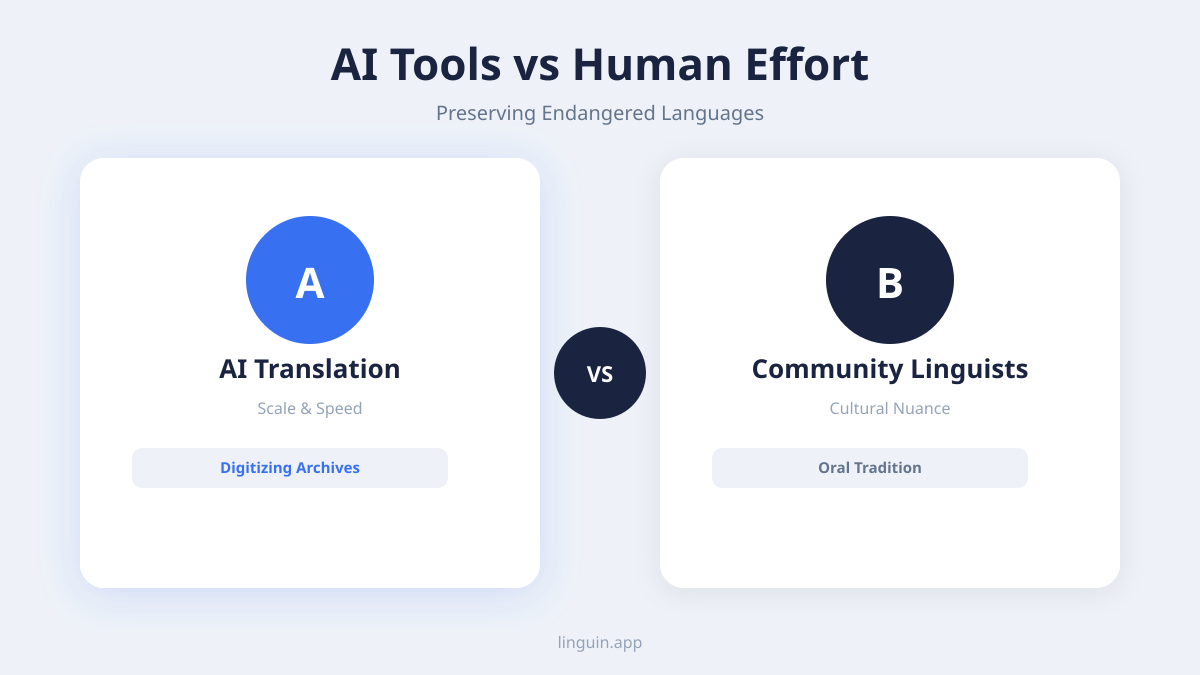
It is important to view the AI’s output as a first draft. The final version should always be polished by fluent speakers to ensure it captures the correct tone and cultural nuances, a concept we detail in managing formal and informal tone. This collaborative process between technology and human expertise ensures the results are authentic and culturally appropriate.
Navigating cultural context and nuance
The most significant challenge in using AI for endangered languages is capturing cultural context and nuance. Languages are deeply intertwined with the culture that created them. Concepts, values, humor, and ways of relating to the world are embedded in the vocabulary and grammar. An AI model, trained on limited data, can easily miss these subtleties, leading to translations that are technically correct but culturally hollow or even incorrect.
A major hurdle is dealing with untranslatable words. Many languages have terms that encapsulate complex ideas, emotions, or relationships for which there is no direct equivalent in other languages. An AI might simply leave the word untranslated or provide a clumsy, oversimplified explanation that loses the original meaning. Successfully handling these requires deep cultural knowledge that is difficult to encode into an algorithm. Our article on untranslatable words and concepts explores this challenge in depth.
Similarly, cultural metaphors and idioms pose a problem. A phrase that makes perfect sense within a specific cultural context may be nonsensical when translated literally. For example, a greeting that references a local landmark or historical event would be meaningless to an outsider. An AI needs to learn not just the words but the story behind them to provide a meaningful translation, perhaps opting for a culturally appropriate equivalent in the target language rather than a literal translation.
The risk of cultural appropriation or misrepresentation is also present. If an AI model produces translations that are culturally insensitive or inaccurate, it can cause harm and erode trust within the community. This underscores why community oversight is non-negotiable. The AI must be a tool controlled by the community, not a replacement for their expertise. The goal is to augment human intelligence, not replace it, ensuring that cultural authority remains with the native speakers.
Ethical considerations and community ownership
The use of AI in preserving endangered languages is not just a technical endeavor. It is an ethical one. The history of linguistics is littered with examples of outside researchers extracting knowledge from communities without providing anything in return. Applying advanced technology to these vulnerable contexts requires a thoughtful, collaborative framework that prioritizes the rights and wishes of the language community.
The principle of community ownership is paramount. The data used to train AI models-the recordings, texts, and knowledge shared by speakers-is the intellectual property of the community. Clear agreements must be established regarding who controls this data, how it is used, and who benefits from any resulting tools or products. The community should have the final say in whether a project proceeds and how the technology is deployed.
This leads directly to the need for informed consent. Community members must fully understand how their language data will be used in an AI system. This is more complex than simple permission. It requires transparent communication about the capabilities and limitations of AI, the potential long-term implications, and the risks of digitization. Consent should be an ongoing process, not a one-time signature.
A key ethical goal is to avoid digital colonization. This occurs when external entities use technology to assert control over indigenous knowledge and cultural expressions. To prevent this, AI development must be community-led or involve deep partnership. The community should be involved in every stage, from data collection to model training and application design. The benefits, whether they are financial, educational, or social, must flow back to the community. This collaborative model ensures that AI acts as an empowering tool for self-determination rather than an instrument of further marginalization.
The future of AI and language revitalization
Looking ahead, the role of AI in language preservation is poised to grow as the technology becomes more sophisticated and accessible. Future developments could make these tools even more powerful and integral to community-led revitalization movements. The focus will likely shift from basic translation to more interactive and immersive language experiences.
One promising area is the integration of AI with speech synthesis. Instead of just translating text, future systems could generate natural-sounding speech in the endangered language. This would be invaluable for learning proper pronunciation and for creating audio resources like narrated stories or conversational practice tools. Hearing the language spoken fluently, even by an AI, can be a powerful motivator for learners.
Another frontier is the development of adaptive language tutors. AI could power personalized learning applications that adjust to a user’s proficiency level, identify areas of difficulty, and provide tailored exercises. Imagine an app that listens to a learner’s attempts at pronunciation and offers gentle, corrective feedback, or one that generates simple stories based on the vocabulary the user has already mastered.
The long-term vision is to create a digital ecosystem for each endangered language. This ecosystem would include:
- AI-powered dictionaries and grammar guides.
- Translation tools integrated into common communication platforms.
- Interactive learning applications for all age groups.
- Digital archives of stories, songs, and conversations, easily searchable and translatable.
Platforms like Linguin, which focus on accurate, context-aware translation, provide a glimpse into this future, where technology serves as a bridge to cultural heritage rather than a barrier.
Frequently asked questions
Can AI actually learn a language with only a few speakers?
Yes, but with limitations. AI models designed for low-resource languages can learn a great deal from a small amount of data, especially with techniques like transfer learning. However, the resulting model will not have the deep, nuanced understanding of a model trained on billions of sentences. Its primary value is in assisting human experts and community members with tasks like drafting translations and identifying patterns, rather than operating completely autonomously. Its accuracy improves significantly with ongoing input from native speakers.
Does using AI devalue the human expertise of native speakers?
Quite the opposite. When implemented ethically, AI amplifies the value of human expertise. The tedious, time-consuming work of initial transcription and analysis can be handled by AI, freeing up linguists and fluent speakers to focus on higher-value tasks that require deep cultural knowledge. These experts are essential for guiding the AI, correcting its errors, and ensuring the outputs are culturally authentic. The AI is a tool that serves the community’s knowledge, not a replacement for it.
How can a community start using AI for their endangered language?
The first step is always community consultation and planning to define the goals. Then, the focus should be on gathering and digitizing all existing language resources: recordings, dictionaries, texts, and so on. Partnering with academic linguists or organizations experienced in digital language preservation is highly recommended. They can provide guidance on available AI tools and ethical frameworks. Starting with a small, well-defined project, like creating a digital word list or translating a set of stories, is a practical way to begin.
What are the risks of putting an endangered language into an AI system?
The main risks involve data privacy, loss of control, and cultural misrepresentation. If language data is uploaded to a generic, cloud-based AI platform, the community may lose ownership and control over how it is used. There is also a risk that the AI will produce inaccurate or culturally insensitive translations that could harm revitalization efforts. Mitigating these risks requires using secure, controllable platforms and ensuring strong community oversight throughout the process.
A collaborative path forward
The potential of AI translation to aid in preserving endangered languages is significant, but its success hinges on a collaborative, ethical approach. The technology offers unprecedented speed in documentation and powerful tools for community engagement, from real-time translation apps to interactive learning platforms. However, these are merely tools. Their effectiveness is determined by the people who wield them.
The core principles are clear. Community ownership of language data and project goals is non-negotiable. AI must be used to augment the irreplaceable knowledge of native speakers and linguists, not replace them. The focus should be on creating practical resources that empower communities to use their language in daily life, thereby ensuring its transmission to future generations.
If you are involved in language revitalization or are simply curious about how technology can support cultural heritage, exploring modern translation tools is a compelling starting point. You can experience the capabilities of context-aware AI translation firsthand by trying a platform like Linguin, which is built to handle nuanced language pairs. The journey to preserve the world’s linguistic diversity is a collective one, and technology, when guided by human wisdom, can be a steadfast ally.