 English
  Español
  Français
  Deutsch
  Português
  Italiano
  Русский
  中文(简体)
  日本語
日本語  한국어
한국어  العربية
  हिन्दी
  Nederlands
  Türkçe
  Polski
AI translation apps handle untranslatable words by analyzing context to find a functional, culturally-aware equivalent, not a direct one-for-one swap. This core capability separates modern AI from simple dictionary tools, allowing for more natural cross-linguistic communication. For professionals, travelers, and anyone navigating multilingual environments, understanding this process is key to using these tools effectively. This article explains the strategies AI uses and how you can leverage them for accurate, nuanced translations.
Key takeaways
- AI uses massive context to provide functional translations for words with no direct equivalent.
- Advanced models differentiate between transliteration, explanation, and adaptation based on the usage scenario.
- Understanding the translator’s approach allows you to choose tools and provide context for better results.
What makes a word or concept untranslatable?
The term “untranslatable” is often misunderstood. It does not mean a word can never be communicated in another language, but rather that there is no single, direct word that carries the exact same meaning, connotations, and emotional weight. This occurs when a concept is deeply embedded in a specific culture’s history, environment, social norms, or worldview. These words act as cultural shorthand, packing a dense package of meaning that another language’s speakers may not have a predefined slot for.
There are several categories of untranslatable concepts. Some words describe unique emotional states, like the Portuguese saudade, a deep melancholic longing for something or someone that may never return. Others define specific social situations, like the German Schadenfreude, pleasure derived from another’s misfortune. Many untranslatable words relate to precise environmental or experiential phenomena, such as the Japanese komorebi, the interplay of sunlight filtering through tree leaves, or the Swedish mångata, the moon’s road-like reflection on water. For everyday speakers, these might be idioms or terms of endearment that rely on shared cultural knowledge.
The challenge for translation, AI or human, is multifaceted. A direct word-for-word translation fails completely, resulting in nonsense. A lengthy explanatory footnote is accurate but destroys the flow of conversation or text. The goal is to find a balance, a translation that conveys the core meaning and appropriate tone within the given context. This requires more than linguistic data, it requires a form of cultural reasoning to decide whether to translate the feeling, describe the scene, or find a near-analogous concept. Modern AI translators, trained on vast datasets of language in use, are developing this nuanced capability.
Core strategies used by advanced AI translators
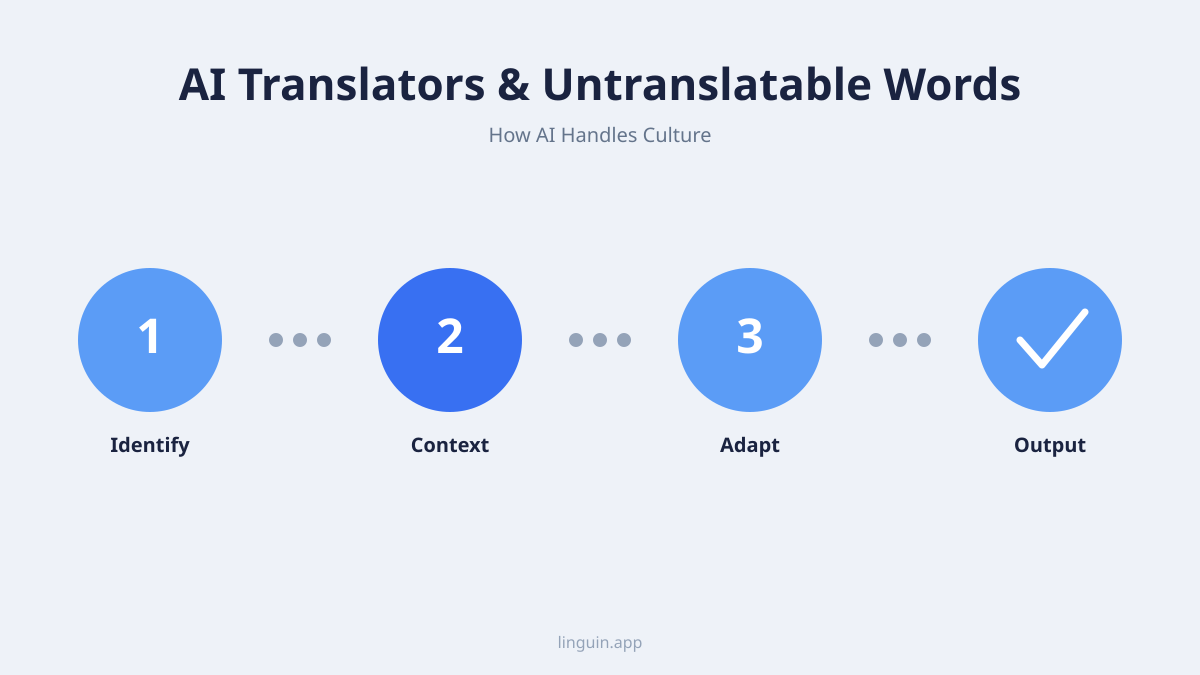
Contemporary AI translation models, like those powering apps such as Linguin, employ a sophisticated toolkit to navigate untranslatable words. They are not simply looking up phrases in a static database. Instead, they analyze the surrounding sentences, the type of document, and the probable intent to choose the most suitable strategy from several options.
Contextual adaptation is the primary strategy. The AI examines the untranslatable word within its full textual surroundings. Say you’re messaging a colleague in Japan and use the word otsukaresama (a polite acknowledgment of someone’s hard work) at the end of a workday. A basic translator might falter. An advanced AI, seeing it in a work chat context, might adapt it to “Thanks for your hard work today,” or “Good work today,” capturing the social function rather than the untranslatable literal meaning. It makes a reasoned choice to fulfill the phrase’s purpose in the target language.
Transliteration with explanation is used for culturally specific terms that are becoming globally recognized. For concepts like hygge (Danish coziness) or ikigai (Japanese reason for being), the AI may first transliterate the word and then add a brief, inline clarification. It might output “hygge (a feeling of cozy contentment)” depending on the sentence structure. This strategy is common when the source term is the subject of discussion itself, rather than just being used casually.
Functional or descriptive translation is applied when the concept describes a specific action or scene. Faced with komorebi (sunlight through leaves), the AI might generate “dappled sunlight” or “sunlight filtering through the trees.” For the Italian culaccino (the stain left by a cold glass on a surface), it could produce “water ring stain.” This method sacrifices the poetic single word but accurately conveys the observable phenomenon, which is often the most important part for understanding.
Finally, AI models use pragmatic substitution. They find a concept in the target language that occupies a similar emotional or social “space.” The Spanish sobremesa (time spent chatting at the table after a meal) might become “post-dinner conversation,” implying a leisurely, social context. This is not a perfect match, but it communicates the core social ritual effectively. The model’s choice between these strategies is guided by its training on millions of real-world translation examples, learning which outputs were judged most natural and accurate by human users.
The role of context, tone, and intent
The single most critical factor in how an AI handles an untranslatable word is the context in which it appears. An AI translator evaluates far more than the immediate sentence. It considers the broader document format-is this a legal contract, a poem, a casual text message, or a business email? The intended audience, the author’s probable tone, and the communicative goal all play a decisive role in the final output. This context-aware translation is what allows for intelligent decisions between a literal explanation and a functional adaptation.
Tone dictates the translator’s approach to nuance. A word like the Yiddish chutzpah (audacity) can be either admirable or insulting. In a sentence praising an entrepreneur, an AI might translate it as “boldness” or “nerve” with a positive connotation. In a sentence describing rude behavior, the same word might become “gall” or “insolence.” The model discerns this from surrounding adjectives, verb choices, and the overall sentiment of the paragraph. This is why providing full sentences or paragraphs to your translator yields vastly better results than translating single, isolated words.
Intent, or the speaker’s goal, is equally important. Consider the Arabic inshallah (“God willing”). In a sentence about future plans, like “We will meet tomorrow, inshallah,” the intent is to express hopeful uncertainty. A skilled AI translation might render this as “We will meet tomorrow, if God wills it” or even “We plan to meet tomorrow,” subtly encoding the cultural nuance of not assuming the future. However, if inshallah is used sarcastically or dismissively in a different context, a good model would need to adapt its translation to reflect that cynical intent, perhaps with a tone of “supposedly” or “allegedly.”
Understanding this, users can actively improve translations. When you encounter a tricky cultural concept, ask yourself about the context you want to convey. Are you translating:
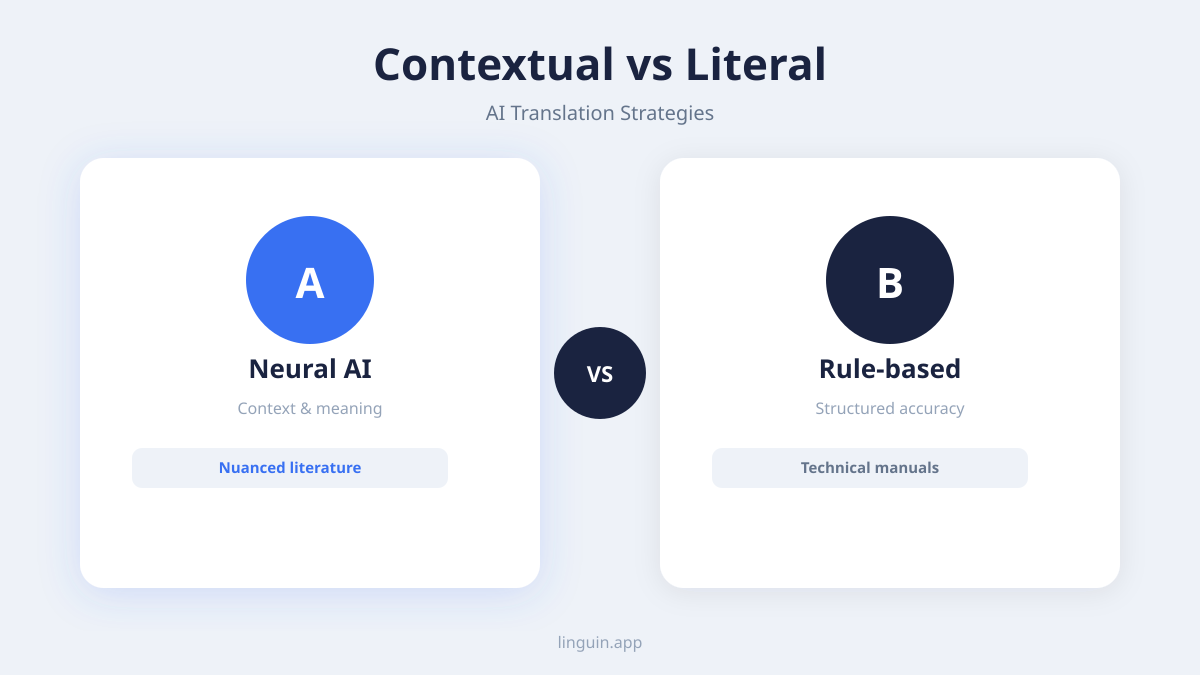
- A novel where preserving the cultural flavor is key? The AI might lean toward transliteration or a closer adaptation.
- An instruction manual where clarity is paramount? A straightforward descriptive translation is best.
- A social media post where natural flow matters? A pragmatic substitution that sounds idiomatic in the target language will work best.
By choosing tools built for context-aware translation and providing sufficient source text, you guide the AI toward the most effective strategy. You can learn more about how this works in our guide to context-aware translation.
Practical scenarios: From business to personal communication
The challenge of untranslatable words is not just academic. It arises constantly in real-world multilingual interactions. Understanding how AI can navigate these moments helps set realistic expectations and achieve communication goals.
Scenario 1: Global customer support. A customer from Brazil writes in with a complaint, using the phrase “estou com saudades do produto antigo” (I have saudades for the old product). A direct, word-for-word translation like “I am with saudades of the old product” is confusing. An AI model trained on customer service interactions, analyzing the complaint context, might translate this sentiment effectively as “I miss the old product’s functionality” or “I fondly remember and prefer the previous version.” This captures the emotional core of the feedback-nostalgia and dissatisfaction-allowing the support agent to respond empathetically and address the real issue. For businesses, this level of nuance is critical in multilingual customer support.
Scenario 2: Working with remote international teams. During a video call with your Swedish team, a colleague mentions the importance of “fika” for team morale. An AI-powered meeting translator or chat app, hearing the word in a workplace discussion, could provide a real-time caption like “fika (a coffee and cake break for socializing).” This immediate, inline clarification keeps the conversation flowing without requiring someone to stop and explain. It fosters cultural understanding and smooth collaboration within remote multilingual teams.
Scenario 3: Reading literature or news. When reading a French article about politics that mentions “laïcité” (the French concept of secularism), a browser extension with advanced AI translation can handle it deftly. It might translate it as “secularism” but the sophisticated model understands, from the surrounding text discussing schools and public symbols, that it refers to the strict French model of separating religion from public life. It ensures you grasp the specific cultural and legal debate, not just a generic term.
Scenario 4: Personal travel and connection. You’re messaging a new friend in Germany who signs off with “Viel Glück!” before your job interview. While “Good luck!” is a standard translation, the phrase carries a weight of genuine, well-wishing warmth. An AI translator in a messaging app doesn’t need to alter this, but its accurate, natural translation helps you receive the intended sentiment. Conversely, if you want to express a complex feeling in another language, understanding that an AI can help find a functional equivalent empowers you to communicate more deeply than with simple phrases.
Limitations and the human-in-the-loop advantage
Despite impressive advances, AI translation of cultural concepts has inherent limitations. AI models generate responses based on statistical patterns in their training data. They lack true consciousness or lived experience. Therefore, they can sometimes miss extremely subtle connotations, historical weight, or highly localized meanings of a term. An AI might translate a regional dialect word or a very niche cultural reference incorrectly if it hasn’t encountered enough examples in its training.
This is where the “human-in-the-loop” principle becomes invaluable. The most effective use of AI translation treats the tool as a powerful first draft generator or a real-time aid, not a final arbiter. A human native speaker or cultural expert can review the AI’s output, especially for sensitive, creative, or high-stakes content. They can judge whether the chosen strategy-be it adaptation, description, or substitution-truly hits the right note for the intended audience. For instance, the marketing localization of an app or a brand slogan will always benefit from a human final check after AI has done the heavy lifting.
Furthermore, human users can “train” the AI in a micro-sense by providing better input. If you know a sentence contains a culturally loaded term, you can add a brief note in parentheses for the AI. For example, translating “He showed real sisu (Finnish perseverance) during the project.” This extra signal helps guide the model. Recognizing these limitations is not a criticism of AI, but a roadmap for its most effective application. It complements human expertise; it does not replace it in every scenario. For a deeper comparison, you can explore the ongoing dialogue about AI versus human translation.
The future of AI and cross-cultural understanding
The trajectory of AI translation technology points toward increasingly sophisticated cultural navigation. Future models will likely move beyond treating text in isolation to integrating multimodal understanding. Imagine an AI that can see an image of a social gathering and understand it as a depiction of sobremesa or gemütlichkeit (German cozy conviviality), then describe it accurately in another language. They will also get better at understanding user-specific context, learning from your past interactions and corrections to personalize translations.
Another frontier is the handling of tone, such as humor and sarcasm, which are often culturally bound and “untranslatable” in a conventional sense. As models improve at discerning intent and emotional subtext, they will better translate jokes, irony, and understatement in ways that preserve their effect, or at least signal the intended tone to the reader. This will make cross-lingual communication not just accurate, but also more natural and engaging.
Ultimately, the goal is not to erase linguistic uniqueness, but to build more robust bridges. By learning how AI translators approximate, adapt, and explain untranslatable concepts, we become more informed users. We learn to appreciate the depth of other languages while gaining a practical tool to share ideas across the cultural divide. The technology serves as a lens, bringing into focus the intricate connections between language, thought, and culture.
Frequently asked questions
Can AI translators perfectly translate idioms and proverbs?
No AI translator can perfectly translate all idioms and proverbs, as many are deeply cultural. However, advanced AI models excel at finding equivalent idioms in the target language that convey a similar meaning or moral. Instead of translating an idiom word-for-word, which often results in nonsense, the AI will substitute a common saying from the target culture that serves the same purpose in the conversation.
Should I avoid using untranslatable words when communicating internationally?
Not necessarily. Using untranslatable words can enrich communication and share cultural concepts. The key is to be aware that they may need explanation. When using an AI tool, provide ample context in your full sentence or paragraph. This gives the AI the best chance to generate a functional translation or a clear description that conveys your intended meaning to the reader.
How does AI handle translating names of foods or cultural items?
AI typically uses a mixed strategy for culturally specific items like food names. For widely known items (sushi, croissant), it will use the original word. For less common items, it may provide a descriptive translation (e.g., “dhal” might become “Indian lentil stew”) or transliterate with a brief explanation, depending on the context and the likelihood that the target audience would recognize the term.
Is one AI translation model better than others for cultural concepts?
Yes, capabilities vary. Larger, more advanced models trained on diverse, high-quality datasets generally perform better with cultural nuances because they have seen more examples of how these concepts are used and explained in real text. Models designed for context-aware translation and deployed in tools focused on natural conversation, like Linguin, often have an edge over simpler, phrase-based translators.
What should I do if the AI translation of a cultural concept seems wrong?
First, check the context you provided. A longer source text often yields a better translation. If it still seems off, the AI may have chosen an inappropriate strategy. Use your own knowledge or a quick search to understand the original term, then you can either edit the translation directly or, in some tools, provide feedback that helps the model learn. Treat the AI output as a helpful draft to be refined.
Getting started with Linguin
AI translation’s approach to untranslatable words hinges on context and intelligent adaptation, moving far beyond simple dictionary lookups. By analyzing the surrounding text, tone, and intent, modern models can provide functional equivalents, descriptive translations, or culturally-aware substitutions that make cross-lingual communication possible and natural. The most effective use of this technology combines its powerful pattern recognition with human cultural insight for sensitive or high-stakes content.
To experience this context-aware approach firsthand, try using a translator that prioritizes full-sentence and paragraph analysis. Next time you encounter a phrase that feels uniquely tied to a culture, paste the entire sentence or conversation snippet into your translator. Observe how the additional context changes the output from a confusing literal translation to a meaningful, communicative one. Linguin is built around this principle, using advanced AI models to navigate the nuances of language across over 100 languages on your macOS, iOS, or directly in your browser.