 English
  Español
  Français
  Deutsch
  Português
  Italiano
  Русский
  中文(简体)
  日本語
日本語  한국어
한국어  العربية
  हिन्दी
  Nederlands
  Türkçe
  Polski
AI translation tools excel at handling non-standard grammar and slang by analyzing context, not just words, to produce natural, accurate results. The challenge of translating casual, imperfect language is central to modern communication, and AI is uniquely equipped to meet it. This matters for anyone communicating across languages in chats, social media, or everyday conversations. In this article, you will get a clear understanding of how this technology works, the specific challenges it overcomes, and how it makes your informal multilingual communication seamless.
Key takeaways
- AI translators use context-aware models to infer meaning from broken grammar and slang, moving beyond direct word-for-word substitution.
- Modern models are trained on vast datasets of informal text, from social media to messaging apps, allowing them to recognize and adapt to casual language patterns.
- The best tools, like Linguin, allow users to specify tone and context, giving the AI crucial signals for choosing the right equivalent in the target language.
The nature of informal communication
Informal communication is the language of daily life. It is filled with contractions, sentence fragments, emojis, and cultural references. Unlike formal writing, which follows established grammatical rules, informal text prioritizes speed, emotion, and connection. This presents a unique hurdle for translation. A literal, word-for-word approach would fail. “You good?” translates poorly if rendered directly into another language without understanding it is a casual inquiry about someone’s state. The AI must grasp the pragmatic function of the utterance.
The core components of informal language include slang, which is highly cultural and temporal. Terms like “ghosting,” “salty,” or “flex” carry meanings far beyond their dictionary definitions. Then there is non-standard grammar, such as dropping subjects (“Going to the store”), using non-standard verb forms (“ain’t”), or creative spelling (“gonna,” “wanna”). Finally, there is the heavy reliance on context. The meaning of “That’s fire” depends entirely on whether you are discussing music, food, or a project presentation. An AI translator must be a sophisticated context engine, piecing together clues from the surrounding conversation, the platform it is on, and even the relationship between speakers.
Say you are messaging a colleague in Japan on a collaborative project and write, “This draft is kinda rough, needs a solid pass.” A basic translator might stumble on “kinda” and “solid pass.” A context-aware AI understands this is feedback within a professional but casual setting. It would aim for a Japanese equivalent that conveys the idea of a preliminary draft requiring thorough review, using appropriately polite but not overly formal language, perhaps avoiding a direct translation of the slang but capturing its intent. This balance is key.
How AI models are trained on informal data
The ability to handle informal language is not innate, it is learned. Modern AI translation models, particularly large language models, are trained on petabytes of text data scraped from the internet. This corpus is not limited to news articles and Wikipedia, it includes billions of public social media posts, forum comments, blog entries, and transcribed dialogue. This exposure is what allows the AI to recognize patterns in how people actually write and speak, not just how they are supposed to. The training process involves the model learning statistical relationships between words and phrases across languages, building a complex map of meaning.
A crucial part of this training involves parallel corpora. These are datasets where the same content exists in multiple languages. For informal speech, this might include subtitles for movies and TV shows, which contain conversational dialogue, or localized versions of video games and social media platforms. By analyzing these alignments, the model learns that “No way!” in English often corresponds to a specific expression of disbelief in Spanish, French, or German, and that the equivalent is rarely the literal translation of the individual words. The model also learns to distinguish between registers. It identifies clusters of words and structures that typically appear together in casual contexts versus formal ones.
Training also involves a technique called masked language modeling. In this process, words are randomly hidden from sentences in the training data, and the model must predict them. When applied to informal text, the model gets better at predicting likely slang terms or grammatical constructions based on context. For instance, given “I’m so ___ with this weather,” the model, trained on informal data, would highly predict words like “done,” “over,” or “fed up” rather than more formal options like “displeased.” This direct exposure to the flow and filler of natural speech is foundational. For a deeper look at how this training impacts overall performance, you can explore our article on AI translation accuracy.
The technical challenge: from syntax to semantics
The primary technical hurdle is bridging the gap between surface-level syntax and underlying semantics. Informal grammar often breaks syntactic rules, so the AI cannot rely on parsing a sentence’s grammatical structure in the traditional way. Instead, it uses neural networks to create dense mathematical representations, called embeddings, of the input text. These embeddings capture semantic meaning and contextual relationships. The sentence “Can’t even rn” has a clear meaning to a native speaker (“I cannot deal with this right now”) despite its fragmented syntax. The AI’s embeddings aim to encode that same core meaning, which is then used to generate a fluent equivalent in the target language.
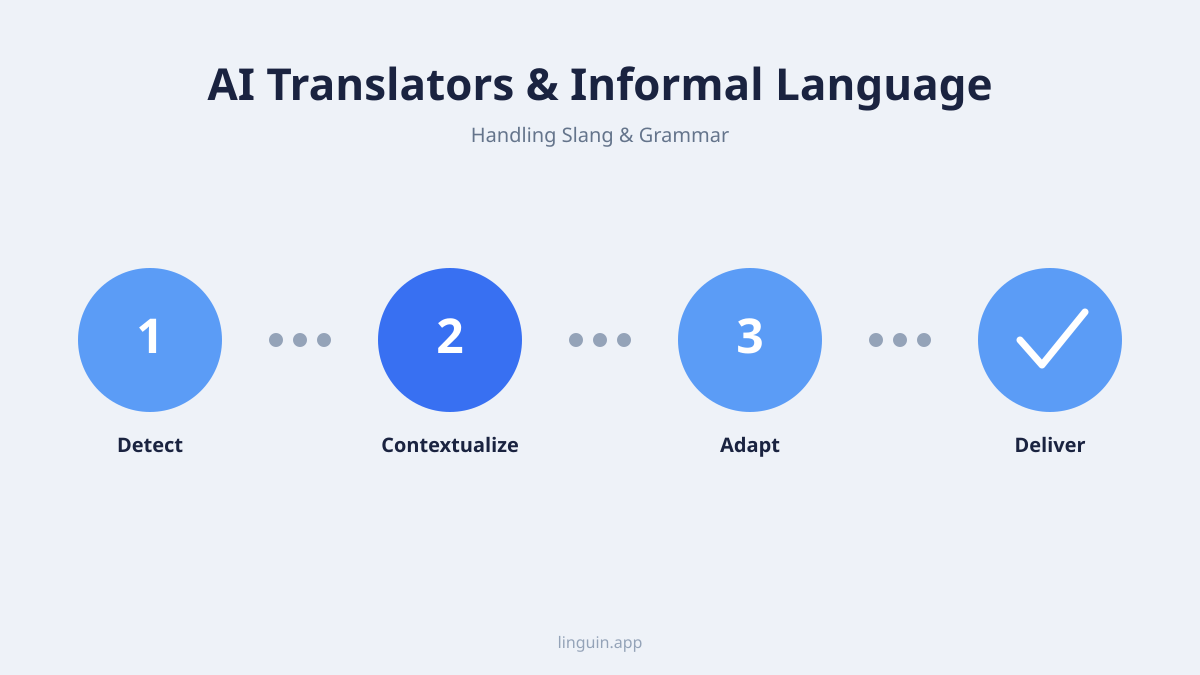
This process involves several steps. First, the encoder part of the model digests the source sentence, building a contextual understanding of each word. The word “sick” will have a different vector representation in “That’s a sick beat” versus “I feel sick.” Next, the decoder part uses this enriched understanding to generate the translation word-by-word, constantly referring back to the context. It is not translating “sick” to “enfermo” (Spanish for ill), it is translating the concept of “impressively cool” into whatever colloquial expression fits the target language and the specified tone. This is where the training on informal parallel data pays off, providing the model with a repertoire of stylistic options.
Another significant challenge is disambiguation. Slang terms are notoriously polysemous. Consider the word “plug.” It could refer to an electrical connector, a stopper for a drain, or, in slang, a source for obtaining something (often illicit). The AI uses the surrounding context to disambiguate. If the previous sentences discuss networking or difficult-to-find items, the slang meaning becomes more probable. The model assigns probabilities to each possible meaning and chooses the translation path that best fits the overall context of the conversation. This ability is critical for tools like the Linguin Chrome extension, which translates live chat and social media feeds where such ambiguity is common.
The role of context and tone settings
Context is the most powerful tool an AI translator has when dealing with informal language. In isolation, a phrase can be meaningless or misleading. In context, its intent becomes clear. Advanced AI translators like Linguin analyze more than just the single sentence provided. They look at the preceding and following sentences in a conversation to establish a discourse context. This helps resolve pronouns, understand implied subjects, and catch the flow of dialogue. If someone messages “LOL, same.” the AI needs to know what “same” refers to, which requires looking back at the chat history.
Beyond the textual context, user-provided settings are invaluable. Specifying the communication tone (e.g., Casual, Professional, Friendly) gives the AI a critical signal. For the input “My bad,” a Casual tone setting might yield a very colloquial equivalent in the target language, while a Professional tone might steer the AI toward a more formal apology like “I apologize for the error.” Some platforms also allow specifying domain or context, like “Social Media” or “Gaming,” which further primes the model to pull from the most relevant subset of its training data. This user guidance dramatically narrows the search space for the appropriate translation.
Imagine you are using a translation app to understand comments on a Brazilian YouTube video. One comment reads, “O cara é brabo!” A literal translation might be “The guy is angry!” But with the context set to “Social Media” and the tone to “Casual,” the AI can leverage its training on similar platforms to understand that “brabo” here is Brazilian internet slang for “skilled” or “impressive,” leading to a correct interpretation like “This guy is awesome!” This contextual tuning is what transforms a generic translator into a specialized tool for real-world communication. For more on managing tone in different scenarios, see our guide on formal and informal tone in emails.
Real-world scenarios and applications
The practical applications for this technology are vast, touching nearly every facet of digital life. One major area is multilingual customer support on live chat or social media. Customers often use informal, frustrated, or shorthand language when reporting issues. An AI that can accurately translate “It’s buggin out fr” into a clear technical description for a support agent in another country streamlines resolution and improves customer satisfaction. The agent receives the translated intent, not gibberish. Linguin is built for such dynamic, multilingual customer support environments.
Another critical scenario is collaboration within global remote teams. On platforms like Slack or Microsoft Teams, communication is fast and casual. A developer in Poland might write to a designer in Mexico, “This mockup looks dope, but can we tweak the CTA?” The AI must translate “dope” as a positive colloquialism and recognize “CTA” as industry jargon (Call to Action). The success of remote multilingual teams hinges on this nuanced, real-time understanding.
Social media management is also transformed. A brand manager monitoring global sentiment needs to understand not just the direct meaning of posts, but the cultural weight of slang and memes. Is a product being called “cheugy” or “based”? The difference in meaning is critical for the brand’s response. An AI translator trained on contemporary informal data can help parse these subtleties at scale, aiding in multilingual social media management.
Finally, for everyday users, it enables genuine personal connection. Chatting with a friend in another language becomes more fluid and expressive. You can use the idioms and casual phrases of your own language, trusting the AI to find a spirit-matched equivalent, preserving the personality and warmth of the exchange. This breaks down barriers not just of language, but of cultural expression.
Limitations and the path forward
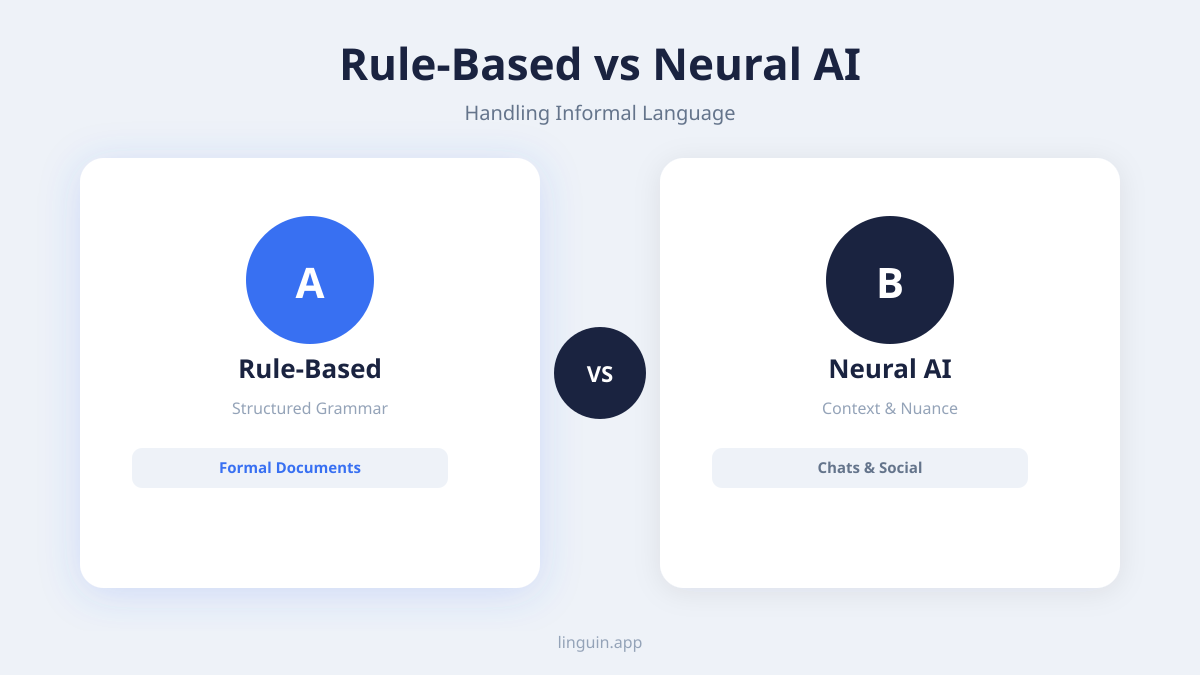
Despite impressive advances, AI translators are not perfect. Their handling of informal language is constrained by their training data. If a new slang term emerges and has not yet proliferated widely across the multilingual web, the model may not recognize it. Similarly, highly niche or regional slang might be missed. The AI also struggles with humor and sarcasm, which rely on a deep, often cultural, understanding of subtext and contradiction. A sarcastic “Oh, great” translated literally loses all its intended meaning. We discuss the complexities of translating humor and sarcasm in a dedicated article.
Another limitation is the potential for cultural misalignment. An AI might successfully translate the words of a casual English phrase into a target language, but the chosen equivalent might carry a different social connotation, perhaps sounding too familiar or disrespectful in a culture with stricter hierarchies. This is where the combination of AI efficiency and human cultural oversight remains powerful. The path forward involves continuous learning. As models are updated with newer data, their grasp of evolving slang improves. Techniques like few-shot learning, where the model can adapt from just a few examples, could allow users to “teach” the translator their own frequently used slang or inside jokes.
Furthermore, the integration of multimodal inputs-analyzing images, emojis, or audio tone alongside text-will provide even richer context. A crying-laughing emoji completely changes the interpretation of a text. Future systems will likely become more interactive, asking clarifying questions when ambiguity is high, much like a human translator would. The goal is a collaborative tool that enhances understanding, aware of its own limitations.
Frequently asked questions
Can AI translators understand brand new slang?
AI translators rely on their training data, which has a cutoff date. Brand new slang that emerges after this date will not be understood immediately. However, the best models are updated regularly with new data, and their deep understanding of linguistic patterns sometimes allows them to infer the meaning of novel slang from context, especially if it follows common morphological patterns. For the most current language handling, using a regularly updated service like Linguin is important.
How do I get the best results when translating informal text?
Provide as much context as possible. If your translation app allows it, set the tone to “Casual” and specify the context, like “Text Message” or “Social Media.” If you are translating a message within a conversation, include the preceding line or two. Avoid translating single, ambiguous slang words in isolation. The more textual clues the AI has, the more accurate its interpretation of informal grammar and slang will be.
Do AI translators work better for some languages than others?
Yes, performance can vary. Languages with vast amounts of digital informal text available for training, such as English, Spanish, or Mandarin, tend to have more robust support for slang and casual grammar. For languages with less digital representation, the models may have seen fewer examples of informal communication, which can affect accuracy. Linguin supports over 100 languages, with continuous improvements focused on expanding high-quality informal language support across all of them.
Can an AI translator learn my personal slang or inside jokes?
Most general-purpose AI translation apps do not have a personalized learning feature for individual user slang due to privacy and scalability. However, the field is moving toward more customizable models. Some applications may allow you to create a custom glossary or add preferred translations for specific terms, which can help in professional or recurring personal contexts.
Mastering informal communication across languages
Translating the messy, vibrant world of informal communication is one of AI’s most practical achievements. By moving beyond rigid rules to understand intent and context, these tools allow us to connect authentically across linguistic divides. The key is recognizing that this technology excels with contextual clues and clear tone guidance, transforming fragmented slang and broken grammar into clear, natural meaning.
To experience this directly, the next step is to put an advanced AI translator to the test with your own informal conversations. Try translating a snippet of a chat thread or a social media comment, first without context and then with the surrounding messages. Notice the difference in fluency and accuracy. Linguin is designed for this exact use case, offering context-aware translation across devices to ensure your informal communication remains effortless and genuine, no matter the language.