 English
  Español
  Français
  Deutsch
  Português
  Italiano
  Русский
  中文(简体)
  日本語
日本語  한국어
한국어  العربية
  हिन्दी
  Nederlands
  Türkçe
  Polski
AI translation tools are now engineered to understand and translate the dynamic world of internet slang and neologisms. For anyone communicating across languages online, from social media managers to global friends, this capability is essential. The informal, fast-evolving language of the internet presents a unique challenge that older translation systems could not handle. This article explains the technical processes behind this adaptation and how it leads to more natural, accurate cross-cultural communication in digital spaces.
Key takeaways
- AI translation models learn internet slang through continuous analysis of massive, real-time datasets from social platforms and forums.
- Contextual understanding is crucial, as the same slang term can have different meanings based on platform, topic, or region.
- The best tools don’t just translate words, they adapt the tone and cultural resonance of slang to feel authentic in the target language.
- User feedback and interaction play a direct role in helping AI systems correct and learn new slang usages faster.
- Effective slang translation bridges cultural gaps in global online communities, customer support, and marketing.
The challenge of a moving linguistic target
Internet slang does not follow the formal rules of language evolution. It emerges rapidly from memes, viral videos, gaming communities, and social media subcultures, often spreading globally before it enters any official dictionary. Terms like “ghosting,” “stan,” or “cheugy” gain specific, nuanced meanings within certain online contexts. For translation tools, the primary challenge is twofold: first, to even recognize these new terms as valid language, and second, to understand their contextual meaning.
Traditional statistical and early rule-based translation systems relied on static, curated corpora of text, such as news articles and books. These sources contained little to no contemporary internet vernacular. When these systems encountered slang, they would either fail to translate it, translate it literally (leading to nonsense), or default to a dictionary definition that missed the modern connotation. This created significant barriers in understanding everyday digital communication.
Modern AI translation tackles this by using neural machine translation (NMT) models trained on vastly different data. These models are fed with petabytes of text scraped from the live web, including social media posts, forum discussions, blog comments, and messaging app transcripts. This data is inherently messy and informal, which is precisely what makes it valuable. By processing this data, the AI learns patterns of how new words are used, what words they are associated with, and how their usage differs from formal language.
The learning process is continuous. As new slang emerges, it appears with increasing frequency in the training data. The AI’s attention mechanisms begin to recognize these new patterns and associate them with specific sentiments, topics, or communities. For instance, it learns that “based” in a political forum has a different weight than “based” in a music fan community, and that both are distinct from the adjective “based” meaning founded upon something. This foundational ability to process unstructured, contemporary data is what separates capable AI translation for internet slang from older technologies.
How AI models learn and adapt to new slang
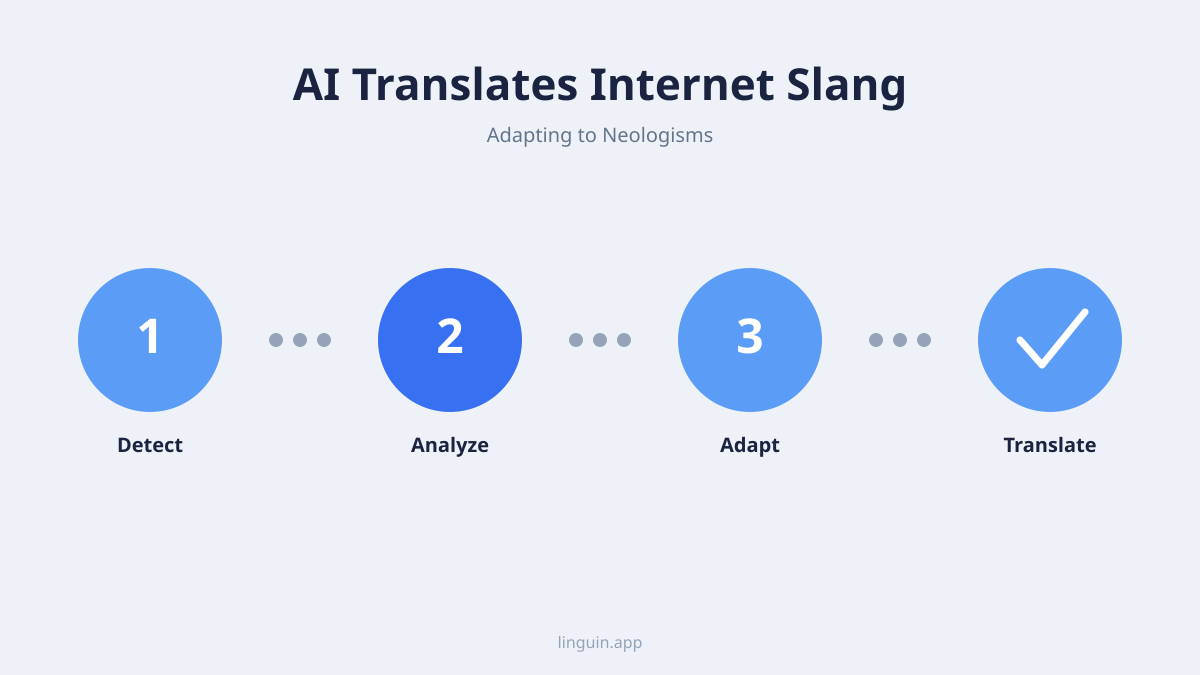
The adaptation to new slang is not a manual process where developers add words to a list. It is an inherent function of the AI’s architecture and training lifecycle. At the core is the transformer model architecture, which processes words in relation to all other words in a sentence, not in isolation. This allows it to infer the meaning of an unknown word from its surrounding context.
When the model encounters a potential neologism or slang term, it analyzes the entire sentence and paragraph. It looks at the other words present, the syntactic structure, and the probable topic. By comparing this context to billions of other sentence fragments it has processed, the model can make a highly educated guess about the new term’s function and meaning. Is it a noun replacing a standard one? Is it an adjective expressing a specific sentiment? Is it a verb describing a new digital action? The context provides the clues.
A critical component is retraining or fine-tuning. While the base model is trained on a massive, broad dataset, it can be periodically fine-tuned on newer, more specific data streams. This might involve focusing a training cycle on recent data from platforms like X (formerly Twitter), TikTok, or Reddit. This fine-tuning reinforces the model’s understanding of the latest linguistic trends without forcing it to relearn everything from scratch. It is akin to a language learner who has mastered grammar and vocabulary now reading current magazines to pick up the latest colloquialisms.
Furthermore, many advanced systems employ subword tokenization. Instead of treating every word as a single unit, they break words into smaller, more common pieces (subwords or characters). This is powerful for slang and neologisms, which are often compounds or derivatives of existing words. A term like “fintech” can be understood through its subwords “fin” (financial) and “tech” (technology). A playful term like “adorbs” is easily decomposed into the root “ador” (from adorable) and the slang suffix “-bs.” This method allows the AI to handle words it has never seen before by assembling meaning from familiar parts.
The role of context in accurate slang translation
The meaning of internet slang is almost entirely dependent on context. The word “salty” can describe a tasty snack, a person who is irritated, or a skilled but disrespectful playstyle in a video game. A direct, word-for-word translation would fail in most scenarios. Therefore, the most important task for an AI translator is not to find a dictionary equivalent, but to first correctly disambiguate the intended meaning within its specific digital context.
This disambiguation happens through deep contextual analysis. The AI examines the source text’s broader environment. What platform is the text from? A professional networking site suggests a different register than a gaming chat. Who are the participants? A conversation between teenagers will use slang differently than one between professionals in a relaxed industry chat. What is the topic? The term “capped” means something different in financial discussions (“interest rate cap”) versus social media (“no cap” meaning no lie) versus gaming (“to cap a point”).
The AI uses all these latent signals to build a probability distribution for the possible meanings of a slang term. It then selects the interpretation that best fits the overall context. This process mirrors how a human reader understands slang. We don’t look up “fire” in a dictionary when we read “That new track is fire!”; we infer from the topic (music) and the positive sentiment that it means “excellent.”
Once the meaning is pinned down, the next challenge is finding an equivalent in the target language that carries the same tone, cultural weight, and informality. This is where transcreation becomes relevant. A good translation might not use a direct slang equivalent if one doesn’t exist. Instead, it might use a common colloquial phrase in the target language that evokes the same feeling. For example, the English internet slang “It hits different” might be translated into Spanish using a phrase like “Tiene otro rollo,” which carries a similar sense of unique, subjective impact in a casual way. The goal is functional and emotional equivalence, not lexical mirroring.
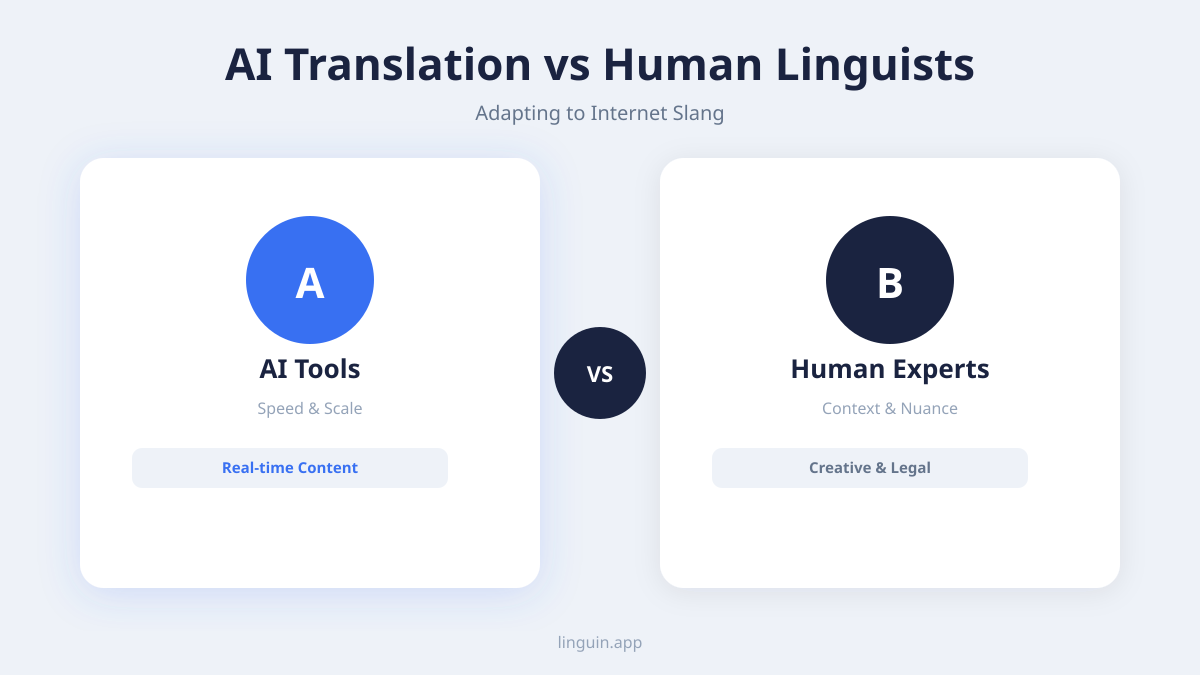
Real world applications and user scenarios
The ability to translate internet slang accurately has moved from a novelty to a business and social necessity. Consider a community manager for a global video game. They must monitor player forums and social media in multiple languages to gauge sentiment, identify bugs, and spot emerging trends. Players communicate heavily in game-specific slang and general internet vernacular. An AI tool that can accurately translate posts complaining about a “nerfed” weapon, praising a “OP” (overpowered) character, or discussing the latest “lore drop” allows the manager to understand community pulse in real time, regardless of language.
Another scenario involves customer support for a global tech brand. A user might submit a support ticket saying, “My app keeps yeeting me back to the login screen.” The term “yeeting” is slang for throwing forcefully. A literal translation would be confusing. An AI translator attuned to slang would understand this describes an abrupt, involuntary logout and translate the intent accurately, allowing the support agent in another country to understand the core issue immediately. This prevents miscommunication and speeds up resolution. For more on this, see how AI enhances multilingual customer support.
In creative and marketing fields, the stakes are high. A marketing team localizing a social media campaign for a youth-oriented product must adapt slogans, hashtags, and engagement copy. Using formal, stilted language will make the brand seem out of touch. Teams need tools that can help them brainstorm how a catchy, slang-heavy English phrase like “Get the ick” or “Main character energy” can be adapted to feel equally fresh and authentic in German, Japanese, or Brazilian Portuguese. This requires a deep, nuanced understanding of contemporary language in each culture. Learn more about the importance of cultural context in marketing translation.
For everyday users, the benefit is seamless social connection. Say you’re in a multilingual group chat where friends share memes and jokes. A friend from Mexico posts a comment in Spanish that includes the slang “crush.” An AI-powered browser extension can instantly translate this inline, preserving the informal, personal meaning of having a romantic interest, rather than translating it as “to compress.” This maintains the flow and emotional tone of the conversation, making digital spaces feel more inclusive and connected.
Limitations and the path forward
Despite impressive advances, AI translation of slang is not perfect. The primary limitation is the inherent lag between a slang term’s emergence and its assimilation into the AI’s model. While the process is faster than ever, there is still a window where very new, niche, or highly localized slang may be misunderstood. A term that explodes on a specific subreddit or Discord server one week may not be reliably translated until it gains wider usage and appears in sufficient training data.
Another challenge is the over-assimilation of bias. Since AI learns from human-generated data, it can inadvertently learn and propagate the biases, offensive uses, or negative connotations sometimes associated with slang. Developers must implement careful filtering, bias mitigation techniques, and ethical guidelines to ensure translations do not reinforce harmful stereotypes or language.
The path forward involves more dynamic, interactive learning. The next generation of tools will likely incorporate real-time user feedback loops more directly. If a user corrects a slang translation, that correction could be anonymized and used to fine-tune the model almost immediately for that user community. Furthermore, tighter integration with specific platforms could allow models to learn the unique lingo of a particular gaming community or professional network faster.
Collaboration with linguistic researchers and community moderators will also be key. These experts can help curate and validate the meanings of new terms, providing a “ground truth” that helps train models more accurately. The future of AI translation for internet slang lies in a hybrid approach: leveraging massive-scale automated learning with targeted, human-informed refinement to handle the chaotic beauty of how language evolves online. For a deeper look at how AI handles other informal language challenges, explore our article on translation for informal grammar and slang.
How Linguin approaches the slang translation challenge
At Linguin, we’ve built our translation systems with the reality of modern digital communication at the forefront. Our AI models are continuously trained on diverse, contemporary datasets that include the ever-changing landscape of social media, forums, and digital content. This ensures that when you translate a tweet, a chat message, or a product review, the tool recognizes and handles informal language as a first-class citizen, not an error.
A core principle is context-aware processing. Linguin doesn’t just translate sentences in isolation. It considers the source of the text-whether it’s from a messaging app, a comment section, or a document-to better infer the appropriate register and meaning of slang terms. This contextual intelligence is what allows for translations that sound natural and accurate. For instance, when managing projects across borders, this capability ensures team banter and informal updates are understood correctly, as detailed in our guide for multilingual project management.
We also prioritize user experience in feedback. Our apps provide straightforward ways to suggest a better translation. This feedback is invaluable for our ongoing model training, helping us correct mistakes and learn new usages faster. It creates a collaborative cycle where the tool improves with use, especially for language that is too new to be in any standard training corpus. For users who need reliable translation directly in their workflow, our AI translator for Mac integrates this adaptive technology seamlessly.
Frequently asked questions
Can AI translation tools keep up with how fast internet slang changes?
Yes, but with a short inherent delay. Modern AI models are trained on data streams that include current social media and web content, allowing them to learn new terms as they gain traction. However, a brand-new slang word that appears today may take a short time to be consistently translated accurately as the model requires enough examples in context to learn its meaning. The process is exponentially faster than updating a traditional dictionary-based system.
How does AI know if slang is being used ironically or sarcastically?
This is one of the more difficult challenges. AI determines irony and sarcasm by analyzing contradictory signals in the context. It looks at the overall sentiment of the conversation, the user’s historical tone, common phrasing patterns for sarcasm (like “oh, great”), and the platform’s norms. While AI has gotten better at this, highly nuanced sarcasm can still sometimes be misinterpreted, as tone is deeply cultural. Our article on translating humor and sarcasm explores this in detail.
Will using AI to translate slang make my communication sound unnatural to native speakers?
Not if the tool is well-designed. The goal of advanced AI translation for slang is transcreation, finding a natural equivalent in the target language. A good tool will avoid a direct, awkward translation and instead use a colloquial phrase or term that a native speaker would use in a similar informal situation. The result should feel authentic, not like a formal text with a strange word inserted.
Is slang translation important for professional or business use?
Absolutely. Professional communication is increasingly conducted on informal platforms like Slack, Teams, or WhatsApp. Business-to-consumer communication happens on social media. Understanding slang and informal tone is crucial for accurate customer support, brand monitoring, marketing, and internal team cohesion in global remote teams. Failing to grasp informal language can lead to misunderstandings about customer complaints, campaign feedback, or even team morale.
How does slang translation handle regional variations within the same language?
Sophisticated AI models are trained on geographically tagged data. This helps them learn that “chido” is common in Mexican Spanish for “cool,” while “bacán” is used in parts of South America. When translating, the system can often infer the regional variant based on the user’s location settings, the spelling conventions, or other contextual clues, and choose the most appropriate local equivalent. This is key for effective communication, as discussed in our piece on translation for regional dialects in business.
Embracing fluid language in a connected world
The dynamic nature of internet slang is not a bug in human communication, it is a feature. It reflects creativity, community building, and the rapid exchange of ideas. For AI translation tools, keeping pace with this evolution is a continuous journey of learning from real world data, understanding deeper context, and prioritizing the authentic intent over the literal word. The most significant takeaway is that effective cross-language communication in the digital age now requires tools that speak the language of the internet, in all its informal, ever changing glory.
For professionals, this means more accurate market insights and customer interactions. For teams, it means smoother collaboration across borders. And for individuals, it means stronger, more genuine connections in global online spaces. The next step is to experience this capability where you communicate most. Try translating a snippet of contemporary text, a social media post, or a casual conversation with a tool designed for modern language. You can explore how Linguin handles these challenges directly in your browser or on your desktop to see how context-aware translation bridges the gap between languages and cultures in real time.