 English
  Español
  Français
  Deutsch
  Português
  Italiano
  Русский
  中文(简体)
  日本語
日本語  한국어
한국어  العربية
  हिन्दी
  Nederlands
  Türkçe
  Polski
Real-time multilingual creative collaboration is now possible, allowing global teams to brainstorm, design, and create together without language barriers. For creative professionals in global agencies, remote design studios, and international marketing teams, language differences can stall the creative flow that depends on spontaneity, nuance, and shared understanding. This article explains how modern AI translation tools transform this dynamic, enabling seamless, immediate communication and fostering a truly inclusive creative process. You will learn the specific challenges of multilingual creative work, how AI overcomes them, and practical strategies for integrating translation into your team’s workflow.
Key takeaways
- AI translation enables instant, context-aware conversion of creative language, from brainstorming chats to design feedback, preserving tone and intent.
- Real-time translation integrated into communication platforms (like Slack, Figma, or video calls) removes the friction of manual translation, keeping the creative momentum alive.
- Effective multilingual collaboration requires tools that handle creative jargon, cultural nuance, and informal dialogue, not just formal business language.
The unique language demands of creative work
Creative collaboration thrives on a free exchange of ideas, often using informal, evocative, and culturally loaded language. Unlike standard business communication, creative discussions involve abstract concepts, subjective feedback, and industry-specific jargon. A copywriter discussing “brand voice,” a designer debating “visual hierarchy,” or a strategist pitching a “campaign narrative” all use terminology that carries weight and specific meaning within their field. When these conversations cross language lines, direct word-for-word translation often fails, losing the subtleties that make creative work compelling.
The challenge intensifies with tone and cultural context. Feedback like “make it pop” or “this feels off-brand” relies on shared cultural understanding and tonal inflection. Translating such phrases requires the AI to interpret intent, not just words. Similarly, brainstorming sessions are filled with idioms, metaphors, and rapid-fire suggestions that would sound nonsensical if translated literally. The tool must discern when a phrase is a creative idiom versus a literal instruction. This is where advanced context-aware AI models excel, analyzing the surrounding conversation to deliver a translation that captures the original creative spark.
Consider a scenario where a creative director in London is reviewing a storyboard with an animator in Seoul. The director says, “The transition here needs more whimsy, it’s too on-the-nose.” A basic translator might struggle with “whimsy” and “on-the-nose,” potentially outputting a confusing or overly literal translation. An AI trained on creative and colloquial language, however, would find equivalents that convey the desire for playful subtlety versus heavy-handedness, allowing the animator to understand the nuanced feedback immediately. This capability is foundational for real-time multilingual creative collaboration, as it maintains the quality and intent of the dialogue that drives innovation.
How real-time translation powers collaborative workflows
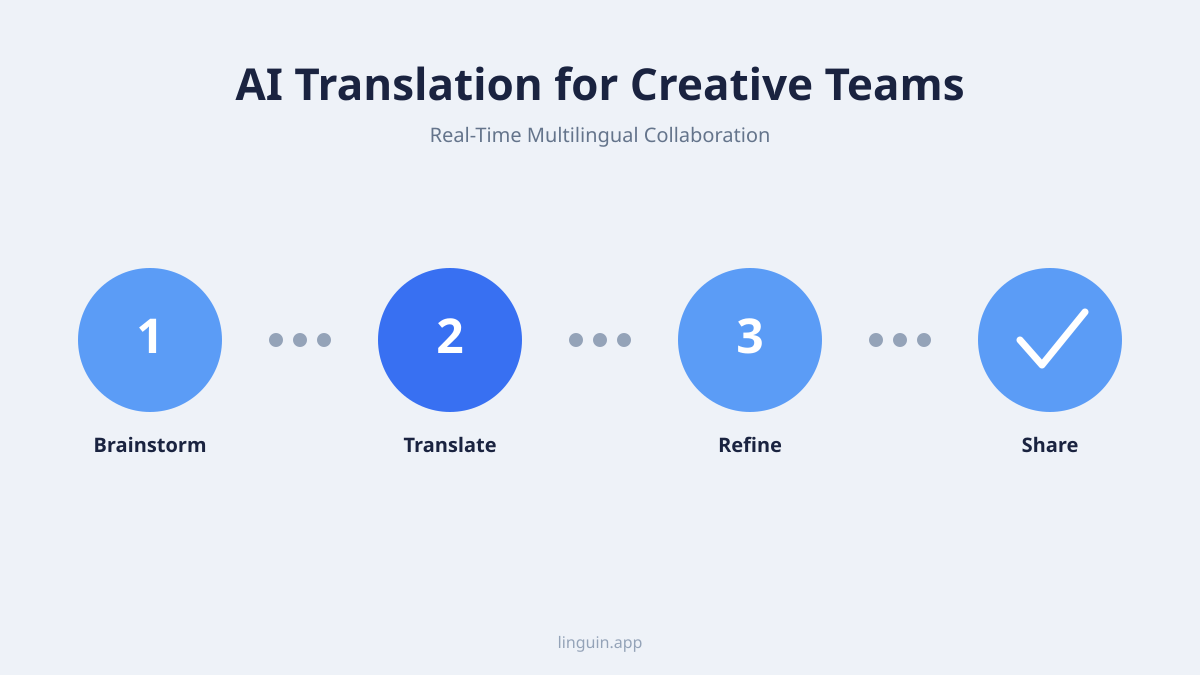
The term “real-time” is critical. Creative energy is fleeting; stopping a video call to manually paste text into a translator, or pausing a chat thread to wait for a translated response, kills momentum and disrupts the flow state essential for innovation. Real-time multilingual creative collaboration requires translation to be instantaneous and invisible, woven directly into the communication channels teams already use. This means AI translation must function within messaging apps, video conferencing tools, collaborative design platforms, and shared document editors.
Integration is key. For example, a team using Figma for design can benefit from a browser extension that translates comment threads on the fly. A copywriting team collaborating on a Google Doc can see translated suggestions appear alongside the original text. During a Zoom brainstorming session, real-time subtitle translation allows every participant to follow the conversation in their preferred language. This seamless integration ensures that language is no longer a separate hurdle to manage, but a background process that enables focus on the creative task itself. Tools like Linguin offer such integrations, acting as a layer over existing workflows rather than requiring teams to adopt a new, siloed platform.
Say you’re messaging a colleague in Japan on Slack about a new logo concept. You type, “The icon feels too corporate. Can we explore something more hand-drawn and organic?” With a real-time translation extension enabled, your message appears to your colleague in Japanese, with the terms “corporate,” “hand-drawn,” and “organic” correctly contextualized within a design critique. They can instantly reply with their own ideas, and you see the translation just as quickly. This immediacy turns a potentially slow, staggered exchange into a dynamic, conversational dialogue that mirrors how monolingual teams operate. The barrier dissolves, and the collaboration becomes about the idea, not the language.
Overcoming the nuance barrier: tone, jargon, and culture
The most significant hurdle for any translation system in a creative environment is nuance. Creative work is fundamentally about nuance: the subtle emotion in a color palette, the implied promise in a tagline, the cultural resonance of a visual metaphor. AI translation for creative teams must therefore be exceptionally adept at handling three areas: specialized jargon, tonal variance, and cultural context. Generic translation services often falter here, producing technically correct but creatively tone-deaf outputs.
Creative and technical jargon presents a first test. Fields like graphic design, UX/UI, video production, and marketing have lexicons that are constantly evolving. An AI model needs continuous training on these specialized datasets to understand terms like “above the fold,” “kerning,” “B-roll,” or “conversion funnel” and translate them accurately into other languages where equivalent terms may or may not exist. The goal is conceptual accuracy, not just dictionary matching. For deeper insight into handling specialized terminology, our article on AI translation for technical jargon and industry terminology explores this challenge.
Tonal variance is equally important. Creative communication swings from formal client presentations to casual, emoji-filled internal chats. An AI must detect whether the text is a polished project brief or an excited brainstorming exclamation and adjust the formality and style of the translation accordingly. The system should preserve the enthusiasm in a message like “This mockup is FIRE!” without translating it to a bland “This mockup is good.” Our guide on managing formal and informal tone in emails and messages discusses this balancing act in detail.
Finally, cultural context is the linchpin. A creative concept that works in one region may fall flat or offend in another due to unspoken cultural norms. While AI translation is not a replacement for a local cultural consultant, advanced models can flag potentially problematic phrases or concepts based on regional data. For instance, translating a slogan that uses a sports metaphor might require the AI to suggest an alternative metaphor more familiar to the target audience. This awareness helps teams avoid missteps early in the creative process. Learn more about this critical aspect in our piece on AI translation for cultural context in marketing.
Practical applications and team scenarios
Real-time multilingual creative collaboration moves from theory to practice in specific, everyday scenarios. Understanding these applications helps teams visualize how to integrate AI translation tools effectively. The common thread is removing friction at the precise points where language differences cause delays or misunderstandings.
Global Design Sprints and Brainstorming: Imagine a week-long design sprint with participants from Berlin, Mexico City, and Tokyo. Using a video conferencing tool with real-time translated subtitles, everyone can contribute verbally in their native language. Simultaneously, ideas jotted on a digital whiteboard like Miro or Mural are translated on hover or click. This allows for rapid ideation where the best concept wins, not the one presented in the most widely understood language. The spontaneous “yes, and…” dynamic of a good brainstorm remains intact.
Multilingual Content Creation and Review: A content team is producing a website for six European markets. Writers draft core messaging in English, and translators in each locale adapt it. With AI translation, the initial drafts can be pre-translated for reviewers, providing a strong starting point that they can refine for cultural nuance. More powerfully, during review meetings, feedback on the French copy can be instantly understood by the English-speaking project manager, speeding up approval cycles. This is especially useful for multilingual project management.
Cross-Cultural Creative Feedback Loops: A video editor in Brazil completes a cut for a social media campaign. The creative director in Canada and the client stakeholder in Italy review it. Their timestamped comments in the video review tool (like Frame.io or Vimeo) are automatically translated for the editor. Instead of waiting for a human translator to compile feedback, the editor can immediately see “The pacing in the second act feels slow” in Portuguese and begin revisions. This tightens the feedback loop from days to hours.
Choosing the right tools for your creative team
Not all translation tools are built for the dynamic, nuanced needs of creative teams. When evaluating a solution for real-time multilingual creative collaboration, several features move from “nice-to-have” to essential. The right tool should act as an enabler, not a distraction, fitting quietly into your existing ecosystem of creative apps.
First, prioritize deep platform integration. The tool should work where your team already collaborates. This often means looking for robust browser extensions (for web apps like Figma, Canva, or Google Workspace) and dedicated desktop apps (for macOS or Windows) that can integrate with system-wide text. For teams that communicate heavily via Slack, Microsoft Teams, or Discord, a bot or integration that translates messages in-channel is vital. The goal is to avoid tab-switching; translation should happen in-place.
Second, assess the AI’s proficiency with creative language. This goes beyond standard accuracy metrics. Test the tool with samples of your own team’s communication: snippets of creative briefs, design feedback, brainstorming notes, and marketing copy. Does it handle your industry’s jargon correctly? Does it preserve the tone, whether enthusiastic, critical, or speculative? Tools like Linguin are built with these varied contexts in mind, employing models trained on diverse datasets that include informal and professional creative writing.
Third, consider the language model and update cycle. AI translation is a fast-moving field. Ensure the tool you choose uses modern, large language models (LLMs) known for their contextual understanding, and that its language packs are updated regularly. Support for 100+ languages is a good baseline, but pay attention to the quality in the specific language pairs your team uses most. Also, evaluate offline capabilities if your team travels or works in areas with unreliable internet, as covered in our review of the best offline translator app.
Finally, look at the user experience for non-native speakers. The best tools offer a bidirectional, seamless experience. For instance, a team member can choose to type in their native language and have it auto-translate for the channel, or they can read all incoming messages in their preferred language. Settings should be easy to manage on a per-conversation or per-application basis. This empowers every team member to participate in the way they are most comfortable, which is the ultimate goal of inclusive collaboration.
Building an inclusive and effective collaborative culture
Technology provides the bridge, but culture determines whether the team will cross it. Implementing AI translation for real-time multilingual creative collaboration requires thoughtful change management to build trust and establish effective new norms. The tool alone will not create harmony; it must be supported by a team culture that values clarity, patience, and inclusive practices.
Start by setting clear expectations. Communicate that the AI is a powerful aid, but not infallible. Encourage team members to speak and write clearly, even in their native language, avoiding overly complex sentences or region-specific slang that might challenge the translator. Establish a norm of “graceful clarification.” If a translated message seems odd or confusing, the recipient should feel comfortable asking for a rephrase rather than making assumptions. This turns potential misunderstandings into moments of learning and refinement.
Foster a culture of “translation-aware” communication. This means being mindful that your words will be translated. It can be helpful to briefly explain cultural references or idioms when you use them. For example, “Let’s take a ‘kitchen sink’ approach here (meaning, let’s try every idea we have).” This extra context helps the AI and, more importantly, your colleagues. It also enriches the team’s shared cultural vocabulary over time. Leaders should model this behavior by using the translation tools transparently and acknowledging the inherent effort in cross-cultural communication.
Celebrate the diversity that the tools unlock. Make space for creative influences from all cultures represented on the team. A designer from Poland might introduce a visual aesthetic that inspires a new direction for a campaign. A copywriter from Nigeria might suggest a narrative structure that resonates more broadly. Use the translation tools not just to mitigate a problem, but to actively solicit and understand these diverse perspectives. The outcome is not just a team that communicates despite language differences, but a team whose creative output is stronger and more innovative because of its multicultural foundation. For teams looking to deepen this practice, our article on managing remote multilingual teams offers further strategies.
Frequently asked questions
How accurate is AI translation for creative brainstorming?
Modern AI translation is highly accurate for contextual meaning, which is crucial for creative work. While it may not achieve perfect literary nuance 100% of the time, it excels at conveying the core idea, tone, and intent behind spontaneous brainstorming language. The accuracy is sufficient to keep the flow of ideas moving rapidly, which is the primary goal of a brainstorm. For a detailed analysis, you can read our overview of AI translation accuracy and its evolution.
Can AI translation handle humor and sarcasm in team chats?
Yes, advanced AI models have become significantly better at recognizing and translating humor, sarcasm, and informal banter. They analyze conversational patterns, emojis, and context to determine when a statement is meant to be funny or ironic. While the exact joke structure may change in translation, the humorous intent is usually preserved, maintaining the social bonding and relaxed atmosphere important in creative team dynamics. We explore this specific topic in AI translation for humor and sarcasm.
What about translating complex creative documents like brand guidelines?
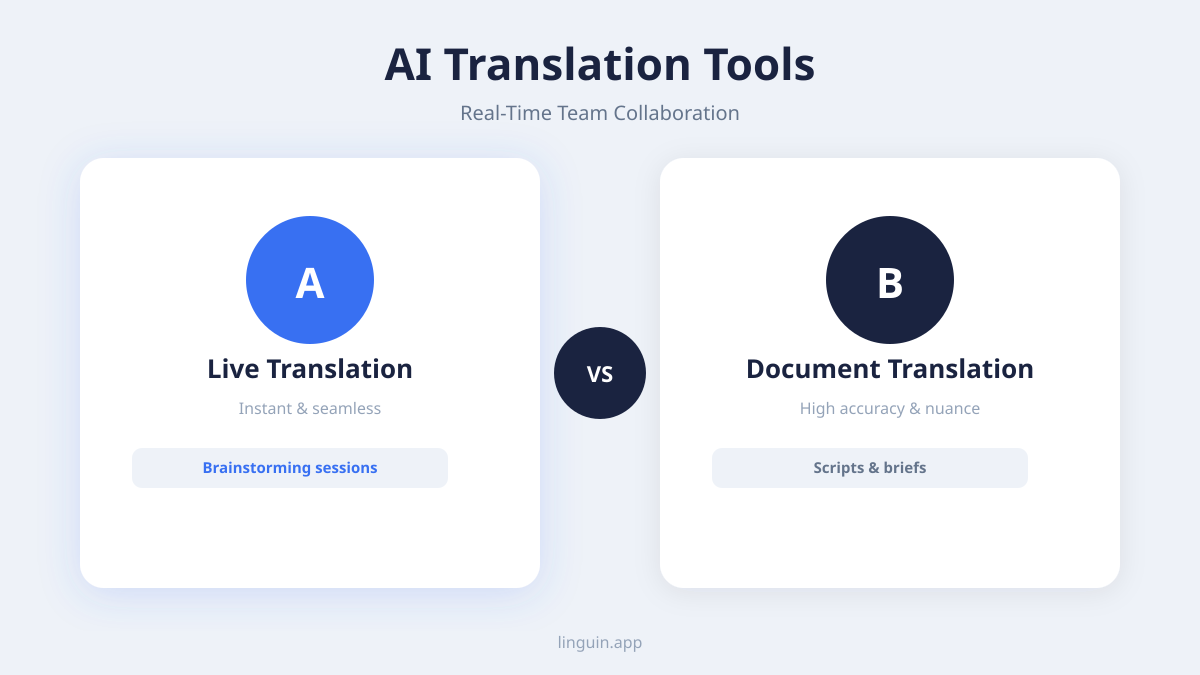
AI translation is an excellent first pass for dense, jargon-heavy documents like brand guidelines, creative briefs, or technical scripts. It can quickly provide a draft translation that captures the bulk of the informational content and specialized terms. This draft should then be reviewed and polished by a native-speaking creative professional to ensure absolute precision in tone, brand voice, and cultural appropriateness. This hybrid approach saves significant time while guaranteeing quality.
Is our conversation data secure when using these translation tools?
Security is a paramount concern. Reputable AI translation providers for businesses implement enterprise-grade security, including end-to-end encryption for data in transit and strict policies about data usage and retention. It is essential to review a provider’s privacy policy and security certifications. Choose tools that are transparent about not using your proprietary creative conversations for training their public models without explicit consent.
Unlocking your team’s global creative potential
The ability to collaborate creatively across languages is no longer a futuristic ideal but a practical reality. Real-time multilingual creative collaboration, powered by sophisticated AI translation, dismantles the primary barrier to building truly global, diverse creative teams. The benefits are clear: faster iteration, richer ideation from multiple cultural perspectives, and a more inclusive environment where talent is valued over linguistic fluency.
The most important step is to integrate translation seamlessly into the channels where your team already creates. The goal is to make language a non-issue, allowing the focus to return to imagination, design, and innovation. By choosing tools that understand creative nuance and fostering a culture of clear, compassionate communication, you empower every team member to contribute their full creative potential.
To experience how this works in practice, consider exploring a translation solution designed for dynamic professional use. Linguin provides AI-powered translation across macOS, iOS, and browsers, built to handle the fluid, nuanced language of creative work. You can start by trying it on the platforms your team uses every day, turning language barriers into bridges for your next great idea.