 English
  Español
  Français
  Deutsch
  Português
  Italiano
  Русский
  中文(简体)
  日本語
日本語  한국어
한국어  العربية
  हिन्दी
  Nederlands
  Türkçe
  Polski
AI translation for academic research is transforming how scholars access global knowledge and collaborate across borders. For researchers, graduate students, and academic institutions, language is no longer an insurmountable barrier to discovery. This technology is unlocking vast repositories of non-English literature, facilitating real-time international teamwork, and accelerating the pace of scientific progress. This article explores the mechanisms, applications, and practical benefits of AI-powered translation in the scholarly world.
Key takeaways
- AI translation provides immediate access to a wider range of international journals, theses, and primary source materials.
- It enables real-time, contextual translation for multilingual team meetings, co-authoring, and peer review.
- Advanced models handle complex academic jargon and discipline-specific terminology with growing accuracy.
- It reduces the time and financial cost traditionally associated with professional human translation in academia.
- These tools foster more inclusive and equitable global research networks.
The evolving landscape of academic research
Academic research has always been a global endeavor, but its communication has been fragmented by language. Historically, significant research published in languages other than English remained inaccessible to large portions of the international community. Scholars either needed specialized language skills or had to rely on costly, slow human translation services, which created delays and limited the flow of ideas.
The digital age brought PDFs and online journals, but the language barrier remained a digital wall. Early rule-based translation tools struggled with the nuance, technicality, and formal structure of academic writing. They often produced confusing or inaccurate translations of complex sentences, specialized terms, and critical data, making them unreliable for serious research purposes.
Modern AI translation, powered by neural networks and large language models, represents a fundamental shift. These systems are trained on massive datasets that include academic texts, allowing them to understand context, infer meaning, and handle the formal tone of scholarly work. This evolution means researchers can now get a functional, accurate understanding of foreign-language content in seconds, not weeks. It democratizes access to knowledge, allowing a researcher in Brazil to quickly grasp a groundbreaking study from South Korea, or a historian in Canada to analyze primary documents from archives in Egypt.
How AI translation works for scholarly content
Understanding the core mechanisms helps clarify why AI translation is uniquely suited for academia. Unlike simple word-for-word substitution, modern AI models process entire sentences and paragraphs as cohesive units. They analyze the relationship between words, the grammatical structure, and the surrounding context to predict the most accurate and natural-sounding translation.
A critical strength for research is domain adaptation. Many advanced AI translation systems can be fine-tuned or are pre-trained on specific corpora, such as biomedical literature, legal texts, or engineering papers. When you feed a paragraph from a physics preprint into a robust AI translator, it doesn’t just translate words. It recognizes formulas, standard notations, and field-specific terminology, ensuring that “black hole” is translated with its astrophysical meaning intact, not as a literal hole. This contextual understanding is what separates current tools from their predecessors.
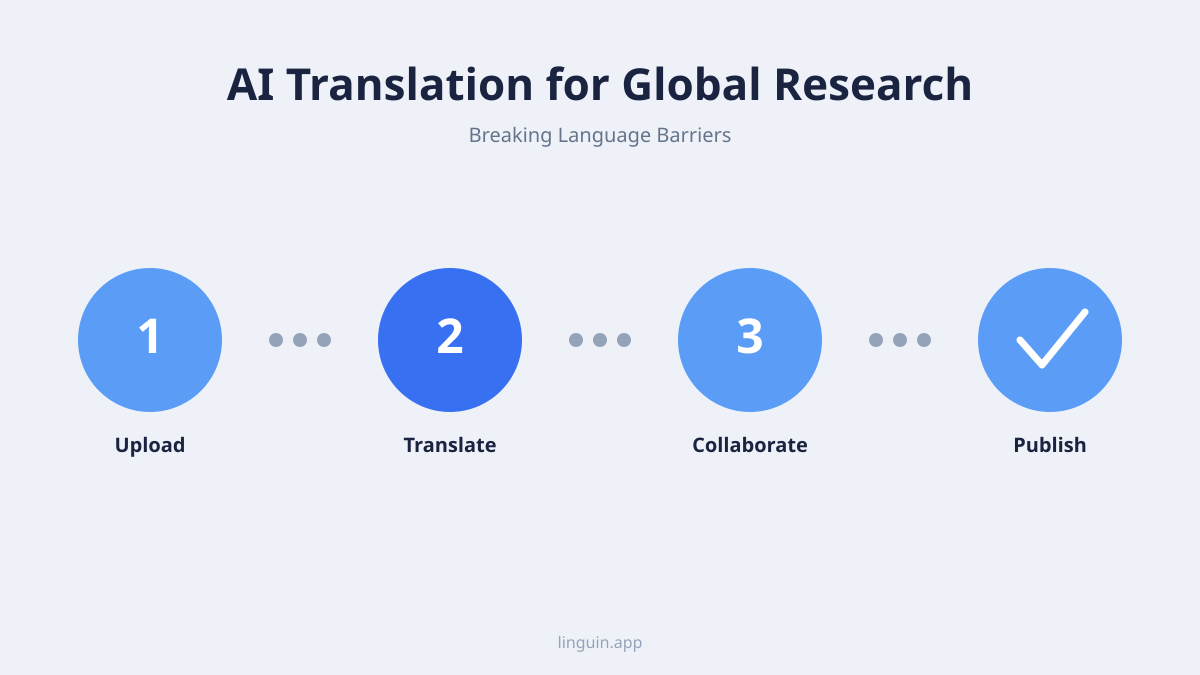
Furthermore, these systems handle academic register effectively. They maintain the formal, objective, and precise tone required in research papers, grant proposals, and conference abstracts. They correctly translate passive constructions, complex citations, and methodological descriptions without collapsing them into informal language. For collaborative writing, this means co-authors can draft and edit in their native languages, with the AI providing a coherent, professionally-toned draft in the target language for final polishing. You can learn more about how AI manages different levels of formality in our guide on formal and informal tone in emails.
Breaking down barriers to literature and data
The most immediate application of AI translation for academic research is in literature review and data sourcing. The volume of research published globally is staggering, and a significant portion exists outside of English.
Accessing non-English journals and repositories: Scholars can now use AI translation tools to scan abstracts, skim methodologies, and evaluate conclusions from journals in Chinese, Spanish, German, Japanese, French, and dozens of other languages. This allows for a truly systematic review, ensuring that relevant studies are not omitted simply due to language. A public health researcher investigating a local intervention in Chile can incorporate findings from Spanish-language reports directly into their meta-analysis.
Working with historical and primary sources: For humanities and social science researchers, AI translation unlocks archives. Personal letters, government documents, historical newspapers, and ethnographic recordings in their original language can be translated to provide key evidence. While expert human analysis remains crucial for nuanced interpretation, AI provides a powerful first-pass tool for identifying relevant materials and understanding their general content.
Understanding code and comments: In fields like computer science and engineering, research often involves shared code repositories. Comments, documentation, and commit messages written in other languages become instantly understandable. This facilitates the replication of studies and the collaborative improvement of open-source research software. The ability to handle mixed content is explored further in our article on AI translation for code-switching and mixed languages.
Say you’re a materials scientist reading a Japanese patent for a novel polymer synthesis. The technical diagrams are clear, but the procedural details are in Japanese. With an AI translation tool integrated into your browser, you can highlight the text and get an accurate, technical translation of the chemical process steps, allowing you to assess its relevance to your work in minutes.
Facilitating real-time multinational collaboration
Research is increasingly conducted by distributed, international teams. AI translation acts as a collaboration layer, removing friction from every stage of joint work.
Multilingual virtual meetings and seminars: Tools that offer real-time speech-to-text translation allow team members to participate in video conferences in their preferred language. A postdoc in Italy can present findings in Italian while colleagues in India and Mexico read live captions or hear a synthesized voice in their own languages. This creates a more inclusive environment where the best ideas can surface, independent of an individual’s fluency in a common lingua franca.
Co-authoring and manuscript preparation: Teams can collaborate on shared documents where each member writes in their native tongue. AI translation can provide draft versions in a unified language for editing and consolidation. This preserves the original nuance and detail each contributor provides, which can sometimes be lost when non-native speakers struggle to express complex ideas in a second language. It streamlines the writing process and reduces the burden on a single “native speaker” to rewrite everyone’s contributions.
Peer review and feedback loops: Reviewers can more easily assess manuscripts submitted in languages they are less familiar with, broadening the potential reviewer pool and reducing bias. Similarly, authors can understand review comments provided in another language, ensuring critical feedback is not missed. For a deeper look at tools that enable this kind of teamwork, see our analysis of AI translation for remote multilingual teams.
Consider a multinational clinical trial consortium. Investigators at sites in Egypt, Brazil, and Indonesia need to align on a complex trial protocol. Using an AI-powered platform, they can discuss amendments in a shared chat, with messages instantly translated. This ensures precise mutual understanding of eligibility criteria, dosing schedules, and adverse event reporting procedures, which is critical for both research integrity and patient safety.
Handling technical jargon and discipline-specific language
The accuracy of translation in academia hinges on its treatment of specialized terminology. A mistranslated term in a legal clause, a chemical compound, or a philosophical concept can change the entire meaning of a text.
Terminology management: Sophisticated AI translation systems build and utilize glossaries. Researchers can create custom terminology lists for their project-defining how specific acronyms, model names, or technical phrases should be translated-and the AI will adhere to these preferences consistently across documents. This ensures that “randomized controlled trial” or “CRISPR-Cas9” is always translated correctly and identically.
Contextual disambiguation: Many terms have different meanings across fields. The word “scaffold” means one thing in biology, another in construction engineering, and something else in education theory. AI models use the surrounding text to disambiguate these terms correctly. They recognize that in a tissue engineering paper, “scaffold” refers to a structure for cell growth, not a temporary platform.
Mathematical and symbolic reasoning: While pure mathematical notation is universal, the descriptive text around it is not. AI translators effectively handle sentences interwoven with equations, variables, and symbols, translating the explanatory prose without corrupting the formulas. This is essential for fields like physics, economics, and applied mathematics. For an in-depth discussion on this challenge, read about AI translation for technical jargon and industry terminology.
Ethical considerations and best practices
While powerful, the use of AI translation in academia requires thoughtful application and an understanding of its limitations. It is a tool to augment human capability, not replace critical scholarly judgment.
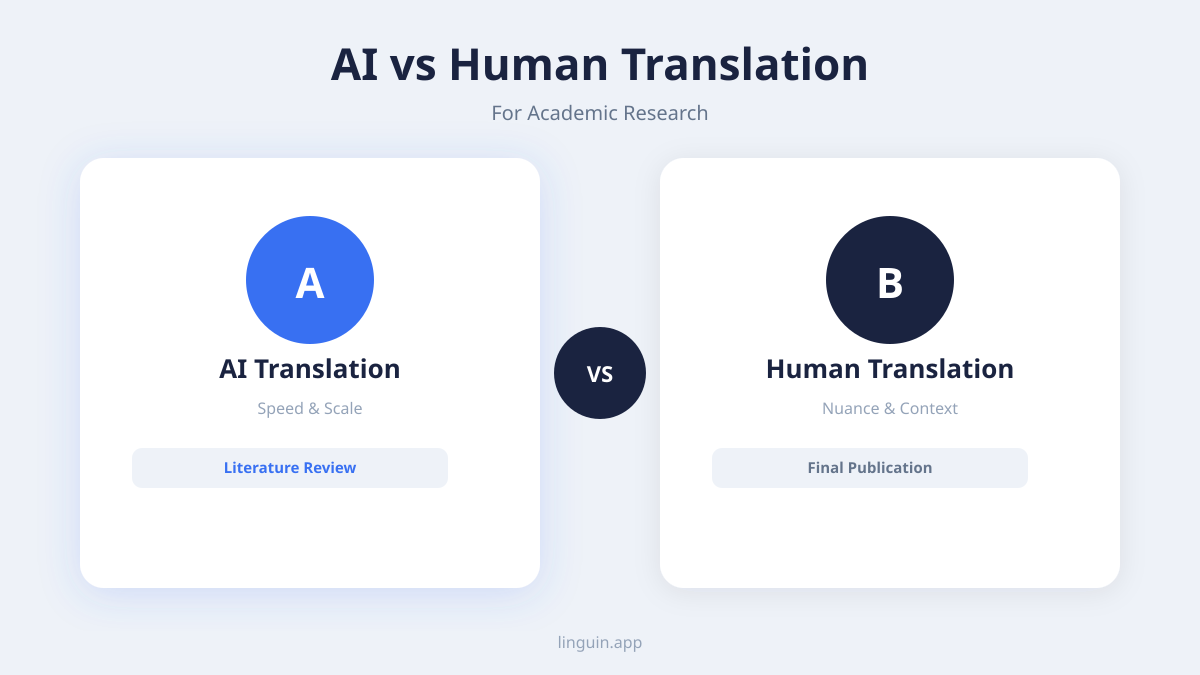
Accuracy verification is paramount: For high-stakes work-such as consent forms for human subjects, precise chemical safety data, or the final version of a manuscript for publication-AI output should be verified by a subject-matter expert proficient in both languages. The AI provides a robust draft, but the human researcher bears final responsibility for accuracy.
Acknowledging the tool: As AI translation becomes commonplace, scholarly norms may evolve. It may become good practice to acknowledge the use of AI translation tools in the methods or acknowledgments section of a paper, especially when they were used to access key non-English sources. This promotes transparency in the research process.
Preserving linguistic diversity: There is a risk that the convenience of translation could further entrench English as the default language of science. Researchers should be encouraged to still publish in their native languages where appropriate, using AI translation to create accessible abstracts and summaries. This supports global knowledge equity. The role of AI in preserving linguistic heritage is discussed in our piece on AI translation for endangered languages.
Bias and representativeness: AI models are trained on existing data, which may contain societal or historical biases. Researchers must be aware that translations, especially of social science or humanities texts, might inadvertently carry over these biases. Critical engagement with the translated text remains essential.
Integrating AI translation into the research workflow
To gain the full benefits, researchers should integrate AI translation tools seamlessly into their existing digital environments.
Browser extensions for literature search: Installing a translation extension allows for on-the-fly translation of journal websites, preprint servers, and academic databases. You can quickly assess the relevance of a paper without downloading it or switching between applications.
Desktop and mobile app integration: Dedicated apps can handle larger documents, such as entire PDFs of foreign theses or reports. They allow for offline translation, which is useful when working in field locations or on airplanes. A tool like Linguin, available as an AI translator for Mac and other platforms, fits directly into a researcher’s desktop workflow.
API connections for large-scale projects: For big, ongoing projects like building multilingual literature databases or translating large archival collections, using a translation API allows for batch processing and integration into custom research software. This automates the initial translation of thousands of documents, which scholars can then filter and analyze.
Say you’re compiling a bibliography on medieval trade routes. You find a promising 80-page PDF of a Portuguese monograph. Instead of sending it for costly human translation, you use a document translation service to get a working English version overnight. You can then pinpoint the specific chapters and passages relevant to your work for closer, verified analysis.
Frequently asked questions
Is AI translation accurate enough for citing in academic papers?
For understanding and identifying sources, it is highly effective. However, for direct quotation in a publication, the translated text should be verified by a qualified human translator or a native-speaking co-author. It is best practice to cite the original non-English source and note that you consulted a translation. The AI translation provides the pathway to the source and its core ideas, which you then interpret and cite responsibly.
Can AI translation tools handle complex academic formats like PDFs with graphs and footnotes?
Many advanced tools now offer dedicated document translation features that preserve the original layout, including headings, footnotes, captions, and bullet points. They place the translated text in the correct position relative to graphs, tables, and images. This maintains the document’s integrity, making it much easier to read and reference. For more on this, see our review of the best PDF translator tools.
How does AI translation compare to using a professional human translator for research?
They serve complementary roles. AI translation is fast, affordable, and excellent for exploration, drafting, and everyday collaboration. It allows you to cast a wide net. Professional human translators are essential for final, public-facing documents where nuance, style, and guaranteed accuracy are critical, such as journal submissions, grant applications, or book chapters. A hybrid approach is often most efficient: use AI for initial comprehension and drafting, then employ a human expert for final polishing of key texts.
Are there privacy concerns when translating sensitive research data?
This is a crucial consideration. When dealing with unpublished data, confidential peer reviews, or proprietary information, you must use translation tools with strong privacy policies. Look for services that offer local processing (on your device), do not store your data, or have clear agreements for enterprise/academic clients that guarantee data confidentiality. Always check the privacy specifications of any tool before uploading sensitive research materials.
Can these tools help me learn a foreign language for research purposes?
Yes, indirectly. By providing immediate, contextual translations, they can help you immerse yourself in academic writing in a target language. You can read the original and the translation side-by-side, which aids in learning technical vocabulary and grammatical structures specific to your field. However, they are not a substitute for dedicated language learning, but rather a powerful support tool for content-based learning. For dedicated language acquisition, explore our thoughts on the best language learning app companions.
Advancing research without language limits
The integration of AI translation into academic research marks a significant step toward a more connected and equitable global scholarly community. Its core value lies in removing the friction of language, allowing ideas, data, and collaboration to flow based on merit and relevance, not linguistic privilege. By providing immediate access to global literature and enabling seamless multinational teamwork, it accelerates the cycle of discovery and innovation.
The most effective approach is a pragmatic one. Embrace AI translation as a powerful assistant for discovery, drafting, and daily communication. Rely on it to expand your horizons and connect with colleagues worldwide. For final, formal outputs, combine its efficiency with expert human verification to ensure precision. This hybrid model leverages the strengths of both technology and human expertise.
To experience how these tools can fit into your own workflow, consider exploring a solution designed for seamless integration across devices. Linguin provides AI-powered translation directly on macOS, iOS, and in your browser, allowing you to translate text and conversations across over 100 languages within the applications you already use for research. Start by using it to translate the abstract of a key paper from another language, or to facilitate a clearer exchange with an international co-author on your next project.