 English
  Español
  Français
  Deutsch
  Português
  Italiano
  Русский
  中文(简体)
  日本語
日本語  한국어
한국어  العربية
  हिन्दी
  Nederlands
  Türkçe
  Polski
AI translation is the key to preparing your content for the unique demands of multilingual voice search. As voice-activated queries become the norm, users expect immediate, natural, and contextually perfect answers in their native language. This shift presents both a challenge and an opportunity for content creators and businesses aiming to reach a global audience. For marketers, developers, and support teams, understanding this intersection is critical for staying relevant. This article explains how modern AI translation tools adapt content for voice search, the specific optimizations required, and how to implement a strategy that speaks directly to your international users.
Key takeaways
- AI translation models excel at producing the natural, conversational language that voice search algorithms prioritize.
- Optimizing for voice search requires translating not just keywords, but entire question-and-answer structures and local intent.
- A multilingual voice search strategy extends beyond web content to include app interfaces, support documentation, and product listings.
- Continuous optimization is needed, as voice search patterns and colloquial language evolve differently in each market.
The rise of voice search and the multilingual imperative
Voice search is no longer a novelty. It is a fundamental shift in how people interact with technology, driven by smart speakers, virtual assistants, and mobile voice commands. The core difference from text search is linguistic. Voice queries are longer, more conversational, and phrased as complete questions. Users ask “where is the best authentic pizza place near me open now” instead of typing “best pizza open.” This natural language processing is the domain where AI translation must operate.
When this behavior scales across languages, the complexity multiplies. A Spanish user might phrase a query differently than a German user, even if they seek the same information. Multilingual voice search optimization therefore isn’t about translating a list of keywords. It is about translating user intent, local colloquialisms, and the expected format of an answer. For a business, failing to account for this means being invisible in voice search results for entire regions. AI translation tools that understand context and conversation are essential to bridge this gap. They enable the creation of content that feels native, not translated, which is exactly what voice search algorithms reward.
Say you’re a travel blogger. Your English article titled “10 Hidden Gems in Rome” might rank for text searches. But for voice search, an Italian user might ask their device, “Cosa posso visitare a Roma che non sia troppo turistico?” which translates to “What can I visit in Rome that isn’t too touristy?” An AI translation system, informed by voice search data, can help you adapt your content’s title, headings, and FAQ section to match this natural question format in Italian, significantly improving its chances of being surfaced by a voice assistant.
How AI translation models understand conversational intent
Traditional translation often operated at the sentence level, focusing on lexical accuracy. Modern AI translation models, particularly neural machine translation systems, work differently. They analyze entire paragraphs and documents to grasp context, tone, and intent. This holistic understanding is what makes them uniquely suited for voice search content. They can discern whether a phrase is a question, a command, or a statement, and translate it while preserving that functional intent.
These models are trained on vast datasets that include conversational language, from movie subtitles to social media dialogues. This exposure allows them to learn how people actually speak, including contractions, filler words, and regional variations. For voice search, this is invaluable. When translating a FAQ page, an AI model can convert the formal “How may I assist you?” into the more natural “How can I help?” in the target language, aligning with how a user would verbally ask for help. This focus on conversational intent ensures the translated content mirrors the phrasing a real person would use when speaking to a device.
Furthermore, these models handle implicit meaning. In voice search, users often omit words they consider obvious. A query like “weather tomorrow” assumes the location. An AI translator preparing location-based content must understand these elisions and ensure the translated content answers the full, implied question. This involves more than word substitution, it requires semantic comprehension. For instance, translating a local business’s “hours of operation” page requires knowing that in some cultures, the common voice query might be “What time do you open?” while in others, it might be “When does the store start business?” A robust AI system can adapt the content to match these local query patterns.
Core strategies for optimizing translated content for voice
Optimizing translated content for voice search requires a dedicated approach that goes beyond standard SEO. The goal is to make your content the best possible spoken answer to a question. Here are the core strategies to implement.
Focus on question phrases and long-tail keywords. Voice searches are 3-5 times more likely to be question-based than text searches. Your content must be structured to answer these questions directly. Use your AI translation tool to not only translate these Q&A pairs but also to discover the natural way these questions are asked in the target language. Tools like Linguin can help maintain the conversational tone across languages, which is crucial for this format. For more on structuring multilingual content, see our guide on AI translation for multilingual SEO content.
Create concise, direct answers. Voice assistants typically read the first 30-50 words of a selected result. The ideal answer is a clear, factual sentence or two at the very beginning of your content. When translating, ensure this “position zero” answer remains concise and doesn’t become awkward or lengthy in the new language. The AI should prioritize clarity and brevity in the translation of this critical snippet.
Structure content for featured snippets. Many voice search answers are pulled from featured snippets (position zero in SERPs). These are often lists, tables, or step-by-step instructions. Use header tags (H2, H3) to create clear sections. When translating, the AI must preserve this structural markup and the logical flow within it. A numbered list in English must be a correctly ordered numbered list in Japanese, with each step translated for clarity and action.
Localize for cultural and regional speech patterns. Optimization must account for dialects and local slang. The way someone asks for a “soft drink” varies dramatically between “soda,” “pop,” or “coke” in different US regions, and these variations are even more pronounced between countries. AI translation tools equipped to handle regional dialects and business terminology can adapt your content to these subtle but important differences, ensuring it resonates with the specific voice search patterns of a locale.
Say you’re managing an e-commerce site for kitchen gadgets. Your English product page for a blender might be optimized for the query “how to make a smoothie in a blender.” For the French market, a common voice query might be “recette de smoothie facile mixer” (easy smoothie recipe blender). Your AI translation should help you create a content block that directly answers this, using the appropriate verbs and casual recipe style common in French cooking blogs, not just a literal translation of the English instructions.
Technical considerations for multilingual voice search
The optimization process extends into the technical backbone of your website or app. Structured data (Schema markup) is a non-negotiable component. It helps search engines understand the content on your page-for example, that a certain block is a recipe, an event, or a FAQ. When you translate a page, you must also translate and update the structured data within it. An AI translation process should account for this, ensuring that name, description, and text fields in the Schema are accurately translated so voice assistants in different languages can parse and use the information correctly.
Page speed and mobile optimization are universal SEO factors, but they are critical for voice search. Many voice searches happen on mobile devices. If your multilingual site uses a suboptimal implementation-like slow-loading translation scripts or unoptimized images on every language variant-it will harm the user experience and your rankings. The technical setup for your translated sites (whether subdirectories, subdomains, or separate domains) must prioritize performance. The content delivered by AI translation should be lightweight and integrated seamlessly.
Managing hreflang tags is another crucial technical task. These HTML tags tell search engines which language version of a page to show users in a specific region. Correct implementation prevents issues like serving your Spanish content to users in Italy. For voice search, this precision is key. A user speaking Italian to their device expects results in Italian. If your hreflang tags are incorrect or missing, your perfectly translated and optimized French page might be served to them, rendering all your work ineffective. While AI translation creates the content, the technical team must ensure these signals are properly placed.
Expanding voice search optimization beyond your website
A comprehensive strategy looks at all touchpoints where a voice query might lead. App interfaces and in-app search are prime examples. If you have a mobile app, users might use voice commands within it. All in-app text, including buttons, menus, help sections, and error messages, should be translated with a conversational tone. An AI translator like Linguin, which offers SDKs for developers, can ensure this in-app language is natural for voice interaction.
Customer support channels are a direct line for voice queries. Your support documentation, chatbot scripts, and even call center FAQs need voice-search-friendly translation. When a frustrated user asks their smart speaker “why is my [product] not connecting to wifi,” the ideal result might be a step-by-step troubleshooting guide from your support site. Translating these guides with clear, action-oriented language is essential. Explore how AI can streamline multilingual customer support in this context.
Product listings on e-commerce platforms and marketplaces are another frontier. On platforms like Amazon, which have their own voice search ecosystems (like Alexa), your product titles, features, and descriptions must be optimized for spoken queries in each language. An AI tool can help you scale this optimization across thousands of listings, ensuring they contain the long-tail, conversational keywords that voice shoppers use. For deeper insights, our article on AI translation for multilingual e-commerce listings covers this in detail.
Local business listings on Google Business Profile, Yelp, and other directories are fundamental for “near me” voice searches. Ensuring your business name, category, description, and posts are accurately and naturally translated for each region can dramatically increase your visibility for local voice queries. This is where AI translation’s ability to handle cultural context and local nuances becomes directly tied to foot traffic and conversions.
Measuring and iterating your multilingual voice search strategy
Optimization is an ongoing process. You must measure performance to understand what works. Focus on analytics that track voice search performance specifically. In tools like Google Search Console, look for increases in impressions and clicks for question-based queries in your target languages. Monitor your rankings for featured snippets in each language version, as these are the primary source for voice answers.
Pay attention to the query reports for your international sites. Analyze the actual search terms bringing users to your translated pages. Are they conversational questions? Are they the questions you anticipated? This data is gold. It tells you if your translated content aligns with how people are verbally searching. You may discover that in one language, users ask a question you haven’t answered, signaling a need for new content or a translation adjustment.
User engagement metrics are also telling. A high bounce rate on a translated page from organic search might indicate that while the page was surfaced for a voice query, the answer wasn’t immediately clear or satisfactory when the user visited. Perhaps the translated answer is buried, or the language is too formal. Use this feedback loop to refine your content. Continuously update and improve your translated content based on performance data and evolving language trends. The fluid nature of conversational language, especially with the rise of internet slang and neologisms, means your translations may need regular tuning to stay effective.
Frequently asked questions
Can AI translation really match human nuance for voice search?
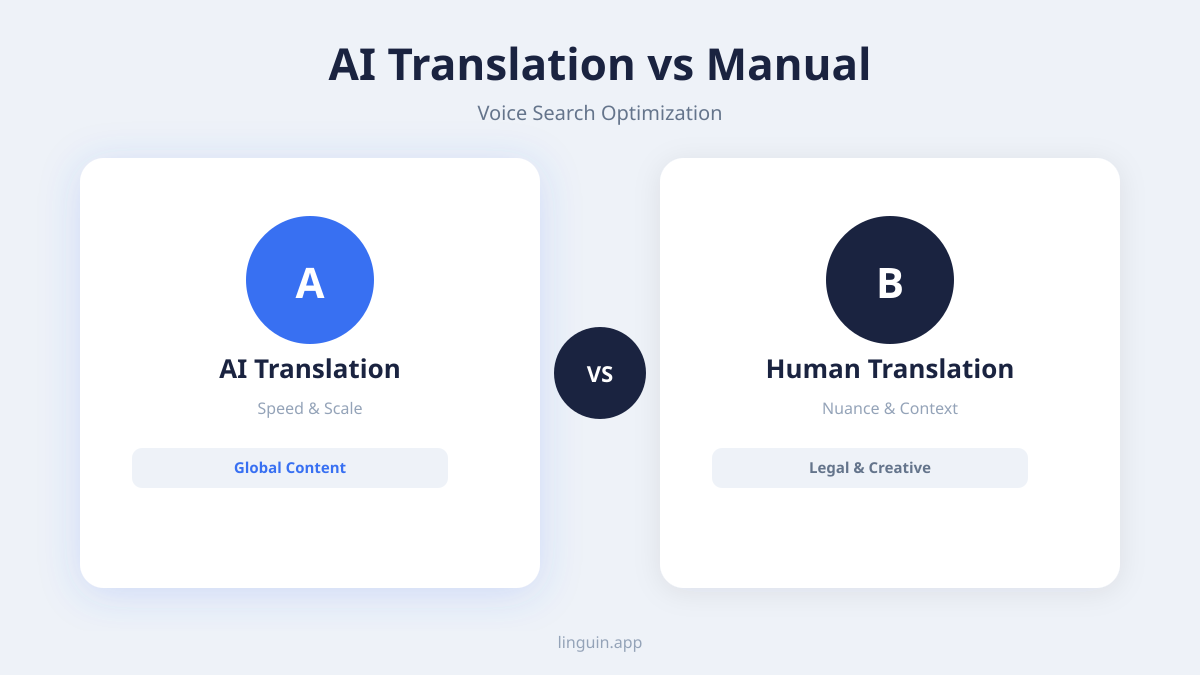
Yes, for the specific domain of conversational query and answer patterns, advanced AI translation models are highly effective. They are trained on massive datasets of natural dialogue, allowing them to replicate the phrasing, simplicity, and intent of spoken questions and answers. While human oversight is recommended for brand-sensitive or creative content, AI delivers the scalable, natural-sounding translation required for voice search optimization across dozens of languages.
How many languages should I optimize for voice search?
Start with your core markets. Prioritize languages where you have significant traffic, business goals, or where voice search adoption is high. It is more effective to have fully optimized content in three key languages than to have poorly optimized or technically flawed content in twenty. Use market research and your existing analytics to identify where the opportunity and audience intent are strongest.
Does voice search optimization work for all types of websites?
The principles apply broadly, but the tactics differ. Local business sites benefit from optimizing for “near me” and action-oriented queries. E-commerce sites need product-focused Q&A. Support and informational sites thrive on “how to” and “what is” questions. The common thread is the need for content that directly answers a spoken question in a clear, concise manner, which must then be accurately translated and localized.
How do I handle languages with different sentence structures in voice queries?
This is where AI translation shines. Languages like Japanese or German often place the verb at the end of a sentence, which could change the focus of a query. Sophisticated AI models understand these structural differences. They can translate the core intent of an English question into a naturally structured question in the target language, ensuring it aligns with how a native speaker would verbally ask it. This goes beyond word order to encompass the entire grammatical and cultural framing of the query.
Implementing your voice search translation strategy
The convergence of voice search and AI translation represents a significant shift in global digital communication. Success hinges on recognizing that voice search demands a different kind of content: conversational, direct, and perfectly aligned with local speaking habits. The strategic use of AI translation allows you to scale this personalized, spoken-word experience across languages efficiently.
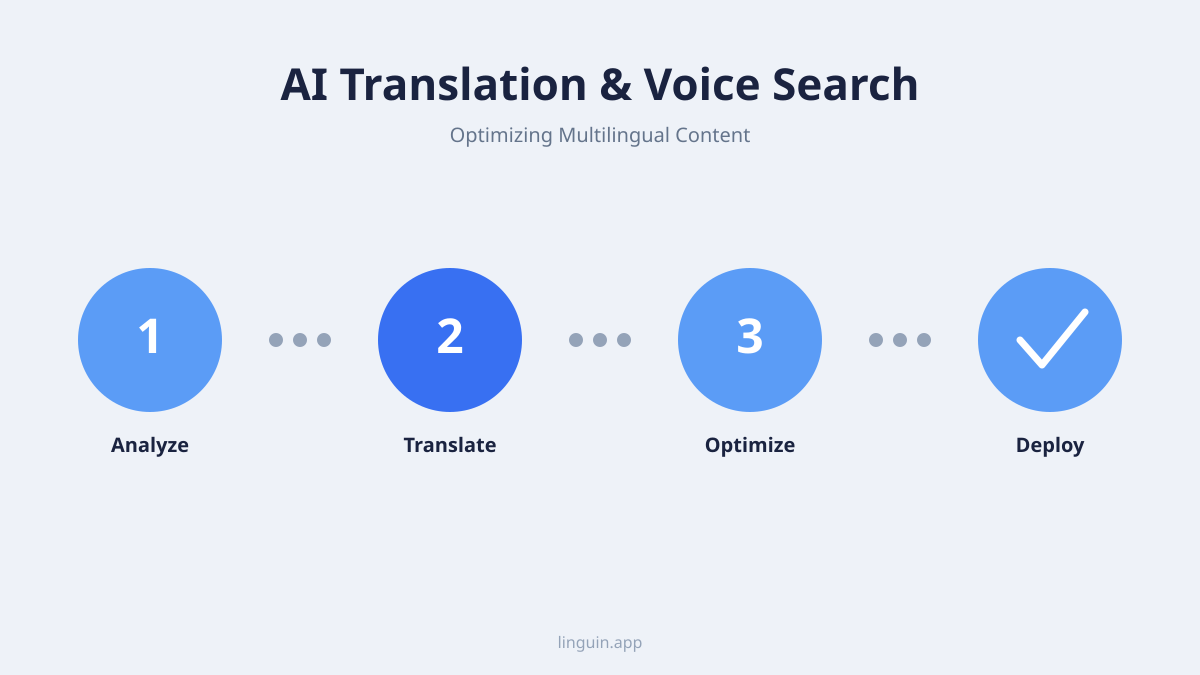
The most important steps are to first audit your existing content for voice search friendliness in your primary language, then identify the key markets for expansion. From there, employ an AI translation tool that prioritizes contextual and conversational accuracy to adapt not just your keywords, but your entire Q&A framework. Remember to integrate this with the necessary technical foundations, like structured data and hreflang tags, and to measure performance diligently in each language.
A practical next step is to take a key piece of your content, such as a popular FAQ or product description, and use a tool like Linguin to translate it into one of your target languages. Then, read the translation aloud. Does it sound like a natural answer to a spoken question? This simple test can illuminate the path forward for making your entire digital presence ready for the voice-first, multilingual future.