 English
  Español
  Français
  Deutsch
  Português
  Italiano
  Русский
  中文(简体)
  日本語
日本語  한국어
한국어  العربية
  हिन्दी
  Nederlands
  Türkçe
  Polski
In global business, the real language barrier is often not between languages, but within them. AI translation for regional dialects is the key to unlocking clear communication across diverse linguistic landscapes. For companies operating internationally, a single standardized translation can miss the mark when communicating with partners, customers, or teams in different regions. This article explains how modern AI translation tools are equipped to handle these subtle but critical variations, ensuring your message is understood as intended, no matter the local dialect. You will learn the importance of dialect awareness, how AI models achieve it, and practical strategies for implementing it in your business workflows.
Key takeaways
- Dialect differences can cause significant misunderstandings in business, from contracts to customer support, even when both parties technically speak the same language.
- Modern AI translation tools use context-aware models and vast, diverse training data to recognize and adapt to regional linguistic variations.
- Proactively configuring your translation tools for specific regional preferences prevents miscommunication and builds stronger local relationships.
The hidden challenge of dialects in global business
When we think of translation in business, we often picture converting English to Mandarin or Spanish to German. However, a more pervasive and subtle challenge exists: translating within a language across its regional dialects. A business proposal written in standard American English may confuse or even alienate a reader in Scotland, where vocabulary, phrasing, and cultural references differ. Similarly, European Portuguese and Brazilian Portuguese have distinct vocabularies and grammatical norms that can impact the clarity of legal documents or marketing materials.
These differences are not mere accents. They encompass vocabulary, grammar, syntax, and idioms. For instance, the word “boot” refers to a car trunk in the UK but a type of footwear in the US. In software localization, a “torch” in a UK English interface is a “flashlight” in the US version. In customer support, a representative using Castilian Spanish terms might fail to connect with a customer in Mexico who uses different words for common items. These gaps can lead to misunderstandings in contracts, ineffective marketing campaigns, and strained professional relationships.
The business cost is real. Miscommunication due to dialectal differences can result in delayed projects, lost sales, and reputational damage. It signals a lack of local awareness and effort. In a world where trust and personal connection are valuable currency, using the wrong regional variant can make a company seem out of touch. Therefore, effective communication requires a tool that doesn’t just translate words, but adapts to the linguistic identity of the target audience. This is where context-aware translation moves beyond a simple word-for-word function.
Consider a scenario where your HR team is onboarding a new remote employee in Argentina. The welcome materials and software guides are written in standard Spanish from Spain. The new hire, while understanding the content, may find the terminology odd or formal, creating an immediate sense of distance. Adapting these materials to Rioplatense Spanish (used in Argentina and Uruguay) with its distinct vocabulary and use of “vos” instead of “tú” makes the communication feel personal and welcoming, fostering better integration from day one.
How AI translation models understand regional variations
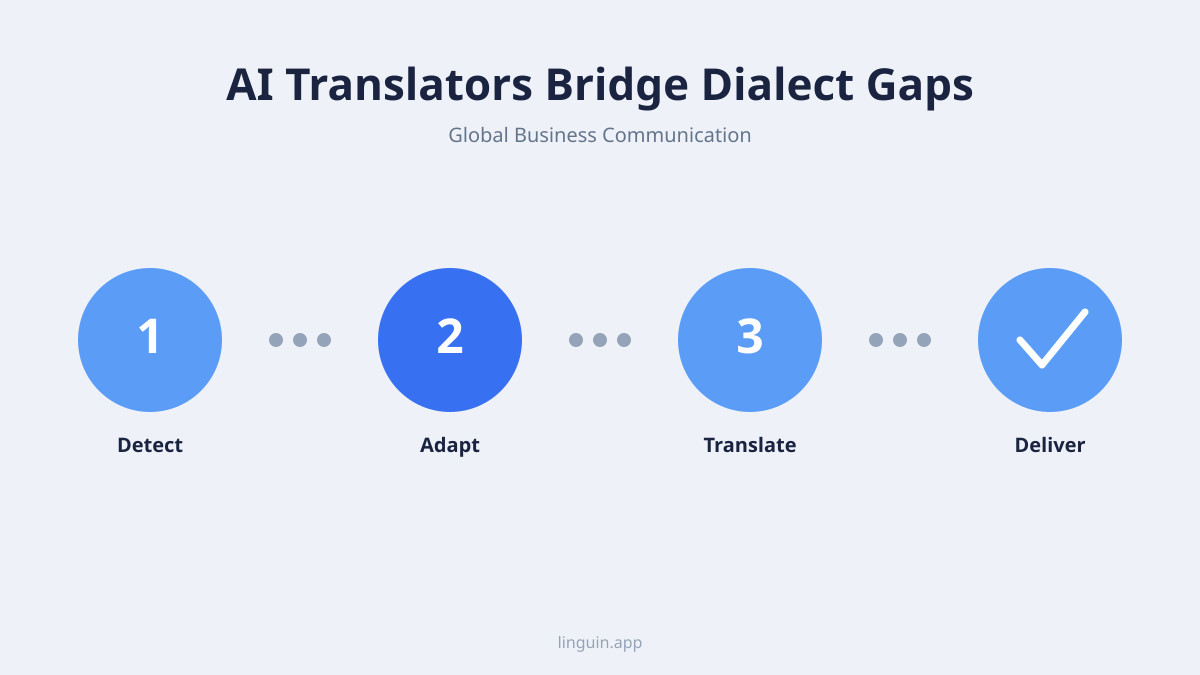
Traditional rule-based translation software often struggles with dialects because it relies on fixed dictionaries and grammatical rules for a language’s “standard” form. Modern AI-powered translation, like the technology behind Linguin, takes a fundamentally different approach. These systems are built on neural networks trained on massive datasets of text and speech from across the internet and curated sources. This training data includes content from blogs, news sites, forums, and literature from many regions, allowing the AI to learn patterns not just in “French,” but in Canadian French, Swiss French, and West African French.
The core mechanism is pattern recognition. The AI model learns that certain words, phrases, and sentence structures correlate with specific regional contexts. It understands that if a text contains words like “lorry,” “flat,” and “brilliant,” it is likely British English. It then can generate translations that are appropriate for that context, or translate from that dialect into another language while preserving the intended meaning. This is a form of contextual understanding, where the AI considers the broader linguistic environment of a phrase, not just the phrase itself.
This capability is enhanced by several technical features:
- Continuous Learning: Many AI models are updated with new data, allowing them to incorporate emerging slang and regional usage from different areas.
- Context Window Analysis: Advanced models analyze the entire sentence or paragraph surrounding a word to determine its most likely regional meaning. The word “chips” means one thing in the context of a British pub and another in an American grocery store.
- Style and Register Detection: Beyond geography, AI can detect whether text is formal or informal, which often overlaps with regional preferences. It can adjust output to match, ensuring a technical manual sounds professional in its target region and a marketing email sounds colloquially correct.
For example, when using a context-aware translation tool, you can often specify a target region or dialect. Translating a customer service script from English to Spanish for support in Mexico will yield different results than translating the same script for Spain. The AI will choose the appropriate greetings, terminology, and phrasing that resonate locally. This goes beyond direct translation to adaptive localization, a critical function for businesses that interact with diverse audiences. You can learn more about the fundamentals of this technology in our guide to context-aware translation.
Practical applications: Where dialect-aware translation matters most
Implementing dialect-sensitive AI translation provides tangible benefits across several key business functions. It is not a niche feature but a core component of professional global communication.
Marketing and advertising campaigns
A marketing message that works in one region can fall flat or cause offense in another if the dialect and cultural nuances are ignored. AI translation tools can help adapt slogans, product descriptions, and ad copy to fit local linguistic preferences. This ensures the message feels native and compelling. For instance, adapting a campaign from European French to Quebec French involves more than translation; it requires changing cultural references, humor, and idioms to connect with the Quebec audience. A dialect-aware system can suggest these adaptations, making localization faster and more authentic.
Customer support and success
This is one of the most critical applications. When customers contact support, they expect to be understood in their own terms. A support agent using a knowledge base translated into the customer’s specific dialect can provide faster, clearer, and more empathetic service. If a customer from Australia reports a problem with their “ute,” a support system calibrated for Australian English will understand this means a “utility vehicle” or pickup truck, avoiding confusion. This directly improves customer satisfaction and resolution times. Explore how this works in practice for AI translation in multilingual customer support.
Internal communications and remote teams
Companies with distributed, multilingual teams face daily dialect challenges. A team discussion between engineers in Munich, Berlin, and Vienna will use different German regionalisms. An AI translator integrated into communication platforms (like chat or email) can help ensure clarity. It can subtly note when a term might be regional or provide a standard equivalent, smoothing collaboration. It allows team members to express themselves naturally while minimizing the risk of misunderstanding. Effective use of these tools is key for managing remote multilingual teams.
Legal and contractual documents
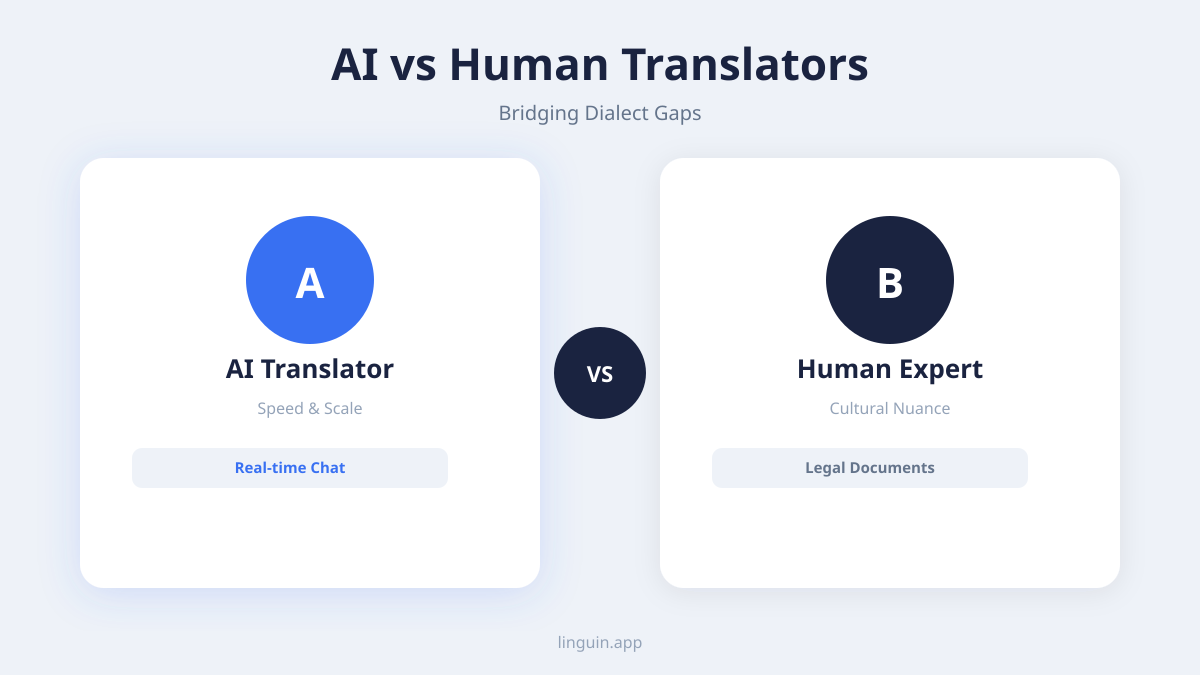
While legal documents should always undergo final review by a human expert proficient in the local legal language, AI translation can provide accurate first drafts that respect regional legal terminology. The difference between “lawyer” in the UK (solicitor/barrister) and the US (attorney) is a basic example. For non-binding agreements, internal policies, or terms of service, using a translation tool configured for the correct regional legal dialect ensures greater initial accuracy and reduces the revision burden on human translators.
Configuring your tools for dialect accuracy
To leverage AI for dialect-specific translation, you need to actively configure and use your tools with intention. It is not fully automatic. Here is a practical guide to setting up your workflow for optimal results.
First, choose a translation tool that explicitly supports regional variants. Look for settings where you can select both a source and a target language and a region or dialect. For example, instead of just “Spanish,” you should see options like “Spanish (Mexico)” or “Spanish (Spain).” Linguin and other advanced apps offer these granular controls. Always set the target region to match your audience. If you are translating a webpage for users in Taiwan, select “Chinese (Traditional, Taiwan)” not just “Chinese (Traditional).”
Second, provide context when you can. If you are translating a short phrase that could be ambiguous, include a brief note about the audience or the situation. Some advanced tools have fields for context hints. For example, when translating “He got a flat,” adding the context “UK, automotive” helps the AI choose the correct meaning (a tire deflation) over the US meaning (an apartment).
Third, build glossaries or style guides for critical projects. Most professional AI translation platforms allow you to create custom dictionaries. You can upload a list of company-specific terms and their preferred translations in different dialects. This ensures consistency across all your materials, whether they are translated for the UK, India, or Singapore. For instance, you can specify that your product name “Spark” should never be translated, but the feature “boot sequence” should be translated as “startup sequence” for US audiences and “boot sequence” for UK audiences.
Finally, implement a human-in-the-loop process for high-stakes content. Use AI to produce the first, dialect-aware draft quickly. Then, have a native speaker from the target region review it for natural flow, cultural appropriateness, and subtle nuances the AI might have missed. This combines the speed and consistency of AI with the nuanced understanding of a human, creating the most effective final product. Understanding the balance between AI and human translation is crucial for quality.
Overcoming limitations and future directions
While AI translation for regional dialects has advanced significantly, it is important to understand its current limitations. AI models are only as good as their training data. Dialects with less digital representation online may not be as well-supported as major national variants. Very recent slang or hyper-local terms from a specific city might not be recognized immediately. The AI may also sometimes blend dialects or default to the most common variant if the context is unclear.
Another challenge is with spoken dialects and strong accents. While speech-to-text and translation technology is improving, heavy accents can reduce transcription accuracy, which then affects the translation quality. The AI’s ability to handle code-switching (mixing languages or dialects within a conversation) is also an area of ongoing development.
The future of this technology points toward even greater granularity and personalization. We can expect:
- More granular dialect options, moving beyond country-level to potentially sub-regional dialects.
- Real-time adaptive translation in conversations that detects the dialect of each speaker and adjusts dynamically.
- Improved handling of mixed-language communication, common in global business where participants might blend English with local terms.
- Tighter integration with other business software, allowing for dialect-aware translation directly within CRM, helpdesk, and design platforms.
For businesses, the strategy is to adopt tools that are transparent about their dialect support and are committed to updating their models. Regularly testing translations with local teams and staying informed about the latest in AI translation accuracy will help you navigate these limitations while benefiting from the powerful capabilities already available. The goal is continuous improvement in making cross-dialect communication seamless.
Frequently asked questions
Can AI translation handle slang and informal dialect?
Yes, modern AI translation models are trained on vast amounts of informal text from social media, forums, and messaging platforms, which includes contemporary slang and colloquialisms from various regions. While it may not catch every brand-new slang term immediately, it is generally proficient with common informal language. The key is to use a tool that allows you to specify an informal or conversational tone, which guides the AI to use a less formal register appropriate for the dialect.
How do I know which regional dialect setting to choose for my translation?
The setting should always match the primary geographic location of your target audience. If you are communicating with customers in Canada, select “English (Canada)” or “French (Canada).” For a broad audience across Latin America, you might choose a neutral variant, but for specific countries like Argentina or Colombia, selecting that country’s dialect is better. When in doubt, consult with a team member or partner from that region to determine the most appropriate and widely understood variant for your purposes.
Is AI translation for dialects accurate enough for legal contracts?
For any legally binding document, AI translation should only be used as a drafting or comprehension aid. The final version must be reviewed and certified by a qualified human legal translator who is a native speaker of the target dialect and understands the local legal system. Dialect differences in legal terminology are profound, and the risk of error is too high to rely solely on AI. Use AI to grasp the general content, but always involve a professional for the official version.
What is the difference between dialect translation and localization?
Translation focuses on converting text from one language or dialect to another while preserving meaning. Localization is a broader process that adapts the entire product or content for a specific locale, which includes translation, but also involves adjusting currency, dates, formats, colors, images, and cultural references to align with local norms and expectations. Dialect-aware translation is a crucial component of localization, ensuring the language part of the adaptation is accurate and appropriate.
Integrating dialect-aware translation into your workflow
The move toward dialect-sensitive communication is a strategic advantage in global business. By acknowledging and adapting to regional linguistic diversity, companies demonstrate respect, build deeper trust, and operate more efficiently. The core takeaway is that language is not monolithic. Effective translation must account for the rich tapestry of dialects that define how people actually communicate.
Start by auditing your current communication touchpoints. Identify where dialect differences could be causing friction, such as in your support documentation, marketing emails for specific regions, or internal team chats. Then, implement a tool that offers granular regional controls. Configure it for your most critical target markets and experiment with translating existing materials to see the improvements.
Linguin is built for this precise challenge. With support for over 100 languages and their key regional variants across macOS, iOS, and browser extensions, it provides the context-aware, dialect-sensitive translation that modern businesses need. Try applying it to a specific task, like adapting a customer email for a different region, and experience the difference in nuance and clarity. Making this small change in your workflow can have a significant impact on your global reach and relationships.