 English
  Español
  Français
  Deutsch
  Português
  Italiano
  Русский
  中文(简体)
  日本語
日本語  한국어
한국어  العربية
  हिन्दी
  Nederlands
  Türkçe
  Polski
Effective collaboration in a remote multilingual team hinges on clear communication, but language differences can create significant barriers. AI translation for remote teams is the key to unlocking fluid, inclusive, and productive workflows across global talent pools. This technology is essential for distributed teams, international startups, and any organization managing contributors from different linguistic backgrounds. This article will explore how AI translation tools work, their practical benefits, and how they fundamentally change the dynamics of remote work.
Key takeaways
- AI translation enables real-time, context-aware communication across dozens of languages directly within your existing work apps.
- It reduces project delays and misunderstandings by providing immediate, accurate translations for messages, documents, and meetings.
- Modern AI tools go beyond literal translation to capture tone, cultural nuances, and industry-specific terminology for professional use.
The language challenge in a distributed workforce
The rise of remote work has dissolved geographical borders, allowing companies to hire the best talent regardless of location. This creates a powerful opportunity, but it also introduces a core operational challenge: language diversity. When team members speak different native languages, everyday collaboration-from quick Slack messages to complex project documentation-can become a source of friction, delay, and error.
Traditional solutions often fall short. Relying on a few bilingual team members to translate creates bottlenecks and burdens those individuals. Scheduling formal human translation for every email or document is costly and slow, grinding real-time collaboration to a halt. Without a systematic approach, teams risk misalignment, duplicated work, and a sense of exclusion among non-native speakers. The goal is not to have everyone speak one language, but to create an environment where every voice can be heard and understood with equal clarity.
This is where modern technology provides a scalable answer. AI-powered translation integrates directly into the digital workflow. It acts as an always-available layer of understanding, working silently in the background of browsers, communication platforms, and productivity suites. For a remote team, this means a developer in Poland can seamlessly review code comments written in Japanese, or a marketing manager in Brazil can instantly understand feedback from a colleague in Egypt. The tool handles the translation, so the team can focus on the work itself.
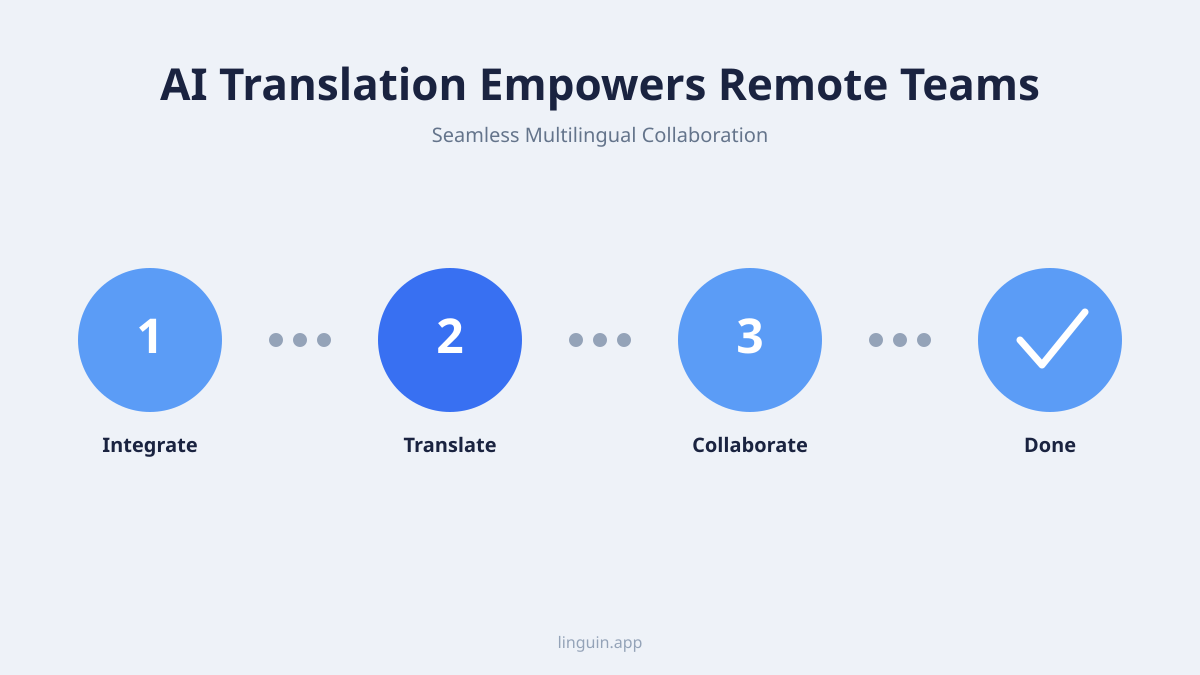
Say you’re messaging a colleague in Japan about a design file. They reply quickly, but the message is in Japanese. Instead of copying the text, opening a separate translation website, pasting it, and then interpreting a potentially clunky result, an integrated AI translation tool can translate the message in-line within your chat app. You read the natural English translation in seconds, reply in English, and your colleague receives your message in clear, natural Japanese. The conversation flows without either party leaving their workflow.
How AI translation tools work for teams
Understanding the mechanics of AI translation helps clarify its value for professional settings. Unlike older rule-based systems that translated word-for-word, contemporary AI models, particularly neural machine translation (NMT) and large language models (LLMs), translate in a more holistic, context-aware manner. They analyze entire sentences and paragraphs to grasp meaning, intent, and even stylistic tone before generating an equivalent in the target language.
For team use, this context-aware translation is critical. Consider the word “run.” In a technical stand-up, “the script will run” refers to execution. In a sales context, “run the numbers” means to calculate. A generic translator might choose the wrong meaning, but a sophisticated AI model considers the surrounding words and the likely domain of the conversation. This ability to understand context drastically improves accuracy for industry-specific jargon, project code names, and technical terminology common in workplace dialogue.
These tools are designed for integration, not isolation. The most effective AI translation for remote teams functions across the applications where work already happens.
- Browser extensions: Translate entire web pages, help articles, or competitor sites in real-time as you browse with tools like the best translation Chrome extension.
- Desktop applications: Offer system-wide translation on macOS, allowing you to translate text in any app, from emails in Outlook to copy in Figma. Explore options in our guide to the best translator app for Mac.
- Mobile apps: Provide on-the-go translation for messages, documents, and even voice conversations during travel or off-site work.
- API integrations: Allow companies to build translation directly into their own internal platforms, wikis, or project management tools.
The process is typically seamless. A user highlights text, clicks an icon, or the translation happens automatically based on preferences. The advanced models powering these tools have been trained on vast corpora of professional and conversational text, enabling them to produce output that sounds natural and is grammatically sound. This eliminates the “translationese”-stilted, awkward phrasing-that can undermine professional credibility and cause confusion. For a deeper dive into how these models achieve accuracy, read about AI translation accuracy.
Core benefits for remote team productivity
Implementing a robust AI translation strategy delivers tangible improvements to a remote team’s output, cohesion, and culture. The primary benefit is the dramatic acceleration of communication cycles. Waiting for translation is a form of workplace latency. When that latency is reduced to near-zero, decisions are made faster, feedback loops tighten, and projects move forward without linguistic pauses.
Asynchronous communication, the lifeblood of remote work, becomes truly global. A team member in a European time zone can write a comprehensive project update before logging off. Colleagues in Asia and the Americas can wake up to that update already translated into their preferred languages, allowing them to contribute immediately. This preserves the deep work focus of asynchronous models while removing the language barrier that often breaks them. Documentation, from HR policies to technical specifications, can be maintained in one source language and made instantly accessible to all, ensuring a single source of truth.
Another significant benefit is the reduction of errors and misunderstandings. Ambiguity in cross-language communication is a major project risk. A subtle misinterpretation of requirements can lead to weeks of work in the wrong direction. AI translation tools, especially those that allow for easy clarification of terms and provide alternative translations, give team members the confidence that they are working from a correct understanding. This builds trust and reduces the need for constant validation, freeing up mental energy for creative problem-solving.
Finally, and perhaps most importantly, it fosters a culture of inclusion. When team members can express themselves in their most comfortable language and be understood, it empowers them to contribute more fully. They are more likely to share ideas, ask questions, and engage in debate. This leads to better outcomes, as diverse perspectives are not lost in translation. It also demonstrates a company’s commitment to its global team, boosting morale and retention. The tool becomes an equalizer, ensuring that talent and insight, not language proficiency, are the primary drivers of influence and contribution.
Implementing AI translation in your workflow
Adopting AI translation is more than just installing an app, it’s about thoughtfully weaving it into your team’s daily habits to maximize its impact. The first step is selecting the right tool. Key considerations include language coverage (does it support all the languages your team uses?), integration capabilities (does it work in Slack, Teams, Chrome, etc.?), and the quality of its context-aware translation for your industry’s specific vocabulary.
Once a tool like Linguin is chosen, successful implementation focuses on onboarding and norms. Introduce the tool as a productivity booster for everyone, not just a crutch for non-native speakers. Offer brief, practical training sessions showing common scenarios: translating a confusing email thread, understanding a foreign-language competitor website, or clarifying a message in a group chat. Encourage team members to set their preferred languages in shared platforms where possible.
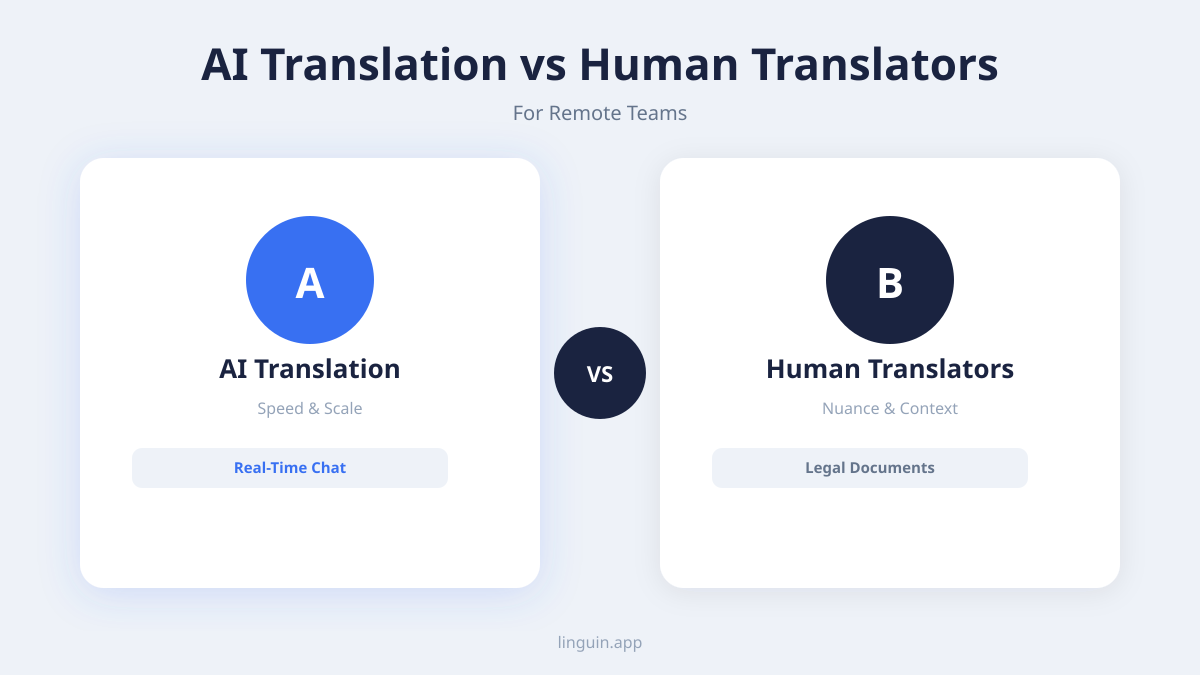
Establishing light-touch guidelines can prevent misuse. For instance, suggest that for very high-stakes external communications (like legal contracts or official press releases), a professional human translator should still be the final step. However, for the vast majority of internal brainstorming, project planning, and daily coordination, AI translation is perfectly suited. Teams should also feel comfortable using the tool to check their own writing before sending it to multilingual colleagues, ensuring clarity.
Consider this scenario: Your product team is analyzing user feedback from a new market in South Korea. The feedback is collected in Korean across various forums and support tickets. Using an AI translation tool with a best PDF translator feature or a browser extension, the team can quickly aggregate and translate these documents. They can then use the tool’s capabilities to identify common themes and sentiment in the translated text, turning a previously opaque data source into actionable insights for the roadmap. This turns a language barrier into a competitive advantage.
The goal is to make translation an invisible, effortless part of the process. When tools are intuitive and integrated, they become a natural part of how the team operates, much like spell check or a calendar invite. This seamless adoption is what unlocks the true productivity gains.
Beyond text: translating meetings and conversations
While text-based communication is a huge part of remote work, real-time spoken interaction remains vital for building rapport, brainstorming, and complex discussions. AI translation technology has evolved powerfully to bridge this gap for live conversations, making multilingual video calls and audio meetings not just possible, but productive.
Modern solutions offer real-time speech-to-text transcription, followed by immediate AI translation of the transcribed text. In a meeting, participants can often see subtitles in their chosen language in near-real-time. Some advanced systems even offer voice translation, where a participant’s speech is translated and spoken aloud in the target language using a synthetic voice that preserves some elements of the original tone. This allows for a more natural turn-taking conversation, even when no shared language exists.
The practical applications are transformative. A weekly all-hands meeting with employees across ten countries can be conducted with live captions, ensuring everyone follows along with leadership updates. A brainstorming session between engineering teams in Berlin and Taipei can proceed fluidly, with ideas flowing freely without a moderator constantly interpreting. It also makes company culture more accessible; virtual social events, training sessions, and onboarding become inclusive to all employees from day one.
For one-on-one or small group conversations, mobile translator apps with voice features are incredibly useful. Imagine a manager in London having a coaching conversation with a direct report in Mexico City. Both can speak in their native language, listening to the translated version through an app, leading to a more authentic and nuanced dialogue than if they were struggling in a second language. This level of understanding strengthens manager-employee relationships across borders. To explore tools built for this, look at options for the best voice translator app.
Implementing this for teams requires reliable software, good audio quality (encouraging the use of headsets), and a brief adjustment period. The result, however, is a team that can leverage the full power of synchronous communication-spontaneity, emotional connection, and rapid ideation-without the traditional constraints of a common language.
Security and privacy considerations
When introducing any new software, especially one that processes sensitive company communications, security is a paramount concern. Teams rightly question what happens to their translated data. Reputable AI translation providers for business use prioritize security through several key mechanisms.
First, look for tools that offer end-to-end encryption for data in transit. This ensures that any text sent from your browser or app to the translation engine is secure from interception. Second, and crucially, understand the provider’s data retention policy. The best services for professional use operate on a “no-log” or immediate deletion policy, where the text sent for translation is not stored permanently on their servers after the translation is delivered. This minimizes data footprint and risk.
For handling highly confidential information-such as unreleased product specs, financial data, or legal discussions-some teams may prefer offline translation capabilities. Certain advanced applications offer offline translation models that run entirely on the user’s device. While these models might be slightly less comprehensive than their cloud-based counterparts, they provide the highest level of privacy, as no data ever leaves the computer or phone. This can be a deciding factor for industries with stringent compliance requirements. You can learn more about this option in our review of the best offline translator app.
Before standardizing a tool, it’s advisable to review its privacy policy and security white papers. Involve your IT or security team in the evaluation process. Questions to ask include: Where are the servers located? Is the provider compliant with relevant frameworks like GDPR or SOC 2? Can translation be enabled or disabled for specific channels containing sensitive information? By choosing a transparent, security-focused provider, teams can gain the benefits of AI translation without compromising on data integrity or confidentiality.
Frequently asked questions
Is AI translation accurate enough for professional business use?
Yes, for the vast majority of internal business communication, modern AI translation is highly accurate. The latest models excel at understanding context and standard professional terminology, producing natural-sounding translations. For mission-critical external documents like legal contracts or official financial reports, a final review by a human professional is still recommended, but AI provides an excellent first draft and is perfectly suited for emails, chats, documentation, and meeting comprehension.
How does AI translation handle slang, idioms, or cultural references?
This is an area where AI has made significant strides. Advanced models are trained on diverse datasets that include colloquial language, allowing them to often translate the intent of an idiom rather than its literal words. For example, it might translate “break a leg” to an equivalent expression of “good luck” in the target language. However, highly niche cultural references can still be challenging. The best practice is to encourage clarity in professional communication, and when using such phrases, be prepared to provide a brief clarification if the translated result seems off.
Can we use AI translation to localize our software or website for international users?
AI translation is an excellent starting point for app localization and website translation, significantly speeding up the initial process. It can quickly produce a first-pass translation of user interfaces, help content, and marketing pages. However, for public-facing products, this output should always be refined by a native speaker or professional localization expert to ensure cultural appropriateness, brand voice consistency, and perfect fluency. AI handles the bulk of the work, while humans provide the final polish.
Will using translation tools discourage team members from learning a common language?
Not necessarily. In fact, it can complement language learning. These tools lower the anxiety of communication, allowing collaboration to happen immediately. As team members are exposed to correctly translated content in another language, they often absorb vocabulary and patterns naturally. The tool removes the pressure and business risk, allowing language learning to become a personal goal rather than a barrier to employment or contribution.
Integrating translation into your team’s foundation
The shift to remote and hybrid work is permanent, and the competition for global talent will only intensify. In this landscape, a team’s ability to communicate seamlessly across languages transitions from a nice-to-have to a core operational competency. AI translation for remote teams provides the practical infrastructure to make this possible, turning language diversity from a challenge into a strategic asset.
The most important points are that these tools enable real-time, inclusive collaboration, drastically reduce the delays and errors caused by misunderstanding, and empower every team member to contribute their best work. They work silently within the apps you already use, from your browser to your messaging platform, making cross-language communication as simple as highlighting text.
The specific next step is to move from theory to a hands-on test. Identify one recurring pain point in your team’s workflow-perhaps it’s understanding multilingual support tickets, or smoothing out a daily stand-up with a mixed-language team. Then, try a capable AI translation tool like Linguin in that specific scenario. Many offer free trials or generous free tiers. Experience firsthand how it feels to remove that one barrier. You may find that what starts as a solution for a single problem quickly becomes an indispensable part of how your connected, global team operates.