 English
  Español
  Français
  Deutsch
  Português
  Italiano
  Русский
  中文(简体)
  日本語
日本語  한국어
한국어  العربية
  हिन्दी
  Nederlands
  Türkçe
  Polski
AI video translate is the process of using artificial intelligence to translate spoken language within video content, either through subtitles, dubbing, or real-time interpretation. It is a powerful tool that makes video accessible to a global audience, breaking down one of the most significant barriers in modern communication: language. This guide will explain how AI video translate works, its key benefits, practical applications, and how you can leverage this technology to connect with a worldwide audience. You will get a comprehensive understanding of the capabilities and considerations involved in translating video with AI.
Key takeaways
- AI video translate combines speech recognition, machine translation, and subtitle generation or voice synthesis to localize video content.
- It enables real-time, conversational translation during live streams, video calls, and meetings, fostering instant cross-border collaboration.
- Effective video translation requires handling not just words, but also cultural context, speaker tone, and visual cues for accurate communication.
How AI video translate technology works
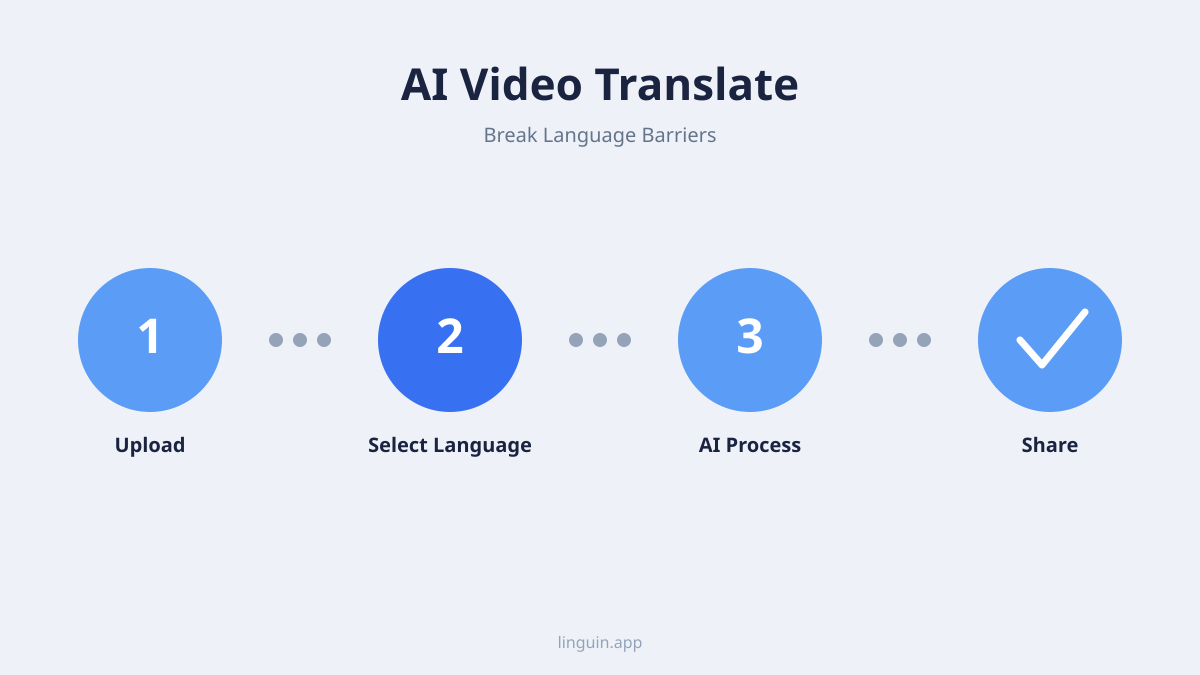
AI video translate is not a single technology but a pipeline of interconnected AI systems working in sequence. The process typically begins with automatic speech recognition (ASR). This is the engine that converts the spoken audio track of a video into a raw text transcript. The accuracy of this first step is critical, as any errors here will be compounded in later stages. Modern ASR systems are trained on vast datasets of human speech and can handle various accents, background noise, and speaking speeds.
Once a transcript is generated, the text is passed to a machine translation (MT) engine. This is where the core language transformation happens. Contemporary AI translation models, particularly large language models (LLMs), go beyond simple word-for-word substitution. They analyze the context of entire sentences and paragraphs to produce translations that sound natural and preserve the original intent. For instance, they can correctly interpret idiomatic expressions or technical jargon based on the surrounding dialogue. The quality of this translation directly impacts whether the final output feels authentic or awkward.
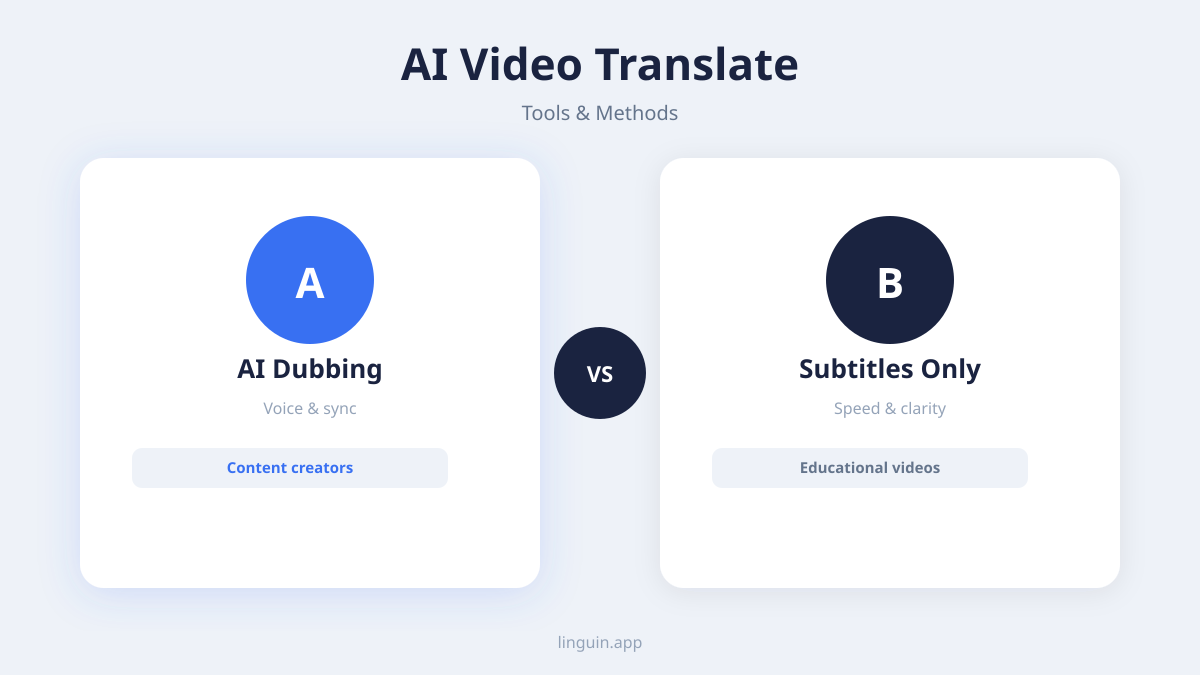
The translated text then needs to be reintegrated with the video. This is done primarily in two ways. The most common method is subtitle generation and synchronization. The AI aligns the translated text with the precise timing of the original speech, creating accurate, readable subtitles that appear on screen. The second, more complex method is AI dubbing or voice cloning. Here, synthetic voice technology generates a new audio track in the target language, matching the original speaker’s tone, pitch, and cadence as closely as possible. This creates a more immersive experience but requires sophisticated technology to avoid the “uncanny valley” effect. Some platforms also offer a hybrid approach with text-to-speech (TTS) narration, which is useful for accessibility or quick turnarounds.
Core benefits of translating video with AI
The primary benefit of AI video translate is democratizing access to information. Educational courses, news broadcasts, corporate training, and entertainment created in one language can become instantly available to a global audience. This breaks down geographic and linguistic silos, allowing knowledge and ideas to flow freely. For creators and businesses, it unlocks new markets without the prohibitive cost and time of traditional human-led localization processes.
Another significant advantage is the enablement of real-time, multilingual conversations. In a live setting, such as an international webinar, a product launch stream, or a cross-border team meeting, AI can provide live captions and translations. This allows participants who speak different languages to engage simultaneously. For example, during a global all-hands meeting, employees in Tokyo, Berlin, and São Paulo can follow along in their native languages, fostering a more inclusive and cohesive company culture. This real-time capability transforms video from a one-way broadcast medium into a two-way conversational platform.
AI translation also brings a level of scalability and speed that manual translation cannot match. Translating and subtitling a one-hour video manually can take days or weeks. AI systems can process the same content in minutes, allowing for rapid content distribution. This is invaluable for time-sensitive materials like news reports, live event coverage, or urgent training updates. Furthermore, AI tools can maintain consistency in terminology across vast video libraries, which is crucial for brands and educational institutions.
Finally, AI video translation enhances accessibility. It provides a foundation for closed captions not only for translation but also for the deaf and hard-of-hearing community. When combined with translation, it makes content accessible to non-native speakers who may also rely on text to fully comprehend spoken dialogue. This dual benefit makes video content more inclusive by design, complying with broader digital accessibility standards and reaching a wider, more diverse viewership.
Practical applications and use cases
The applications for AI video translate are vast and touch nearly every sector that uses video for communication. In the corporate and enterprise world, it is revolutionizing internal and external communications. Multinational companies use it to localize training videos for employees worldwide, ensuring consistent messaging and compliance. External-facing content, such as product demos, investor presentations, and customer testimonials, can be quickly adapted for different regional markets. Say you’re a project manager coordinating with software developers in Poland and UX designers in Mexico. Using an AI-powered translation tool during your daily video stand-up meeting can provide real-time subtitles, keeping everyone aligned and productive without waiting for a human interpreter.
In education and e-learning, the impact is profound. Online course platforms and universities can subtitle lectures and courses in dozens of languages, making high-quality education accessible to students everywhere. This is not limited to formal education. Think of a fitness instructor on YouTube whose workout videos are translated into multiple languages, allowing them to build a global community of followers. Similarly, technical tutorials for software developers, often recorded in English, become usable by millions more learners when accurately subtitled in their native languages.
The media and entertainment industry is a natural fit. Streaming services use AI for the initial translation and subtitle creation of vast catalogs of shows and movies, which are then polished by human editors. This accelerates the global rollout of new content. For content creators on platforms like YouTube, TikTok, or Twitch, AI translation tools empower them to engage with international audiences directly. A gaming streamer, for instance, can have their live commentary translated for viewers in other countries, building a more inclusive fanbase. For more on adapting humor and tone in entertainment, see our guide on AI translation for humor and sarcasm.
Customer support and marketing are also being transformed. Companies can create a single product explainer video and then generate localized versions for different markets, complete with translated voiceovers or subtitles. This ensures brand consistency while resonating locally. In live marketing, such as a global product launch event on social media, real-time translation captions can engage a worldwide audience simultaneously, driving immediate global buzz.
Key challenges and how to address them
While powerful, AI video translation is not without its challenges. The most prominent is accuracy and context handling. AI can struggle with homophones, heavy accents, poor audio quality, or rapid-fire dialogue. More importantly, it may misinterpret cultural references, slang, or industry-specific terminology. A marketing video full of local idioms might translate literally but lose all its persuasive impact. To mitigate this, the best practice is to use AI for the first draft or for real-time understanding, but to employ human-in-the-loop (HITL) review for content intended for permanent publication. Human editors can catch nuanced errors and adapt the translation to fit cultural norms, a process detailed in our article on AI translation for cultural context in marketing.
Another challenge is handling multiple speakers and audio quality. In a video with several people talking over each other or with significant background music, AI speech recognition can fail. The solution lies in pre-processing the audio when possible, using tools to isolate speech, and choosing AI platforms known for robust noise handling. For live translation, a dedicated, high-quality microphone feed for each speaker dramatically improves accuracy.
Synchronization and readability of subtitles present technical hurdles. Text must appear on screen long enough to be read but must also match the pacing of speech. AI systems have become adept at this, but issues can arise with very fast dialogue. Furthermore, the physical placement of subtitles must not obscure important visual elements in the video. Most professional tools allow for manual adjustment of timing and positioning to ensure a seamless viewer experience.
Finally, there is the challenge of voice synthesis for dubbing. Creating a synthetic voice that sounds natural, conveys emotion, and matches the on-screen speaker’s lip movements is incredibly difficult. Current solutions often involve training a voice model on a specific speaker’s clean audio or using a selection of pre-trained, generic voices. For high-stakes projects like movies or flagship corporate videos, this area still benefits significantly from human voice actors, with AI serving as a tool for generating the initial translated script and rough timing cues.
Choosing the right AI video translate tool
Selecting a tool depends heavily on your specific needs. The first consideration is output format. Do you need subtitles (SRT, VTT files), a dubbed audio track, or real-time captions for a live stream? Some tools specialize in one area, while others offer a full suite. For instance, a YouTube creator might prioritize automatic subtitle generation and translation, while a corporate team might need a solution that integrates with Zoom or Microsoft Teams for live meeting translation.
Evaluate the language coverage and translation quality. A tool might support 100 languages, but the quality can vary dramatically between common language pairs (like English to Spanish) and less common ones. Look for tools that use modern, context-aware AI models, as they handle nuance better. It’s wise to test the tool with a sample of your specific content, especially if it contains technical terms or casual speech. You can learn more about evaluating quality in our primer on AI translation accuracy.
Integration and workflow are critical for efficiency. Does the tool fit into your existing video production pipeline? Some are standalone web applications where you upload a video, others are desktop software, and others are APIs or SDKs for developers to build into custom applications. For frequent use, features like batch processing, project management, and collaborative review interfaces can save immense time. If your work involves managing multilingual social media content, a tool that connects with your publishing platform can be a game-changer.
Consider cost and scalability. Pricing models vary: pay-per-minute of video processed, monthly subscriptions with minute limits, or enterprise licenses. Calculate your expected monthly volume to find the most economical model. Also, assess the tool’s speed; if you process hours of video daily, a faster, potentially more expensive engine might be cost-effective in terms of productivity gained. For large-scale projects like localizing an e-learning platform, an API-driven solution that automates the entire pipeline is often the best choice.
Best practices for effective AI video translation
To achieve the best results, start with the source material. High-quality, clean audio is the single most important factor for accurate transcription and translation. Use a good microphone, record in a quiet environment, and encourage speakers to articulate clearly. If you’re working with existing video, use audio enhancement software to reduce background noise before sending it to the translation AI. This upfront investment dramatically improves the entire pipeline’s output.
Always review and edit the AI’s output. Treat AI as a highly skilled first draft writer. A human reviewer should check the translated subtitles or script for errors in translation, context, and timing. This is especially important for content meant for public consumption, branding, or legal compliance. The review should focus on natural flow, cultural appropriateness, and technical accuracy. For insights into handling informal language, our article on AI translation for informal grammar and slang offers valuable guidance.
Respect cultural localization. Translation is more than words. Visual elements, colors, gestures shown in the video, and even examples used in the dialogue may need adaptation for different cultures. The AI might translate the text correctly, but a human must assess if the overall message is culturally suitable. This might involve changing images or examples in the video itself, which goes beyond simple translation into full localization.
For subtitles, adhere to readability standards. Keep lines short (typically 35-40 characters), use a clear, high-contrast font, and ensure subtitles are on screen long enough to be read comfortably (usually 1-2 seconds per line). Avoid obscuring faces or key on-screen text. For dubbed content, ensure the new voice track’s emotional tone matches the original performance as closely as possible, even if the exact words differ slightly to achieve natural-sounding dialogue.
ai video translate FAQ
Can AI video translate handle specialized vocabulary, like medical or legal terms?
Yes, but with caveats. Many advanced AI translation platforms allow for custom glossaries or terminology databases. You can upload a list of preferred terms and their translations (e.g., specific product names, medical jargon, legal phrases), and the AI will prioritize using them. However, for highly specialized content, the initial translation should always be reviewed by a subject matter expert to ensure absolute precision, as context is critical in technical fields.
Is real-time AI video translation accurate enough for important business meetings?
Real-time translation has improved significantly and is suitable for facilitating understanding in live meetings, video calls, and streams. It allows participants to follow the conversation’s gist and contribute in their own language. However, for situations where contractual details or precise negotiations are discussed, it should be used as an aid alongside a professional human interpreter or followed by a review of meeting minutes. The technology excels at enabling communication, not replacing high-stakes, nuanced human interpretation.
What is the difference between AI subtitling and AI dubbing?
AI subtitling generates translated text that appears on screen, leaving the original audio intact. It is less invasive, faster to produce, and preserves the original speakers’ voices. AI dubbing replaces the original spoken audio with a synthetic voice speaking the target language. Dubbing is more immersive for the viewer but is technically more complex, requiring high-quality voice synthesis and careful audio alignment, and can sometimes feel less natural than subtitles.
How long does it take to translate a one-hour video with AI?
The processing time varies by tool, audio quality, and language pair, but it is remarkably fast compared to manual work. A cloud-based AI service can typically transcribe, translate, and generate subtitles for a one-hour video in under 10 minutes. The more time-consuming part is the essential human review and editing phase, which can take an additional few hours to ensure a polished, accurate final product.
Integrating AI video translate into your workflow
Adopting AI video translation effectively requires a strategic approach. Start by identifying the pain points in your current workflow. Is it the speed of localizing training content? The cost of live interpreters for global team calls? The inaccessibility of your video library to international audiences? Pinpointing the specific problem will guide you to the right type of tool, whether it’s for batch processing archived videos or for real-time communication.
The next step is to pilot the technology. Choose a non-critical project, such as an internal team meeting or a past webinar, and run it through an AI video translation process. Evaluate the output for accuracy, ease of use, and time saved. This hands-on test will reveal the tool’s strengths and the level of human post-editing required for your content. It also helps build internal confidence and establishes a baseline for quality expectations.
Finally, make it a seamless part of your process. For content creators, this might mean adding a “translate and subtitle” step right after video editing. For global teams, it could involve standardizing the use of a translation-enabled video conferencing tool for all cross-regional meetings. The goal is to make multilingual communication the default, not the exception. Tools like Linguin, which work across macOS, iOS, and as browser extensions, can fit into various digital environments, providing translation support wherever you work with text or conversations, forming a complementary layer to dedicated video translation services. By understanding the capabilities, challenges, and best practices outlined here, you are equipped to break down language barriers and connect with a truly global audience through video.