 English
 Español
 Français
 Deutsch
 Português
 Italiano
 Русский
 中文(简体)
 日本語
 한국어
 العربية
 हिन्दी
 Nederlands
 Türkçe
 Polski
Translating Latin to English is a common task for students, historians, and curious minds. While Latin is a foundational language, its complex grammar and ancient context make accurate translation a unique challenge. This guide explores the modern tools and methods for Latin to English translation, from AI-powered apps to professional human services. You will learn how to choose the right approach for your needs, whether you are deciphering a quote, studying a text, or working with historical documents.
Key takeaways
- AI translation tools offer fast, accessible Latin translation but may struggle with complex grammar and historical context.
- Professional human translation services provide high accuracy for critical documents but come at a higher cost and slower speed.
- The best approach combines technology for initial understanding with careful review of grammar, vocabulary, and cultural references.
The unique challenges of Latin translation
Latin presents specific obstacles that distinguish it from translating modern languages. Its status as a classical language means there are no native speakers to consult for contemporary usage. The language also features a highly inflected grammar system. This means the function of a word in a sentence is determined by its ending, not its position. A single Latin noun can have up to ten different forms depending on its case, number, and gender. Verbs are equally complex, with a wide array of tenses, moods, and voices. This inflectional richness allows for a flexible word order that can be confusing for direct, word-for-word translation.
Beyond grammar, vocabulary presents another layer of difficulty. Many Latin words have multiple possible meanings depending on the context. The word res, for instance, can be translated as “thing,” “matter,” “affair,” “property,” or “situation.” Choosing the correct English equivalent requires understanding the broader passage. Furthermore, Latin literature is filled with cultural and historical references to mythology, Roman law, and political institutions that may not have direct parallels today. A translator must decide whether to translate these concepts literally, find a modern analogy, or add an explanatory note.
The age of Latin texts introduces issues of textual criticism. Manuscripts often have variations, abbreviations, or damage that must be interpreted. Translators sometimes work not from a perfect original, but from a reconstructed text based on the best available copies. This scholarly dimension is absent from most modern language translation. For a student trying to understand Cicero or a researcher analyzing a medieval church document, these factors make Latin to English translation a task that often requires more than a simple dictionary lookup.
Modern translation methods: AI, human, and hybrid
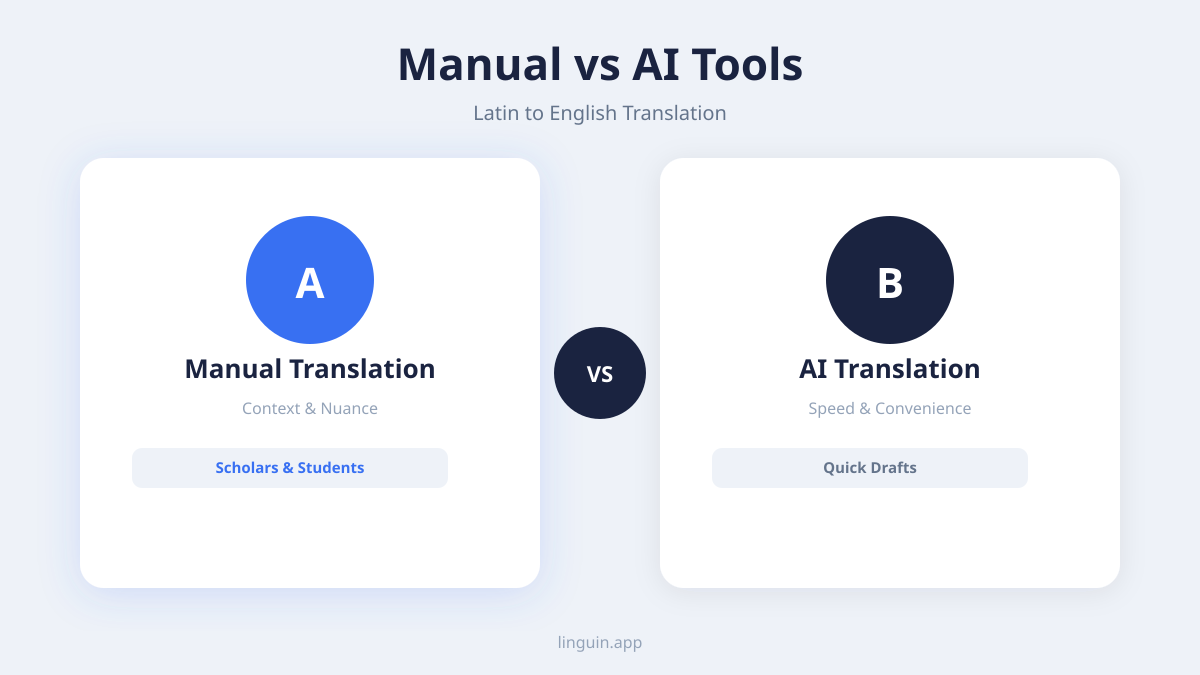
Today, you have several options for handling Latin to English translation, each with distinct advantages and trade-offs. The rise of AI-powered translation has brought instant, often free tools to everyone’s fingertips. These systems use neural networks trained on large corpora of text, including parallel texts of Latin and English works. They can provide a good general sense of a passage quickly, which is useful for getting the gist of a text or translating short phrases. However, their training data is limited to existing translations, which may not cover every obscure text or perfectly capture nuanced grammatical constructions.
Professional human translation services remain the gold standard for accuracy, especially for publishing, legal documents, or academic research. A skilled translator brings an understanding of Latin’s grammatical subtleties, historical context, and stylistic conventions. They can make informed decisions about ambiguous vocabulary and structure the English output to read naturally. This expertise comes at a cost. For example, according to Tomedes, a professional translation service charges about $0.15 per word for Latin to English translation, with a standard 250-word page costing about $38. The process also takes significantly longer than an automated translation.
A practical middle ground is a hybrid approach. This involves using an AI tool to generate a preliminary draft, which is then carefully reviewed and edited by someone with knowledge of Latin. This person corrects grammatical errors, refines word choices, and clarifies ambiguous passages. This method leverages the speed of technology while ensuring the final output meets a high standard of accuracy. It is an efficient strategy for students reviewing texts, editors working with translated content, or professionals who need a reliable draft to build upon. The key is to never treat the AI output as final, but as a starting point for human refinement.
Evaluating AI translation tools for Latin
When choosing an AI tool for Latin to English translation, it is important to look beyond basic availability and consider factors like context handling, limits, and special features. Most major platforms like Google Translate include Latin, but their capabilities vary. For instance, according to 9to5Google, Google Translate added a new AI-powered ‘Live translate’ feature for real-time conversation translation, rolling out in August 2025. While this is designed for spoken languages, it indicates a shift towards more context-aware AI models that could benefit written Latin translation over time.
Free tools often come with usage limits that are important to know. According to Merlin AI, its free Latin to English translation tool has a daily limit of 102 translation requests and a per-request limit of 10,000 characters. For translating longer texts like chapters or documents, these limits can be a constraint. Other platforms operate on credit systems. According to Transept, its free plan includes 2,500 credits per month for translation tasks, as of an update in October 2026.
Some tools are built for specific translation tasks. According to the same Transept changelog, the service added support for EPUB book translation, including importing .epub files and exporting translated EPUBs with original formatting preserved, in October 2026. This is particularly useful for scholars or enthusiasts working with digital Latin texts. Conversely, some platforms have notable gaps. According to BookTranslator.ai, Kindle Translate does not support Latin translation, as it only covers five language pairs: English to and from Spanish, French, German, Italian, and Portuguese.
When testing a tool, try translating a known complex sentence. A good indicator of quality is how the tool handles subordinate clauses, ablative absolutes, and indirect discourse. Does it produce coherent English syntax, or a confusing jumble of words? Also, check if the tool allows you to see alternative translations for a word or phrase, which can help you understand its reasoning and choose the best option.
Best practices for accurate and meaningful translation
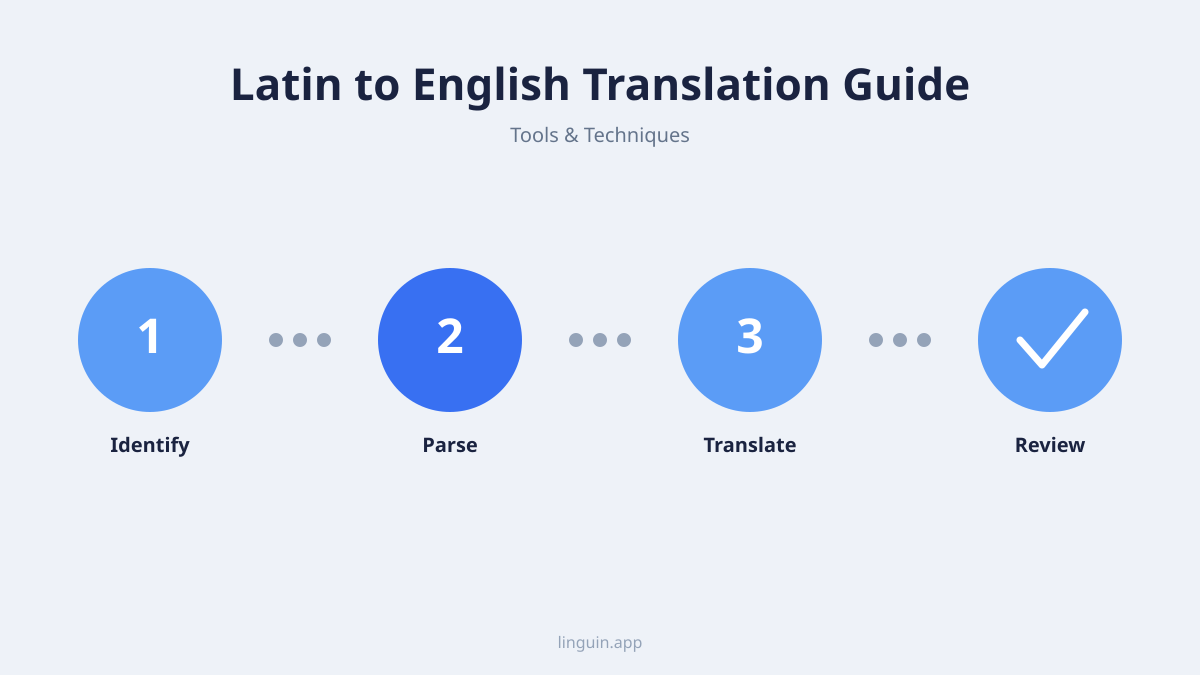
Achieving a good translation from Latin to English is a step-by-step process. Start with a clear understanding of the sentence structure. Identify the main verb and its subject first. Then, locate direct objects, indirect objects, and prepositional phrases. Diagramming a complex sentence can be very helpful. Pay close attention to agreement: adjectives must agree with their nouns in case, number, and gender, and verbs must agree with their subjects in number and person. These agreements are your guideposts through the text.
Next, build your vocabulary understanding with reliable resources. Use a comprehensive Latin dictionary, not just a simple word list. For important terms, consult a lexicon that provides detailed definitions and examples of usage from classical literature. Remember that context is everything. The meaning of capere in a military text (“to capture”) differs from its meaning in a philosophical text (“to comprehend”). Be wary of false friends, or words that look like English words but have different meanings. The Latin virtus means “manliness, courage, excellence,” not quite the modern “virtue.”
The final step is crafting readable English. A literal, word-for-word translation from Latin often results in awkward, confusing English. Your goal is to convey the meaning, tone, and style of the original in natural modern English. This may involve changing the word order, breaking up a long periodic sentence into shorter ones, or finding an English idiom that matches the sense of a Latin phrase. For poetic texts, you must also consider meter and rhetorical devices. The translation should sound like a coherent piece of English writing, not a decoded cipher. For more on handling specific tones and styles, see our guide on AI translation for formal and informal emails.
Common use cases and scenarios
Latin translation is not just for academia. It serves a variety of practical and personal purposes. Consider a graduate student working on a thesis about Roman engineering. They need to translate passages from Vitruvius’s De Architectura. Using an AI tool, they quickly get a draft of several pages. However, the technical terminology for architectural elements and mechanical devices is sometimes mistranslated. The student uses the draft to understand the overall argument but cross-references each technical term with a specialized lexicon and confirms the translation of complex descriptive passages against existing scholarly translations. This hybrid approach saves time while ensuring academic rigor.
Another scenario involves a genealogist researching family history in medieval church records. These documents are often written in abbreviated Latin. The genealogist uses a translation app on their phone to get the gist of baptismal or marriage entries. However, the app struggles with the archaic abbreviations and the formulaic legal language. The genealogist then joins a specialized forum or consults a paleography guide to decipher the abbreviations and understand the standard phrasing of such documents. The AI output provides a crucial starting framework, which expert community knowledge then completes.
For a novelist writing historical fiction set in ancient Rome, translation needs are different. They might use a tool to translate everyday Latin phrases they want characters to say, or to understand the nuances of Latin curses, greetings, or military commands. Accuracy is important for authenticity, but the primary goal is creative inspiration and plausible dialogue. The writer might use the tool to explore different ways a Latin sentiment could be expressed in English, choosing the version that best fits their character’s voice. Exploring how AI handles cultural nuances and idioms can be particularly useful in this creative context.
Cost and accessibility of translation services
The financial and practical accessibility of Latin translation services spans a wide spectrum. At one end, free AI tools and browser extensions provide immediate access at no cost, subject to the usage limits discussed earlier. These are ideal for casual queries, students doing homework, or quick checks. For more sustained use, subscription-based AI services offer higher limits and sometimes advanced features. According to BookTranslator.ai, its Guest plan for Latin translation starts at $1.99, supporting up to 300,000 words per task. Their Pro Plan costs $8 per month or $96 per year and includes 50,000 credits per month for high-volume Latin translation.
For professional, publication-ready results, human translation is the primary option. The cost is proportional to the text’s complexity and the translator’s expertise. Legal documents, poetic works, or highly technical manuscripts will command higher rates than straightforward prose. The per-word rate from a service like Tomedes reflects the specialist skill required. When budgeting for a human translator, also factor in the time required. A careful, scholarly translation cannot be rushed, so projects may take days or weeks depending on length.
Accessibility is not just about price. It is also about the format of the source material and the desired output. Can the service handle a scanned PDF of an old book, or does it require plain text? Does it preserve the formatting of a complex document with footnotes and columns? The recent addition of EPUB support in tools like Transept highlights a move towards accommodating the formats users actually work with. For those integrating translation into a workflow, such as multilingual software development or academic collaboration, API access and batch processing capabilities become key accessibility factors.
Questions people ask
Is Google Translate accurate for Latin?
Google Translate can provide a basic understanding of Latin text, but its accuracy is inconsistent. It works reasonably well for simple, declarative sentences and common phrases. For complex sentences with subordinate clauses, poetic language, or specialized vocabulary, it often produces confusing or incorrect translations. It should be used as a preliminary guide, not a definitive source, especially for academic or formal purposes.
Can AI translate entire Latin books?
Yes, several AI tools are capable of translating long texts, including entire books. Services like BookTranslator.ai are designed for this specific task. However, the quality of a raw, unedited AI translation of a full book will likely contain errors in grammar, word choice, and nuance. For a publishable or scholarly result, AI-generated book translations require extensive human editing and proofreading by someone proficient in Latin.
What is the best free Latin translator online?
The “best” free translator depends on your need. For quick phrase translation, Google Translate or Merlin AI are readily accessible. For longer texts with higher character limits, a tool like Transept’s free plan may be more suitable. The best approach is to test a few with a sample of your text to see which produces the most coherent and accurate output for your specific content.
How do I translate Latin legal documents?
Legal documents require the highest degree of accuracy. While an AI tool can give you a general idea of the content, you should always consult a professional translator who specializes in legal Latin. They will understand the formulaic language, standard abbreviations, and legal concepts. Mistakes in translating wills, deeds, or contracts can have serious consequences, making professional service essential here.
Bringing clarity to classical texts
Translating Latin to English bridges a gap of centuries, connecting modern readers with the language of law, science, literature, and philosophy for over a millennium. The process demands respect for the source material’s grammatical complexity and historical context. While AI tools offer unprecedented speed and accessibility for initial exploration, their output must be approached with a critical eye. For important or nuanced work, the expertise of a human translator or a careful hybrid review process remains invaluable.
The most effective strategy is to match the tool to the task. Use instant apps for curiosity and quick checks, leverage specialized AI for bulk text processing, and invest in professional services for formal publications and critical documents. By understanding the strengths and limits of each method, you can unlock the meaning of Latin texts with greater confidence and accuracy. To experience AI-powered translation that integrates directly into your browser for quick Latin look-ups, you can try the Linguin Chrome extension.