 English
 Español
 Français
 Deutsch
 Português
 Italiano
 Русский
 中文(简体)
 日本語
 한국어
 العربية
 हिन्दी
 Nederlands
 Türkçe
 Polski
An Old English translator bridges the gap between the language of the Anglo-Saxons and modern English. These tools, powered by advanced AI, can now handle the complex grammar and vocabulary of this historical language. Whether you are a student decoding a line of Beowulf, a writer seeking authentic historical dialogue, or a curious mind exploring linguistic roots, understanding these translators is key. This guide will explain how Old English translation works, evaluate the best current tools, and show you how to apply them effectively in your projects.
Key takeaways
- Modern AI models have shown significant competence in translating Old English, achieving high scores in morphological and lexical accuracy.
- Specialized online tools offer features like interactive dictionaries, AI analysis for missing words, and translation into historical language variants.
- Effective translation requires understanding Old English’s grammatical structure and using tools as aids alongside traditional scholarly resources.
What is Old English and why translate it?
Old English, also called Anglo-Saxon, was spoken in England from roughly 450 to 1150 AD. It is the earliest recorded form of the English language and is fundamentally different from the English we speak today. Its vocabulary is heavily Germanic, with Latin influences from Christian missionaries. The grammar is complex, featuring a system of cases (nominative, accusative, genitive, dative, instrumental), grammatical gender, and numerous verb inflections. Recognizing these differences is the first step in any translation effort.
People seek to translate Old English for various reasons. Academic scholars and students work with primary source texts like the Anglo-Saxon Chronicle, epic poems such as Beowulf, and religious works. Writers and creators might want to incorporate authentic Old English phrases into historical fiction, games, or media to add depth. Genealogists occasionally encounter Old English terms in ancient documents. Even casual language enthusiasts are drawn to it to understand the roots of modern English words and phrases.
The core challenge in translation is not merely substituting words. Old English syntax, word order, and idiomatic expressions do not map directly onto modern English. A word-for-word translation often results in nonsense. Effective translation requires interpreting meaning within its historical and cultural context. This is where the nuance of human expertise has traditionally been essential, but AI is now providing powerful assistance.
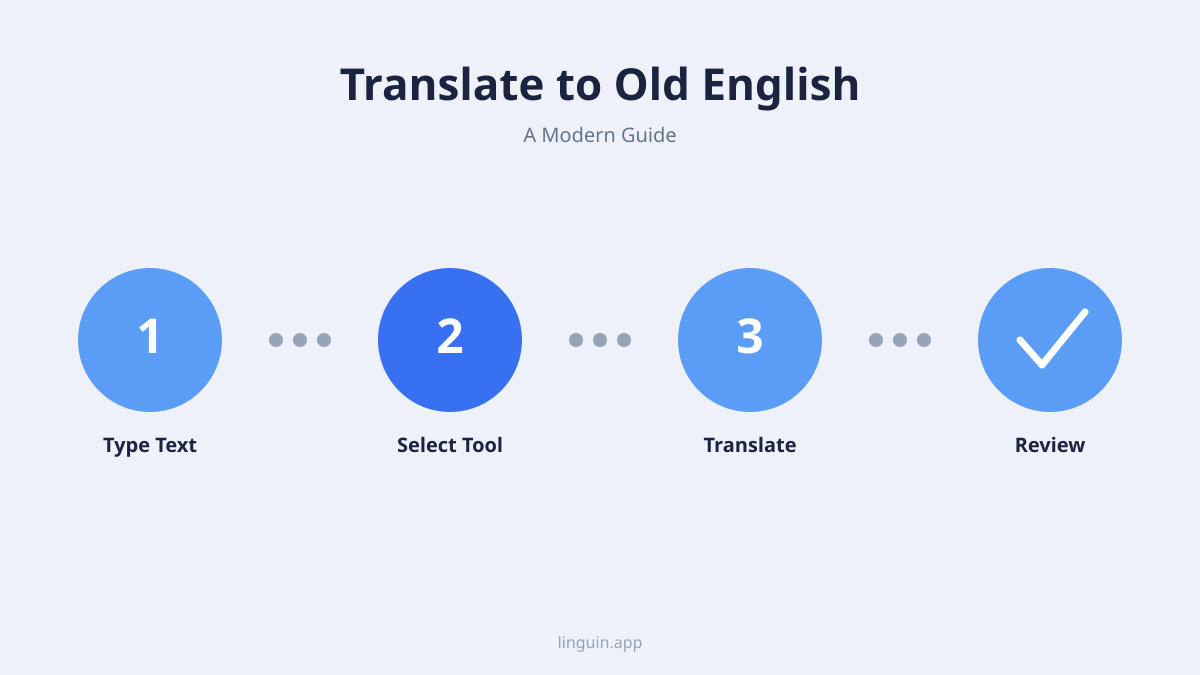
How AI is transforming Old English translation
Artificial intelligence has changed translation for modern languages, and its impact is now being felt in historical linguistics. Unlike simple dictionary lookup tools, modern AI models are trained on vast corpora of text, allowing them to grasp context, grammar, and style. For Old English, this means AI can learn from available digitized manuscripts and parallel texts (where Old English and modern translations are aligned).
A human evaluation study published in June 2026 found that GPT-4 demonstrates remarkable competence in translating Old English, particularly in morphological and lexical accuracy. This indicates that general-purpose large language models can handle the language’s complex word forms and vocabulary. Furthermore, specialized systems are being developed. According to a report in the International Journal of Humanities and Arts Computing, a specialized AI pipeline for Old English, using character-level processing and custom word embeddings, achieved a test LAS (Labeled Attachment Score) of 79.65% for dependency parsing on a 25,000-word dataset. This shows targeted AI can parse grammatical relationships within sentences effectively.
These AI tools work by analyzing the input text, identifying known words and their forms, and predicting the structure and meaning of unfamiliar phrases. They can suggest plausible translations for fragmentary text or words not in their primary dictionary. For example, if you input a modern English sentence you wish to render in Old English, the AI uses its understanding of Old English grammar and vocabulary to construct a plausible period-appropriate translation, not just a word swap. This capability is invaluable for creating new content in Old English, a task nearly impossible with older rule-based systems.
A look at modern Old English translator tools
Several dedicated online platforms now offer Old English translation services, moving beyond academic projects into accessible web tools. Each has a slightly different focus and feature set.
One prominent example is the AI Old English Translator tool. According to Old English Translator, it offers a free tier that includes AI translation for 1,000 words, interactive click-to-define, unlimited dictionary lookups, and AI analysis for missing words. For higher volume needs, the same source notes a Pro plan for $9.9 per month, which includes AI translation for 100,000 words per month and priority support. This tool exemplifies the freemium model common in this space.
Another approach is taken by the Saxon English Translator. According to Saxon English Translator, this tool uses a configured DeepSeek model to translate modern English into historical English variants, providing a translation, practical notes, and a compact glossary. This is useful for those who want to generate historical language rather than decipher it.
For translating entire documents, some tools offer integrated solutions. According to DocuGlot, their tool for Old English translation offers a freemium + premium pricing model and is noted for high accuracy and native document preservation. This highlights a need for handling file formats like PDFs or Word documents without losing formatting.
These tools often have community or project origins. The Old English Translator project, accessible at oldenglishtranslator.app, was featured in a launch story on EarlyHunt in July 2026, highlighting its AI-driven approach. Similarly, the Translator Old English platform, operated by Old English Language Tools LLC, was started in 2023 as a project to make Shakespearean, medieval, and Anglo-Saxon English easy to translate, according to Translator Old English.
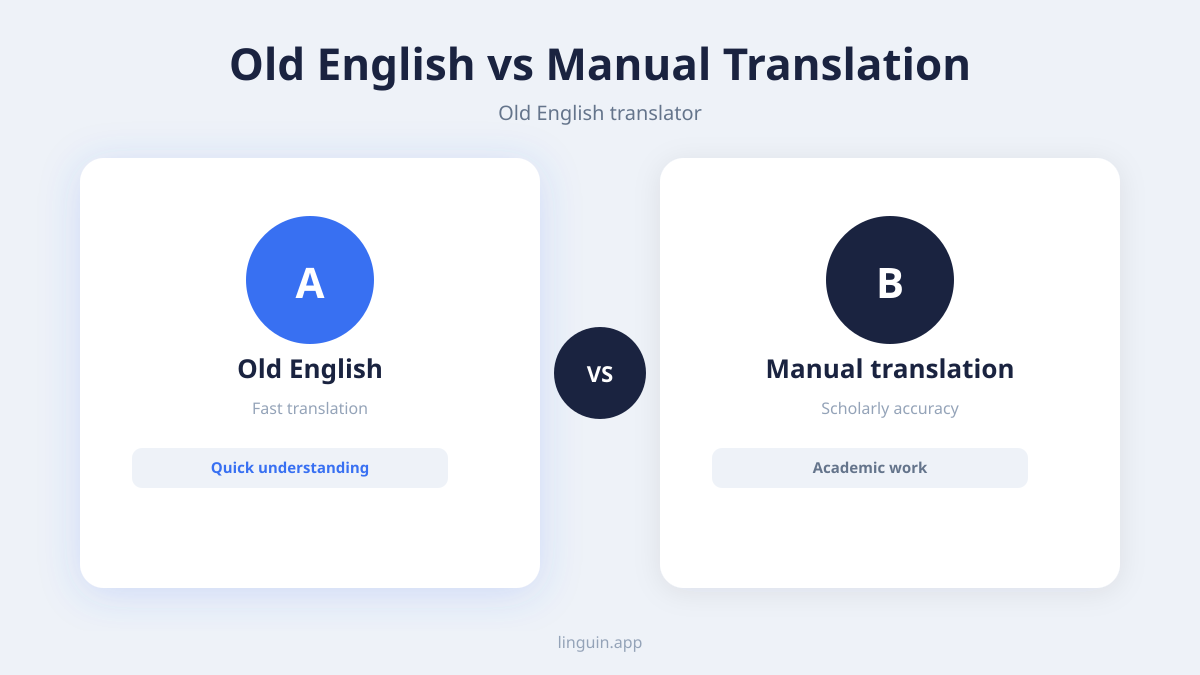
Practical use cases and scenarios
Understanding the theory is one thing, but applying an Old English translator to real tasks shows its true value. Here are concrete scenarios where these tools provide practical help.
Scenario 1: A literature student analyzing Beowulf.
A student encounters the line: “Hwæt! We Gardena in geardagum…” A basic dictionary might translate “Hwæt” as “what,” but that misses the poetic function. Using an AI-powered translator, the student inputs the line. The tool provides a contextual translation like “Listen! We of the Spear-Danes in days of yore…” and allows the student to click on “Gardena” to see a glossary entry explaining it as a genitive plural form of “Gar-Dene” (Spear-Danes). The AI’s ability to handle case endings and compound words accelerates comprehension, letting the student focus on thematic analysis rather than getting bogged down in every grammatical detail.
Scenario 2: A novelist writing historical fiction.
An author is crafting a scene set in a 10th-century English village and wants a character to utter a believable Old English oath. Instead of guessing or using an anachronistic phrase, the author uses a tool like the Saxon English Translator. They input the modern English phrase “By God’s bones!” The tool generates a plausible Old English equivalent, perhaps “Þurh Godes ban!” along with notes on usage and a glossary of the terms. This provides a layer of authenticity that enhances the reader’s immersion without requiring the author to become a linguistics expert.
Other common use cases include:
- Genealogy: Deciphering occupations, relationships, or locations in pre-1066 parish records written in Old English.
- Linguistic research: Tracking the evolution of specific words or grammatical constructions from Old to Modern English.
- Content creation: Generating unique Old English inscriptions for artwork, film props, or thematic social media content.
- Education: Teachers creating accessible exercises or translations for students beginning to learn the language.
For translating other historical documents, you might find our guide on how to translate a birth certificate to English helpful for managing different formal structures.
Key features to look for in a translation tool
With several options available, knowing which features matter will help you choose the right Old English translator for your needs. The best tools offer more than a simple text box.
Translation direction and context. A fundamental feature is bidirectional translation: Modern English to Old English, and Old English to Modern English. Some tools specialize in one direction. More advanced tools provide context-aware translation, where the AI considers the surrounding sentences to choose the correct meaning of ambiguous words. This is crucial for dealing with Old English words that have multiple modern equivalents.
Interactive dictionaries and parsing. Look for tools with integrated, clickable dictionaries. When you click a word in the translated text or input, a pane should show its dictionary form (lemma), part of speech, case, gender, and definition. Some tools even provide a full morphological parse, breaking down the grammatical components of a word. This educational feature is invaluable for learners.
Document and format support. If you need to work with scans of manuscripts or existing digital documents, check if the tool supports file uploads. According to DocuGlot, their tool emphasizes native document preservation, which is key for maintaining the layout of complex texts. The ability to handle PDFs, images with OCR (Optical Character Recognition), or standard document formats saves significant time.
AI explanation and analysis. Premium tools often include AI that explains its translations. If a word is missing from the lexicon, the AI might suggest a probable meaning based on root words and context. Some tools, like the one noted by Old English Translator, include “AI analysis for missing words” as a core feature. This transforms the tool from a passive dictionary into an active research assistant.
When evaluating any translation tool, consider its core purpose. For robust, multi-language AI translation that includes modern languages, you might explore a dedicated platform like Linguin. For insights on how AI translators compare to traditional ones, our analysis of Google Translate vs AI translator provides a useful framework that applies to historical language tools as well.
Limitations and the role of human expertise
While AI Old English translators are powerful, they are not infallible. Recognizing their limitations prevents overreliance and ensures accurate results, especially for serious academic or publication work.
The primary limitation is training data scarcity. Compared to modern languages with trillions of words of digital text, the corpus of extant Old English is small, estimated at around three million words. This means AI models have less material to learn from, which can affect their ability to handle rare words or unique poetic constructions. They may generate plausible-sounding but incorrect translations for obscure passages.
Another issue is the handling of ambiguity and poetic language. Old English poetry, in particular, uses kennings (metaphorical compound phrases like “whale-road” for sea) and flexible syntax for metrical purposes. An AI might translate a kenning literally, missing the metaphor, or struggle with the scrambled word order common in verse. It often lacks the deep cultural and historical context a human scholar uses to interpret meaning.
Furthermore, these tools can sometimes produce anachronistic or invented forms. When generating Old English from modern English, an AI might create a word that follows correct grammatical rules but is not attested in any historical source. For a novelist, this might be acceptable; for a scholar, it is a problem.
Therefore, the best practice is to use AI translators as a powerful aid, not an authority. Use them to get a rough draft, parse difficult grammar, or look up words quickly. Then, verify the output against established scholarly translations, consult academic dictionaries like the Dictionary of Old English, or seek review from a human expert. The tool accelerates the process, but the final interpretation, especially for nuanced or high-stakes work, requires human judgment. This principle of human-in-the-loop translation is key for quality, much like when choosing the best translator app for Mac for professional work.
FAQ
Can AI accurately translate Old English?
AI can provide highly accurate translations for many Old English texts, especially in terms of grammar and vocabulary. A 2026 study confirmed GPT-4’s competence in morphological and lexical accuracy. However, accuracy drops with poetic, ambiguous, or fragmentary text. AI is best used as a first pass or an aid, with important results checked against scholarly resources.
What is the best free Old English translator online?
Several tools offer robust free tiers. According to Old English Translator, their free plan includes AI translation for 1,000 words, an interactive dictionary, and word analysis. The “best” tool depends on your need: for learning, choose one with detailed parsing; for document translation, pick one that supports file uploads. Trying a few to compare results is recommended.
How is translating to Old English different from translating from it?
Translating modern English into Old English is often more challenging. It requires the AI to not only know the vocabulary but also correctly apply the complex case system, verb conjugations, and archaic syntax. Tools that specialize in this, like the Saxon English Translator, use models configured for this generative task. The output should always be considered a reconstruction, not a historically attested phrase.
Can I use these tools for academic research?
Yes, but with caution. AI translators are excellent for initial transcription, vocabulary lookup, and parsing sentence structure, which can speed up research. However, any translation used in formal academic work must be verified and cited with the same rigor as a human translation. Do not present AI output as definitive without critical evaluation and cross-referencing with standard editions.
Bringing historical language into your workflow
Old English translation has moved from a niche academic skill to an accessible task thanks to AI-powered tools. These platforms can parse complex grammar, provide interactive dictionaries, and even generate historical language for creative projects. The key is to understand both their capabilities and their limitations, using them as intelligent assistants rather than oracles. Whether you are deciphering a single word or an entire manuscript, the combination of modern AI and traditional scholarly methods yields the best results.
For those who work with multiple languages, both ancient and modern, having a reliable translation tool integrated into your daily workflow is essential. Linguin provides AI-powered translation across 100+ languages directly on your macOS, iOS, and browser, focusing on context-aware, natural-sounding output. If you regularly switch between research, writing, and communication in different languages, consider Linguin for Mac to handle your modern translation needs efficiently, leaving you more time to delve into the past.