 English
  Español
  Français
  Deutsch
  Português
  Italiano
  Русский
  中文(简体)
  日本語
日本語  한국어
한국어  العربية
  हिन्दी
  Nederlands
  Türkçe
  Polski
To translate a birth certificate to English, you need a certified translation that meets specific legal standards. This is a mandatory step for submitting documents to U.S. authorities like USCIS, for passport applications, and for many academic and professional purposes. This guide explains the entire process, from understanding official requirements to choosing a translation service, ensuring your document is accepted without delay.
Key takeaways
- A certified translation with a signed statement of accuracy is required for U.S. immigration and most legal processes.
- Professional services offer certified translations with guarantees of acceptance, while AI tools are best for personal understanding.
- Costs vary widely, from around $20 to $30 per page, with turnaround times from minutes to several business days.
- The translation must be a complete, literal translation of all text, stamps, and seals on the original document.
- Keeping the original document’s format and preparing a clear scan are crucial first steps for any translation method.
What is a certified translation?
A certified translation is a translated document accompanied by a signed statement from the translator or translation company. This statement certifies that the translation is a complete and accurate representation of the original document. This is not a notarization, which involves a notary public verifying the translator’s identity. The certification itself is the critical component for official acceptance.
For U.S. Citizenship and Immigration Services (USCIS) and most government agencies, the certification must include specific language. It typically states that the translator is competent in both languages and that the translation is true and accurate to the best of the translator’s knowledge and ability. The certification includes the translator’s signature, printed name, date, and contact information. USCIS requires a complete English translation and a certification from the translator stating the translation is complete and accurate for foreign-language documents.
Certified vs. notarized translation People often confuse these terms. A certified translation is certified by the translator’s statement of accuracy. A notarized translation is one where the translator signs their certification statement in front of a notary public, who then stamps it. The notary verifies the translator’s identity, not the quality of the translation. Some agencies, like certain U.S. courts or foreign governments, may require notarization. However, for USCIS, a standard certification is almost always sufficient. It is vital to check the specific requirements of the organization requesting the translation.
When is it absolutely required? You will need a certified English translation of a birth certificate for several key scenarios:
- Submitting applications to USCIS for visas, green cards, or citizenship.
- Applying for or renewing a U.S. passport with a foreign-born parent.
- Enrolling in a U.S. school or university with foreign academic records.
- Completing legal processes like marriage, adoption, or estate settlement involving foreign documents.
- Meeting employment verification requirements for certain professional licenses.
For personal use, such as understanding the contents of a family heirloom document, a simple translation may be enough. But for any official or legal proceeding, assume a certified translation is necessary.
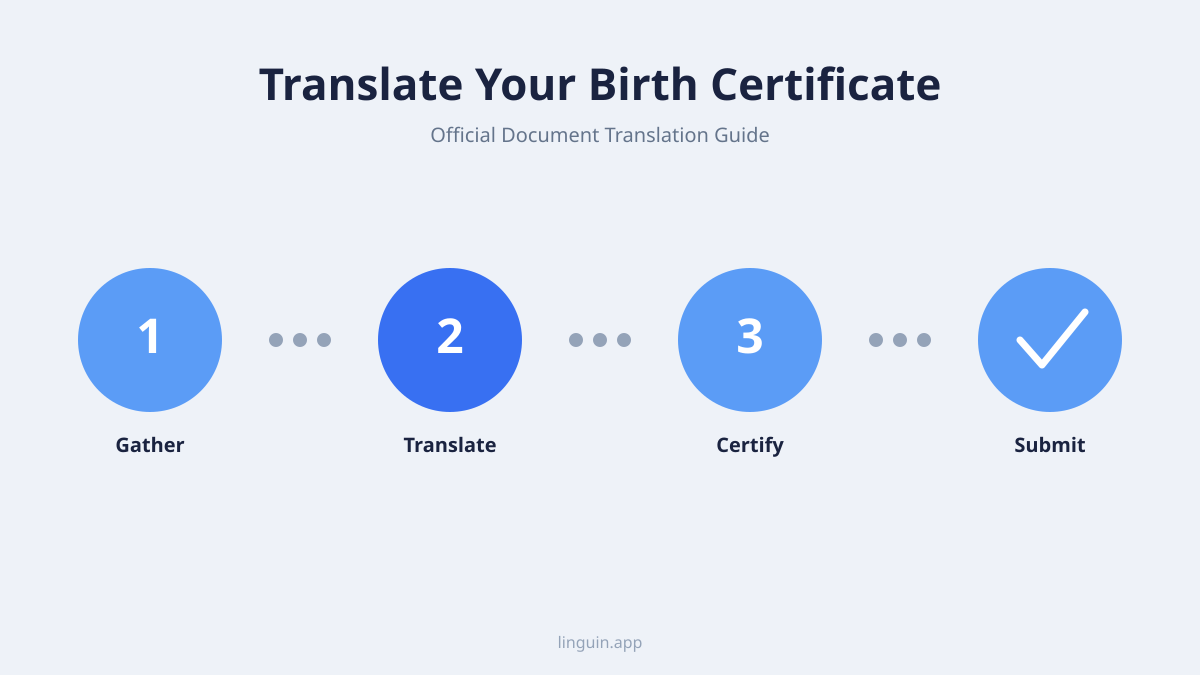
Official requirements for birth certificate translations
Government agencies have strict, non-negotiable rules for translated documents. Failing to meet these requirements can result in application delays, requests for evidence (RFEs), or outright rejection. The core principle is that the translation must allow an English-speaking official to understand the document exactly as they would if it were originally in English.
USCIS translation requirements USCIS policy is the standard most often referenced. Their requirements are clear. Any document in a foreign language submitted must include a full English translation. The translator must certify that they are competent to translate and that the translation is complete and correct. This certification must be included with the translation. The translation does not need to be notarized. The translated document should be formatted similarly to the original, maintaining the placement of official seals, signatures, and stamps. The translator’s certification is often placed on a separate page or at the bottom of the translation.
Passport agency and other department standards The U.S. Department of State, which issues passports, has similar requirements. When proving citizenship for a passport using a foreign birth certificate, it must be accompanied by a certified English translation. Other agencies, like the Social Security Administration or state Departments of Motor Vehicles, follow comparable guidelines. It is always prudent to verify the specific requirements on the agency’s official website or by contacting them directly, as minor variations can occur.
What must be translated? A proper translation leaves nothing out. This includes:
- All personal data: full name, date and place of birth, parents’ names, registration number.
- All informational text: headings, field labels (like “Date of Registration”), and legal paragraphs.
- All official markings: stamps, seals, signatures, and handwritten notes from officials.
- The document’s layout: indicating where stamps and signatures appear on the original page.
The translation should be literal and factual, not interpretive. For example, if the original uses a formal title for a government office, the translation should use the equivalent formal English title, not a colloquial term.
How to get a birth certificate translated to English
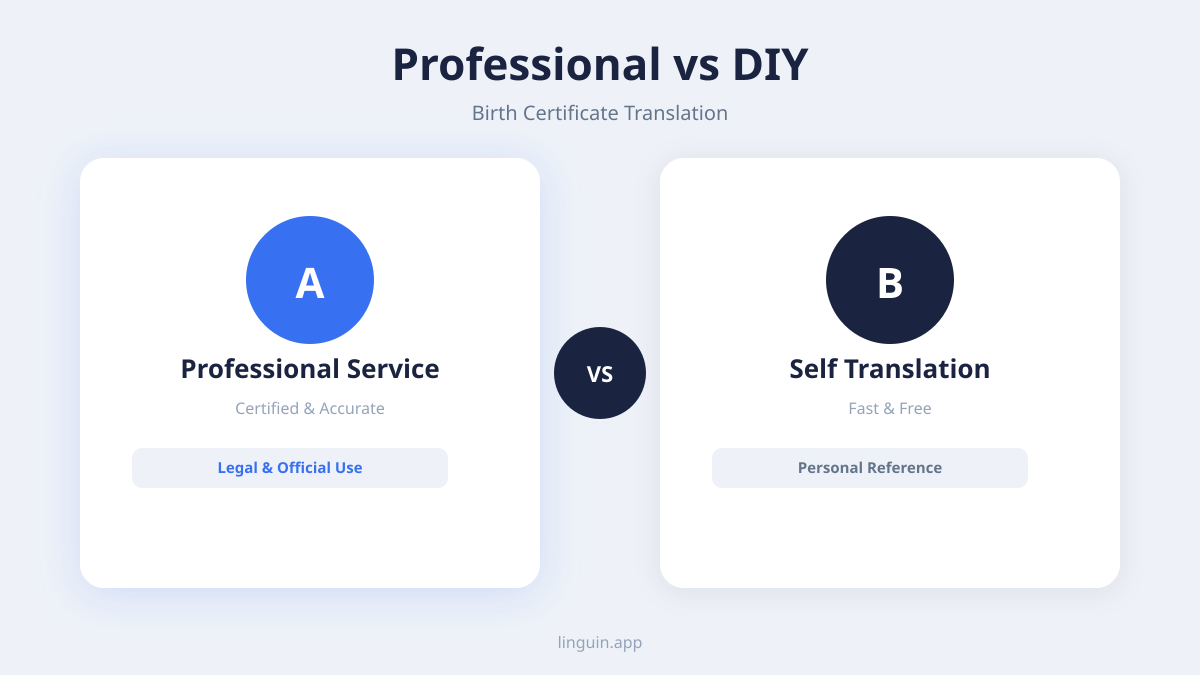
You have three primary paths to get your document translated: professional translation services, freelance translators, and AI-powered tools. The best choice depends entirely on your need for certification, budget, and required speed.
Professional translation services This is the most reliable method for certified translations needed for official use. These companies specialize in legal document translation and guarantee their work will be accepted by agencies like USCIS. They manage the entire process. You upload a scan, they assign a qualified translator, perform quality checks, add the required certification statement, and deliver a formatted translation. According to CertOf™ Translation, they processed 2,672 pages of fast certified translation orders across 53 document types in the quarter preceding February 2026. This volume indicates a common need for speed and reliability.
Freelance translators You can hire an independent translator directly through platforms or professional networks. This can sometimes be more affordable, but it requires more diligence. You must verify the translator’s qualifications and experience with legal documents. You must also ensure they provide the correct certification format. It is a more hands-on process, involving clear communication about requirements, deadlines, and deliverables. Always ask for samples of previous certified translations and check reviews.
Using AI translation tools AI-powered apps like Linguin provide instant, context-aware translations. This method is excellent for getting a quick understanding of a document’s contents for personal use. For instance, you could use the Linguin Chrome extension to quickly translate text from a scanned PDF on a website. However, AI translations are not certified. No government agency will accept a printout from Google Translate or an AI app as a valid legal document. These tools are a powerful first step for comprehension but are not a substitute for a certified translation when one is required.
Costs and turnaround time for certified translation
The price and speed of getting a certified translation can vary significantly based on the service provider, language pair, and document complexity. Understanding this landscape helps you budget and plan accordingly.
Industry pricing overview Most services charge per “source page,” which typically means a standard page of text. A birth certificate is often one or two pages. Prices are influenced by the service’s overhead, quality assurance processes, and guarantee policies. For example, Languex offers certified birth certificate translation for $24.50 per page with a standard 24-hour turnaround. Similarly, Corpus Localization offers certified birth certificate translation starting at $19.99 per page with a standard 24-hour turnaround.
There is a range in the market. Official Translations charges a flat rate of $29.95 per page for certified birth certificate translation, regardless of source language. CertTranslate offers certified Spanish-to-English birth certificate translation for $24.95 per physical page with a 24-hour delivery. For a different price point, CertOf™ Translation reports an average turnaround time of 4.0 minutes (243 seconds) for birth certificate translations. They offer certified birth certificate translation at a price of $9.99 per source page, while Official Translations charges $29.95 per page.
Factors affecting cost and speed Several elements can change the final quote:
- Language Pair: Translations from common languages like Spanish or French are often less expensive than from less common languages.
- Document Complexity: A handwritten certificate or one with faded stamps takes longer to decipher than a clean, typed document.
- Urgency: Most services offer expedited options (e.g., same-day or 2-hour service) for a significant premium over standard 24-48 hour delivery.
- Additional Services: Notarization, mailing hard copies, or translating multiple copies will add to the cost.
Evaluating value The cheapest option is not always the best when your immigration status or legal matter is at stake. Value comes from accuracy, a guarantee of acceptance, clear communication, and professional formatting. Look for services that explicitly guarantee their translations for acceptance by U.S. authorities and offer free revisions if needed.
Step-by-step guide to preparing your document
Proper preparation of your birth certificate is the first and most important step in the translation process. A clear, complete document ensures an accurate translation and prevents unnecessary back-and-forth with the translator.
1. Obtain a high-quality scan You need a digital copy to upload to a translation service. Use a flatbed scanner if possible, not a smartphone photo, to avoid shadows, glare, or distortion. Set the scanner resolution to at least 300 DPI (dots per inch). Save the file in a common format like PDF or JPG. Ensure the entire document, including all edges and any seals that may be in the margins, is visible in the scan. If your document has writing on both sides, scan both sides.
2. Verify document completeness Before sending it for translation, double-check that the scan is legible. Zoom in on stamps, signatures, and any handwritten portions. If you cannot read it, the translator will struggle. If parts are faded or damaged, you may need to contact the vital records office in the country of origin to request a new, clearer copy or an official extract. A translated document from an illegible source will not be useful.
3. Gather supporting information While not always required, providing context can help the translator. You might note the country and, if known, the specific province or city where the certificate was issued. This helps with translating specific governmental terms correctly. If you have an old document with archaic language, any notes you have about it can be helpful. However, the translator’s job is to translate what is on the page, not to interpret missing information.
4. Choose your service and submit Once your scan is ready, select your translation method based on your need for certification. If using a professional service, their website will have an upload portal. You will typically need to provide your email for delivery, select the target language (English), and indicate you need a certified translation. For personal understanding, you can use an AI tool. For example, you could use a tool like Linguin to translate a PDF on your Mac to quickly grasp the content before deciding if you need a certified version.
Common challenges and how to avoid them
Several pitfalls can delay or invalidate a birth certificate translation. Being aware of these common issues helps you navigate the process smoothly.
Illegible or damaged originals This is the most frequent problem. Old documents, poor-quality photocopies, or certificates with water damage can be impossible to translate accurately. Solution: Always start with the best possible source. Request a new certified copy from the relevant government archive if needed. The time and cost to obtain a clear original are always less than the cost of a rejected application.
Non-standard formats or archaic language Birth certificates from some countries or historical periods may use terminology, formats, or official titles that do not have direct English equivalents. Solution: Use a translation service that specifically employs translators familiar with the legal and administrative systems of the document’s country of origin. They will know how to properly render terms like “Civil Registry” or “Act of Birth” into the appropriate English legal terminology.
Missing certification statements Submitting a translation without the proper certification, or with a certification that lacks required elements (signature, date, statement of competence), will result in rejection. Solution: When ordering from a service, explicitly confirm that their deliverable includes a proper certification statement. If working with a freelancer, provide them with a template of the certification required by your target agency (e.g., the USCIS standard wording).
Mismatched personal details Sometimes, the name or birth location on a foreign certificate may have a different spelling from what you use on other official documents (like a passport). Solution: The translator must translate exactly what is on the document. Do not ask them to alter the spelling to match your other papers. If there is a discrepancy, you may need to provide an official “proof of name change” document or a letter of explanation to the agency reviewing your application, not to the translator.
For handling text in various digital formats, our guides on how to translate a Word document and how to translate image text can be useful for preparatory steps.
FAQ
Can I translate my own birth certificate?
No, for certified purposes, you cannot certify your own translation. Most agencies, including USCIS, require the translator to be someone other than the document’s holder or an interested party in the application. The certification requires a statement of impartiality and competence, which is compromised if you translate your own document. You must use a third-party translator or service.
How long does a certified translation take?
Turnaround times vary. Standard service from most professional companies takes 24 to 48 business hours. Expedited services can deliver translations in a few hours or the same day for an additional fee. According to data from CertOf™ Translation, some services report average turnaround times as fast as a few minutes for birth certificates. Always confirm the expected delivery time before placing your order.
Will USCIS accept a translation from any service?
USCIS does not pre-approve or endorse specific translation services. They will accept any translation that meets their stated requirements: completeness, accuracy, and a proper certification statement. Reputable professional services design their certifications explicitly to meet USCIS standards and often guarantee acceptance. It is your responsibility to ensure the translation you submit complies with the rules.
What if my birth certificate is not in a common language?
Professional translation services work with a network of translators covering a wide range of languages. While languages with fewer speakers may cost slightly more or have a slightly longer turnaround due to translator availability, any legitimate service can handle them. Be sure to specify the exact language and dialect if possible (e.g., Mandarin Chinese vs. Cantonese).
Is a notarized translation better than a certified one?
Not necessarily. Notarization adds an extra step where a notary verifies the translator’s identity. It does not attest to the translation’s quality. For most U.S. purposes, a certified translation is the standard requirement. Only seek a notarized translation if the requesting agency, often a foreign government or a specific U.S. court, explicitly asks for it. When in doubt, a certified translation is the safe starting point.
Getting started with your translation
Translating a birth certificate to English is a straightforward process when you understand the requirements. The key is to distinguish between needing a translation for personal understanding, which AI tools can provide instantly, and needing a certified translation for official use, which requires a professional service. Always start with a clear, high-quality scan of your original document and confirm the specific certification needs of the agency you are submitting to.
For quick, personal understanding of documents or text in over 100 languages, you can explore tools like Linguin. It can help you translate audio conversations or text on any website for everyday needs. When you are ready to proceed with a certified translation for USCIS or legal purposes, choose a reputable service that guarantees its work. Your next step is to locate your birth certificate, prepare a clear digital copy, and select the translation path that matches your official requirements. Learn more about Linguin’s translation tools.