
 English
 Español
 Français
 Deutsch
 Português
 Italiano
 Русский
 中文(简体)
 日本語
 한국어
 العربية
 हिन्दी
 Nederlands
 Türkçe
 Polski
Need to translate your marriage certificate? You might need a certified translation for a government agency like USCIS, a legal proceeding, or for your own personal records. This document is more than a piece of paper; it is official proof of a legal relationship, and any translation must be accurate and formatted correctly. A mistake can lead to delays, rejections, or legal complications. This guide explains the entire process, from choosing the right service to understanding certification requirements, and shows how modern AI translation tools can assist.
Key takeaways
- Certified translations are required for official use with USCIS, courts, and consulates, and include a signed statement from the translator.
- Professional translation services charge per page, with prices ranging from around $15 to $30 per page, and typically deliver in 2-3 business days.
- AI translation apps like Linguin provide fast, context-aware drafts for personal understanding but cannot produce legally certified documents.
- The translated certificate must match the original’s layout exactly, preserving all seals, stamps, signatures, and handwritten notes.
- Always verify the specific requirements of the requesting institution, as rules for certification can vary between countries and agencies.
When do you need to translate a marriage certificate?
A marriage certificate translation is often required when you need to present the document to an authority that does not use the original language. The most common scenario is immigration. If you are applying for a visa, green card, or citizenship in a new country, the immigration department will need to understand your civil documents. In the United States, USCIS (U.S. Citizenship and Immigration Services) mandates that any document in a foreign language must be accompanied by a full English translation and a certification from the translator.
Legal proceedings in a foreign country are another key reason. This could involve filing for divorce, claiming an inheritance, or finalizing an adoption where the marriage certificate is a key piece of evidence. Courts require certified translations to ensure all parties and officials can review the document accurately. Similarly, if you are registering your marriage in another country’s civil registry, a translated and often apostilled version will be necessary.
Even for non-official purposes, a translation can be invaluable. Imagine you married abroad and want to share the certificate with family members who speak a different language. Or perhaps you need to provide it to a financial institution in your new country for a joint account. While a certified translation might not be required in these cases, accuracy is still important to avoid confusion. Using a reliable tool for a preliminary understanding can save time. For instance, you could use an AI translator like Linguin to get the gist of a document before deciding if a certified service is needed, similar to how you might translate a PDF on Mac for quick review.
Official vs. personal use
The type of translation you need depends entirely on the end use.
- Official/legal use: This always requires a certified translation. The translator or translation company provides a signed statement attesting that the translation is complete and accurate to the best of their knowledge. This certificate is often stamped and includes the translator’s credentials. Agencies like USCIS and most courts will reject an uncertified translation.
- Personal/informal use: If you only need to understand the document’s content for personal records or to share with family, an accurate, high-quality translation is sufficient. AI-powered translation apps are excellent for this. They can handle the formal language of a certificate and provide a natural-sounding output quickly. This is useful for checking details before submitting for official certification or for keeping a personal translated copy.
What is a certified translation?
A certified translation is a translated document paired with a signed statement from the translator or translation company. This statement, often called a certificate of accuracy, declares that the translation is a true and complete representation of the original text. It is not a notarization, which is a separate step where a notary public verifies the translator’s identity and signature. Some institutions require both a certification and notarization.
The certification must include specific elements to be accepted. It typically has the translator’s full name, signature, date, and a statement of competency (e.g., “I certify that I am fluent in both English and [Source Language] and that the attached translation is accurate and complete.”). The contact information of the translator or company is also included. The certified translation is usually presented with a copy of the original document, the translation, and the certificate of accuracy stapled together.
Who can provide a certified translation? Requirements vary by country. In many places, including the U.S. for USCIS purposes, the translator does not need to be officially accredited by a government body. They simply need to attest to their own competence. However, using a professional translation service is the standard and safest approach. These services employ qualified linguists and stand behind their work. For example, the translation service Official Translations states that its certified marriage certificate translations are accepted by USCIS, the Department of State, courts, and consulates.
How to choose a translation service
Selecting the right service is critical for official documents. You must balance cost, speed, quality, and the specific requirements of the agency receiving the document.
Professional translation services specialize in legal and official documents. They guarantee accuracy, provide the necessary certification, and often offer guarantees that their work will be accepted. When comparing services, look for those that explicitly mention experience with marriage certificates, immigration, and legal documents. According to Official Translations, a professional translation service, they offer certified marriage certificate translation for a flat rate of $29.95 per page. Prices do vary, however. CertOf™ Translation reports a price of $14.99 per page, while CertTranslate offers certified translation starting at $24.95 per page. Always get a clear quote upfront.
Turnaround time is another key factor. For standard service, a linguist translates and certifies a marriage certificate typically in 2-3 business days. If you need it faster, many services offer expedited options. For instance, according to CertOf™ Translation, they offer a 5-10 minute delivery option for urgent cases, though this usually comes at a premium cost.
AI translation tools and apps like Linguin serve a different, complementary purpose. They are perfect for getting an immediate, context-aware understanding of a document. You can use them to translate the text on your phone or computer in seconds, which is helpful for verifying information or for personal use. However, it is essential to remember that no AI app can provide a legally binding certification statement. The output from an AI tool is a draft. For official purposes, you must still engage a human professional or service to review, finalize, and certify the translation. Think of AI as a powerful first step, similar to how you might use an app to translate image text from a foreign document before seeking official verification.
What to provide for an accurate translation
To ensure your marriage certificate is translated correctly and without delay, you need to provide the translator with clear, complete materials.
First, you need a high-quality scan or photograph of the original document. The image must be legible. Ensure the entire document is in the frame, all text is clear, and any stamps, seals, or signatures are visible. Blurry photos or cropped edges can lead to missing information. If your certificate has handwritten portions, like signatures or marginal notes, these must be perfectly clear, as they are crucial elements. A service may refuse to work with a poor-quality image.
Second, provide any specific instructions from the receiving institution. If USCIS, a court, or a consulate gave you guidelines for the translation (e.g., “include a copy of the original,” “certificate must be on company letterhead”), share these with your translator. This prevents rework.
Third, clarify any ambiguous elements. Marriage certificates can contain archaic language, local legal terms, or abbreviations. If you know the specific meaning of a term or the full name of an institution that is abbreviated, inform the translator. For example, if a Spanish certificate uses the term “Registro Civil,” confirming it should be translated as “Civil Registry” is helpful.
Finally, specify the required format. Do you need the translation in a Word document, a PDF, or a hard copy? Most professional services will provide a PDF that includes the original scan, the translation, and the certificate of accuracy as one file, which is commonly accepted. If you need a physical copy mailed, confirm that option.
The translation process and what to check
Once you submit your document, the translation process begins. For a professional service, a qualified linguist who is a native speaker of the target language and familiar with legal terminology will handle the task. They translate the text, paying close attention to precise terms for dates, names, locations, and legal statuses. They then format the translation to mirror the original document’s layout as closely as possible, preserving line breaks, headings, and the placement of stamps and signatures.
After the translation is complete, the service attaches the certificate of accuracy. They may also offer notarization as an add-on service, where the translator signs the certificate in front of a notary public. You should confirm whether your receiving institution requires notarization, as it is not always needed for USCIS submissions.
When you receive the final translated package, you must check it thoroughly before submission.
- Compare line by line: Ensure every single piece of text from the original appears in the translation, including headers, footers, and all marginalia.
- Verify proper names: Check that all names of people, places, and institutions are translated correctly or, in the case of proper names, transliterated accurately.
- Confirm dates and numbers: Dates should be converted to the target language’s format (e.g., from DD/MM/YYYY to Month DD, YYYY) clearly. Any certificate numbers must match exactly.
- Inspect the certification: Ensure the certificate of accuracy is signed, dated, and includes the translator’s statement and contact information. It should be physically or digitally attached to the translation and original.
- Review formatting: The translation should look clean and professional, ideally matching the original’s structure for easy cross-reference.
For personal drafts created with AI tools, you should perform similar checks for accuracy. While convenient for translating business documents or emails, the formal nature of a certificate demands extra scrutiny.
Using AI translation for support and drafts
AI-powered translation applications have transformed how we approach language barriers for everyday tasks, and they can play a supportive role with official documents like marriage certificates.
The primary advantage is speed and accessibility. With an app like Linguin installed on your Mac, iPhone, or as a browser extension, you can translate text instantly. Say you receive a scanned copy of your foreign marriage certificate via email. Instead of waiting to send it to a service, you can use the app to get an immediate understanding of its contents. This helps you verify names and dates quickly, or understand what information is present before you even begin the official process. It is akin to using a tool to translate a Word document for internal review.
These tools excel at context-aware translation. Modern AI models do not just translate words in isolation; they understand the surrounding text. This is vital for the formal, structured language of a certificate. The AI can correctly interpret common legal phrases and standard document sections, producing a more natural and accurate draft than older, word-for-word translation engines. This draft can be invaluable for personal reference or for preparing yourself before consulting a professional.
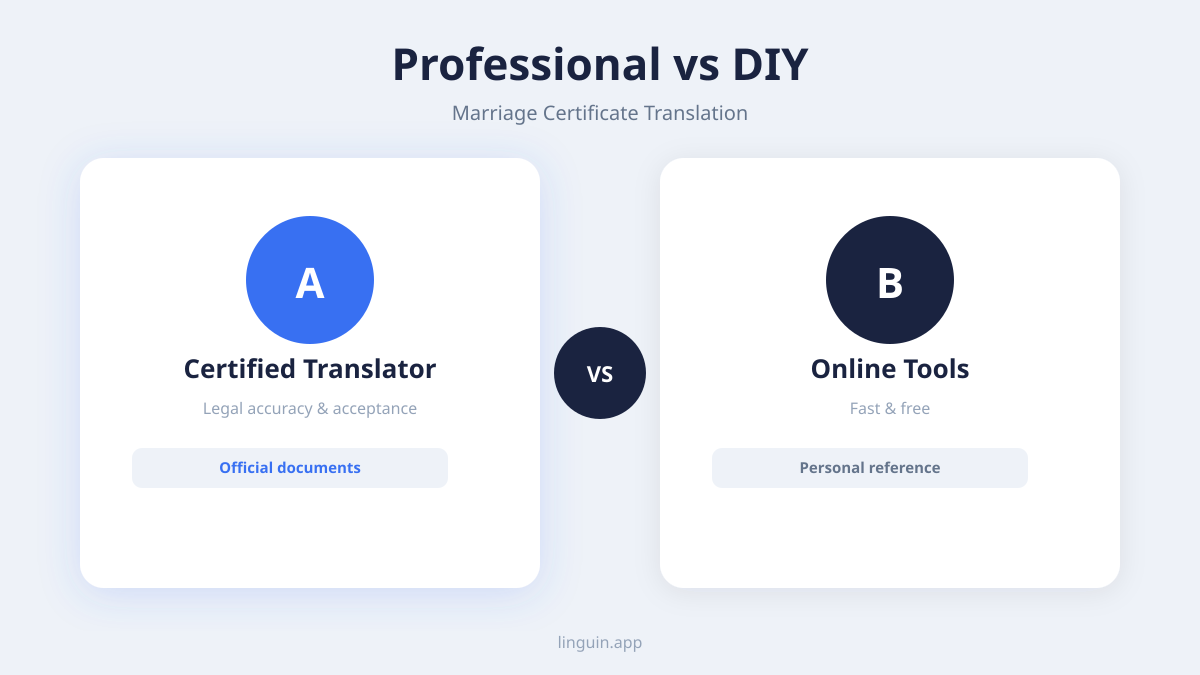
However, the limitations are clear and important. AI cannot certify. It cannot provide the signed statement of accuracy that governments and courts require. It also cannot guarantee 100% perfection, especially with handwritten text, unusual fonts, or complex legal jargon specific to a region. Therefore, the best practice is a hybrid approach: use the AI tool to get a fast, high-quality draft for your own understanding and verification. Then, use that draft to streamline your communication with a professional human translation service, who can produce the final, certified version. This two-step method saves time and money while ensuring the final product meets all legal standards. For other document types, like an academic paper, a similar approach is often used for initial review.
Common questions
Can I translate my own marriage certificate for USCIS?
USCIS allows you to translate your own documents, but you cannot certify your own translation. The certification must come from someone else who can attest to your competency in both languages and the accuracy of the translation. In practice, it is strongly recommended to use a disinterested third party-a professional service or a qualified translator-to avoid any appearance of conflict of interest and to ensure acceptance.
How long does a certified translation take?
For standard service with a professional company, the process typically takes 2 to 3 business days from submission to delivery of the final certified package. Many services offer expedited options, ranging from same-day to 24-hour turnaround, for an additional fee. According to one service, CertOf™ Translation, they even offer a 5-10 minute delivery option for extreme emergencies.
What languages are supported for certified translation?
Most professional translation services support a wide range of languages due to their network of linguists. For example, the translation service LinguaOne provides certified marriage certificate translations in more than 100 languages. Another service, according to Virtual Same Day Marriage, claims to have handled marriages involving over 20 languages. For AI draft translation, apps like Linguin also support over 100 languages, making them useful for initial translation of less common language pairs.
Getting started with your translation
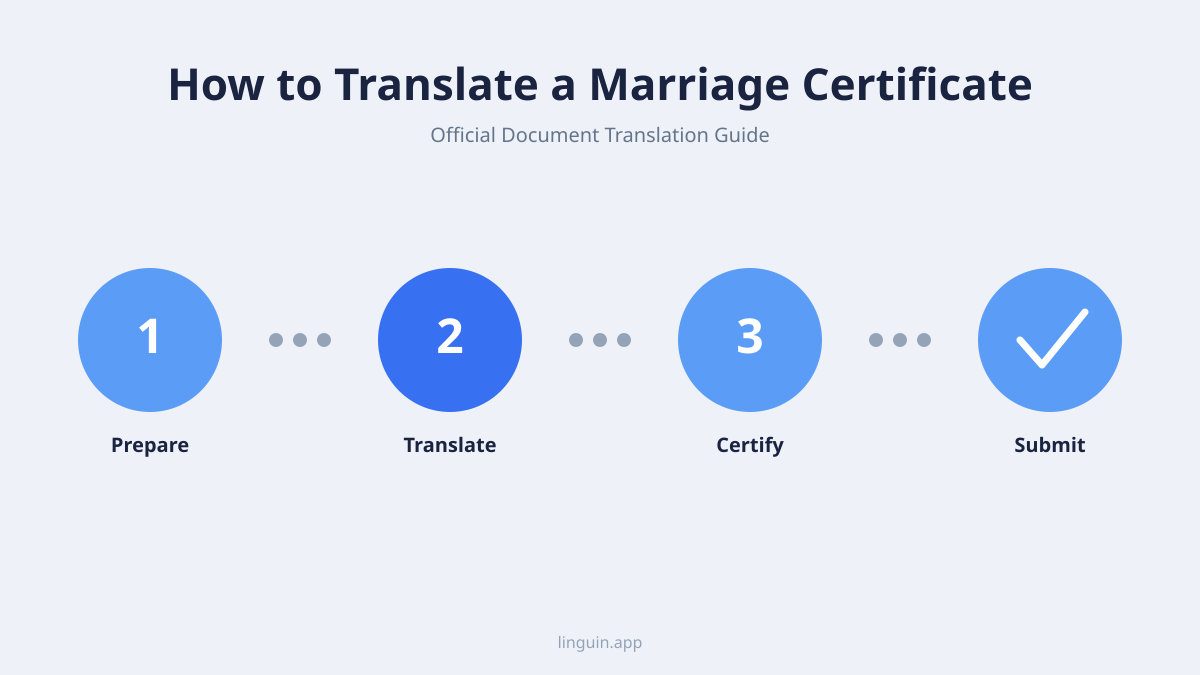
Translating a marriage certificate is a straightforward process when you know the requirements. First, determine if you need a certified translation for official use or a high-quality translation for personal understanding. For official purposes, select a reputable professional service that guarantees acceptance by your target institution, such as USCIS or a foreign court. Provide them with a clear scan of your original certificate and any specific instructions.
For personal use, or to create a draft to inform your next steps, an AI translation app can be an immediate help. You can quickly grasp the document’s content, check details, and save time. Remember, this draft is not certified, but it is a powerful tool for preparation and clarity.
The key to a smooth experience is matching the tool to the task. Use professional services for legal certification. Use intelligent AI tools for speed, accessibility, and initial understanding. If you want to explore how AI translation can assist with documents and text in your daily workflow, you can try Linguin for Mac, iOS, or as a browser extension to get started.
-vs-translator.png)