 English
 Español
 Français
 Deutsch
 Português
 Italiano
 Русский
 中文(简体)
 日本語
 한국어
 العربية
 हिन्दी
 Nederlands
 Türkçe
 Polski
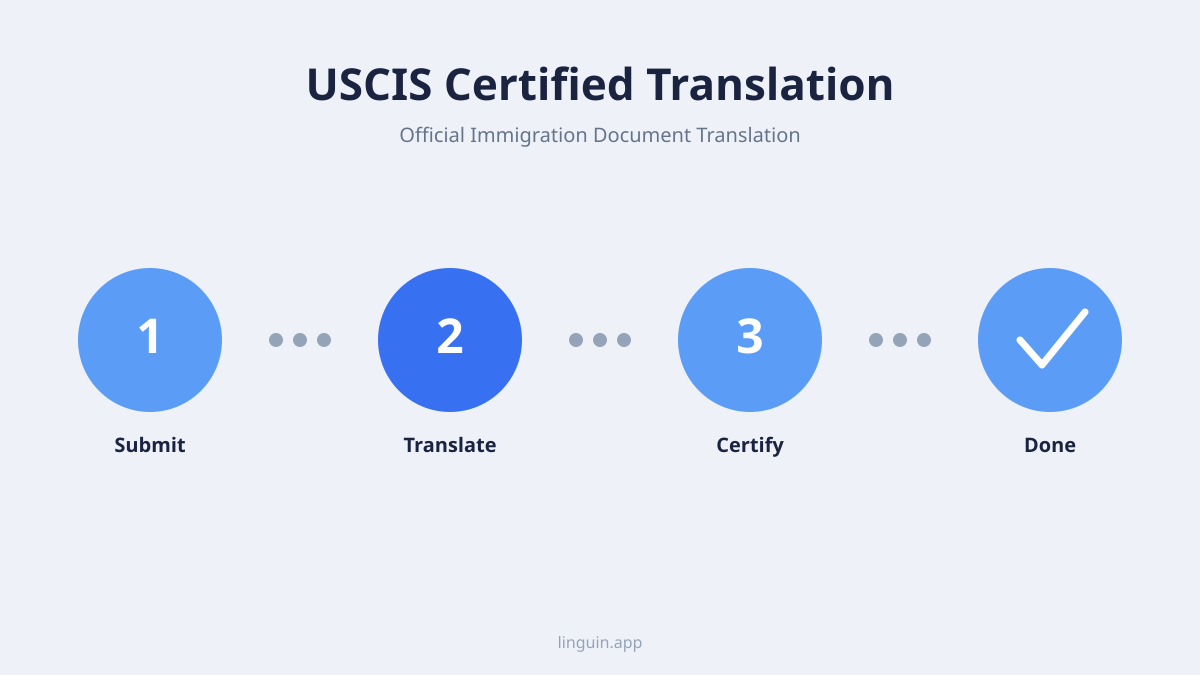
A USCIS certified translation is a translated document accompanied by a signed statement from the translator or translation service attesting to its completeness and accuracy. It is a mandatory requirement for any foreign-language document submitted with a U.S. immigration application. For anyone navigating the complex path to a visa, green card, or citizenship, submitting a correctly certified translation is a non-negotiable step that can affect the outcome of your case. This guide will explain the exact requirements, clarify common misconceptions, and show you how to obtain a compliant translation for USCIS.
Key takeaways
- USCIS requires a certified translation for any document not in English, which must include a specific signed statement from the translator.
- Notarization is not a USCIS requirement for translations, and insisting on it can lead to unnecessary cost and delay.
- The certification applies to the translation’s accuracy, not the translator’s credentials, as no U.S. agency certifies individual translators.
- Prices for certified translation services for immigration documents commonly range from $25 to $60 per page.
- Even for online filings, you must upload a certified translation of each foreign-language document.
Understanding the USCIS certified translation requirement
United States Citizenship and Immigration Services (USCIS) requires that every document submitted as part of an application be in English. If you are submitting a birth certificate, marriage license, academic transcript, police clearance, or any other official record in a foreign language, you must include a full English translation. More specifically, that translation must be certified.
A certified translation for USCIS consists of two parts. The first part is the translated document itself, which should be a complete and accurate English version of the original. The second, and equally critical, part is the certificate of accuracy. This is a separate letter or statement attached to the translation, signed by the translator or a representative of the translation company. This statement must include several key declarations: that the translator is competent in both languages, that the translation is a true and correct representation of the original document, and that it is complete.
The purpose of this requirement is straightforward. USCIS officers are evaluating the evidence in your case, and they need to understand it. They rely on the translator’s certification as a guarantee of the document’s contents. An uncertified translation, even if perfectly accurate, will not be accepted and can lead to a Request for Evidence (RFE) or denial. The stakes are high, as an RFE can delay your application by months.
Consider a typical scenario. You are applying for a marriage-based green card and need to submit your foreign birth certificate and marriage certificate. You have the original documents in Spanish. You cannot simply write out an English version yourself and submit it. You need a professional, certified translation that comes with the formal attestation. This certified package becomes the official English version of your documents for USCIS purposes.
It is also important to understand what certification is not. The certification is for the translation, not the translator. No U.S. government agency, including USCIS, certifies translators. The statement certifies that a specific translation is accurate. This distinction is important because it means you are not required to find a government-licensed translator, which does not exist in the U.S. context. You need a translator or service willing to provide the required certification statement.
What documents need a certified translation?
Any foreign-language document that serves as evidence in your immigration application requires a certified English translation. The rule applies universally, regardless of the document’s origin, formality, or length. USCIS does not provide an exhaustive list because the principle is absolute: if it’s not in English, it needs a certified translation.
Common documents that routinely require translation include:
- Personal civil documents: Birth certificates, marriage certificates, divorce decrees, death certificates, and adoption papers.
- Legal and police records: Court documents, police clearance certificates (often called “police certificates” or “certificates of good conduct”), and criminal records.
- Financial records: Bank statements, tax returns, and proof of assets or income from foreign sources.
- Academic records: Diplomas, degree certificates, academic transcripts, and professional qualifications.
- Medical records: Vaccination records, doctor’s letters, or medical exam results from overseas physicians.
- Personal affidavits: Sworn statements or letters of support written in another language.
Even short documents, like a single-page birth certificate, must be translated and certified. There is no minimum page threshold. Conversely, lengthy documents like multi-year academic transcripts must be translated in their entirety. You cannot selectively translate only certain pages or sections. The translation must be complete.
Another common situation involves documents that are partially in English. Some international documents, like passports or certain academic transcripts, may have key fields in both English and another language. If any part of the document that contains required information is in a foreign language, the entire document typically needs a certified translation. The safest practice is to translate the whole document to avoid any questions from an immigration officer.
For documents you create yourself, the rules are different but clear. If you are writing a personal statement or affidavit in English, no translation is needed. However, if you are submitting a letter from a family member or friend that is written in a foreign language, that letter must be accompanied by a certified translation. The content you submit as evidence must be fully accessible to the officer reviewing your file.
The certification statement: format and content
The certification statement is the legal heart of a USCIS certified translation. Its format is not dictated by a specific government form, but its content must meet USCIS expectations to be valid. A proper statement creates a clear chain of accountability, identifying who is responsible for the translation’s accuracy.
A standard certification statement should include the following elements:
- A declaration of the translator’s competence in both the source and English languages.
- A clear statement that the attached document is a true, accurate, and complete translation of the original foreign-language document.
- The date of the certification.
- The translator’s full name and signature.
- The translator’s address and contact information.
Often, the statement will also include the printed name of the translator beneath the signature for clarity. When using a translation service, the statement is typically provided on the company’s letterhead and signed by a project manager or officer of the company, who attests to the competence of their translator. The original foreign document is not attached to the translation package you submit. You submit the original or a copy of the foreign document alongside its certified English translation.
Here is an example of what the body of a certification statement might look like:
“I, [Translator’s Name], certify that I am fluent in the English and [Source Language] languages, and that the attached document is a true, accurate, and complete translation of the [Document Name] provided to me. This certification is made to the best of my knowledge and belief.”
It is critical to note what is not required. USCIS does not require notarization for certified translations. This is a widespread misconception. A notary public verifies the identity of the person signing a document, not the content of the document itself. While some translation services offer notarization as an add-on, it is an unnecessary step for USCIS purposes and can add cost and time. The signed certification statement from the translator is sufficient.
For digital submissions, which are now the norm for most applications, the process is the same. According to latranslation, the USCIS online filing translation requirements for 2026 still require certified English translations for foreign-language documents submitted digitally. You will scan both the original document and the certified translation (including the signed statement page) into a single PDF file for upload. The digital signature on the certification is acceptable.
Who can provide a certified translation?
Since there is no government licensure for translators in the United States, the question of who can provide a certified translation has a practical answer. The provider must be willing and able to produce a translation that meets the format and content standards described above and to attach the signed certificate of accuracy.
Professional translation services are the most common and reliable source. These companies employ or contract with translators who are subject-matter experts, often specializing in legal and immigration documents. They manage the process, ensure quality control, and provide the certification on company letterhead. Certified translation services for common immigration documents are commonly priced per page, with a typical market range of $25 to $60 per page. Some services offer different pricing; for example, Corpus Localization offers certified translation for USCIS purposes starting at $19.99 per page for eligible standard documents, according to Corpus Localization.
Freelance translators are another option. A qualified freelance translator with experience in legal documents can provide a certified translation. You must verify their credentials, sample work, and familiarity with USCIS requirements. They should provide the certification statement on their professional letterhead or with their full contact details.
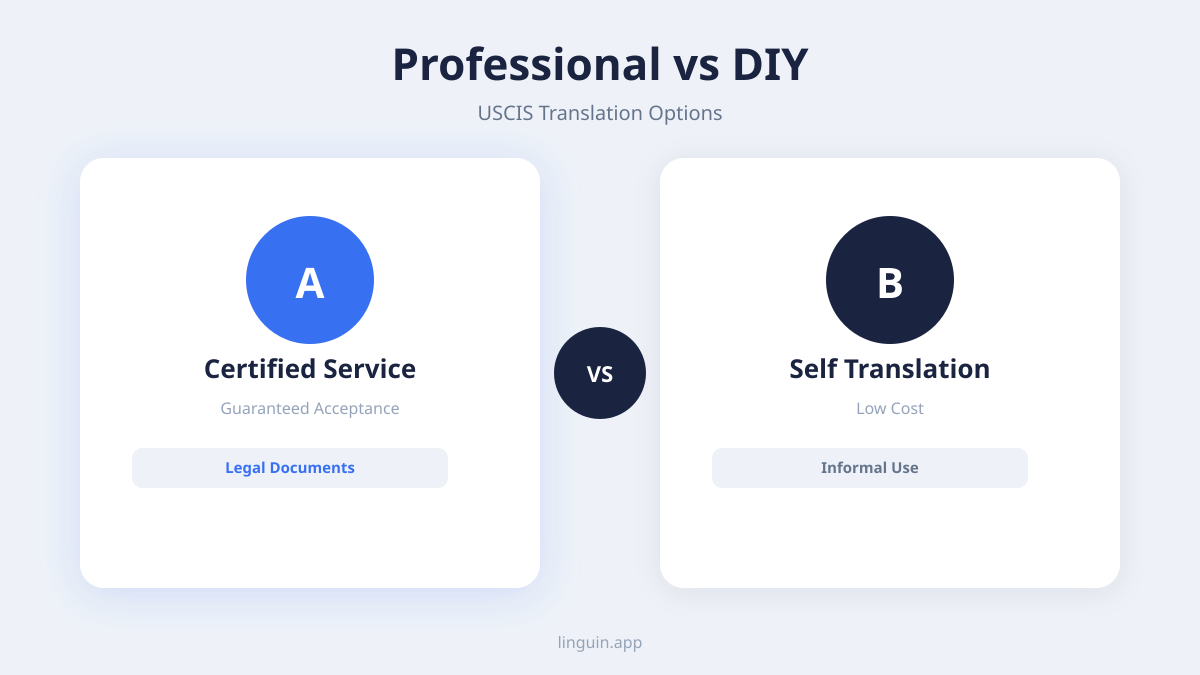
You cannot certify your own translation, even if you are perfectly bilingual. The certification requires a disinterested third party to vouch for the accuracy of the work. Similarly, a friend or family member should not certify a translation for you, as this lacks the necessary objectivity and professional distance that USCIS expects.
The key is competency. The translator must demonstrate they are qualified. For a service, this is implicit in their business offering. For a freelancer, you might review their resume, professional certifications from organizations like the American Translators Association (ATA), or client testimonials. The goal is to use a provider whose certification will be accepted without question by a USCIS officer. For insights into how AI is assisting professional translators with complex tasks, you can read about AI translation for multilingual legal document review.
Cost and turnaround time for USCIS translations
The cost of a USCIS certified translation is not fixed. It depends on several variables, including the document’s language, complexity, length, and the service provider you choose. Understanding these factors can help you budget appropriately and avoid unexpected fees.
Pricing is most commonly done on a per-page basis. A “page” is typically defined as a standard 8.5” x 11” page with single-spaced translation text. If the original document is densely packed, it may count as more than one page for pricing. As noted, the market rate generally falls between $25 and $60 per page. Simple, straightforward documents like a birth certificate will be at the lower end. Complex documents like academic transcripts with specialized terminology, legal contracts, or handwritten notes will cost more per page due to the additional time and expertise required.
Some services may offer a flat fee for common documents. Others, like Translatorus, offer certified translations for USCIS starting at €30.00 per page with a standard delivery time of 24 to 48 hours, according to Translatorus. Be sure to clarify what is included in the quoted price. Are there setup fees, notarization fees (which you don’t need), or rush fees? Is the certification statement included? Reputable services are transparent about their pricing.
Turnaround time is the second critical factor. Standard processing can take 2 to 5 business days. If you need the translation faster, most companies offer expedited or rush services for an additional fee, which can deliver translations within 24 to 48 hours or even the same day. Always build translation time into your application preparation schedule. An RFE because you are waiting on a translation can set your entire case back by months, making a rush fee a worthwhile investment if you are up against a deadline.
To manage costs, prepare clear, legible copies of your documents. A blurry scan or poor-quality photo can slow down the translator and increase the chance of error. Provide any context that might be helpful, such as explaining ambiguous names or terms. If you have multiple documents, submitting them together to the same service can sometimes qualify you for a volume discount. For other scenarios where managing multilingual content efficiently is key, consider reading about AI translation for multilingual project management.
Common pitfalls and how to avoid them
Even with the best intentions, applicants can make mistakes with their USCIS certified translations that lead to delays or problems. Being aware of these common pitfalls is the best way to avoid them.
The most frequent error is submitting an uncertified translation. This includes machine translations from tools like Google Translate or even a well-written translation from a bilingual friend that lacks the formal certification statement. USCIS will not accept these. Always ensure the translation package includes the signed certificate.
Another major pitfall is the notarization misconception. Applicants sometimes believe their translation must be notarized, or they pay extra for this service thinking it adds legitimacy. As confirmed, USCIS does not require notarization for certified translations. This can lead to unnecessary costs. The signed statement from the translator is the requirement.
Incomplete translations are a third issue. Translating only the first page of a multi-page transcript or omitting stamps, seals, or marginal notes on a document can render the translation incomplete. Every single word, number, seal, stamp, and signature on the original document must be translated or their presence noted in English. For example, a stamp in Spanish that says “Certified Copy” must be translated and its placement on the document indicated.
Using an unqualified translator is a risk. While a family member may be fluent, their translation lacks the professional objectivity and may not include the proper certification wording. USCIS may question the credibility of such a translation. It is best to use a professional service or qualified freelancer.
Finally, poor document handling can create issues. You should never send your only original document to a translation service. Always provide a high-quality scan or photocopy. The translation is based on the copy, and you will submit the copy alongside the certified translation to USCIS. Keep your originals safe. Also, ensure the translated document is formatted cleanly and is easy to read, matching the layout of the original as closely as possible. For understanding how tone and register are handled in professional translation, which is crucial for documents, our article on AI translation for formal and informal tone in emails provides useful context.
The role of AI translation tools like Linguin
AI-powered translation tools like Linguin have transformed everyday communication across languages, offering instant, context-aware translations for websites, chats, and documents. However, it is important to understand their distinct role in the context of USCIS certified translations.
Tools like Linguin are excellent for comprehension, drafting, and real-time conversation. For instance, you might use Linguin to read a foreign-language website about document requirements or to draft a letter in another language. This can be incredibly helpful during the preparatory stages of your immigration journey. You can quickly understand the general content of a document you need to translate officially. If you are collaborating with someone who speaks another language, Linguin can help bridge the communication gap seamlessly.
However, the current output from any fully automated AI translation tool, including Linguin, cannot be submitted as a certified translation to USCIS. The certification requires a human professional to take responsibility for the accuracy and completeness of the translation, attested by their signature. An AI, no matter how advanced, cannot sign a certificate of accuracy.
The practical and valuable role for AI is in supporting the human translation process. A professional translator might use an AI tool like Linguin as a first-pass draft or to check consistency of terminology, significantly speeding up their work. This efficiency can sometimes be reflected in lower costs or faster turnaround times from your translation service. The final product, however, is still reviewed, edited, and certified by a human expert. To learn more about how AI achieves high accuracy in general translation tasks, you can explore our analysis of AI translation accuracy.
Think of it this way: you would use Linguin to understand a document’s content quickly. But for the official submission, you would send that document to a professional service. The translator may use technology to aid their work, but they provide the human judgment and legal certification that USCIS mandates. This distinction ensures your application relies on a translation with accountable, professional backing.
Common questions
Do USCIS translations need to be notarized?
No, they do not. This is a common misconception. USCIS requires a signed certification statement from the translator attesting to the accuracy and completeness of the translation. A notary public only verifies the identity of the person signing a document, not the content of the document itself. Paying for notarization is an unnecessary extra step for USCIS submissions.
Can I translate my own documents for USCIS?
No, you cannot certify your own translation, even if you are fully bilingual. The certification requires a statement from a competent third party who is not the applicant. The translator must be disinterested and professionally accountable for the work. You must use a professional translation service or a qualified freelance translator.
How long is a certified translation valid for USCIS?
A certified translation does not have an official expiration date from USCIS. It is considered valid as long as the underlying original document it translates is still valid and relevant to your case. For example, a translation of your birth certificate from years ago is still acceptable, as the birth certificate itself does not expire. However, if you obtain an amended or updated version of the original document, you will need a new certified translation of that new version.
What if my document is already partially in English?
If any part of the document containing required information is in a foreign language, the safest practice is to get a full certified translation. Some documents, like international passports, have a standardized bilingual format. When in doubt, consult with your immigration attorney or obtain a translation to prevent a potential Request for Evidence from USCIS.
Ensuring your application is complete
Successfully navigating immigration procedures depends on meticulous attention to detail, and your document translations are a fundamental part of that. Remember that a USCIS certified translation requires both an accurate English version of your document and the accompanying signed certificate of accuracy from the translator. Avoid the unnecessary cost of notarization, and always use a professional service or qualified translator to ensure the work meets the required standard.
By understanding the requirements, preparing clear copies of your documents, and choosing a reputable provider, you can cross this task off your list with confidence. This allows you to focus on the other important aspects of your application. While tools like Linguin are perfect for everyday multilingual tasks and preparation, the final step for your official documents requires the certified human touch.
For all your other translation needs, from understanding foreign correspondence to browsing the web in another language, you can explore the capabilities of Linguin for Mac to make your daily multilingual interactions smoother.
-vs-translator.png)